Human beings have always looked up at the sky for comfort: stars, sunsets, passing clouds that look suspiciously like your ex.
But in the last century, the sky has also become a place of fear.
When destructive power arrives from above, there’s no front line, no “safe distance,” and often no warning at all.
These 10 air attacks didn’t just change battlesthey rattled entire nations, rewrote military strategy, and forced the world to rethink what war could do in a single night.
How Air Attacks Changed the Rules of War
Before aircraft became deadly serious business, wars were mostly fought where you could see your enemy.
Air power smashed that rule. Bombers made it possible to hit factories, cities, ports, and symbols of national pride without ever crossing a border on foot.
From the 1930s on, the world watched in shock as one city after another discovered what it meant to be attacked from abovesometimes in minutes, sometimes over months of grinding raids.
Below, we’ll walk through 10 of the most impactful air attacks in historyevents that shook the world, altered public opinion, and still echo through military doctrine and international law today.
1. Guernica
1. Guernica, 1937: The Sky Turns into a Political Statement
What Happened
On April 26, 1937, during the Spanish Civil War, the small Basque town of Guernica was bombed by the Nazi German Condor Legion and Italian Aviazione Legionaria,
acting in support of General Franco’s Nationalist forces.
The town was a communications hubbut also a cultural heart of Basque identity, which made its destruction feel especially symbolic.
Why It Shook the World
Guernica wasn’t the first bombing of civilians, but it became the most famous early example of a modern, targeted air raid on a population center.
Foreign journalists reported the devastation almost immediately, and Pablo Picasso’s painting Guernica turned the attack into a universal symbol of civilian suffering in war.
What We Learned
Guernica showed that air power could be used not just to destroy bridges and railways, but to terrorize civilians and break morale.
It was a grim preview of what World War II would soon bring to many other cities.
2. The Blitz
2. The Blitz, 1940–1941: London Endures the Longest Night
What Happened
From September 7, 1940, to May 11, 1941, Nazi Germany’s Luftwaffe launched a sustained bombing campaign against the United Kingdom.
London was hit repeatedly, along with other major cities like Coventry, Liverpool, and Birmingham.
The raids killed tens of thousands of civilians and destroyed large areas of housing and infrastructure.
Why It Shook the World
For eight months, British citizens lived with blackouts, air-raid sirens, and nights spent in underground shelters and Tube stations.
Instead of collapsing, British morale hardened. Images of Londoners calmly sweeping glass from the streets and making tea among the rubble became powerful propaganda,
convincing the world that bombing alone might not break a determined population.
What We Learned
The Blitz made clear that mass bombing of cities could cause horrific casualties and destructionyet still fail to force surrender.
It also cemented the idea of “home front resilience” as a critical factor in modern war.
3. Pearl Harbor
3. Pearl Harbor, 1941: A “Day of Infamy” from the Sky
What Happened
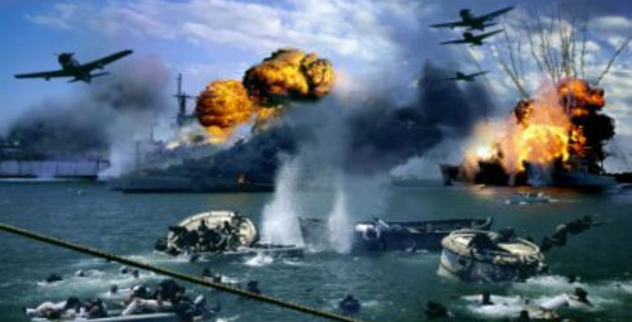
On December 7, 1941, Japan launched a surprise air attack on the U.S. Pacific Fleet at Pearl Harbor in Oahu, Hawaii.
Waves of carrier-based aircraft struck battleships, airfields, and support facilities.
The attack killed about 2,400 Americans, wounded more than 1,100, and sank or damaged numerous ships and aircraft.
Why It Shook the World
Pearl Harbor pulled the United States fully into World War II.
In one morning, Americans went from uneasy observers to active combatants.
President Franklin D. Roosevelt called it “a date which will live in infamy,” and he was rightthe phrase is still instantly recognizable today.
What We Learned
Pearl Harbor showed how carrier-based air power could cripple a fleet in port, even without a formal declaration of war.
It also underscored the dangers of underestimating an adversary’s ability to coordinate long-range attacks.
4. Tokyo Firebombing
4. Tokyo Firebombing, 1945: A City Turned to Ash in One Night
What Happened
On the night of March 9–10, 1945, U.S. B-29 bombers carried out a massive firebombing raid on Tokyo.
Flying low, they dropped incendiary bombs that created a firestorm in the densely built wooden neighborhoods.
Conservative estimates suggest at least 80,000 civilians were killedlikely closer to 90,000–100,000with about a million left homeless.
Why It Shook the World
The scale of destruction in a single night rivaled or exceeded that of later nuclear attacks, but with conventional weapons.
Photos of a flattened Tokyo shocked even hardened military planners and fed a growing ethical debate about area bombing.
What We Learned
The Tokyo firebombing proved how vulnerable modern cities were to incendiary bombing.
It also raised painful questions that still haunt historians and ethicists: when does strategic bombing become indistinguishable from deliberate terror?
5. Dresden
5. Dresden, 1945: Firestorm over a Cultural Jewel
What Happened
Between February 13 and 15, 1945, British and American bombers struck the German city of Dresden in a series of raids,
dropping thousands of tons of high explosives and incendiaries.
The resulting firestorm destroyed much of the historic city center and killed up to 25,000 people.
Why It Shook the World
Dresden was known for its architecture and art, not its military industry.
Its destruction became one of the most controversial Allied actions of the war,
sparking fierce debate over whether the bombing was militarily necessary or primarily punitive.
What We Learned
Dresden became a symbol of “terror bombing” and helped drive postwar efforts to define clearer rules for the protection of civilians in armed conflict.
It also highlighted how easily cultural heritage can disappear in the span of a few hours.
6. Hiroshima
6. Hiroshima, 1945: The First Nuclear Shadow
What Happened
On August 6, 1945, a U.S. B-29 bomber dropped a uranium-based atomic bomb, nicknamed “Little Boy,” on the Japanese city of Hiroshima.
The bomb exploded hundreds of meters above the city, instantly killing tens of thousands of people; by the end of 1945, around 140,000 were dead due to the blast, burns, and radiation.
Why It Shook the World
This was the first use of nuclear weapons in war.
The mushroom cloud over Hiroshima became an icon of a new era in which human beings could annihilate entire cities with a single bomb.
Survivors’ testimonies and later studies on radiation effects deepened the horror and urgency of nuclear disarmament debates.
What We Learned
Hiroshima forced the world to confront the idea that technology had outpaced traditional concepts of “proportional” warfare.
It also made the stakes of great-power conflict unimaginably high.
7. Nagasaki
7. Nagasaki, 1945: The Second Bomb and the End of the War
What Happened
Three days after Hiroshima, on August 9, 1945, the U.S. dropped a plutonium-based bomb called “Fat Man” on Nagasaki.
Around 27,000 people were killed instantly, with the death toll rising to roughly 70,000 by the end of the year as injuries and radiation took their toll.
Why It Shook the World
The second nuclear attack convinced many Japanese leaders that continued resistance was impossible.
Within days, Japan announced its intention to surrender, bringing World War II to a close.
For the rest of the world, Nagasaki confirmed that Hiroshima had not been a one-time horrornuclear weapons were now a repeatable, deployable reality.
What We Learned
Nagasaki amplified questions about necessity, morality, and long-term human suffering.
Together with Hiroshima, it became central to global movements for nuclear nonproliferation and arms control.
8. Operation Rolling Thunder
8. Operation Rolling Thunder, 1965–1968: The War That Came from Above
What Happened
Operation Rolling Thunder was a sustained U.S. bombing campaign against North Vietnam that ran from March 1965 to late 1968.
American aircraft dropped hundreds of thousands of tons of bombs on transportation networks, industrial sites, and air defenses,
aiming to force North Vietnam to stop supporting the war in the South.
Why It Shook the World
Rolling Thunder became the longest bombing campaign in history up to that point and a defining image of the Vietnam War.
Yet despite the staggering tonnage dropped and heavy U.S. losses, the campaign failed to achieve its main political goals.
Images of bombed villages, destroyed infrastructure, and civilian casualties also fueled global and domestic opposition to the war.
What We Learned
Rolling Thunder showed that air power alone cannot easily bend an opponent’s political willespecially in a conflict fueled by ideology and supported by outside powers.
It also exposed the limits of “metrics” like bomb tonnage or sorties flown as meaningful measures of success.
9. Desert Storm Air Campaign
9. Operation Desert Storm, 1991: Precision Warfare in Prime Time
What Happened
In January 1991, after Iraq’s invasion of Kuwait, a U.S.-led coalition launched a massive air campaign as part of Operation Desert Storm.
Over several weeks, coalition aircraft targeted Iraqi command centers, air defenses, military units, and infrastructure before a short ground offensive liberated Kuwait.
Why It Shook the World
For many viewers around the globe, this was the first war watched live on television: green-tinted night-vision footage, “smart bombs” steering into targets,
and commentators marveling at the apparent precision.
The campaign shaped public perceptions of air power as clean, surgical, and almost video game–likethough later analyses highlighted significant civilian and infrastructural damage.
What We Learned
Desert Storm showcased satellite guidance, stealth aircraft, and real-time surveillance as the new normal of warfare.
It also raised tough questions about how “precision” should be defined when targets are embedded in civilian society.
10. September 11
10. September 11, 2001: Airliners Turned into Weapons
What Happened
On September 11, 2001, 19 terrorists associated with al-Qaeda hijacked four U.S. commercial airliners.
Two planes were flown into the Twin Towers of the World Trade Center in New York City, one into the Pentagon near Washington, D.C., and a fourthUnited Flight 93crashed in Pennsylvania after passengers resisted.
Nearly 3,000 people were killed, making it the deadliest terrorist attack in U.S. history.
Why It Shook the World
9/11 shattered the assumption that civilian air travel was fundamentally safe.
The idea that ordinary passenger jets could be turned into guided missiles, live on global television, was as psychologically destabilizing as it was strategically shocking.
The attacks triggered sweeping changes in security, surveillance, foreign policy, and military operations, including the U.S.-led war in Afghanistan.
What We Learned
9/11 showed that “air attack” no longer had to mean hostile bombers crossing borders.
In a globalized, high-tech world, the lines between civilian infrastructure and potential weapon can blur in terrifying ways.
Reflections / Experience section
Living with the Legacy of the Sky: Reflections and Modern Experiences
Reading about these air attacks can feel like flipping through humanity’s worst highlight reel.
Yet they’re not just history triviathey quietly shape how we move, how we build, and how we think about safety today.
Start with cities. Many of the places on this list still carry scars, even if you have to know where to look.
In Tokyo, Hiroshima, Dresden, London, and Guernica, memorials, rebuilt neighborhoods, and preserved ruins all compete for space with convenience stores, commuters, and selfie sticks.
It’s entirely possible to grab a coffee on a street that was once a firestorm and never realize itunless you stop to read the plaque or listen to a local guide.
Then there’s the experience of flying itself.
Modern aviation is statistically incredibly safe, but 9/11 permanently changed how airports and passengers behave.
Security lines, reinforced cockpit doors, and strict protocols are part of an invisible chain of responses to one morning in 2001.
Most travelers don’t consciously think, “This procedure exists because someone turned an airliner into a weapon,”
but that’s exactly what happened: policy and design quietly absorbed the shock so that everyday life could continue.
For people who lived through these events, the “air attack experience” is often less about bombs or planes and more about sensations:
sirens in the night, the rumble of engines overhead, the smell of smoke, the frantic search for family members in the chaos.
Survivors of the Blitz talk about sleeping in Underground stations and emerging in the morning to streets that looked like a different city.
Survivors of Hiroshima and Nagasaki describe a world where shadows burned onto walls and ordinary objectslunch boxes, tricyclesbecame museum pieces staring back at us from another reality.
On the military side, experiences shifted from romanticized “knights of the air” images to something far more complicated.
World War II bomber crews faced intense danger every sortie, often with casualty rates that made survival feel like a coin flip.
Later, pilots and weapons officers in Vietnam, the Gulf War, and beyond operated increasingly complex systems,
sometimes launching precision weapons from high altitude or long range with only a cloud of dust on a monitor to show the impact.
That distancephysical and emotionalhas sparked ongoing debates about the psychological weight of pressing a button versus fighting face-to-face.
For civilians under bombardment, the experience is almost the opposite: hyperlocal and intimate.
Air attacks collapse the distinction between front lines and home, turning apartment blocks into battlefields.
People adapt in very human ways: children learn to identify aircraft by sound; families pre-pack “go bags”; neighbors trade information about the nearest shelter or the best corner of a basement.
The sky becomes something you monitor, not just admire.
And yet, out of all this destruction, cultures have found ways to remember without being completely defined by trauma.
Annual ceremonies at Pearl Harbor, silent walks in Dresden, anti-war art inspired by Guernica, peace parks in Hiroshima and Nagasakiall of these are attempts to say,
“This happened, it mattered, and we’re going to make sure the sky means something more than fear.”
The uncomfortable truth is that air power isn’t going away.
Drones, hypersonic missiles, and cyber-physical systems are simply the latest chapter in a story that began when the first bomber lifted off the runway.
The experiences of the people who lived through these 10 attacks are a warning label for that future:
enormous power from above always comes with enormous responsibility below.
Simple conclusion
Conclusion
From Guernica to 9/11, these air attacks didn’t just change military manualsthey rewired how societies think about safety, vulnerability, and the meaning of “home front.”
They remind us that the sky can be both beautiful and terrifying, and that decisions made in command rooms can transform entire cities in a single night or morning.
Understanding these events isn’t about glorifying destruction; it’s about learning how easily it happensand how important it is to prevent it from happening again.