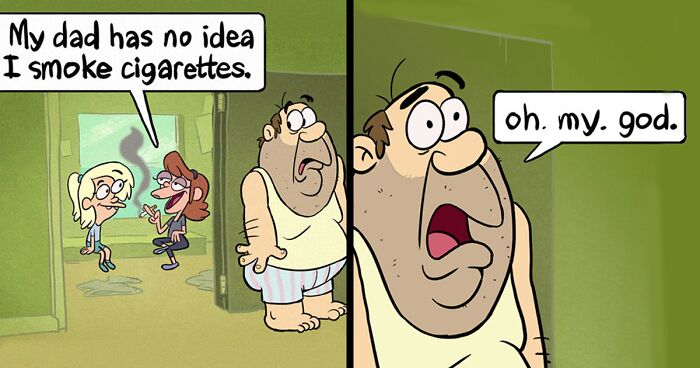
If you’ve ever laughed at a comic and then immediately thought, “Wow, that was kind of dark,” there’s a good chance you’d feel right at home with ToonHole Comics. Their funny comics with unexpected twists have become a staple on Bored Panda, where readers flock to see what new weird, sharp, or uncomfortably honest joke will land in the final panel. These are not just random gagsthey’re little snapshots of modern life, full of social satire, pop culture references, and the kind of observations you only make after your third cup of coffee and a doomscrolling session.
The set of “35 Funny Comics With Unexpected Twists That Poke Fun At Our Society” fits perfectly into ToonHole’s universe: bright colors, expressive characters, and punchlines that yank the rug out from under you. The jokes are often dark but rarely mean-spirited; instead, they flip everyday situations on their head, exposing how strange our norms actually are. From tech addiction and social media drama to parenting, dating, and late-night anxiety, each strip delivers a quick laugh and a tiny existential crisis, all in four panels or less.
Who Is Behind ToonHole Comics (And Why Bored Panda Keeps Featuring Them)
ToonHole isn’t just one artistit’s a small collective of cartoonists who met through animation and built a webcomic together. Over the years, different “ToonHole” artists have become familiar names to comic fans: ToonHole Ryan (Ryan Kramer), ToonHole Chris (Chris Allison), ToonHole John, and others have each brought their own flavor of humor to the project. Many of them work or have worked in professional animation, from Looney Tunes projects to feature studios, which helps explain the polished, expressive cartooning and cinematic timing that their comics are known for.
Bored Panda and other pop-culture sites have repeatedly highlighted ToonHole’s work, especially collections of “funny comics with unexpected twists” and “dark humor comics” that resonate with readers who enjoy a clever surprise at the end. The artists themselves often mention influences like Calvin and Hobbes, The Far Side, classic Warner Bros. cartoons, Tex Avery shorts, and even old-school slapstick animation. You can feel those roots in their work: big facial expressions, squash-and-stretch movement, and punchlines that land like a falling anviljust, you know, with more Wi-Fi jokes.
A collective with a shared love for twisted humor
Although each ToonHole artist has a distinct stylesome using watercolor textures and softer palettes, others leaning into crisp digital linesthey all share the same twisted sense of humor. Many of their comics start from a very relatable premise: a couple on a date, a kid glued to a screen, an employee suffering through a meeting, a superhero responding to a crisis. Then, in the final panel, the situation bends into something absurd, darkly ironic, or brutally honest. That consistency is a big reason their work has spread across social platforms, meme pages, and humor sites.
What Makes These 35 Funny Comics So Addictive?
There’s no shortage of webcomics on the internet, so why do people keep sharing ToonHole strips and Bored Panda keeps curating them into new lists? It comes down to three big ingredients: the unexpected twist, the visual clarity, and the social satire baked into the jokes.
1. The punchline hits in the very last panel
ToonHole’s funniest comics usually operate like tiny magic tricks. The first panels set up a scene that feels familiar and safeparents giving advice, a therapist asking questions, a superhero responding to a signal in the sky. The readers think they know where it’s going. Then the last panel completely shifts the meaning: the superhero cares more about social media clout than justice, the “wholesome” advice turns out to be self-serving, or the parent is way more unhinged than the child.
That patternpredictable setup, unpredictable payoffis incredibly satisfying. Our brains love detecting patterns, and they love it even more when the pattern is broken in a clever way. The humor arrives in the split second when you realize, “Oh no, I totally misread that,” and your understanding of the situation flips. These comics are designed for that moment.
2. Simple, bold art that serves the joke
Another reason these comics work so well is that the artwork is clear and readable even at a glance on a phone screen. ToonHole compositions usually focus on a few characters, a simple background, and strong body language. You almost never need to zoom in to get the joke; the expressions do half the storytelling. This is especially important when comics are shared on platforms like Bored Panda, social media feeds, or Pinterest boards, where people swipe past hundreds of images in seconds.
The color choices also carry a lot of weight. Bright, cheerful palettes make the darker punchlines feel even more surprising. A soft watercolor wash behind a gruesome or cynical gag creates contrast: your eyes are in a Saturday morning cartoon while your brain is saying, “Wow, that’s bleak.”
3. Humor that reflects the absurdity of modern life
Behind the weird twists, these comics are about the strange little rituals and contradictions of being alive right now. Many ToonHole strips mock the way we interact with technology, how we present ourselves online, the pressure to be productive all the time, and the gap between what we say we value and what we actually do. That’s why readers from different countries still recognize themselves in the jokes, even though the artists are drawing from a particularly Americanand very internet-awareperspective.
Social Satire Hidden Inside Each Unexpected Twist
“35 Funny Comics With Unexpected Twists That Poke Fun At Our Society” isn’t just a catchy title. These comics genuinely poke at some of the most recognizable parts of contemporary life: screens, status, relationships, and the bizarre way we all cope with them.
Tech, social media, and digital dependency
One recurring theme in ToonHole comics is how completely technology has wrapped itself around our daily existence. You’ll see characters treating their phones like sacred objects, relying on smart devices for basic thinking, or measuring their self-worth in likes, views, and follows. A typical twist might turn an “inspirational” moment into a reminder that the character is actually performing for an audience, not experiencing genuine connection.
These gags land because most of us have had that experience: staring at a gorgeous sunset and then immediately trying to find the best caption instead of just enjoying it, or texting someone in the next room rather than getting off the couch. The comics don’t preach, but they let us laugh at our own worst habits.
Relationships, expectations, and awkward honesty
Another big target is relationshipsromantic, platonic, and everything in between. ToonHole artists love to set up the kind of conversation you might overhear at a bar or a family gathering and then twist it into total chaos. A friend asking how your love life is going might cheerfully reveal a disturbing kink in the final panel; a couple’s “heart-to-heart” might turn out to be more about ego than love.
Some comics toy with gender expectations, too. You might see a character being told to “smile more” or “dress to impress,” only for the ending to flip that demand back on the other person in a way that’s both petty and satisfying. These moments resonate with anyone who’s ever been on the receiving end of casual sexism or judgment.
Work, capitalism, and burnout culture
Work culture is another recurring punchline. Whether it’s a boss pushing impossible deadlines, employees snowed under by emails, or customers demanding ridiculous levels of service, ToonHole comics embrace the chaos of modern labor. The twist might reveal that the company’s “self-care initiative” is just extra unpaid tasks, or that the hero is motivated not by justice but by a paycheck and free snacks.
In a world where burnout is practically a shared hobby, it feels cathartic to see that frustration turned into a bright, ridiculous comic. Instead of a lecture about capitalism, you get a visual joke that says, “Yes, this is all ridiculous, and you’re not imagining it.”
Why Dark Humor and Unexpected Endings Appeal To So Many People
Dark humor, especially in short comic form, is a bit like hot sauce: some people can’t get enough, others think it’s too much, and occasionally someone spills it all over the table. ToonHole comics embrace that risk. The stakes are lowit’s just a few panelsbut the emotional payoff can be surprisingly big.
Our brains love pattern-breaking stories
The unexpected twist is a classic storytelling device because it rewards attention. You follow the setup, build a prediction in your mind, and then the final panel breaks that prediction. That tiny moment of surprise triggers a mix of emotional responsesshock, recognition, embarrassment, reliefwhich often pop out as laughter.
When the twist also includes a layer of social commentary, it hits even harder. It’s not just a random shock; it feels like a mirror being held up to something you’ve noticed but never put into words. That’s why collections like Bored Panda’s “funny comics with unexpected twists” get shared so widelythey compress complex feelings about society into tiny, snackable stories.
Not everyone loves the darknessand that’s okay
Of course, not everyone is a fan of this style. Some critics find the jokes too edgy, too cynical, or simply not to their taste. That tension is natural when you’re mixing humor with uncomfortable topics. Dark humor always walks a tightrope between “saying the quiet part out loud” and “wow, that was unnecessary.”
One interesting side effect of ToonHole’s popularity is that it sparks conversation about where people personally draw their lines. Some readers adore the comics that tackle death, anxiety, or moral hypocrisy; others prefer the ones that stay closer to slapstick or absurdity. In a way, scrolling through a batch of 35 comics becomes its own personality quiz: which ones make you laugh, which ones make you wince, and which ones make you say, “I’m sending this to my group chat immediately”?
How To Enjoy ToonHole Comics Without Being “That Person” Online
If you’re planning to share ToonHole comics you found via Bored Panda or other sites, a little context goes a long way. These strips are funny, but they can also be intense, and not everyone in your feed is in the mood for existential dread wrapped in pastel colors.
Share with care (and maybe a caption)
When a joke nudges at sensitive topicsmental health, violence, or painful social experiencesit can help to add a light caption or reaction rather than just dropping the image with no comment. Something like “This one roasted my phone addiction” or “Too real for anyone working overtime this week” signals that you’re laughing at the theme, not at people’s pain.
And if a particular comic feels like it might hit a little too close to home for someone you know, it’s okay to enjoy it privately. Not every joke needs to be broadcast; some are best appreciated with your morning coffee and zero witnesses.
Supporting the artists behind the jokes
Another way to enjoy these comics is to go beyond the curated list and explore ToonHole’s own platforms. The artists post on their website and various social channels, often sharing new strips, sketches, or behind-the-scenes details about how the comics are made. Some have Patreons, art prints, or books available, which is a great way to support the people who create the jokes that keep popping up in your feed.
Bored Panda and similar sites help introduce ToonHole to a global audience, but the heart of the work lives with the artists themselves. Following them directly means you get to see experiments, deep cuts, and comics that might not make it into every viral listplus you help keep the lights on in the studios where all those unexpected twists are born.
Reader Experiences: Binge-Watching 35 ToonHole Comics In One Sitting
So what is it actually like to sit down and scroll through 35 ToonHole comics with unexpected twists, especially in a Bored Panda-style gallery? The best word is “whiplash”but in a fun way. One moment you’re giggling at a silly pun, the next you’re staring at your phone wondering why that last panel made you think about your job, your phone habits, or the way you talk to your friends.
At first, the experience feels light and snackable. You swipe, you read, you laugh, you move on. Maybe you rank your favorites in your head. But after ten or fifteen comics, patterns start to emerge. You notice how often characters are glued to screens, how many jokes end with someone misunderstanding reality, or how frequently “normal” situations quietly turn sinister. You realize that the artists are doing more than chasing easy laughsthey’re mapping out a whole emotional landscape of modern life, panel by panel.
Many readers describe ToonHole marathons as strangely validating. When a comic roasts toxic positivity, hustle culture, or the pressure to be endlessly online, it gives you permission to find those expectations ridiculous instead of taking them as a given. Seeing those frustrations exaggerated in cartoon form can make your own stress feel a little less heavy. It’s like having a friend lean over and whisper, “You see it too, right? This is absurd.”
On the flip side, bingeing dark humor can also be intense. After a while, you might feel emotionally tired, the same way you do after a long true-crime podcast or an hours-long meme session. That’s your brain telling you it’s time to take a break, touch some grass, maybe read a wholesome comic about a dog who just wants snacks. The good news is that ToonHole’s best strips work just as well in small doses. You can drop in, read one or two, get your hit of twisted laughter, and step away.
For creators, ToonHole’s success is also quietly inspiring. Their comics show that you don’t need elaborate continuity, long story arcs, or massive casts of characters to make an impact. With just a few panels, a handful of props, and a sharp idea, you can say something real about society. If you’re an aspiring cartoonist, studying how these comics build tension, misdirect the reader, and then flip the premise in the final frame is almost like a free masterclass in visual storytelling.
Ultimately, reading “35 Funny Comics With Unexpected Twists That Poke Fun At Our Society” is an experience that lingers. Some jokes will fade, but a few will stick in your mindthe ones that nailed a feeling you’ve never said out loud, or the ones you immediately wanted to show a friend because it was “so us.” That combination of laughter, recognition, and a tiny sting of truth is exactly what makes ToonHole’s humor feel special.
Final Thoughts
ToonHole’s comics sit at the crossroads of dark humor, social satire, and classic cartoon energy. The 35 funny comics highlighted on Bored Panda are just one slice of a much larger body of work, but they capture what makes the collective so distinctive: sharp twists, vivid art, and a willingness to poke fun at the way we live now. Whether they’re roasting tech obsession, calling out performative virtue, or exposing the weirdness of relationships and work, these comics turn our everyday anxieties into something we can laugh aboutat least for a few panels.
If you enjoy humor that makes you think as well as laugh, ToonHole is worth diving into. Just don’t be surprised if, after scrolling through those 35 unexpected endings, you start noticing how many punchlines are hiding in your own daily routine.