If light had a passport, some of the photons reaching Earth tonight would have pages so full of stamps they’d need a second booklet.
Astronomers recently teased out a beam of light that’s been traveling since the universe was still in its awkward “figuring myself out” phaselong before the Sun existed, long before Earth, and definitely long before anyone invented email.
The trick? A wildly bright object called a quasar, plus a conveniently placed galaxy that acts like a cosmic magnifying glass. Together,
they let scientists “spot” ancient light that would otherwise be too faint to study. It’s not just a cool flex for telescopesit’s a rare window into
how the early universe transformed from dark and foggy to star-filled and transparent.
What “the oldest light” really means (and why it depends on your telescope)
“Oldest light in the universe” sounds like a single trophy you can put on a shelf. In reality, it’s more like a category at an awards show:
different kinds of “oldest” depending on what you’re measuring.
The cosmic microwave background: the universe’s baby picture
The oldest light we can observe is the cosmic microwave background (CMB)a faint glow left over from when the universe cooled enough
for atoms to form and light finally had room to travel freely. That happened when the universe was about 380,000 years old. The CMB
started out as intense radiation and has been stretched by cosmic expansion into microwaves, which is why you need specialized instrumentsnot a backyard telescopeto “see” it.
Over the last decade, teams have measured and mapped the CMB with incredible precision, including new high-definition images that sharpen our view
of the early universe’s structure and motion. Think of it as upgrading from a grainy ultrasound to 4Kstill mysterious, but suddenly packed with usable detail.
Ancient starlight and quasar light: the first cosmic lighthouses
When people say scientists spotted “some of the oldest light,” they’re often talking about the oldest light we can detect in optical and infrared
from the first generations of bright objectsearly stars, early galaxies, and especially quasars. This light comes later than the CMB, but it’s still
mind-meltingly old: it’s been traveling for most of the universe’s lifetime.
And here’s the fun twist: unlike the CMB (which is more like a universal background hum), quasar light is like a spotlight cutting through fog.
That spotlight picks up “fingerprints” from the gas it passes through. If you want to understand when the universe went from opaque to transparent,
quasars are some of your best flashlights.
The headline discovery: a quasar seen through a cosmic magnifying glass
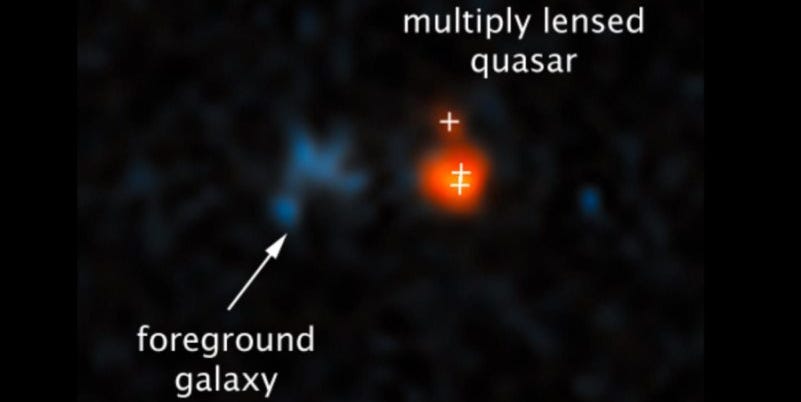
The star of this story is a quasar known as J0439+1634 (full catalog name: J043947.08+163415.7). When astronomers observe it, they’re
seeing the quasar as it was about 12.8 billion light-years awaymeaning its light left when the universe was only around
one billion years old.
Meet J0439+1634: bright enough to be suspicious
Quasars are powered by supermassive black holes that are actively feeding. As gas spirals in, it heats up, glows fiercely, and can
outshine entire galaxies. J0439+1634 is an especially extreme exampleits apparent brightness is often described as equivalent to
hundreds of trillions of Suns.
For astronomers, “too bright” can be a clue. In the early universe, objects that luminous are rare. So researchers asked a very reasonable question:
is this quasar truly that bright, or is something boosting it?
The boost: gravitational lensing (the universe’s free upgrade)
It turns out the quasar is brightened by gravitational lensing. A faint galaxy between us and the quasar bends spacetime enough that
the quasar’s light is amplifiedand, in this case, even split into multiple images.
With observations from major ground-based telescopes and sharp imaging from space, astronomers determined that the quasar’s brightness was being
boosted by about a factor of 50. Without this natural “cosmic telescope,” the quasar would have looked dramatically dimmer and would have been much harder to study.
Why this particular lens was a big deal
Not all lensing galaxies are helpful. Many are bright enough to swamp the viewlike trying to read a dim street sign while someone shines a flashlight in your face.
In this case, the lensing galaxy is unusually faint, which made it easier to separate the quasar’s light from the lens’s starlight.
The result is a rare combo: an early-universe quasar that’s magnified enough to be studied in detail, but not so visually “messy” that the lens ruins the data.
For researchers chasing clues about the universe’s first billion years, that’s basically hitting a cosmic jackpot.
How gravitational lensing actually works (without turning your brain into soup)
Gravitational lensing is one of those ideas that sounds like science fiction until you remember the universe didn’t consult our comfort level before deciding how physics should operate.
In Einstein’s general relativity, mass curves spacetime. Light follows the curves. So if a massive objectlike a galaxysits between us and a distant source,
it can bend and amplify the light, similar to the way a glass lens bends and focuses light in a camera.
Depending on the alignment, lensing can create arcs, rings, or multiple images of the same object. For J0439+1634, that bending was strong enough to
split the quasar into multiple apparent points of light. Scientists can model that geometry to estimate how much the quasar’s brightness has been boosted.
Lensing is more than a neat optical trickit’s a practical tool. It lets astronomers study objects that would otherwise be too faint, and it can reveal
information about the lens itself, including mass distribution (and, indirectly, dark matter).
Why quasars are perfect “flashlights” for the early universe
The early universe wasn’t always friendly to light. After the CMB era, the cosmos was filled with neutral hydrogen gas that absorbed high-energy photons.
For a long stretch, there were no stars and no galaxiesjust a dark, cooling universe with clumps of gas slowly gathering under gravity.
Then came the first luminous objects. Their radiation began to change everything. Quasars are especially useful because:
- They’re brightso their light can be measured from extreme distances.
- Their spectra are richmeaning they contain detailed features that can be analyzed like barcodes.
- They shine through the intergalactic mediumso the gas between galaxies leaves telltale absorption signatures in the quasar’s light.
In simple terms: a quasar is like a stadium floodlight shining through fog. By studying how the light changes, you learn what the fog is made of,
how thick it is, and whether it’s starting to clear.
The Epoch of Reionization: when the cosmic fog lifted
The period astronomers care about most here is the Epoch of Reionization, when radiation from the first massive stars and early galaxies
began to re-ionize neutral hydrogen. That process gradually turned the universe from “UV-opaque” to “UV-transparent,” allowing light to travel more freely.
J0439+1634 comes from this transitional era. That matters because reionization is still one of the least directly observed phases of cosmic history.
Researchers want to know: When did it begin? How patchy was it? How quickly did it spread?
A lensed quasar gives scientists enough photons to run deeper analysesprobing absorption signatures, estimating how much neutral hydrogen remains,
and testing models of early galaxy growth and black hole evolution.
How astronomers “date” light without a cosmic receipt
When headlines say “12.8 billion light-years away,” it’s tempting to imagine a simple yardstick. In practice, astronomers combine a few tools:
1) Redshift: the universe stretches the light
As space expands, it stretches the wavelengths of traveling light. The more expansion that happened during the light’s journey, the more “redshifted” it is.
For J0439+1634, the measured redshift is about z = 6.51, placing it in the early universe.
2) Spectroscopy: the light’s “barcode”
Astronomers split the quasar’s light into a spectrum and identify features from known atoms and ions. Matching those patterns and measuring how far
they’ve shifted provides a precise estimate of distance and era. It’s cosmic forensics: you can’t interview the quasar, but its light testifies anyway.
3) Lensing models: separating “intrinsic” brightness from boosted brightness
Because lensing can make objects look brighter than they truly are, researchers model the lens geometry to estimate the magnification factor.
For this quasar, the boost is roughly 50x, which means the quasar’s true luminosity is lower than the raw observed brightness suggests.
That correction matters for big questionslike how quickly early black holes grew. If a quasar looks outrageously luminous, you might conclude the black hole is impossibly massive.
But if lensing is doing the heavy lifting, the black hole may be “merely” enormous instead of reality-breaking.
What scientists can learn from one absurdly bright, extremely distant quasar
Finding a lensed quasar during reionization isn’t just another dot on a sky map. It can reshape what astronomers think they’re missing.
Hidden populations: the quasars we didn’t know we skipped
Strongly lensed quasars can be tricky to identify. The lensing galaxy can contaminate colors and shapes, causing traditional survey filters to miss them.
That means there may be a larger population of early-universe lensed quasars hiding in plain sightmisfiled, miscategorized, or never flagged as candidates.
Early black hole growth: fast, messy, and not fully explained
Quasars this early imply black holes grew very large very quickly. Whether that happened through rapid accretion, mergers, heavy “seed” black holes,
or some mix of processes is still debated. A bright, well-studied target like J0439+1634 provides real constraints instead of hand-wavy cosmic guesswork.
Early galaxies: dust, gas, and star formation in the universe’s youth
Follow-up observations at different wavelengths can reveal dust emission, gas content, and star formation activity in the quasar’s host galaxy.
Even when lensing complicates the picture, it also makes faint features easier to detectlike turning up the brightness so you can finally see the details.
Where “oldest light” research goes next
The quasar story is part of a bigger trend: astronomy is getting better at reading the early universe across multiple bands of light.
Researchers are combining:
- Space telescopes for sharp imaging and deep infrared sensitivity (ideal for early galaxies and quasars).
- Radio and submillimeter observatories to probe cold gas, dust, and early star formation.
- CMB experiments that map the universe’s oldest observable glow and test cosmology with increasing precision.
- Time-domain surveys that catch rare events and help find more “accidental alignments” like strong lenses.
Put together, it’s like reconstructing a family history using baby photos (CMB), awkward childhood snapshots (reionization era), and teenage yearbook pictures (early galaxies).
The universe is still the same character, but the lightingand the dramachanges fast.
Conclusion: a photon’s-eye view of cosmic history
Spotting some of the oldest light in the universe isn’t just about bragging rights for telescopes. It’s about building a timeline:
when the first stars ignited, how the cosmic fog cleared, and how black holes and galaxies grew up together in a universe that was still basically in diapers.
A lensed quasar like J0439+1634 is a rare giftan early-universe lighthouse boosted by a natural gravitational magnifier. It gives scientists a brighter,
cleaner signal from a time that’s otherwise hard to study. And it reminds us that in astronomy, sometimes the universe doesn’t just offer answersit hands you a magnifying glass and says, “Go ahead. Look closer.”
Experiences: How to “feel” ancient light in everyday life (without launching a telescope into orbit)
“Oldest light” can sound like something only professors with laser pointers get to enjoy. But you can build a surprisingly real, personal sense of cosmic time
with a few experiences that connect you to what astronomers are doingno PhD required and no need to pretend your porch is an observatory.
1) Try a “light-travel-time” stargazing session
The next clear night, step outside and pick a bright star. Then do the simplest (and most underrated) astronomy move: pause and remember that you’re not seeing “now.”
You’re seeing a message that left that star in the past. For nearby stars it’s only a few years or decades. For more distant objects, it’s thousands of years.
Your eyes are basically receiving ancient postcards at the speed limit of the universe.
Want to level up? Use binoculars to find the Andromeda Galaxy (in the Northern Hemisphere, it’s a classic target). The light reaching you from Andromeda began its trip
long before modern humans built cities. When astronomers chase quasars and early galaxies, they’re doing the same thingbut on a timeline so huge it makes “ancient history” look like a sticky note.
2) Visit a planetarium and ask for the “early universe” show
Planetariums are underrated time machines. Many shows include visuals of the cosmic microwave background, reionization, and galaxy formation.
It’s one thing to read “380,000 years after the Big Bang” on a screen; it’s another to watch the sky dome fill with a map of the universe’s earliest light.
If you go with family, friends, or a school group, it becomes a shared “whoa” momentlike everyone briefly agrees the universe is the coolest thing we’re all ignoring on weekdays.
3) Follow along with real telescope imagesthen do a “what am I looking at?” challenge
When you see an image of a lensed quasar or a lensed galaxy, don’t just scroll. Stop and ask: What’s the background object? What’s the lens? Why does it look distorted?
Gravitational lensing images are like optical illusions with a physics explanation. Once you learn the basicsmass bends light, alignment creates arcs and multiplesyou start recognizing patterns everywhere.
It’s a small skill, but it changes how you see space photography: you’re not just looking at something pretty; you’re decoding a phenomenon.
4) Make “cosmic time” tangible with a simple scale model
Here’s a practical mind-hack: build a timeline where the entire age of the universe is one calendar year.
On that scale, the cosmic microwave background appears in the first hour or so of January 1. The first stars and the epoch of reionization show up early in January.
The Sun forms late in the year. Modern humans arrive in the last minutes of December 31.
Suddenly, “some of the oldest light” isn’t abstractit’s like looking at the earliest pages of a book while your own chapter is a footnote at the end.
5) Join a local astronomy club (or a school science group) for a “big scope” night
If you’ve never looked through a large amateur telescope, it’s worth it. A club event can show you galaxies, nebulae, and sometimes quasars (depending on equipment and sky conditions).
Even when you can’t see an early-universe quasar directly, you’re learning the same observational language astronomers use: brightness, contrast, sky glow, seeing conditions, and patience.
Plus, it’s one of the few hobbies where someone can say “That faint smudge is a galaxy” and everyone nods like that’s normal.
6) Do the “spectra in the real world” experiment
Astronomers learn about distant objects by splitting light into spectra. You can get a tiny taste of that idea by looking at diffraction patterns in everyday life
like the rainbow spread you might see through certain materials or a simple diffraction grating. It’s a reminder that “light” isn’t just brightness; it carries information.
Quasar research is basically that principle taken to the extreme: turning ancient photons into a history lesson about hydrogen, dust, black holes, and the early cosmic web.
The best part about these experiences is that they don’t require you to “understand everything” to feel the impact. The early universe is complicated.
But the emotional truth is simple: the night sky is full of messages from the past. Scientists are learning to read the oldest ones more clearlyand you can practice the same sense of wonder,
one photon at a time.