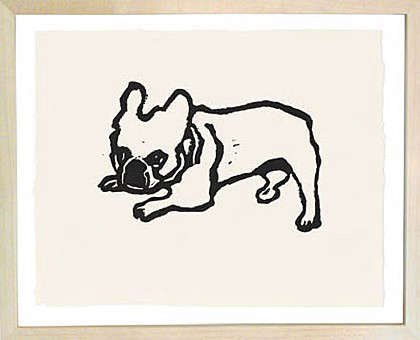
Mark’s Dog – Small Hugo Guinness Print is the kind of artwork that proves a small print can carry a very large personality. At first glance, it may seem simple: a dog rendered in Hugo Guinness’s unmistakable black-and-white linocut style. But look a little longer and the charm starts to wag its tail. The image feels clever, handmade, slightly mischievous, and wonderfully humandespite being, technically, a dog.
For collectors, decorators, dog lovers, and people who believe blank walls are a polite emergency, this small Hugo Guinness print offers more than decoration. It brings together contemporary printmaking, Brooklyn studio craftsmanship, graphic humor, and the emotional magnetism of dog art. It is refined without being stiff, playful without becoming childish, and stylish without needing to shout, “I went to art school.”
This guide explores what makes Mark’s Dog special, who Hugo Guinness is, how the linocut process shapes the final artwork, how to style the print at home, and why a small hand-printed dog may be exactly the kind of character a room needs.
What Is Mark’s Dog – Small Hugo Guinness Print?
Mark’s Dog is an 8 x 10 inch Hugo Guinness linocut print available in small format. It is sold in framed and unframed versions, with the framed presentation measuring 10 x 12 inches. The work is hand-printed in Hugo Guinness’s Brooklyn studio, signed by the artist, and printed with India ink on fine paper. Because each print is made by hand, small variations in ink application and paper tone are part of the appeal rather than a flaw. In other words, the print has manners, but it does not behave like a photocopy.
The subject is direct and memorable: a dog with the pared-down confidence that defines Guinness’s visual language. Instead of building realism through dozens of tiny details, he uses economical lines and bold shapes. That restraint gives the dog its comic timing. The image does not over-explain itself. It simply sits there, being a dog, as if it has been waiting all morning for someone to admire it.
Who Is Hugo Guinness?
Hugo Guinness is a British-born artist, illustrator, painter, and writer based in Brooklyn, New York. His work is known for bold black-and-white graphics, hand-drawn wit, and a fascination with everyday objects, animals, people, and phrases. He has been featured in major publications such as The New Yorker, The New York Times, and Vogue, and has collaborated with brands including J.Crew and Coach.
Guinness is also known for his creative relationship with filmmaker Wes Anderson. His art appeared in Anderson’s visual world, and he shared an Oscar nomination with Anderson for the story of The Grand Budapest Hotel. That film connection makes sense when looking at his prints. Like a Wes Anderson prop, a Hugo Guinness linocut can feel both humble and perfectly composed: a dog, a chair, a shoe, a word, a small object that suddenly becomes a whole little universe.
Why the Linocut Medium Matters
Linocut is a relief printmaking process. The artist carves an image into a block, inks the raised surface, and transfers the design onto paper. Areas cut away remain blank, while raised areas receive ink. The result often has strong contrast, crisp silhouettes, and a hand-made vitality that digital printing rarely captures.
In the case of Hugo Guinness, the linocut medium is not just a production method; it is part of the personality. His prints rely on immediacy. A line has to earn its place. A shape has to carry expression. A small wobble in the ink may become part of the print’s humor. This is why Mark’s Dog feels alive. The dog is not polished into boredom. It keeps a bit of studio energy, a little ink-born attitude, and perhaps the expression of a pet who has just heard the word “walk.”
The Appeal of Small Art With Big Character
Large artwork can dominate a room, but small artwork often invites people closer. That is one reason the small Hugo Guinness print format works so well. At 8 x 10 inches unframed, Mark’s Dog is compact enough for a hallway, reading nook, kitchen wall, powder room, bookshelf vignette, or gallery wall. Yet the black-and-white composition gives it enough visual weight to stand on its own.
Small art also feels personal. A dog print does not need to announce itself like a giant abstract canvas above a fireplace. It can live in a corner and still become the piece guests remember. In fact, it may be better that way. The viewer discovers it, smiles, and immediately feels as if the homeowner has a sense of humor. That is powerful interior design magic: one small dog, zero throw pillows required.
Design Style: Minimal, Witty, and Warm
Mark’s Dog works because it balances simplicity and emotional warmth. The black-and-white palette makes it easy to pair with many interiors: traditional, modern, cottage, eclectic, urban, farmhouse, or that increasingly common style known as “I bought what I liked and somehow it works.”
The print’s graphic quality complements white walls, dark painted rooms, patterned wallpaper, wood furniture, antique frames, modern metal lighting, and layered gallery arrangements. It can make a clean room feel less sterile or help a maximalist wall breathe by adding a strong monochrome pause. Dog art can sometimes become overly sentimental, but Guinness avoids that trap by keeping the image spare, funny, and slightly deadpan.
Framed vs. Unframed: Which Option Makes Sense?
The framed version of Mark’s Dog comes floated in a natural wood frame with UV-resistant plexiglass. This presentation gives the print a finished, gallery-ready appearance and helps protect the work from light exposure. For buyers who want a quick, professional-looking installation, framed is the simplest route.
The unframed option gives more flexibility. It allows collectors to choose a frame that suits their home, whether that means black wood, walnut, white oak, brass, antique gilt, or a thin modern profile. If you already have a gallery wall with a specific framing rhythm, unframed may be the better choice. A professional framer can help with archival matting and mounting, which is especially important for works on paper.
How to Style Mark’s Dog at Home
1. Hang It in a Gallery Wall
A small Hugo Guinness print is a natural fit for a gallery wall. Pair Mark’s Dog with sketches, black-and-white photography, vintage documents, small paintings, postcards, or other animal prints. Because the image is graphic and clean, it can act as a visual anchor among more colorful or detailed pieces.
2. Let It Stand Alone
Do not underestimate the charm of a single small artwork on a narrow wall. A tiny print hung in an entryway, next to a doorframe, or above a side table can feel deliberate and elegant. The key is breathing room. Give the dog a little space, much as you would with an actual dog who has claimed the best spot on the rug.
3. Place It Near Books
Guinness’s work has a literary quality, so Mark’s Dog looks excellent near bookshelves. Lean a framed version on a shelf beside novels, ceramics, or a small lamp. This makes the artwork feel collected rather than staged. It also gives the dog the intellectual atmosphere it deserves. Surely Mark’s dog has opinions about Proust.
4. Use It in a Mudroom or Entry
Because the subject is a dog, the print feels especially at home near leashes, coats, boots, and baskets. A mudroom can be practical without looking like a storage unit having an identity crisis. A small art print adds personality and says, “Yes, we own rain boots, but we also have taste.”
5. Pair It With Other Hugo Guinness Prints
Collectors often enjoy grouping Hugo Guinness works because the consistent black-and-white style creates cohesion while the subjects keep the arrangement lively. A dog print can sit alongside a flower, a word print, a car, a household object, or another animal. The result feels like a tiny visual conversation.
Why Dog Art Never Really Goes Out of Style
Dogs have occupied art, literature, family photos, and household mythology for centuries. They symbolize loyalty, humor, companionship, appetite, chaos, and the mysterious ability to nap in the most inconvenient doorway. A dog print can therefore feel both personal and universal.
Mark’s Dog succeeds because it avoids generic cuteness. It is not a cartoon puppy with oversized eyes begging for wall space. It is a character study in miniature. The print lets the viewer imagine a story: Who is Mark? Why does his dog look like that? Is the dog noble, guilty, patient, or plotting to steal toast? The unanswered questions make the artwork more engaging.
Collecting Hugo Guinness Prints
Hugo Guinness prints appeal to collectors because they are handmade, signed, visually recognizable, and easy to live with. They occupy a sweet spot between fine art and everyday wit. The works are serious enough to collect but relaxed enough to enjoy over breakfast.
For new collectors, Mark’s Dog is an approachable entry point. Its small size makes it easier to place, and its subject has broad emotional appeal. For existing collectors, it can deepen a group of Guinness animal prints or add a canine note to a broader collection of black-and-white works on paper.
Care Tips for a Hand-Printed Work on Paper
Works on paper need thoughtful care. Keep Mark’s Dog away from direct sunlight, damp bathrooms, steamy kitchens, and heating vents. Light, humidity, and temperature swings can affect paper and ink over time. If framed, UV-resistant glazing is a smart choice. If unframed, store the print flat in archival materials until it is professionally framed.
When handling an unframed print, wash and dry your hands thoroughly or use clean cotton gloves. Avoid touching the printed surface. Do not use tape, household glue, or bargain-bin mounting tricks that future-you will regret. A good frame job is not just decoration; it is insurance against your artwork slowly turning into a cautionary tale.
Is Mark’s Dog a Good Gift?
Yes, especially for people who love dogs, handmade art, black-and-white interiors, Brooklyn artists, gallery walls, or quietly funny objects. It is a thoughtful housewarming gift, birthday gift, holiday gift, wedding gift, or memorial gift for someone who appreciates canine companionship without needing a paw-print mug.
The print is also a strong option for someone who has everything. People who have everything usually do not have a Hugo Guinness dog watching over their hallway. That is your opening.
Buying Considerations Before You Order
Before buying Mark’s Dog – Small Hugo Guinness Print, consider where it will hang, whether you prefer framed or unframed, and whether you are comfortable with the natural variation that comes with hand-printing. The uniqueness is part of the value. Each print may vary slightly in ink density or paper tone, which means yours will not be a sterile duplicate.
Also consider timing. Handmade and framed works may require production time before shipping. If the print is intended as a gift for a specific date, do not wait until the last minute unless your decorating strategy includes panic.
Experiences Related to Mark’s Dog – Small Hugo Guinness Print
Living with a small print like Mark’s Dog is different from simply owning wall decor. The experience is quieter and more personal. It is the kind of artwork that becomes part of a daily route through the home. You pass it on the way to make coffee. You notice it while searching for keys. You catch it in the corner of your eye and, for reasons that are hard to explain, your mood improves by one small notch.
One of the pleasures of this print is that it does not demand a formal viewing experience. You do not need to stand in front of it with folded arms, whispering, “Fascinating use of negative space,” although you absolutely may if guests are nearby and you want to sound impressive. Instead, it works like a visual companion. Its dog subject gives it warmth, while Guinness’s pared-back style keeps it from becoming overly sweet.
In a real home, small artwork often succeeds where larger pieces struggle. A huge statement piece can feel like a commitment. A small print can be moved, regrouped, leaned, reframed, and rediscovered. Mark’s Dog might begin in a hallway, then migrate to a kitchen shelf, then join a gallery wall, then settle above a desk. Like an actual dog, it may eventually choose its own favorite room.
The print also creates conversation. Visitors may ask who made it, who Mark is, or whether the dog resembles a pet they once knew. That is the social strength of recognizable but slightly mysterious art. It gives people an entry point. Not everyone wants to discuss theory, but almost everyone has something to say about dogs. Some guests will see dignity. Others will see mischief. Someone will inevitably say, “That looks exactly like my neighbor’s dog,” and they will be right in spirit, if not in breed.
For dog owners, the emotional connection can be even stronger. The print captures the general dog-ness of dogs: alert, comic, loyal, possibly hungry. It does not need realistic fur texture to feel true. In fact, the simplification may make it more universal. The image becomes less about one specific animal and more about the idea of canine personality: the tilt of attention, the odd elegance, the strange seriousness dogs bring to ordinary life.
For collectors, the experience is also tactile and craft-based. Knowing that the print was hand-inked and hand-pulled changes how you see it. Slight differences are not defects; they are evidence of process. A darker patch of ink, a softened edge, or a variation in paper tone reminds you that a person made this object. In an age when so many images arrive as frictionless pixels, that handmade quality feels refreshingly grounded.
Decoratively, the print is forgiving. It can soften a modern room, sharpen a cozy one, and add wit to a traditional space. In a child’s room, it feels friendly without being babyish. In an office, it adds charm without looking unserious. In an entryway, it greets people better than many humans manage before coffee. The dog does not judge your mail pile. It simply observes.
The best experience of Mark’s Dog, though, may be how it rewards repeated looking. At first, you see a dog. Later, you see line, balance, confidence, humor, and the intelligence of leaving things out. That is the magic of Hugo Guinness’s small prints. They are simple, but not thin. They are funny, but not disposable. They are decorative, but not empty. Mark’s Dog proves that a small piece of paper can make a room feel more aliveand possibly better supervised.
Conclusion
Mark’s Dog – Small Hugo Guinness Print is a compact artwork with lasting charm. It combines the handmade character of linocut printmaking, the clean wit of Hugo Guinness’s visual style, and the timeless appeal of dog art. Whether framed as a stand-alone piece, tucked into a gallery wall, or given as a gift, it brings humor, warmth, and graphic elegance to a home.
Its small size makes it versatile, but its personality makes it memorable. That is the real reason this print works so well: it does not try too hard. It simply captures the spirit of a dog with a few confident marks, proving once again that good art does not always need to be large, loud, or complicated. Sometimes it just needs a tail, a little ink, and the good sense to sit exactly where it belongs.