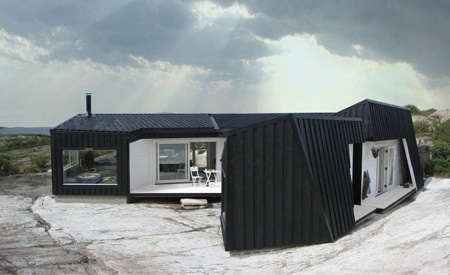
Some cabins try to “blend in” by looking like every other cabin. Cabin Vardehaugen takes a different approach: it blends in by behaving like the landscape. It crouches. It turns its shoulders into the wind. It makes an outdoor room where “outdoors” is usually a full-contact sport.
Designed by Fantastic Norway (with Håkon Matre Aasarød leading the design), this compact family retreat sits on Norway’s Fosen peninsula near the fjord at Grøttingenan exposed coastal setting where the view is generous and the weather is not particularly interested in your weekend plans. The result is a cabin that feels both bold and inevitable: a sculpted black-and-white shell wrapped around warmth, daylight, and a surprisingly social floor plan.
Meet the Cabin: A Fox-Curled Retreat on Norway’s Edge
The cabin’s most famous description is also the most accurate: it’s shaped like a mountain fox curling up to avoid the cold wind. That metaphor isn’t a branding trickit’s a design strategy. The building bends into an irregular horseshoe to create a sheltered atrium (a protected outdoor pocket) while still reaching outward toward panoramic views.
The site itself is dramatic: an outcrop by the mouth of a fjord, set roughly 35 meters above sea level. From up here, the cabin can see nearly everythingsea, rock, heath, changing lightand, unfortunately, everything can see the cabin too, including the wind. So the cabin does what sensible people do on blustery days: it hunkers down, gets its hood up, and finds a sunny spot.
The Site as Client: Wind, Rock, and a 35-Meter View
In many projects, “site analysis” becomes a polite paragraph and a diagram. At Vardehaugen, site analysis becomes the building. The cabin is placed in a small depression near the top of the outcrop, using the land’s subtle protection while keeping the big view. The body of the building lies snugly alongside a low rocky ridge and embraces polished bedrock that extends outward on the property.
Mapping the wind (with more humility than heroics)
One of the most instructive parts of this project is how literally the designers treated wind as data. Wind behavior on the property was registered using simple tools (like windsocks) and conversations with local inhabitantsbecause coastal wind doesn’t care what your spreadsheet says; it cares what the coastline does.
Even better: the planning phase involved repeated trips across seasons to understand how the site behaves over time. Some drafts were drawn full-scale in the snow to visualize the building’s exact placement and size. If that sounds obsessive, it’s the good kind of obsessive: the kind that keeps your front door from becoming a wind tunnel and your deck from becoming a kite.
Form Follows Forecast: The Horseshoe Plan and the Sheltered Atrium
The cabin’s plan begins as a long, narrow barthen bends into a protective curve. This move does three important things at once:
- It creates a sheltered outdoor “atrium” that functions like a microclimatean outdoor room you can actually use.
- It organizes privacy and social space by placing bedrooms and bathrooms toward the more protected side.
- It aims the living spaces toward the fjord so the best views land where people actually spend time.
Why the curve matters
Straight buildings on windy sites tend to behave like a flat palm catching air. Curved or angled buildings can deflect and redirect. Cabin Vardehaugen’s geometry helps reduce direct wind pressure on key outdoor areas, so the atrium becomes the social “center” of the cabinlike a traditional farmyard courtyard, but updated for a place where the weather has strong opinions.
The annex: a small piece with a big job
A small annex helps define the atrium and improves shelter from cold and wind. It’s a good reminder that “extra” structures aren’t always indulgent; sometimes they’re performance. On harsh sites, a modest outbuilding can act like a windbreak, a privacy screen, and a spatial cue that makes the outdoor room feel intentional instead of accidental.
Black Shell, White Heart: A Protective Skin That’s Also a Wayfinding System
From the outside, the cabin reads like a graphic object: dark, angular surfaces with crisp lighter bands near entrances and living zones. That contrast isn’t just for style points (though it does look fantastic in low winter sun). It helps tell you what the building is doing.
Roof becomes wall, wall becomes shield
On the most exposed sides, the black roof folds down into wall surfaces. Those walls are set at angles intended to give the wind less “purchase,” increasing protection where the cabin is most vulnerable. In practical terms: the building turns its tough surfaces toward the weather and keeps its softer, more open moments where people arrive and gather.
Material choices: simple timber, serious durability
The cabin is constructed with a straightforward wooden framework and clad in treated pine. In high-exposure coastal settings, durability is not a luxury; it’s basic competence. Wood can perform beautifully outdoors when it’s detailed to shed water, dry out, and resist decay. Cabin Vardehaugen pairs its dramatic form with pragmatic construction decisionsincluding anchoring strategies suited to bedrock conditions.
Inside the Loop: Kitchen Spine, Observatory Living Room, Cozy Nooks
Many modern cabins chase the “one big room” dream. Cabin Vardehaugen delivers openness without turning the interior into a single echo chamber where you can hear someone unwrap a snack from three counties away.
The kitchen as the social hinge
The kitchen acts as the spine of the building, tying together bedrooms, living spaces, and the atrium. From the workbench, you can see across key zonesinside and outsideso cooking stays connected to whatever is happening, whether it’s a storm watching session or a family card game.
The living room as an “observatory”
The living room occupies the outermost point of the property and is described as functioning like an observatory. The payoff is a sea view in three directionsan immersive, wraparound relationship to the fjord and sky. It’s a classic cabin move, upgraded: the place you sit becomes the place you notice the world.
Open plan, but with retreats
While the plan is open, the curve of the cabin restricts long sightlines and creates sheltered nooks and crannies. That’s an underrated trick: you can have togetherness without losing the ability to step away, read, nap, or stare into a mug of coffee like it’s going to reveal your destiny.
What This Cabin Teaches About Climate-Responsive Design
Even if you never build on a fjord (fair), Cabin Vardehaugen is a master class in making architecture behave. It pulls together strategies that show up repeatedly in resilient design guidance:
1) Start with microclimate, not mood boards
The cabin’s form is basically a site diagram you can live in. It reflects a process of studying wind patterns and seasonal changes, then shaping the building to respond. If your site is exposed, your “style” should include shelter and durabilitynot just aesthetics.
2) Make an outdoor room that’s actually usable
The atrium is the project’s secret weapon. Outdoor living isn’t only about adding a deck; it’s about creating a microclimate. A bent plan, a low roof edge, and a small annex can turn “too windy” into “perfectly fine with a blanket.”
3) Detail for rain, drying, and wind-driven weather
Coastal climates amplify moisture risk. Good enclosure design typically assumes water will get behind cladding sometimes, and then focuses on drainage and drying. That’s why many high-performance wall assemblies rely on clear water-control layers, a drainage gap, and ventilation pathways. The big idea: you don’t win by pretending water doesn’t existyou win by giving it an exit.
4) Let the building guide people
The cabin’s black protective shell and lighter entry/living zones do more than look sharp; they act like a map. In harsh weather, legibility matters. You want arrivals to be obvious, sheltered, and quickbecause nobody wants a dramatic scavenger hunt to locate the front door in sideways rain.
Why Cabin Vardehaugen Still Feels Fresh
Plenty of cabins are photogenic. Fewer are conceptually coherent from the first sketch to the last board. Cabin Vardehaugen holds up because every “cool” move has a job: the curve shelters, the roof folds to protect, the annex reinforces the atrium, the kitchen anchors the plan, and the living room reaches toward the horizon.
It’s also refreshingly honest about what a cabin is supposed to do. A cabin is not a trophy. It’s a device for being somewhereespecially somewhere wild. This one doesn’t fight the coast; it negotiates with it. And it does that with geometry, humility, and a color palette that looks like it can handle a little drama (because it can).
Architect Visit Add-On: of Cabin-Style Experiences
You approach a cabin like this differently than you approach a “regular” house. A regular house sits there and waits for you. Cabin Vardehaugen looks like it has already been waiting for the weatherand the weather has been showing up early.
The first thing you notice is the sound. Not insideoutside. Wind in a coastal landscape doesn’t whisper; it narrates. It moves across rock and heath, changes pitch at the ridge, then hits the cabin and slides off those angled surfaces like it’s been redirected by a polite bouncer. The cabin doesn’t eliminate the wind. It edits it.
As you get closer, the building’s graphic logic becomes a kind of wayfinding. The darker cladding feels like a protective coat pulled tight, while the lighter bands signal the places that are meant for people: the entry, the gathering spaces, the transition points where you step out of the raw coast and into a calmer pocket of air. It’s practical, but it also feels oddly comfortinglike the architecture is saying, “Yes, I know it’s windy. I planned for that.”
Then you find the atrium. This is the moment the cabin “clicks.” Out on the exposed side, the landscape is wide, bright, and intense. In the atrium, the air slows down. Conversation becomes normal-volume again. Someone sets a mug on a bench without performing a reflex test. You can imagine summer nights here, but you can also imagine the shoulder seasonswhen the sun is low, the light is silver, and the outdoor room becomes the best seat in the house because it’s outside without being punished for it.
Step inside and the plan continues the same idea: togetherness with escape hatches. You can move from the kitchen to the living room and still feel connected, but the curve interrupts the “endless loft” effect. Sightlines bend, corners appear, small calm places show up where you can read, sketch, or just stare out at the fjord and pretend you’re conducting important research on clouds (very serious work).
And the living roomyes, it really does feel like an observatory. The view isn’t framed like a single picture; it wraps around you. You sit down and the coast becomes a slow movie: light sliding across water, dark patches of weather approaching and dissolving, birds moving like punctuation marks in the sky. It’s the kind of space that makes you forget the word “screen time” exists. Outside, the elements are in charge. Inside, you’re warm, dry, and still part of the scene.
By the time you leave, you realize the cabin’s greatest trick isn’t the bold shapeit’s the experience of protection without disconnection. You don’t hide from the landscape. You inhabit it, with just enough shelter to enjoy the wild parts. That’s the real luxury here: not softness, but smartnessarchitecture that knows exactly what kind of place it’s in, and behaves accordingly.