If you’ve ever stared at a dying phone battery and thought, “Why can’t you just… eat the air?”
congratulations: you and a few brilliant microbes have the same energy strategy. (They’re just
better at it. Rude.)
The phrase “enzymes make electricity from thin air” sounds like a clickbait spell from a
wizard school for chemistry majors. But it’s rooted in real science: certain biological molecules
(enzymesnature’s tiny catalysts) can move electrons in ways that, when we connect them to the right
materials, can be measured as an electrical current. No turbines. No flames. Just air… and a lot of
clever engineering.
In this article, we’ll unpack what “thin air” actually means, how an enzyme can turn trace gases into
usable electricity, why humidity can also play the “air battery” role, and what it will take to turn
this from lab magic into everyday tech. Expect science, practical constraints, and the occasional
jokebecause electrons are serious, but we don’t have to be.
The “Thin Air” Part: What Are We Harvesting?
When people hear “electricity from air,” they often picture wind power. Fair! Wind is air that’s
doing cardio. But the breakthroughs here target still airthe calm, boring air that sits around
your house judging your life choices.
There are two “hidden fuels” in that calm air that researchers keep coming back to:
-
Trace gases (especially tiny amounts of hydrogen): not enough to fill a balloon, but enough
for certain microbes to survive. - Water vapor (humidity): the same stuff that makes your hair do interpretive dance in August.
Both can support electron movement under the right conditions. The key is not “free energy.”
The key is capturing a chemical or physical gradienta difference in concentration,
charge, or moisture that can push electrons in one direction, like a tiny, invisible waterslide.
Why this isn’t a perpetual motion machine
Electricity isn’t something you “find” lying around like spare change in couch cushions. You convert
energy from one form to another. Here, the conversion comes from either:
- Chemical energy stored in molecules (e.g., hydrogen reacting in a controlled way), or
- Surface/charge effects created when water interacts with nano-sized pores and materials.
So yes, it can feel like thin-air electricity. But scientifically, it’s more like
“electricity from overlooked ingredients already floating around you.”
Meet Huc: The Enzyme That Treats Atmospheric Hydrogen Like a Snack
One of the most attention-grabbing findings in recent years involves an enzyme often described as
a “natural battery.” The enzyme is a type of hydrogen-processing catalyst (a hydrogenase) that some
bacteria use to pull energy from extremely low concentrations of hydrogeneven the faint
traces found in ordinary air.
The headline-worthy twist: when researchers isolate that enzyme and connect it to an electrode setup,
it can generate an electrical current. Not a lightning bolt. More like a steady trickle.
But for sensors and microelectronics, a trickle can be the difference between “dead” and “always-on.”
How an enzyme turns chemistry into current
Enzymes don’t “make” electricity the way a generator does. They run chemical reactions that move
electrons from one place to another. If you give those electrons a convenient highwaylike a properly
designed electrodethen electron flow can become measurable current.
In simplified terms, the process looks like this:
-
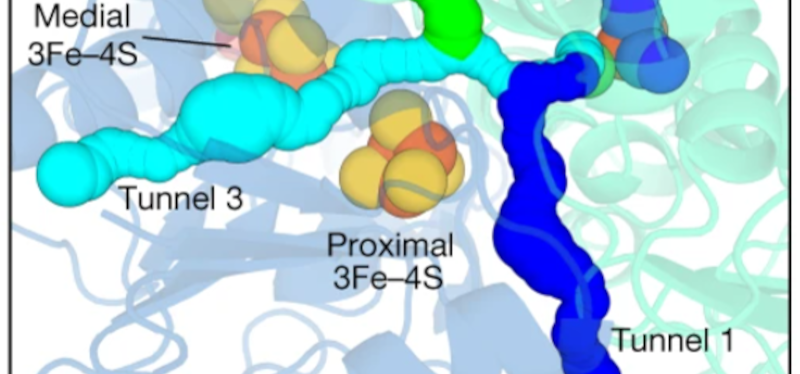
Hydrogen molecules (H2) reach the enzyme’s active site through specialized
channels in the protein structure. - The enzyme splits and oxidizes hydrogen, freeing electrons.
-
Those electrons travel through the enzyme’s internal “wiring” (metal clusters and cofactors),
then into an external circuit when an electrode is present.
The reason this is such a big deal is the concentration. Atmospheric hydrogen is present at
extremely low levels. Most catalysts would shrug and go back to sleep. This enzyme doesn’t.
Why this enzyme is unusual (and why engineers care)
A lab discovery is nice. A lab discovery that survives real-world abuse is nicer. Reports on this
class of enzyme emphasize a few traits that make it engineering-friendly:
- High affinity for hydrogen: it can function when hydrogen is scarce.
-
Oxygen tolerance: many hydrogen-processing enzymes hate oxygen; air contains oxygen.
That’s awkward. Oxygen-tolerant designs are a major plus. -
Stability: if the enzyme can handle temperature swings and storage, it stops being a
fragile “lab flower” and becomes a potential component.
That combination hints at future devices like ultra-sensitive hydrogen detectors,
low-power environmental monitors, or microgenerators that sip from the atmosphere the way a hummingbird
sips nectartiny amounts, but constantly.
Another Route: Electricity From Humidity (Yes, Your Weather App Is Involved)
If the enzyme story is “trace hydrogen becomes current,” the humidity story is
“water vapor meets nanomaterials and causes a continuous voltage.”
This line of work is often discussed under the umbrella of ambient energy harvesting.
One well-known approach uses a thin film of biologically produced protein nanowires.
When water molecules move through or across that film, they can create a charge imbalancea voltage.
Connect electrodes, and you can draw a continuous current.
The moisture gradient trick (tiny dam, tiny river)
A helpful mental image is a dam: water wants to move from “more water” to “less water.”
In humidity harvesting, you’re creating a moisture gradient across a thin film.
Water interacts differently across the material, and that can drive charge separation.
No spinning blades required.
Researchers have even pushed beyond one special bio-material, exploring “generic” approaches where
nanopores (very tiny holes) in a variety of materials can generate similar effects.
The pores’ size matters because nanoscale confinement changes how water molecules and ions behave.
What humidity harvesting is good at
Humidity-based devices have a practical charm:
- They can run day and night as long as the environment isn’t bone-dry.
- No moving parts means fewer mechanical failures.
- Small power, steady output pairs nicely with low-power electronics.
The tradeoff is scale: these devices are not designed to power your refrigerator. They’re designed
to power things that sip energylike sensors, microcontrollers, and transmitters that wake up briefly,
send a message, then nap again.
So… Are We Replacing Power Plants With Air?
Not anytime soon. The honest version: thin-air electricity is a micro-power story,
at least with today’s designs. The hype version: “Goodbye, grid!” The truth lives closer to
“Hello, sensors that stop needing battery changes.”
Why the gap? Power density. Air is spacious. Spacious is another word for “not very concentrated.”
Even if a catalyst is excellent, the amount of fuel (trace hydrogen) or the strength of the gradient
(humidity differences) limits how much current you can pull.
The best near-term use cases
Thin-air electricity shines when you need:
-
Remote monitoring: pipelines, forests, farms, oceans, or industrial sites where replacing
batteries is expensive. - Wearables and medical sensors: devices that benefit from steady trickle charging.
- Internet of Things (IoT): tiny nodes that transmit small packets of data intermittently.
- Hydrogen sensing: a catalytic system tuned to low hydrogen could double as a detector.
In other words: it’s less “power the city” and more “power the invisible stuff that keeps the city
functioning.”
What happens if hydrogen isn’t just a trace gas?
Here’s where things get interesting. Air has a tiny amount of hydrogen. But industrial settings
might have controlled low concentrations of hydrogenstill safe, still modest, but far more than
ambient background. An enzyme-based system that works at trace levels could, in principle, perform
even better when given more of its favorite snack.
That links thin-air enzyme tech to a broader conversation: hydrogen as an energy carrier in fuel cells.
The difference is that conventional fuel cells typically rely on materials like platinum catalysts,
while enzyme systems offer a biologically inspired alternative for specific niches.
What Would an “Enzyme Battery” Look Like in the Real World?
If you imagine a jar of enzyme sitting on a table producing electricity like a cartoon pickle jar
labeled “POWER,” let’s upgrade that mental image. Real devices would likely look like
enzyme-coated electrodes assembled into something akin to a micro fuel cell.
Enzymatic biofuel cells 101
Enzymatic biofuel cells use enzymes as catalysts on electrodes. You can think of them as:
- An anode side where a fuel is oxidized (electrons are released),
- A cathode side where a reaction consumes those electrons (often involving oxygen),
- An electrolyte that allows ions to balance charge.
For thin-air enzyme concepts, the trick is getting:
(1) gas access, (2) stable enzyme attachment, and
(3) efficient electron transfer to the electrodeall at once.
Nature solved this inside a microbe. Engineering has to solve it inside a device.
Manufacturing questions engineers can’t dodge
Cool biology doesn’t automatically become a product. The big questions include:
- Production scale: Can we make enough enzyme reliably, affordably, and with consistent activity?
-
Immobilization: How do we “park” enzymes on electrodes without blocking the active site
or letting them wash away? -
Lifetime: Do they keep working for weeks, months, yearsor do they retire early like
a sitcom character after season one? - Packaging: Can the device stay functional across humidity shifts, dust, and temperature swings?
The encouraging news is that enzyme-electrode research has been active for decades, and modern materials
(nanostructured carbons, conductive polymers, porous supports) keep improving the “wiring” between biology
and electronics.
Environmental and Safety Angle
Thin-air electricity is appealing because it’s quiet, low-temperature, and potentially low-impact.
But “green” isn’t a vibe; it’s a checklist. A few points matter:
-
Fuel source: If a device uses trace hydrogen in ambient air, it’s not competing with food,
land, or sunlight. If it uses added hydrogen, sustainability depends on how that hydrogen is produced. -
Materials: If the electrode materials or membranes are rare, toxic, or hard to recycle,
the environmental win shrinks. -
Safety: At trace levels, hydrogen is not a practical hazard. In concentrated settings,
engineering controls and ventilation matterjust like they do for any hydrogen tech.
The most realistic “green win” is replacing or reducing battery dependence in devices that would otherwise
eat through piles of disposable cells.
The Roadblocks (Because Science Isn’t a Montage)
If this were a movie, we’d cue inspirational music, cut to a lab montage, and end with a city powered
by bacteria. Real life is less cinematic and more “debugging, paperwork, and one electrode that refuses
to behave.”
1) Power level vs. real-world demand
The enzyme and humidity approaches currently fit best in the micro-power range. That’s not a flawit’s
a market. But it does mean careful expectations. Powering a sensor? Plausible. Powering a toaster?
Not unless your toast is purely conceptual.
2) Durability in messy environments
Lab conditions are clean. The world is… not. Dust, biofouling, chemical contaminants, and temperature
cycling can degrade performance. A practical device needs protective architectures that still let
gas or water vapor reach active surfaces.
3) Cost and scaling
Even if an enzyme is stable, manufacturing it at scale with consistent quality is its own mountain.
Add the cost of electrodes, membranes, packaging, and testing, and the price tag can climb quickly.
The winning products will likely be the ones that solve expensive pain pointslike battery replacement
in remote or high-risk locations.
Bottom Line: Thin-Air Electricity Is Small Power With Big Potential
“Enzymes make electricity from thin air” is not a promise that your home will run on vibes and oxygen.
It’s a window into a smarter future of electronics: tiny devices that scavenge just enough energy from
their environment to stay alive.
In the near term, expect progress where low, steady power is valuablesensors, wearables, and monitoring.
In the longer term, enzyme-based systems could influence how we think about catalysts, fuel cells, and
ultra-efficient chemistry at ambient conditions.
Microbes learned to survive on scraps floating in the air. We’re just learning how to borrow the trick
without having to become microbes. (Though if your meetings get longer, don’t rule it out.)
Real-World Experiences: What It’s Like to Chase “Thin-Air” Electricity
Let’s talk about the human side of “electricity from air,” because the lab results are only half the story.
The other half is what it feels like to work with systems that produce power in the way a houseplant
“produces” oxygen: slowly, quietly, and only if you stop expecting fireworks.
The first experience most people haveengineers, makers, curious studentsis a reset of intuition. We’re used
to power sources that announce themselves. A wall outlet has confidence. A battery has drama. Thin-air energy
harvesting has neither. You don’t hear it. You don’t smell it. You mostly stare at a meter and wonder if the
numbers are moving or if you’re blinking too hard.
That’s actually the point: thin-air systems reward patience and good measurement habits. If you’re experimenting
with humidity-harvesting films, for example, you quickly learn how much the environment matters. A slightly open
window changes airflow. A nearby cup of hot coffee changes local moisture. Even your hand hovering over the setup
can shift temperature and humidity enough to nudge the voltage. It’s like trying to weigh a feather during a
mild breezepossible, but your setup has to be smarter than your curiosity.
The second experience is learning to love the “trickle.” If you build or test a microgenerator, you stop thinking
in terms of “charging my phone” and start thinking in terms of “keeping a capacitor topped off.” That change is
surprisingly empowering. You begin designing electronics differently: low-power modes, duty cycles, burst
transmissions, and energy storage become the heroes. A sensor might wake up every five minutes, take a reading,
transmit for a fraction of a second, then go back to sleep. Thin-air electricity fits that rhythm like a metronome.
If you’re exploring enzyme-based current generation, the experience shifts again. Biology adds personality. Enzymes
are not just components; they’re catalysts with preferences. They like certain pH ranges, temperatures, and surfaces.
They don’t enjoy being dried out (most of them, anyway), and they’re picky about how they’re attached to electrodes.
It’s common to discover that “the same” electrode preparation gives different results on different daysuntil you
standardize every step like you’re baking soufflé in a wind tunnel.
People also tend to underestimate the value of “boring” outcomes. A stable, repeatable micro-current is boring in
the same way that steady internet is boring: you only notice it when it disappears. In real deploymentsremote
monitoring, environmental sensors, infrastructure health checksboring reliability is the premium product.
A tiny current that shows up every day is more useful than a big spike that shows up when it feels like it.
There’s also a very practical experience: thin-air systems make you think about maintenance early.
How do you prevent dust buildup? What happens during a heat wave? How do you protect sensitive surfaces while still
letting gases or water vapor reach them? In many prototypes, the “power-generating material” is not the limiting
factorpackaging is. The best designs are often the least glamorous: simple housings, smart airflow paths,
hydrophobic/hydrophilic coatings, and safeguards that keep performance consistent across seasons.
Finally, there’s the experience of explaining it to other humans. You will say, “It makes electricity from air,”
and someone will immediately ask, “So it’s free energy?” You will take a slow breath, smile, and say, “Nobut it’s
extremely convenient energy.” And that’s the real takeaway: thin-air electricity isn’t about replacing everything.
It’s about removing batteries where batteries are the worst part of the job.