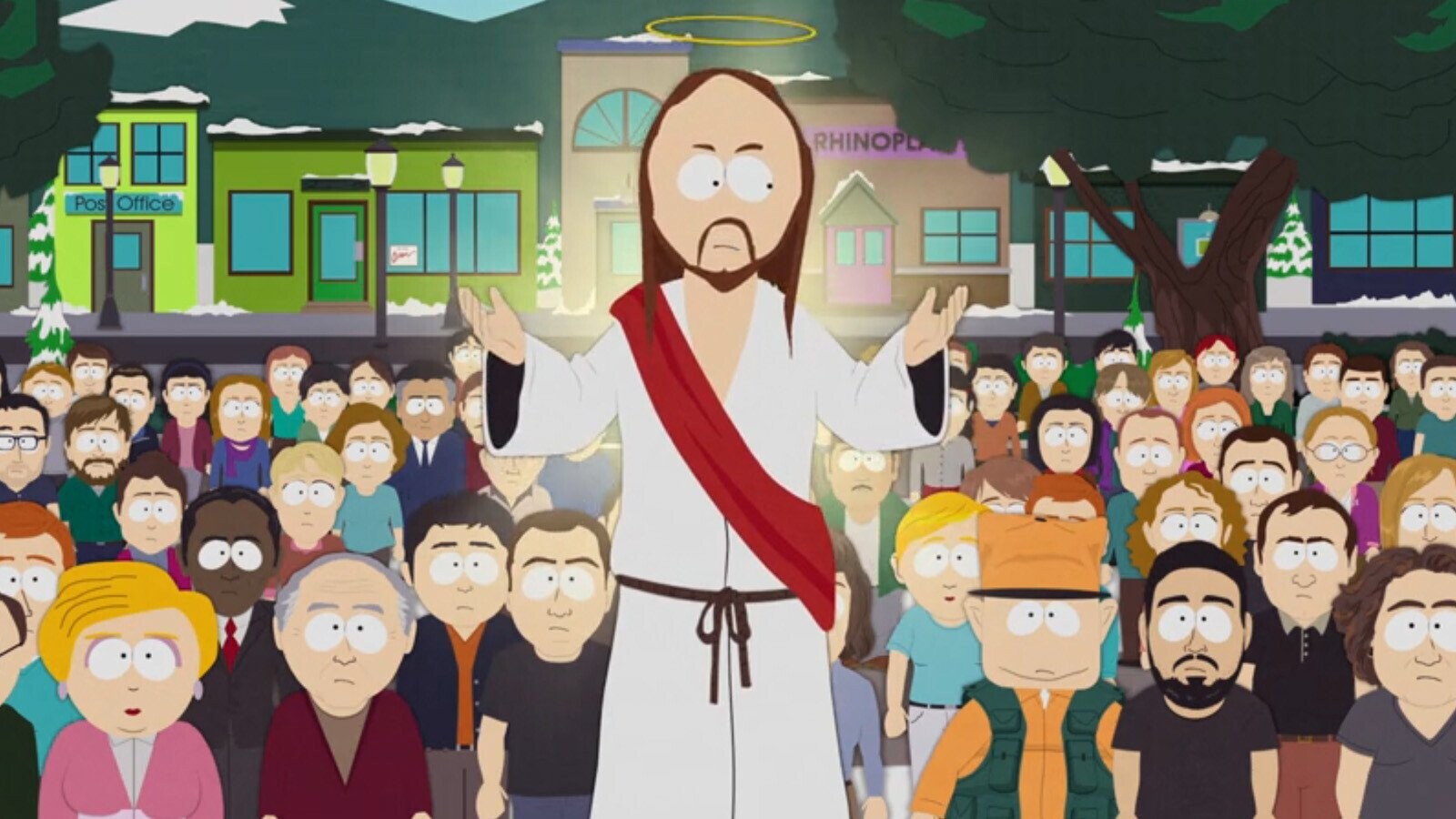
Some people dream of meeting their heroes. Others dream of paying off student loans. And then there’s a third, highly specific category of dreamers:
the ones who want to be a vaguely-bearded background extra in South Park while Jesus delivers a big speech and Randy Marsh does whatever Randy
is doing this week (usually something that would get a “sir, please step away from the microphone” at a PTA meeting).
In the Season 27 premiere, “Sermon on the ‘Mount,” South Park came roaring back with the kind of headline-grabbing chaos it’s been perfecting
since the late ’90s: religion, politics, corporate media drama, and an episode stuffed with characters that feel like they crawled out of a group chat
where nobody’s been sober since 2004. But tucked inside that spectacle is a small, delightful “wait… who is THAT?” moment: a real fan-turned-cartoon
who actually made it into the episode.
The funniest part? This wasn’t a celebrity cameo or an industry insider wink. It was a regular personan actual contest winnerwho got immortalized
in classic cut-out animation. The internet did what it always does: paused, zoomed, argued, congratulated, and briefly considered launching an
investigative task force made entirely of people who can identify a background character by elbow shape.
What Happened in the ‘South Park’ Season Premiere (and Why It Went Viral)
“Sermon on the ‘Mount” didn’t ease viewers back into the show with a gentle “remember Kenny?” vibe. It came in hotswinging at politics, media,
and the show’s own corporate ecosystem. The episode includes Jesus showing up in the public-school setting and Randy Marsh reacting in the most Randy
way possible: by turning confusion into outrage and then turning outrage into a community project that somehow becomes everyone’s problem.
The premiere’s satire also takes direct aim at President Donald Trump’s political orbit and the broader news-and-entertainment machine surrounding it.
In classic South Park fashion, the episode mixes crudeness with commentary and then dares you to admit you’re thinking about it.
It’s the show’s signature move: make you laugh first, then make you uncomfortable that you laughed, then make you laugh again because you’re
uncomfortable. If that sounds exhausting, congratulationsyou understand the brand.
This episode’s timing mattered, too. It landed in the middle of very real corporate negotiations and streaming-rights drama swirling around the series,
making the satire feel less like “topical humor” and more like “we are joking, but also… we are absolutely not joking.” That’s a big reason the premiere
didn’t just get watchedit got dissected.
The Plot Is Loud, But the Details Are Where the Fun Lives
The big beats are easy to spot: Jesus, Randy, a charged town reaction, and a barrage of topical references. But South Park is also a show that
rewards the “rewind and squint” crowd. Its background gags, tiny character moments, and quick visual jokes are basically catnip for fans who treat an
episode like a scavenger hunt.
Which is exactly why this season premiere created the perfect hiding place for a real person: not front-and-center like a celebrity guest voice, but
visible enough that the hardcore audience would find him… and then talk about him like he’s the new Bigfoot.
The Charity Contest That Put a Real Fan Into ‘South Park’
The “real guy” moment didn’t happen by accident. It happened because South Park Studios ran a contest tied to wildfire relief efforts in
Southern California. The basic idea was both generous and brilliantly on-brand: support a serious cause, and one winner gets turned into a
“permanent resident” of South Park (the town, not the existential condition).
Entry was connected to fundraising that benefited the SoCal Fire Fund, an initiative created to support community-centered recovery after the January
2025 firesespecially for students, school employees, and families dealing with the fallout. It’s the kind of cause that actually maps onto the real
world, even if the prize involves being drawn with a weird little mouth and an outfit that looks like it came from a 1998 thrift store.
Why This Kind of Contest Feels So ‘South Park’
The show has always been good at turning cultural attention into narrative fuel. But this contest did something slightly different: it turned the
audience itself into part of the show. Not as a metaphor. Literally. Someone’s friend group got to watch an episode and say, “That one. That’s Paul.
That’s our guy. Look at him, just standing there, existing in Colorado.”
And because South Park is built on a visual style that can turn almost anyone into a character without losing the show’s identity, it’s the
rare series where a fan cameo doesn’t feel like a “stunt.” It feels like a natural extension of the world. Background extras have always been part of
the show’s texture. This time, one of them was real.
So… Who’s the Real Guy?
According to reporting highlighted by Cracked, the contest winner was identified as “Paul T.”a regular person (and now, arguably, a minor
folk hero) whose animated likeness appears in the crowd behind Jesus during the big moment in “Sermon on the ‘Mount.”
That’s the magic of the cameo: it’s not flashy, but it’s unmistakably there once you know where to look. You can almost feel the writers’ room
grinning like: “We hid a human in the episode. Let the fandom do the rest.”
Why Fans Briefly Thought He Was Someone Else
When you drop a random bearded guy into a show with decades of recurring weirdness, people will immediately ask:
“Is that a reference?” Some fans reportedly assumed the character might be David Blainebecause South Park has previously run an episode
where Blaine is entangled in a cult-like storyline that involves Jesus stepping in to help.
It’s a very South Park fan reaction: nobody can accept that a background character is just a background character. Everything is a clue.
Everyone is a suspect. Every beard is evidence.
“Permanent Resident” Sounds Like a Joke… Until It Isn’t
The phrase “permanent resident” is doing a lot of work. On one hand, it’s funny because it sounds like the town of South Park has an HOA and a
stack of forms. On the other, it implies Paul T. could pop up again. Maybe he’s just a recurring extra. Maybe he’s the guy in the line at the store
when Randy buys something medically inadvisable. Maybe he becomes the only sane adult in town, which would make him the most fictional character
in the whole series.
Why Hanging Out with Jesus and Randy Marsh Is the Ultimate ‘South Park’ Flex
If you’re going to become a microscopic piece of South Park history, being placed near Jesus and Randy is a premium location.
It’s like getting floor seats at a concert where the band is “Religious Satire” and the opening act is “Middle-Aged Chaos.”
Jesus: A Long-Running ‘South Park’ Weather Pattern
Jesus in South Park isn’t a one-off gag. He’s part of the show’s DNA, used at different times for commentary on media, religion, politics,
and the American tendency to turn everythingeven moralityinto a consumer product. His presence in the Season 27 premiere continues that tradition:
the show uses him as both a character and a symbol, depending on what joke needs landing.
Randy Marsh: The Show’s Most Reliable Agent of Disaster
Randy’s evolution from “Stan’s dad” into “human tornado with a credit card” is one of the defining arcs of modern South Park.
He’s the character most likely to turn a minor inconvenience into a town-wide emergency and then blame everyone else for not supporting his vision.
Put a normal person near that energy, even in the background, and it becomes funny on principle.
It also highlights something the show does well: it frames big cultural issues through the reactions of deeply flawed characters.
Randy isn’t there to guide you to a balanced conclusionhe’s there to embody the exact wrong way people sometimes respond to complicated problems.
Which is why he makes great satire and terrible group projects.
The Paramount+ Deal, Streaming Wars, and Why the Episode Feels Extra “Meta”
This premiere didn’t exist in a vacuum. Around the same period, major news outlets reported on a new long-term deal tied to South Park:
a multi-year agreement involving dozens of new episodes and major streaming rights. In other words, while the show was airing a story about power,
pressure, and institutions, the real world was having its own version of that conversationjust with more lawyers.
That context matters because South Park has always loved punching at systems. But it’s especially potent when the system includes the
very corporate structures that distribute the show. It creates a layered effect: the episode is a satire, and the production context is part of what
makes the satire feel sharp.
Why Viewers Notice When ‘South Park’ Is “Fighting the Air It Breathes”
Fans can tell when the show is aiming outward at politicsand when it’s also aiming inward at entertainment industry dynamics.
The Season 27 premiere works on both levels. It’s about culture, but it’s also about the machinery that packages culture and tries to keep it
profitable, safe, and predictable.
And that’s part of the reason a small, human cameo hits so well. In an episode swimming in big, loud headlines, the idea that a charity contest winner
is quietly standing behind Jesus is a reminder that South Park is still, at its core, a show made out of tiny choices: a visual gag here,
a background face there, a joke that lasts two seconds but lives in your head for two weeks.
What This Cameo Says About ‘South Park’ Fandom (and Why It’s Kind of Sweet)
It’s easy to treat this story like a novelty: “Ha, a random guy got animated!” But it also shows how the South Park fandom works.
People don’t just watch. They study. They rewatch. They pause frames like they’re analyzing the Zapruder film, except instead of history it’s
Randy Marsh’s latest disaster and a mysterious extra with a beard.
More importantly, the cameo came from fundraising tied to wildfire recovery. That’s not just a fun factit changes the vibe. The cameo isn’t only a
“cool prize.” It’s a small symbol of support for real communities dealing with real loss. The show’s sense of humor is famously ruthless, but that
doesn’t mean the people behind it can’t be serious about helping their own crew, neighbors, and city.
So yes, it’s hilarious that someone’s permanent legacy might be “Guy Behind Jesus.” But it’s also a reminder that fandom can be more than consumption.
Sometimes it becomes participation. Sometimes it becomes community. And sometimes it becomes a cartoon version of your buddy that you can point at
for the rest of your life.
Conclusion: The Funniest Cameos Are the Ones You Have to Earn
In a season premiere that already had plenty of “did they really just do that?” moments, the Paul T. cameo stands out because it’s oddly wholesome:
a normal person gets a once-in-a-lifetime Easter egg, tied to a charitable effort, hidden in a scene with two of the show’s most loaded characters.
It’s also the kind of story only South Park can pull off without feeling fake. The show has always blurred linesbetween comedy and critique,
between nonsense and commentary, between the fictional town and the real world that keeps trying to out-parody it. Turning a fan into a permanent
resident is just another way of saying: “This world is weird, and you’re invited.”
And if Paul T. shows up again? Congratulations in advance to the internet, which will immediately create a tracking spreadsheet, a conspiracy board,
and at least one 43-minute YouTube video titled: “EVERY TIME PAUL T. APPEARS (AND WHAT IT MEANS FOR AMERICA).”
Fan Experiences: What It Feels Like When a “Random Dude” Becomes Part of the Show
Watching a South Park premiere is rarely a quiet activity. Even if you’re alone, it tends to feel social, because the show has trained people
to react in real timetexting friends, refreshing social feeds, and sending the kind of messages that would be horrifying to explain to a grandparent.
“Jesus is back” is already a wild sentence. “Jesus is back and there’s a contest winner behind him” is the kind of detail that turns a normal viewing
into a group investigation.
One of the most common “fan rituals” with South Park is the rewatch. The first viewing is for impact: the big jokes, the shock moments, the
loud satire. The second viewing is for hunting: background characters, blink-and-you-miss-it signs, and tiny reactions that change how a scene lands.
The Paul T. cameo fits perfectly into that tradition. The show doesn’t stop and announce him. It trusts that the audience will do what it always does:
obsess lovingly over the smallest pixel of information.
And there’s a special kind of joy when the “obsession” has a human face. Fans love celebrity cameos, sure. But a real personsomeone who isn’t famous,
who didn’t promote anything, who didn’t show up because of a marketing dealhits differently. It feels like the show briefly opened a side door and
let a viewer walk into the world. It turns the phrase “the audience is part of the experience” into a literal animation choice.
For people who entered the contest (or even just heard about it), the emotional arc is surprisingly relatable: you see the announcement, you think
“no way,” you imagine what your cartoon self would look like, and you start mentally preparing a lifelong joke where you introduce yourself at parties
as “technically a Colorado resident.” Even the act of donating can feel like participation beyond fandoma reminder that the crew behind the show is
made of real people living in real places, dealing with real disasters. That awareness adds weight to what might otherwise be dismissed as a silly
sweepstakes.
Then there’s the pure social currency of it all. If your friend ends up in South Park, you don’t just watch the episodeyou curate it.
You clip the scene. You circle the character in screenshots like a proud sports parent. You send it to everyone you know with the same energy as
“my cousin got on the Jumbotron.” It becomes a story you can tell forever, because it’s both ridiculous and true.
Finally, there’s the strange comfort of the cameo itself. In a premiere built around huge cultural arguments and big, noisy satire, the Paul T. moment
is small and human. It’s a reminder that fandom isn’t only about reacting to what’s on screenit’s about the community around it: the rewatchers, the
joke-makers, the people who care enough to look closely, and the ones who occasionally turn that care into something positive, like supporting wildfire
recovery. In the middle of a chaotic episode, a single background character can quietly say: “Yep. Real people live here, too.”