Breaking up with a bank can feel surprisingly dramatic. You’re not just leaving a building with free pensyou’re untangling
direct deposits, autopays, subscriptions you forgot existed, and that one check your aunt still insists on mailing.
The big question, though, is the one that keeps people up at night: Will closing a bank account hurt my credit score?
Here’s the good news: closing a checking or savings account usually does not affect your credit score directly.
Here’s the less-fun (but very fixable) news: it can affect your credit indirectly if the closure triggers
missed payments, collections, or fees you didn’t see coming. Let’s walk through what’s real, what’s myth, and how to close
an account without your financial life turning into a sitcom episode.
Quick Answer: Does Closing a Bank Account Hurt Your Credit?
Not directly. Most checking and savings accounts are deposit accounts, not credit accounts. Since you’re not borrowing
money in a typical checking/savings relationship, the account itself generally isn’t reported to the three major credit bureaus
the way a credit card or loan would be.
That means if you close a checking account in good standingwith a zero balance, no unpaid fees, and no pending paymentsyour
credit score typically won’t even notice you did it.
Why Bank Accounts Usually Don’t Show Up on Your Credit Report
Credit scores (like FICO and VantageScore) are built around how you manage creditthings like payment history, balances owed,
credit utilization, length of credit history, and new credit. A basic checking account doesn’t fit that category.
So what’s the “credit score” actually watching?
- Payment history (are you paying credit accounts on time?)
- Credit utilization (how much revolving credit you’re using vs. available)
- Length of credit history (how old your credit accounts are)
- New credit (recent openings and inquiries)
- Credit mix (revolving vs. installment credit)
In other words: your checking account is more like the stage crew than the lead actor. It matters to the show, but it’s not the
thing being reviewed by the critics.
When Closing a Bank Account Can Affect Your Credit Score (Indirectly)
While the closure itself isn’t a credit event, the mess around it can create credit problems. Here are the common ways that happens.
1) You close the account with a negative balance (hello, collections)
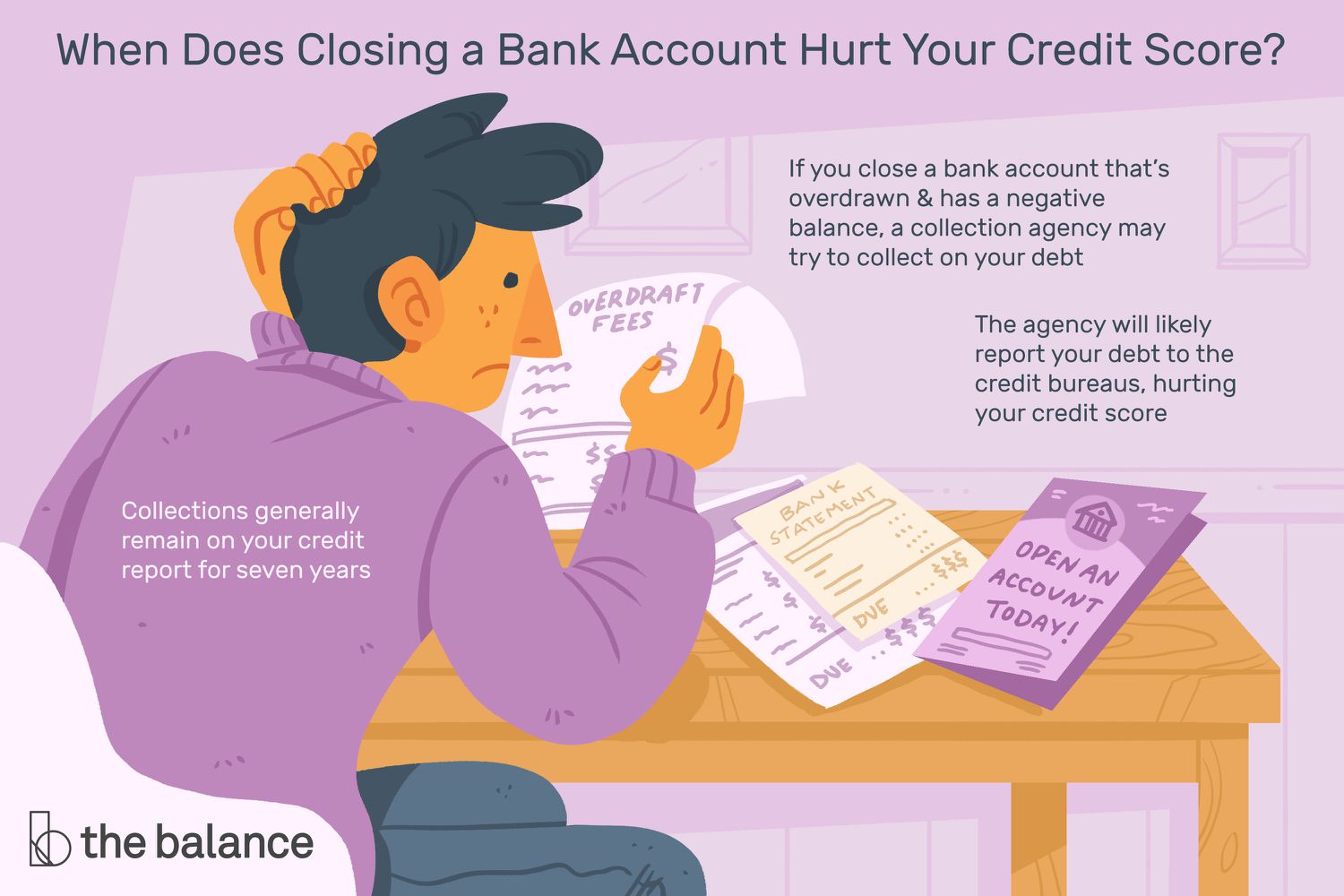
If your account is overdrawn and you close itor the bank closes itany unpaid negative balance can be sent to collections.
Once a collection account hits your credit report, your credit score can drop (sometimes sharply).
Example: You close an account at $-87 because an autopay hit after you moved your money. The bank charges fees, the balance grows,
and eventually it goes to collections. That’s not “closing the bank account” hurting your creditit’s the unpaid debt.
2) Automatic payments bounce, causing late payments on credit accounts
This is the sneakiest credit-score hit because it’s so unintentional. If your credit card, student loan, car loan, or mortgage autopay is tied to
the account you close, your payment may fail. If you don’t catch it and the payment becomes 30+ days late, that late payment can be reported and
damage your score.
Pro tip: Autopay fails are rarely cinematic. It’s usually a boring email you don’t open until it’s emotionally too late.
3) Overdraft or fee disputes aren’t resolved before closure
Some people close accounts specifically because they’re tired of fees. Totally fair. But closing before everything is settled can cause leftover
charges to become delinquent. If those become collections, that’s when credit trouble starts.
4) The account is closed “involuntarily” and reported to specialty agencies
Even if your credit score doesn’t change, your banking life might. Banks often use specialty consumer reporting agencieslike
ChexSystems and Early Warning Servicesto evaluate risk when opening new checking accounts.
If an account is closed due to unpaid negative balances or suspected fraud, that closure may be reported to these systems. This typically affects your
ability to open new deposit accounts, not your credit score. But it can still be a major inconveniencelike getting “grounded” by the banking system.
Credit Score vs. “Banking Reports”: The Confusing Part Everyone Mixes Up
A lot of people say “it hurt my credit,” when what they really mean is “a bank denied my account.” Those are different systems.
What a credit report tracks
- Credit cards, mortgages, auto loans, student loans, personal loans
- On-time vs late payments, utilization, collections, public records (where applicable)
What a ChexSystems/Early Warning-type report tracks
- Checking account closures (especially for cause)
- Unpaid negative balances, charged-off deposit accounts
- Bounced checks and suspected account misuse (depending on the system and institution reporting)
Think of it like this: your credit report is your borrowing reputation. Your ChexSystems/EWS-type report is more like
your “deposit account behavior” file. Different audiences, different consequences.
What About Closing a Bank Account That’s Linked to a Credit Card?
Closing the bank account doesn’t directly change your credit card account. But it can create ripple effects:
- Autopay disruption: missed credit card payments can trigger late fees and credit reporting.
- Returned payment risk: if a payment is submitted from a closed account, you might get a returned-payment fee from the card issuer.
- Credit limit changes are separate: closing checking doesn’t reduce credit limits, but your issuer could still take action for other reasons.
Does Closing a Checking Account Affect Your Credit “History Length”?
Not in the same way people worry about with credit cards. Closing a credit card can impact utilization and sometimes credit age calculations.
Closing a checking account generally doesn’t factor into credit history length because it isn’t part of typical credit scoring models.
If you’re mixing up the two, you’re not alone. Financial advice on the internet sometimes treats all “accounts” like they’re the same species. They’re not.
One is a credit relationship; the other is a deposit relationship.
Could Banking Behavior Ever Impact a Score?
In most common credit scoring models, your checking account behavior isn’t included. However, there have been efforts to use
optional, consumer-permissioned banking data to help some peopleespecially those with thin credit filesthrough alternative scoring approaches.
The key idea: if you consistently keep a cushion in your account and avoid overdrafts, that information might help in certain situationsbut it’s not
the standard way most lenders evaluate borrowers today. So for most people: don’t count on “good checking vibes” to save your credit score. Count on
on-time payments and low utilization.
How to Close a Bank Account Without Creating Credit Problems
If you want to switch banks and keep your credit score calm and unbothered, use this checklist.
Step 1: Open the new account first (don’t leap without a landing)
It’s easier to move everything when you already have the new account ready. Plus, you can test it with a small deposit and confirm you can log in, transfer funds,
and receive direct deposits.
Step 2: Move direct deposit and automatic payments
- Update your employer payroll details for direct deposit
- Update autopay for credit cards, loans, rent, utilities, subscriptions
- Don’t forget annual and quarterly payments (insurance, property taxes, memberships)
Step 3: Leave a buffer and wait for pending transactions to clear
Keep the old account open long enough for outstanding checks and scheduled debits to clear. A short overlap period can prevent overdrafts and returned payments.
Step 4: Bring the balance to zero (and confirm fees won’t pop up later)
Transfer remaining funds out, then verify there are no monthly maintenance fees, overdraft interest, or “surprise, we charged you anyway” service charges pending.
If you’re closing early after opening, ask if there’s an early closure fee.
Step 5: Get written confirmation of closure
Request an email or letter confirming the account is closed with a $0 balance. Save it like it’s a concert ticket from your favorite bandbecause it’s proof you did
everything correctly.
Step 6: Monitor for 30–60 days
Watch for:
- Failed autopays (especially credit cards and loans)
- Refunds or chargebacks still routed to the old account
- Stray subscriptions that didn’t get the memo
Specific Scenarios: What Happens to Your Credit?
Scenario A: You close a checking account in good standing
Likely credit impact: none. Your credit score should remain unchanged, assuming no payments fail.
Scenario B: You close the account, but a credit card autopay was tied to it
Likely credit impact: potentially serious if it causes a 30+ day late payment. Fix by updating autopay immediately and making a manual payment if needed.
Scenario C: The account was overdrawn and sent to collections
Likely credit impact: negative. A collection account can hurt your score. Fix by paying/resolving quickly and keeping documentation.
Scenario D: Bank closes your account for unpaid fees or suspected fraud
Likely credit impact: not necessarily direct, but it may appear on specialty banking reports and make opening new accounts harder.
If money is owed and goes to collections, then credit damage becomes possible.
Should You Keep an Old Bank Account Open “For Credit Reasons”?
Not usually. Keeping a no-fee checking account as a backup can be convenient, but doing it “for your credit score” is typically unnecessary.
A better reason to keep an extra account open is practical: redundancy. If your primary bank has an outage, fraud freeze, or payment delay, a backup account can keep
bills paid. Just make sure it truly is no-fee and you won’t accidentally trigger dormancy issues or minimum balance fees.
Bottom Line: The Smart Way to Think About It
Closing a bank account is usually credit-neutral. The danger isn’t the closureit’s the chain reaction: missed payments, unpaid balances, or accidental overdrafts that
snowball into collections. Handle the transition like a careful moving day: label boxes, forward mail, and don’t throw out the electricity bill because you “feel free.”
Real-World Experiences: What People Learn After Closing a Bank Account (About )
People’s experiences with closing a bank account tend to fall into two categories: “That was easy” and “Why is my gym still charging me like we’re in a committed relationship?”
Most of the lessons come from the boring details, not the dramatic closing moment.
One common experience is the autopay boomerang. Someone switches banks, updates the obvious bills, and feels accomplished… until a less-frequent payment hits.
Think annual subscriptions (cloud storage, professional dues, a streaming service you only use during football season). When that payment tries to pull from the closed account,
it fails. Sometimes the merchant emails you. Sometimes they don’t. And if that missed payment is tied to a credit accountlike a credit card or loanpeople find out the hard way
that “set it and forget it” becomes “set it and regret it.”
Another real-world theme is the tiny negative balance that grows teeth. People close an account thinking it’s at $0, but a pending transaction clears afterward,
or a final fee posts, or an overdraft charge appears. The amount might start small$12, $28, $63but it can pile up with additional fees if not noticed quickly. Experiences like
this usually don’t wreck credit immediately, but they can escalate if ignored long enough to go to collections. The practical takeaway people mention: leave a buffer, wait for
everything to clear, and keep the old account open for a short overlap period.
Many also describe the frustration of being denied a new account even though their credit score is fine. That’s when they discover the existence of specialty
banking reports. For someone who had an account closed for overdrafts or unpaid fees years ago, the denial can feel confusing: “My credit is goodwhat do you mean no checking
account?” The lesson here isn’t panic; it’s awareness. Banking access and credit access aren’t identical, and a bank’s screening process may rely on different data than a lender’s.
On the happier side, plenty of people report that closing an account becomes a financial reset. They switch to an account with fewer fees, set up balance alerts,
and build a small cash cushion so overdrafts become rare. The irony is that while closing the account doesn’t directly improve a credit score, the better habits that followmore
on-time payments, fewer fee spirals, less reliance on credit to cover shortfallsoften support stronger credit outcomes over time.
The most consistent “wish I’d done this sooner” tip people share: download statements and get closure confirmation in writing. Not because banks are villains,
but because receipts are peace of mind. When you can prove the account closed at $0, you sleep betterand your future self will thank you.