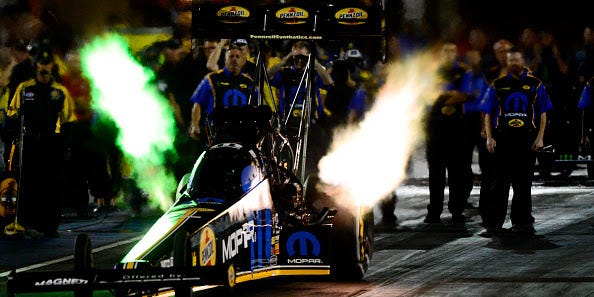
If you’ve ever wondered what “too much power” sounds like, congratulationsyou’ve already described a Top Fuel dragster.
These are the kings of straight-line chaos: a 500-cubic-inch, supercharged, fuel-injected Hemi-based V8 that can cover
1,000 feet in under four seconds while ripping past 330 mph. And the headline numberabout 11,000 horsepowersounds like
somebody fat-fingered a calculator… until you learn how the engines are built to survive exactly long enough to finish a pass.
The secret is that Top Fuel isn’t about “efficient.” It’s about “relentlessly effective” for a handful of heartbeats. That’s why
the engineering playbook looks nothing like street performanceand why everything from the fuel to the spark system is designed
to shove unbelievable amounts of energy through the cylinders, right now, consequences later.
The 11,000 HP Question: Is It Real, and How Do You Measure It?
Measuring horsepower in Top Fuel is tricky because the engine is basically a controlled detonation that’s only meant to live at full
violence for seconds. Traditional dyno testing at maximum output is notoriously difficult, and teams historically relied on performance
data (like acceleration) to estimate power.
That said, modern instrumentation has helped turn “educated guess” into “credible number.” In late-2015 testing, a torque sensor
approach (paired with RPM) produced a peak reading over 11,000 horsepowerspecifically 11,051 hp in one widely reported test.
That doesn’t mean every run is a constant 11,051. It means the combination of fuel, air, ignition, and clutch management can
produce a peak in that neighborhood when everything lines up and the tires hold on for dear life.
Also worth remembering: “horsepower” in Top Fuel is less like a steady stream and more like a tidal wave. The engine’s output is
ramped, managed, and (sometimes) rescued in real time by the tune-up and clutch strategy. Peak power may happen mid-run,
while other moments are spent fighting traction, cylinder-to-cylinder consistency, or the kind of heat that makes metal question
its life choices.
The Big Three That Make Big Power: Fuel, Air, and Spark
One of the cleanest ways to understand Top Fuel horsepower is to break it into the three pillars of internal combustion: fuel,
air, and spark. Top Fuel doesn’t just optimize each pillarit turns the knobs until they squeak, then turns them some more.
1) Fuel: Nitromethane Is the Main Character
Top Fuel runs on a nitromethane-based blend (with methanol as part of the mix under rules), and nitromethane is the reason
a 500ci engine can behave like it’s trying to power a small city block.
Here’s the key advantage: nitromethane carries oxygen in its chemical makeup. That meanscompared with gasolineyou can burn
far more fuel for a given amount of incoming air. More fuel burned (in the right conditions) equals more heat release, more cylinder
pressure, and more power. It’s also why these engines drink fuel at a rate that seems like a prank:
a Top Fuel dragster can burn up to around 15 gallons during a single run.
Nitromethane also helps with cooling because of how it absorbs heat as it vaporizes. In a sport where “cooling system” is basically
“we’re going to dump enough fuel in there to chill the party,” that matters. Teams aren’t trying to sip fuelthey’re trying to feed the
beast without detonating it into shrapnel.
2) Air: The 14-71 Roots Blower Is a Giant Air Shovel
Nitromethane is powerful, but it still needs air. Enter the iconic supercharger: a large Roots-style 14-71 “huffer” perched on top
of the engine like a chrome lunchbox full of bad decisions.
Boost pressures commonly land in the “tens of PSI” rangebut Top Fuel lives in the “hold my helmet” range. Figures in the
45–50 psi neighborhood are often cited for these setups, and in some configurations the blower can push around 60 psi of boost.
That’s multiple atmospheres of pressure crammed into the intake so the engine can inhale aggressively enough to match the fuel
being dumped in.
The blower’s airflow numbers are similarly wild. In one breakdown of a modern Top Fuel supercharger, rotor speeds in the
neighborhood of 12,000 rpm and airflow on the order of thousands of cubic feet per minute (cfm) were discussednumbers that
start to make sense only if you stop thinking “car engine” and start thinking “industrial air pump that happens to race.”
And yes: turning that supercharger takes power. A meaningful chunk of engine output is used just to drive the blower.
Top Fuel is one of the few places where “parasitic loss” sounds adorablelike calling a tornado a “breezy moment.”
3) Spark: Lighting the Party Takes Welding-Level Energy
Now for the underrated hero: ignition. It’s not enough to have fuel and air; you have to light it, reliably, under absurd cylinder
pressuresand keep lighting it even as the environment gets hotter, wetter (with fuel), and angrier.
Top Fuel engines use two spark plugs per cylinder (16 total) and extreme magneto-based ignition. In one technical overview,
the required magneto setup was described as producing about 44 amps of primary currentcomparable to a small arc welder
and the engine can burn through all 16 spark plugs in a single run. That’s not “maintenance”; that’s “spark plug speed-dating.”
Why does the ignition need to be so intense? Cylinder pressure. With the supercharger packing in air and the fuel system hosing in
nitromethane, pressures can soar to levels far beyond typical racing engines. The spark’s job is to create a reliable flame kernel
in a storm of pressure and fuel dropletsand if the spark can’t do it, the engine can “drop a cylinder,” pour raw fuel, and quickly
turn “race day” into “fire drill.”
The Engine: A 500ci Hemi, But Basically From Another Planet
Rules cap displacement at 500 cubic inches, and the architecture traces back to Chrysler’s Hemi conceptbut Top Fuel engines are
purpose-built from specialized parts. They’re billet-aluminum works of art designed to handle brutal loads for a short distance.
Compression ratios are typically lower than many gasoline performance engines, in part because nitromethane behaves differently
and because the combo relies on boost and fuel mass flow to create power. Cooling is also handled in unconventional ways:
there’s no “radiator cruise” here. The engine is cooled largely through oil management and the fuel/air chargeanother reason the
fuel system plays double duty as both “power adder” and “thermal survival kit.”
Fuel Delivery: The Fire Hose Behind the Horsepower
If nitromethane is the main character, the fuel system is the special effects budget. You can’t make five-digit horsepower with a
polite little injector pulse. Top Fuel uses constant-flow mechanical injection and a web of nozzles that feed fuel into multiple
locations to keep distribution as even as possible under boost.
In one modern team example, a Top Fuel pump was cited at roughly 92 gallons per minute, and multiple nozzles per cylinder head
work alongside additional nozzles upstream. The point isn’t just “more fuel”it’s “the right fuel, in the right places, at the right time,”
so each cylinder contributes without detonating or going dead.
This is also why “fuel flow advancements” get talked about like they’re secret rocket tech. The engine’s ability to ingest more
nitromethanewhile keeping it lithas been a major factor in the march toward quicker 1,000-foot times and higher speeds.
Parts Longevity: Built Strong, Used Briefly
Top Fuel power comes at a price: parts are consumed like they’re on a punch card (“Break 10 pistons, get one free!”).
Even with constant improvements in blocks, heads, rods, and oil blends, components live on strict schedules.
In one team-level snapshot, crankshafts might survive around a dozen runs in a best-case scenario, while pistons and connecting rods
may be replaced every handful of runs, and bearings can be treated as essentially one-run items. That’s not because the parts are bad.
It’s because the forces are ridiculous.
The goal isn’t to build an engine that lasts 100,000 miles. The goal is to build an engine that makes maximum power for 1,000 feet,
doesn’t grenade, and can be rebuilt for the next round. Top Fuel is the rare motorsport where “reliability” means “it made it to the turnoff.”
The Clutch Is Where the Magic Happens
Here’s a spicy truth: the engine can make all the horsepower it wants, but if you apply it wrong, you’ll just turn the rear tires into
expensive smoke machines.
That’s why Top Fuel tune-ups are inseparable from clutch strategy. Modern teams use timers and controlled clutch application to
manage how quickly the drivetrain “loads” the engine and hooks the tire. A well-executed run is a choreographed transfer of power:
the driver hits the throttle, systems shift from idle fuel to high-flow “run” fuel, and the clutch management determines whether that power
becomes accelerationor a physics lecture about traction limits.
Get it right and you’re seeing those sub-3.7-second, 330+ mph performances. Get it wrong and you might be watching tire shake,
a dropped cylinder, or a catastrophic failure. In Top Fuel, “close enough” is how you end up on a highlight reel for the wrong reason.
Why the Race Is 1,000 Feet (Not the Traditional Quarter-Mile)
If you grew up hearing “a quarter-mile at a time,” you’re not wrongdrag racing’s classic distance is 1,320 feet. But Top Fuel and Funny Car
competition moved to 1,000 feet beginning in 2008 as a safety measure, increasing shutdown room at the end of the strip.
The change didn’t make the cars “less extreme.” It just acknowledged that when you’re doing 330+ mph in under four seconds, you need every
possible advantage to slow down safely after the finish. In other words: the race is already over before your brain has finished yelling,
“THIS IS A TERRIBLE IDEA AND I LOVE IT.”
So… How Do They Reach 11,000 HP? The Short Version
- Nitromethane fuel allows dramatically more fuel mass to burn, thanks to its oxygen content.
- A huge Roots supercharger force-feeds air at extreme boost so the engine can match the fuel.
- Brute-force ignition (magnetos, two plugs per cylinder) keeps combustion happening under insane pressure.
- Constant-flow fuel injection delivers an almost unbelievable volume of fuel, distributed across many nozzles.
- Purpose-built components survive the violence for secondsthen get inspected and replaced on tight schedules.
- Clutch and power management translate horsepower into forward motion instead of tire smoke.
Experiences at the Track: What 11,000 Horsepower Feels Like (and Why You Never Forget It)
Even if you’re not a “car person,” Top Fuel has a way of converting skeptics in about half a second. The experience starts before the run:
you’ll see crews moving with a calm urgency, like people who have done this a thousand times but still respect the fact that the machine
they’re working on could rearrange the laws of nature if it’s annoyed. The engine idles with a choppy, angry rhythmless “vroom” and more
“industrial earthquake.” You can feel it in your chest, like someone turned your ribcage into a subwoofer.
Then comes the burnout. The rear tires haze the air with a thick cloud that smells like rubber and ambition. The car looks impossibly long,
and yet it squats like it’s about to pounce. When the driver backs up and lines up, everything gets oddly quiet in the crowdnot silent, but
focused. People who were chatting a second ago suddenly remember they have eyeballs and want to use them.
The launch is the part your brain struggles to store correctly. The car doesn’t “take off.” It teleports forward in violent increments.
Your eyes try to track it, but the dragster is already somewhere else, and your senses are lagging like bad Wi-Fi. The sound hits next:
a sharp, ripping thunder that makes you understand why fans bring ear protection and still grin like kids at a fireworks show. The exhaust
flames flicker, the ground seems to vibrate, and the air itself feels thickeras if the engine just grabbed a handful of atmosphere and
wrung it out.
And that’s the wild part: the pass is over almost immediately. You’re left with a short afterimage of speed, the smell of nitro and hot metal,
and the sudden awareness that your heart is beating faster than it needs to. Around you, people laugh, shout, or just shake their heads like
they’ve witnessed something that shouldn’t exist outside a video game.
If you wander into the pits afterward, you’ll see the other side of the spectacle: meticulous work. Engines get torn down and checked.
Components get measured and swapped. It’s less “mad scientist” and more “surgical team,” except the patient is a supercharged nitro V8
that only has to live for 1,000 feet at a time. You start to appreciate that the 11,000 horsepower story isn’t just about a big numberit’s
about repeatability under brutal conditions, round after round. The racers aren’t just chasing speed; they’re chasing consistency in a world
where tiny changes in traction, weather, or tune can turn a hero run into a tire-spinning disappointment.
By the end of the day, you’ll probably notice something funny: you keep replaying the launch in your head, trying to “understand” it.
But Top Fuel isn’t fully understandable in a normal way. It’s a sensory experience first and an engineering lesson second. And that’s why,
whether you come for the horsepower or the spectacle, you leave with the same thought: “Okay… I get it now.”
Conclusion
Top Fuel dragsters reach around 11,000 horsepower by turning the fundamentals of combustion into an extreme sport:
nitromethane fuel (oxygen-rich and cooling), massive supercharged airflow, and ignition powerful enough to light a storm.
Add constant-flow fuel delivery, short-life-but-strong parts, and clutch strategy that meters power into the track, and you get
the fastest accelerating piston-engine race cars on Earth. It’s engineering on the edgebuilt to survive for seconds, rebuilt
for the next round, and unforgettable every single time they light the pipes.