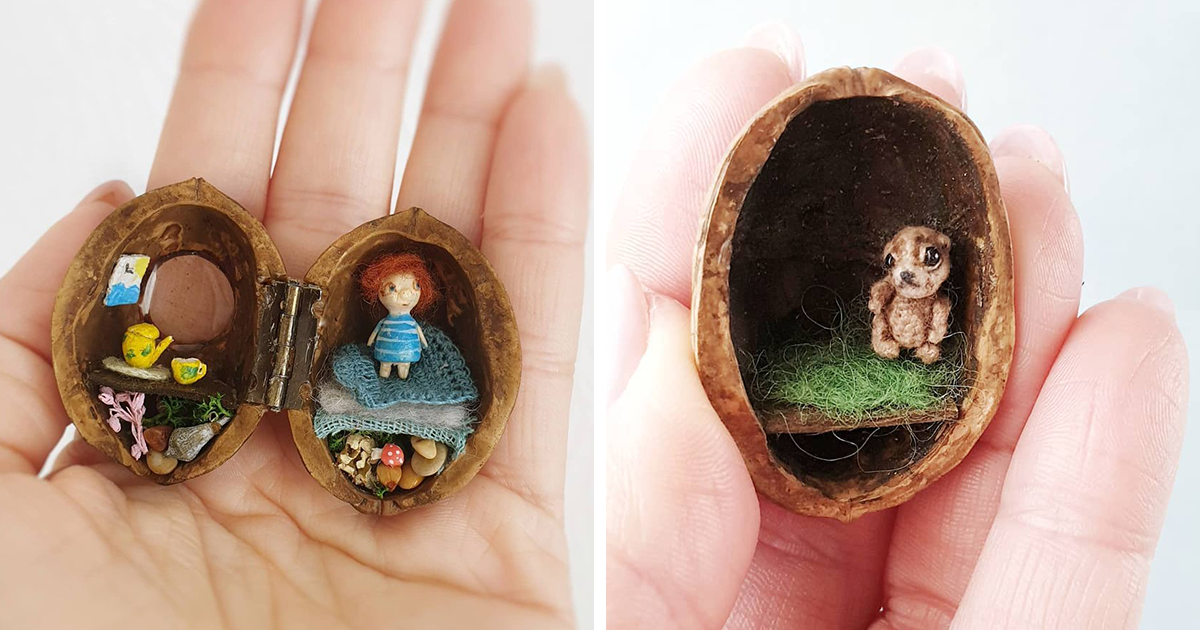
Imagine opening a walnut and, instead of finding a snack, discovering a fully furnished fairy cottage with books on the shelf, a glowing window, and a bed waiting for a very small, very tired traveler. That’s the magic of miniature fairy houses made from walnut shells – tiny worlds you can balance on your fingertip.
This whimsical trend was popularized online by a Russian miniature artist who creates an entire village of fairy homes inside real walnut shells, showcased in a 19-photo series that quickly captured global attention. These tiny houses sit right at the intersection of art, craft, storytelling, and pure childhood wonder, and they’ve inspired crafters, collectors, and dreamers around the world.
In this article, we’ll wander through these walnut-shell fairy houses, explore how they’re made, look at why miniatures fascinate us so much, and finish with practical tips and personal experiences so you can start crafting your own “world in a nutshell.”
Meet the Russian Artist Behind the Walnut Worlds
The viral fairy houses you may have seen on Bored Panda are the work of Russian artist Kristina Loginova, a miniature art “maniac” (her words, not mine) who fills walnut shells with impossibly detailed interiors – tiny beds, books, fireplaces, and even little staircases curling up the shell’s curve. Her 19-photo series of walnut houses shows the level of dedication it takes to make something you could accidentally vacuum up in two seconds flat.
Although her work looks like something straight out of an illustrated fairy tale, it’s also rooted in the rich tradition of miniature art. From dollhouse rooms to tiny dioramas, artisans have long used small scale to invite viewers into a more intimate, story-driven world. By choosing walnut shells instead of conventional dollhouse rooms, Kristina adds a natural, organic frame that makes each piece feel like a secret you just cracked open.
The 19 images of her walnut houses are all different, yet they belong to the same imaginary village. One may look like a woodland cottage lined with moss and mushrooms; another might be a tiny library with a reading nook carved into the shell. The artist uses polymer clay, fabric scraps, moss, and paint to build each micro-scene, layering details until the shell feels like a complete home for a resident who’s just stepped out for a moment.
Why Walnut Shells Make Perfect Fairy Houses
So why walnuts? Of all the things you could use for a tiny fairy house, a walnut shell may not be the first material that comes to mind – until you try holding one side by side with a small bead or tiny figure. Suddenly it makes perfect sense.
1. The natural shape is already house-like.
A split walnut shell forms a ready-made “room” – curved walls, a defined floor, and a snug, enclosed feeling. You don’t have to build a structure; you just decorate it. Nature basically does the construction, you handle the interior design.
2. The texture adds built-in character.
The irregular interior of a walnut shell is full of interesting ridges and curves. Instead of fighting them, artists turn those shapes into shelves, arches, lofts, and niches. A tiny ledge becomes a window seat; a deeper pocket transforms into a sleeping nook.
3. They are small, sturdy, and easy to display.
Walnut shells are hard, durable, and light. You can hang them as ornaments, turn them into necklaces or keychains, or simply line them up on a windowsill as a fairy neighborhood. Crafters on marketplaces like Etsy and similar platforms often sell walnut-shell houses as collectible miniatures and gifts precisely because they’re portable and surprisingly tough for something so delicate-looking.
4. They’re eco-friendly and upcycled.
The base material is literally a leftover from snack time. Many fairy house tutorials emphasize using natural or recycled materials – twigs, moss, leaves, bark, acorns, and, of course, nutshells. Turning something that would usually be thrown away into a piece of art fits perfectly with modern eco-conscious crafting and the “slow living,” handmade aesthetic.
How a Tiny Fairy House Is Born Inside a Walnut Shell
Every artist has their own process, but if you look across walnut-shell tutorials, miniature blogs, and fairy-garden guides, a clear pattern appears. Let’s walk through a typical build, step by step.
1. Preparing the Walnut Shell
The first challenge is getting a clean, unbroken shell. Instead of smashing walnuts with wild abandon (fun, but unhelpful), artists score or tap the shell carefully around its natural seam. A small craft knife, nutcracker, or gentle tapping with the back of a spoon can separate the halves with minimal damage.
Once the walnut is open, the nut meat is removed (eat it now or save for baking – fairy art is hungry work). The inside of the shell is cleaned and sometimes lightly sanded. Some artists seal the interior with clear varnish or matte medium to protect it and give glue a stable surface to grip.
2. Building the Floor and Background
Next comes the “architecture.” Many walnut-shell artists start by creating a floor and back wall. That might mean:
- Adding a thin layer of moss on the bottom to mimic grass or carpet.
- Cutting a tiny circle of wood veneer, cardboard, or polymer clay as a hardwood floor or stone tiles.
- Painting the back interior surface like a wall with a soft gradient or sky effect.
- Gluing in a printed paper wallpaper for a cozy cottage feel.
On some walnut houses, the shell’s natural curves are left visible as “plaster walls,” while others get covered with layers of paint and texture to create brick, stone, or wood paneling.
3. Adding Micro-Furniture and Decor
This is where the real magic happens. Miniature artists use every trick in the tiny-toolbox:
- Beds and chairs: Built from slivers of wood, toothpicks, wire, or air-dry clay, topped with fabric scraps for blankets and cushions.
- Books and scrolls: Made from narrow strips of paper, rolled or folded, then painted to look like leather-bound volumes.
- Fireplaces: Sculpted from clay or built from tiny stones, often with a painted “fire” and a gloss medium or resin “glow.”
- Plants and mushrooms: Tiny tufts of moss, dried flowers, or clay mushrooms tucked into corners for a forest feel.
- Lighting: Some advanced makers add LEDs, fiber optics, or glow-in-the-dark paint to create the illusion of light spilling from windows.
The goal is to make the shell feel like it belongs to a specific character – a bookish forest elf, a traveling wizard, a woodland witch, or a tiny child who lives inside a tree.
4. Designing the Exterior
While the interior gets most of the attention, the outside of the walnut shell is just as important for storytelling:
- Roofs made from moss, bark, or clay tiles.
- Windows cut into the shell or painted on, sometimes with little shutters.
- Doors sculpted from clay or carved from thin wood and glued onto the shell surface.
- Hanging loops for ornaments or necklaces.
Once the outside is decorated, the two halves of the shell may be glued back together around the interior scene, leaving an open front or a hinged closure that can be opened like a locket.
19 Pictures, 19 Tiny Stories
In the original Bored Panda feature, each of the 19 photos focuses on one walnut-shell house, shot in soft, natural light. Even without a written story, you can feel the narrative in each piece:
- A tiny house with a bookshelf and ladder suggests a solitary scholar living in the woods.
- A shell with mushrooms and moss all around it feels like a cottage that sprouted from the forest floor.
- A house with warm yellow “light” at the window creates the impression that someone is home, just out of sight.
This combination of photographic storytelling and sculptural craft is part of why the series went viral. It’s not just “look what I made”; it’s “here’s a world you can step into – if you were only a few centimeters tall.”
Why Miniature Fairy Houses Captivate Us
Our obsession with tiny things isn’t new. Museums in the United States, for example, have long exhibited ultra-detailed miniature rooms and “nutshell” dioramas – even used as forensic training tools in the mid-20th century. The appeal is always the same: miniatures invite us to slow down, stare, and notice details we’d ignore at normal scale.
Miniature fairy houses in walnut shells tap into a few powerful psychological buttons:
- Nostalgia: They remind us of childhood dollhouses, fairy tales, and the feeling that something magical might live inside the walls.
- Control and order: In a chaotic world, a tiny, complete environment feels safe and understandable. Everything is in its place.
- Surprise and delight: There’s a shock factor when you realize how small the scene actually is. Your brain goes, “There’s no way that bed has tiny pillows,” and then… it does.
- Story in a single glance: Miniatures are like visual haiku. You get a setting, mood, and character suggestion in one compact, layered image.
The Russian walnut houses also bring in a touch of folklore. They look like they belong in Slavic fairy tales: tucked into roots, hidden in winter forests, or carried in a traveler’s pocket as a portable home.
How to Start Making Your Own Walnut Fairy Houses
You don’t need to be a professional miniature artist to start. You just need patience, good light, and the willingness to chase tiny beads across the floor when they escape.
Basic Tools and Materials
Here’s a simple starter list:
- Whole walnuts (in shells), as uncracked and smooth as possible.
- Strong craft glue or gel superglue.
- Fine-tipped tweezers (your new best friends).
- A craft knife or small saw to open the shells carefully.
- Polymer clay or air-dry clay for furniture and decor.
- Tiny scraps of fabric, lace, ribbon, and paper.
- Moss, dried flowers, and other natural elements for the fairy-garden feel.
- Optional: miniature LED lights or glow-in-the-dark paint.
Start with a Simple Scene
For your first walnut, think small (yes, even smaller than “walnut small”). Instead of planning a full living room, try just:
- A bed with a blanket and pillow in a moss-lined room.
- A reading nook with a chair, a stack of books, and a teeny rug.
- A tiny “forest shrine” with candles, stones, and flowers.
Once you get a feel for scale and glue control, you can move on to multi-element scenes with stairs, multiple levels, and exterior details.
Safety and Sanity Tips
A few practical notes from the miniature world:
- Work over a tray: Tiny parts love to escape. A shallow tray or box lid keeps them from rolling off your table and into another dimension.
- Take breaks: Your eyes and neck will thank you. Miniatures demand intense focus and good lighting.
- Test glues: Some glues fog clear surfaces or don’t hold well on varnished shell interiors. Experiment on a spare shell first.
- Keep scale consistent: If the chair is the size of the bed, but the books are the size of the chair, things feel “off.” Try to imagine an invisible fairy standing inside your shell – would the sizes make sense?
Experiences from the Walnut Workshop (Extra Insights)
Now let’s get more personal and talk about what it’s really like to live with this kind of art – hours hunched over tiny shells, bits of clay under your fingernails, and moss quietly taking over your workspace.
The first thing you learn when making walnut fairy houses is humility. Walnuts crack the way they want to crack. On a good day, they split neatly along the seam, giving you two perfect halves. On a bad day, one side explodes dramatically, your “future fairy cottage” looks like a demolition site, and you mutter something polite-ish while sweeping it into the “texture experiments” box.
The second lesson is about patience. Most people underestimate how long it takes to create a single micro scene. You might spend an entire evening sculpting a bed that’s less than an inch long. By the time you’re happy with the headboard, you realize you still have to sew a miniature pillowcase and figure out how to glue it in without leaving giant glue blobs that look like alien slime. It’s slow, repetitive work – but the moment the room finally comes together, it’s incredibly satisfying.
Then there’s the emotional attachment. When you spend hours building a tiny world, it starts to feel like a character in your life. You remember which house has the mushroom lamp, which one belongs to the “bookish fairy,” and which one was an experiment with winter colors that turned out far cozier than expected. If you sell your walnut houses or gift them to others, every piece that leaves the studio takes a little story with it.
Reactions from people seeing the walnut houses for the first time are almost always the same: they lean in, squint, and then their face does the “miniature surprise.” They laugh, point, and start noticing details. Kids, in particular, immediately start inventing elaborate backstories: which fairy lives where, who visits whom, and what happens when the village goes to sleep. Adults often go quiet for a minute – there’s a nostalgic, almost meditative quality in looking at something so small and complete.
On the practical side, shipping and displaying walnut fairy houses is its own adventure. If you’ve ever mailed a delicate ornament across the country, you know the stress. Each walnut house needs a protective “cocoon” – layers of tissue, bubble wrap, and sometimes its own little box – so it arrives intact. Some artists create custom stands or domes to keep dust (and curious cats) away. Others hang them on seasonal branches, turning a simple twig arrangement into a glowing fairy neighborhood.
There are also funny little mishaps that only miniature artists talk about. Like the time a stray cat hair became the perfect broom for a fairy house. Or when a speck of glitter landed on a windowsill and suddenly turned into an intentional “crystal.” Or the day you realize half your “scrap” bin is actually full of treasure – because in miniature lands, the corner of a candy wrapper can become stained glass, and the frayed edge of a ribbon turns into a shaggy rug.
Over time, working at this scale changes how you see ordinary objects. Walnuts stop being just food; they’re potential real estate. Twigs are building beams, moss is carpet, and every piece of packaging gets inspected for “mini potential” before it hits the recycling bin. It’s as if your brain installs a permanent fairy-house filter over the world.
Perhaps that’s the biggest gift of these walnut-shell houses: they train you to see magic in small, overlooked things. A broken shell becomes a doorway, a scrap becomes a curtain, and a 19-photo series of tiny homes becomes a worldwide invitation to imagine life at one-inch scale. Whether you’re an artist, a collector, or just someone who needs a bit more wonder in your day, miniature fairy houses from walnut shells are a reminder that even the smallest spaces can hold entire stories.
Conclusion: A Whole Fairy Village in the Palm of Your Hand
The Russian artist’s walnut fairy houses show what happens when patience, imagination, and natural materials collide. Each shell becomes a self-contained universe, captured in just a handful of photographs but remembered long after the browser tab closes.
If you’re drawn to these tiny worlds, don’t just scroll past them. Try cracking open your own walnut, gather a few scraps of moss and fabric, and see what kind of story you can build in a space smaller than a tablespoon. You might discover, like so many miniature artists before you, that shrinking the world down is sometimes the easiest way to make your creativity feel limitless.