Some people keep a dream journal. I apparently keep a digital crime scene.
That is the easiest way to explain this strange little ritual: I wake up from a nightmare, stare at the ceiling like a confused possum, and then, instead of forgetting it over coffee, I open Photoshop and rebuild the whole unsettling thing layer by layer. Healthy? Debatable. Artistically useful? Weirdly, yes.
There is something oddly powerful about turning a nightmare into an image you can zoom in on, crop, color-grade, and boss around with a layer mask. In sleep, fear runs the show. On a canvas, fear has to wait while you decide whether the shadows need more contrast. That shift matters. It takes the chaos of a bad dream and turns it into story, mood, composition, and meaning.
That is what this series is about. These seven Photoshop pieces are inspired by the kind of nightmares that stick around long after the alarm goes off: the ones with impossible architecture, faceless strangers, endless hallways, giant eyes, missing voices, and the creeping feeling that something is wrong even when everything looks almost normal. Nightmare art is not just about gore or jump scares. The best unsettling images work because they distort ordinary things just enough to make your brain yell, “Absolutely not.”
And Photoshop is perfect for that job. Surreal photo manipulation thrives on contradiction. You can make a bedroom float in the sky, give a hallway no exit, stretch perspective until it feels wrong, or light a face like it belongs to a person who has not blinked since 2007. Layers, masks, blend modes, texture overlays, and color grading let you build scenes that feel familiar at first glance and deeply cursed at second glance. It is interior design for the unconscious mind.
Why Nightmares Make Such Good Art
Nightmares are messy, emotional, and packed with symbols. They do not care about logic, and honestly, that is a gift for visual storytelling. A nightmare can place a childhood home at the bottom of the ocean, put a stranger in your kitchen, and convince you that the lamp in the corner is somehow judging your life choices. In waking reality, that sounds ridiculous. In art, that is atmosphere.
The most effective dream-inspired digital art borrows from the language of surrealism: normal objects in abnormal relationships, realistic detail applied to impossible scenes, and a mood that says, “You are safe, but also maybe do not turn around.” That combination is what gives nightmare photography and surreal Photoshop composites their bite. They are believable enough to feel real, but wrong enough to bother you long after you scroll past them.
There is another reason this works: nightmares are deeply personal, but the emotions inside them are universal. Fear of being watched. Fear of losing control. Fear of not being able to speak, run, or wake up. When an image captures one of those feelings, viewers do not need the exact backstory. They recognize the emotion immediately. That is what makes dream-inspired horror art so sticky. It is less about literal monsters and more about emotional accuracy.
The 7 Nightmare Photos I Recreated in Photoshop
Pic 1: The Hallway That Would Not End
This piece started with a simple corridor and ended with a visual panic attack. In the original nightmare, I kept running toward a door that never got closer. Every time I thought I had made progress, the hallway stretched again like it had a personal grudge.
To recreate that feeling, I built the image around forced perspective. Repeating wall lights, identical door frames, and a gradually narrowing floor pattern made the space feel infinite without turning it into fantasy nonsense. Then I darkened the far end just enough to make the eye search for an exit that was never really there. The trick was restraint. Too much distortion and the image turns cartoonish. Too little and it just looks like a hotel with bad carpet.
What makes this nightmare effective is not the hallway itself. It is the emotional math: effort plus no progress equals dread. That formula shows up in a lot of nightmare art, and it is devastating because it feels familiar even outside sleep. We have all had a day that looked suspiciously like this hallway.
Pic 2: The Figure Standing in the Doorway
Ah yes, the classic “someone is definitely in the room and I hate that for me” nightmare. The figure in this image is little more than a silhouette, but that is exactly the point. Detail can reduce fear. Ambiguity lets the viewer finish the image with their own imagination, and the imagination is often a dramatic little menace.
In Photoshop, this scene depended on contrast and placement. The room itself stayed soft and realistic: rumpled sheets, a dim lamp, familiar furniture. Then the doorway became the anchor of the entire composition. I kept the figure tall, still, and centered enough to feel intentional, but not so sharp that it looked like cosplay. A touch of grain helped unify the scene and made the darkness feel less digital and more lived-in.
This image works because it turns one of the most ordinary parts of a home into a threat. Doorways are supposed to connect spaces. In nightmares, they become announcements.
Pic 3: The Room Full of Eyes
This one came from that uniquely exhausting dream logic where you somehow know you are being watched by everything at once. Not one person. Not one creature. Just an entire environment behaving like surveillance with wallpaper.
Visually, this was the most fun to build and the most annoying to look at, which means it succeeded. I composited oversized eyes into picture frames, ceiling cracks, folds in curtains, and the grain of the wooden floor. The key was to vary size and clarity so the viewer notices them in stages. First one. Then three. Then, unfortunately, all of them.
Nightmare visuals often become stronger when the horror is cumulative instead of immediate. A giant monster is obvious. A normal room that slowly reveals itself to be observant is much more intimate and much ruder.
Pic 4: Drowning in a House That Should Be Dry
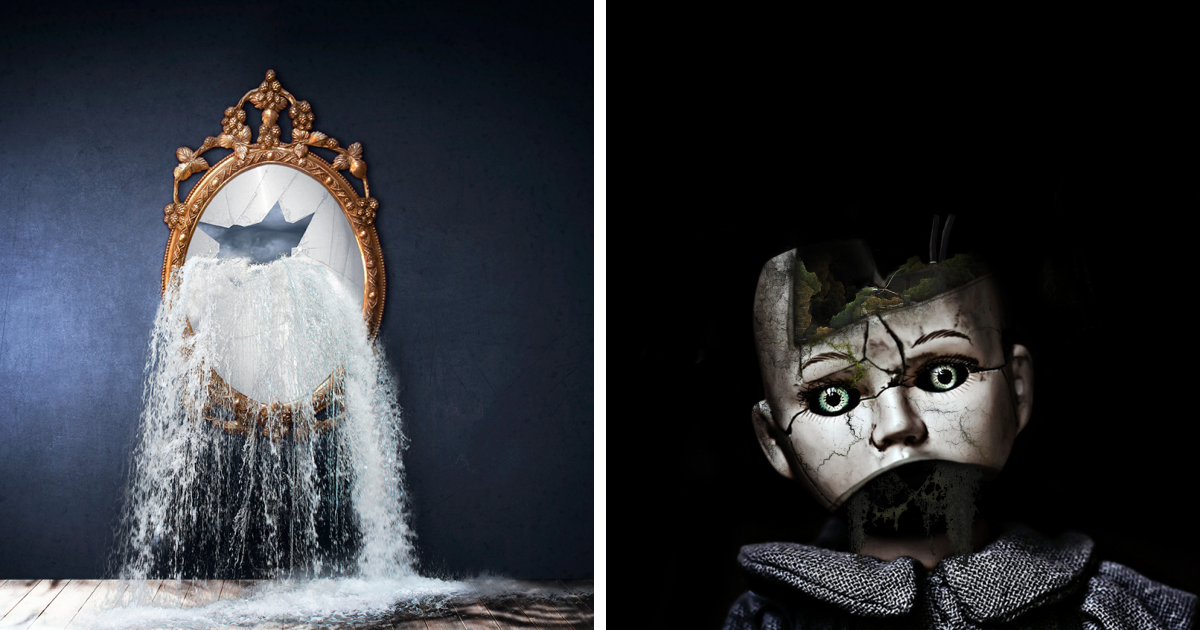
Water in nightmares has range. Sometimes it is cinematic and symbolic. Sometimes it is just your subconscious saying, “Good luck breathing, champ.” In this image, I wanted the eerie quiet of a flood happening indoors, where the furniture still sits politely while everything else has gone terribly wrong.
I built this scene by blending a domestic interior with underwater texture, suspended particles, floating objects, and softened light rays. The hardest part was keeping the water believable while preserving the stillness of the room. If the edit looks too action-heavy, it becomes disaster art. If it stays too clean, it loses the suffocating tension that makes the nightmare effective.
This piece is less about chaos than inevitability. The room is not exploding. It is surrendering. That slow, silent kind of fear is often more unsettling than obvious violence.
Pic 5: No Mouth, No Sound
Everybody seems to have some version of the “I tried to scream and nothing came out” nightmare. It is one of those dream experiences that bypasses logic and goes straight for helplessness. So naturally, I turned it into portrait art because apparently I enjoy emotional damage with a clean edit.
The final image shows a face that looks almost normal until you notice the mouth has been blended away into skin texture, light, and shadow. Not in a gore-heavy way. More in a “your brain takes a second to register what is missing, and then files a complaint” kind of way.
For a surreal portrait like this, subtle retouching matters more than shock. Smooth transitions, believable skin tones, and careful shadow placement keep the image uncanny instead of silly. If you can make viewers lean in before they recoil, you have nailed it.
Pic 6: The Staircase That Climbed Into Nowhere
Some nightmares do not chase you. They just assign you impossible architecture and expect results. This image came from a dream where stairs turned upward forever, with each landing leading to a darker, narrower set above it.
To create that structure, I stacked and transformed multiple staircase elements, matched the grain and lighting, and used atmospheric haze to suggest impossible depth. Color did a lot of the emotional work here: desaturated walls, cold highlights, and a muddy shadow palette that made the space feel airless. Nothing in the frame is attacking you. The building itself is the problem.
This is where Photoshop compositing shines. A dream does not need realism in the documentary sense. It needs internal consistency. If the light, perspective, and texture all agree, the brain will accept a staircase to nowhere for much longer than it probably should.
Pic 7: My Childhood Bedroom, But Wrong
This last image may be the most unsettling one in the set because it uses familiarity as the weapon. The room is based on a childhood bedroom: same layout, same window, same toy shelf, same cheap little lamp. But every object is off by a few degrees. The wallpaper pattern does not repeat correctly. The shadows lean the wrong direction. The stuffed animal on the bed has one eye too many. The window shows daylight, but the room is lit like midnight.
That is the sweet spot for nightmare art. Not pure fantasy. Not realism. Corrupted memory.
When viewers respond most strongly to these images, it is usually this one. Not because it is the loudest, but because it feels possible for a split second. And in horror, that split second is gold.
How Photoshop Turns Bad Dreams Into Good Visual Storytelling
If you are wondering why Photoshop works so well for nightmare-inspired digital art, the answer is control. Nightmares are emotional chaos. Photoshop is controlled chaos. You can isolate one object, alter one shadow, clone out one comfort, and build a whole emotional tone through tiny decisions.
Surreal photo manipulation is not only about adding bizarre elements. It is about making all the elements belong together. Lighting has to agree. Perspective has to make sense. Color grading has to support the mood. Texture has to unify the frame. A floating chair is not creepy because it floats. It is creepy because everything else in the room looks so convincingly real that the floating feels like a violation of the rules.
That is why the best nightmare recreations do not throw every horror trick at the screen. They use discipline. A limited palette. Repeated shapes. Selective detail. Negative space. A single focal point that pulls the eye exactly where the dread lives. In other words, the same visual storytelling principles that make any strong image work, just with more insomnia.
Why People Cannot Stop Looking at Nightmare Art
There is a reason viewers linger over unsettling images longer than they do over polished, pretty ones. Nightmare-inspired artwork creates tension between attraction and avoidance. You want to understand what you are seeing, but part of you also wants to close the tab and go look at puppies. That push and pull is powerful. It creates engagement without needing cheap tricks.
It also helps that nightmare art gives shape to feelings that are usually hard to explain. Anxiety rarely arrives with a neat little label. It arrives as pressure, distortion, repetition, and dread. A strong surreal Photoshop image can capture those sensations faster than a paragraph ever could. That is why dream-inspired visual art often feels intimate even when it is bizarre. It translates emotion into scenery.
And on the internet, where thousands of images compete for attention every minute, emotional specificity wins. A generic horror image may get a glance. A carefully built nightmare scene gets a pause. A pause is everything.
Final Thoughts
Recreating nightmares in Photoshop sounds like the kind of hobby a therapist would write down with great interest. But creatively, it makes perfect sense. Nightmares are already cinematic. They come with mood, symbolism, scale distortion, emotional urgency, and the occasional architectural crime. Photoshop simply gives those half-remembered fragments a body.
These seven images are not really about fear for fear’s sake. They are about translation. Taking something invisible, irrational, and deeply private, then turning it into something visual, shareable, and weirdly beautiful. The nightmare may start in sleep, but the image belongs to waking life. And that changes the relationship. Once you can edit the monster, it loses a little of its power.
Also, if I ever start recreating my tax paperwork as horror art, please check on me.
Extended Personal Experience: What It Actually Feels Like to Recreate Nightmares in Photoshop
The strangest part of this process is not building the image. It is remembering the nightmare accurately enough to build it at all. Dreams fall apart fast. You wake up with a feeling first, a few strong visuals second, and the logic of the thing already dissolving like it knows you are taking notes. So I learned to record fragments immediately: “wet ceiling,” “doorway person,” “hallway too long,” “room watching me.” Not elegant, but effective. My notes app looks like a haunted grocery list.
Once I sit down in Photoshop, the emotional memory becomes the map. I am rarely trying to recreate a nightmare frame for frame. I am trying to rebuild the sensation of it. Was it suffocating? Humiliating? Quiet? Fast? Did it feel like I was trapped, watched, or erased? Those questions matter more than literal accuracy, because nightmares are often emotionally precise even when they are visually absurd.
There is also a weird moment of resistance every time. Part of me does not want to reopen the image in my head. That makes sense. Nightmares are not exactly beloved family heirlooms. But once I begin isolating objects, matching shadows, and adjusting tones, the fear changes shape. It becomes a design problem. The looming figure is no longer an intruder from sleep. It is now a subject whose edge softness needs work. The impossible hallway is not an existential trap. It is a perspective challenge. That shift sounds silly, but it is real. Creative control can make disturbing material feel manageable.
And then there is the surprise factor. Sometimes the final piece ends up sadder than scary. Sometimes it feels almost funny in retrospect, like my subconscious hired a very dramatic production designer. Sometimes an image that seemed terrifying in the dream becomes visually flat until I remove half the effects and let the quiet details do the work. Nightmare art taught me that fear is often less about spectacle and more about implication. One wrong shadow can be more effective than a monster with a full special-effects budget.
The most rewarding part is hearing that other people recognize themselves in these images. Someone sees the endless staircase and says, “That is exactly what my anxiety feels like.” Someone sees the missing mouth portrait and says, “I have had that dream.” Suddenly the work is not just personal catharsis or late-night digital witchcraft. It becomes connection. Apparently, the human brain has a shared file labeled “absolutely not,” and many of us access it after midnight.
So yes, recreating nightmares in Photoshop is odd. It is also creative, oddly therapeutic, and visually rich in a way that clean, cheerful inspiration sometimes is not. Nightmares hand you raw emotion. Photoshop gives you the tools to shape it. Somewhere between those two things is the final image: unsettling, specific, and honest in a way only dream logic can be. I would still prefer eight uninterrupted hours of peaceful sleep, of course. But if my subconscious insists on screening avant-garde horror every night, I might as well get a decent art series out of it.