If you’ve ever watched the northern lights spill across places that absolutely did not order the northern lights, you’ve already seen the “pretty” side of space weather. The less photogenic side? Power grid stress, GPS errors, satellite drag, radio blackouts, and a lot of very serious people suddenly talking very fast in control rooms.
The good news is that solar storm forecasting is getting smarter. A new wave of research, including fresh work from NSF NCAR and Southwest Research Institute, suggests scientists may be able to push warning times farther outpotentially from hours to weeks for certain high-risk conditions. That doesn’t mean we’ll get a perfect “solar hurricane forecast” next week. It does mean the science is moving in a direction that could help utilities, airlines, satellite operators, and emergency planners prepare earlier and better.
In plain English: we may be getting better at spotting the Sun’s bad moods before they become Earth’s bad day.
Why Solar Storm Warnings Matter More Than Ever
Modern life runs on systems that are surprisingly sensitive to space weather. GPS timing helps synchronize telecom networks and parts of the power grid. Aviation depends on navigation and communications that can degrade during solar events. Satellites can experience charging, signal disruptions, and orbital drag. Even pipelines and long transmission lines can be affected by geomagnetically induced currents.
That’s why the phrase catastrophic solar storm gets so much attention. Scientists and forecasters use more precise languagelike G1 through G5 geomagnetic storm levelsbut the concern is real: an extreme event can produce widespread operational disruption, especially in a highly connected, highly electrified society.
And no, this is not science fiction. It’s applied physics with a side of anxiety.
What a Solar Storm Actually Is (Without the Jargon Avalanche)
The Sun produces several kinds of activity that can affect Earth:
Solar Flares
These are bursts of electromagnetic radiation. They can trigger radio blackouts quicklyespecially on the sunlit side of Earthbecause X-rays reach us in about 8 minutes (the speed of light is undefeated).
Coronal Mass Ejections (CMEs)
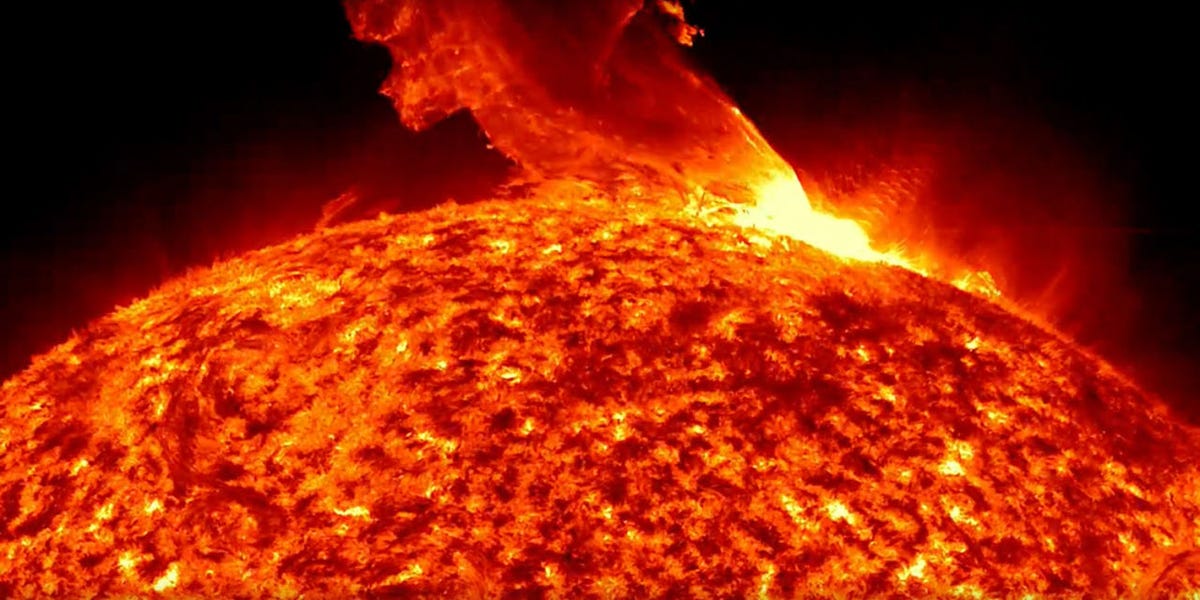
These are giant eruptions of magnetized plasma launched from the Sun. When Earth-directed, CMEs can take roughly 1–3 days to arrive, though the fastest extreme events can move much faster. If the magnetic field orientation is just wrong for us (especially southward relative to Earth’s field), the CME can dump energy into Earth’s magnetosphere efficiently and drive a geomagnetic storm.
Solar Energetic Particles
These high-energy particles can create radiation hazards for astronauts, satellites, and high-latitude aviation routes.
NOAA’s Space Weather Prediction Center (SWPC) communicates impacts using scales for geomagnetic storms (G), radiation storms (S), and radio blackouts (R). That system matters because it translates “plasma physics” into “what might break, what might slow down, and what needs a backup plan.”
What’s New: Data + Physics + AI Could Stretch Warning Time
The most exciting recent development is not a single telescope image or one flashy algorithm. It’s the combination of global solar observations, physics-based modeling, and AI tools.
In February 2026, researchers from NSF NCAR and Southwest Research Institute announced a first-step forecasting tool called PINNBARDS (yes, scientists are also surprisingly good at acronyms). The key idea is powerful: instead of waiting for small, last-minute magnetic signatures that only become predictive hours before an eruption, the system tries to connect surface observations of solar active regions to deeper magnetic dynamics inside the Sun.
Why that matters: if scientists can better identify where large, flare-producing active regions are likely to emergeand how they evolvethey may gain more lead time before major space weather events happen. The research team described this as a path toward forecasts weeks in advance, rather than just hours in advance.
That is a big shift in practical terms. “A few extra hours” helps operations teams react. “A few extra days or weeks” helps organizations plan, schedule, stage equipment, reduce exposure windows, and coordinate across sectors.
This Idea Didn’t Come Out of Nowhere
If the 2026 tool feels like a sudden breakthrough, it’s actually part of a longer scientific story. Back in 2017, NASA highlighted research on Rossby waves on the Sunlarge-scale wave patterns (similar in concept to planetary-scale atmospheric waves on Earth) that may help explain and eventually predict solar activity patterns over longer timeframes.
That work was especially notable because researchers used multi-spacecraft observations to get a fuller view of the Sun. NASA’s STEREO mission, together with Solar Dynamics Observatory (SDO), helped scientists observe features across the entire Sun for extended periods. In other words, they weren’t trying to forecast solar storms while peeking through a keyhole.
The newer AI-enabled tools build on that same principle: better forecasts begin with better global context. You need to understand the Sun’s large-scale magnetic choreography, not just the dramatic solo at the end.
Where Current Warnings Work Welland Where They Still Struggle
Today’s space weather warnings are already useful. NOAA SWPC issues watches, warnings, and alerts with different lead times depending on the hazard. In general, watches can provide notice from hours to days when risk is elevated, while warnings focus on imminent or likely events with shorter lead times.
That system helps operators make real decisions. Airlines can prepare for communication or navigation disruptions. Satellite teams can adjust operations. Power grid operators can increase monitoring and mitigation readiness.
But there’s a forecasting gap that scientists have been chasing for years: predicting the emergence and eruption potential of dangerous active regions earlier, before the Sun makes its move. That’s where new data-driven and physics-informed models could make the biggest difference.
Another challenge is that not every CME is equally damaging. Speed matters. Direction matters. Magnetic orientation matters a lot. Two solar eruptions can look similar at first and produce very different outcomes at Earth. Forecasting intensity, not just arrival, remains hard.
Why This Is Timely Right Now
We’re in a period of elevated solar activity. NASA and NOAA announced that the Sun reached the maximum phase of Solar Cycle 25 in 2024, and NOAA’s updated cycle products show a broader peak window that extends into the mid-2020s. Translation: the Sun has been busy, and even after the formal peak, strong events can still occur.
The May 2024 G5 geomagnetic storm (often referred to as the Gannon storm) was a huge wake-up call and a scientific gift at the same time. NASA later described it as the biggest geomagnetic storm in more than two decades and one of the best-documented events of its kind. It produced spectacular auroras, yesbut also real-world effects across systems on the ground and in space.
The lesson wasn’t “panic.” The lesson was “pay attention, measure everything, and improve forecasting while the data is fresh.”
New Missions Are Improving the Warning Pipeline Too
Better forecasting is not just about smarter software. It also depends on where we put the hardware.
NOAA’s Space Weather Follow On–L1 (SWFO-L1) mission (now renamed SOLAR-1) is a major step for operational space weather readiness. Positioned near the L1 Lagrange point about a million miles from Earth, it can monitor the solar wind and solar eruptions upstreambasically acting like an early lookout posted between the Sun and Earth.
That L1 vantage point is crucial because it gives forecasters direct measurements of incoming solar wind conditions before they hit Earth. It won’t solve the long-range prediction problem by itself, but it improves the speed and quality of operational data when time is tight.
NASA and NOAA also continue to support a broader heliophysics fleet and next-generation research efforts. Add in open-source forecasting tools like NASA-enabled DAGGER, and the ecosystem is becoming more capable, more collaborative, and more practical for real users.
What Better Warnings Could Change in the Real World
If warnings improve from “hours” to “days or weeks” for some categories of risk, the benefits stack up quickly:
Power Grids
Utilities could stage crews, adjust maintenance windows, increase transformer monitoring, and prepare mitigation plans before severe geomagnetic conditions arrive.
Satellites and Space Operations
Operators could delay sensitive maneuvers, prepare safe-mode procedures, manage charging risk, and account for increased atmospheric drag on low-Earth-orbit spacecraft during geomagnetic storms.
Aviation
Airlines and dispatchers could plan alternate routes or communications strategiesespecially for polar or long-range flights that rely more heavily on HF communication and are more exposed to certain space weather effects.
GPS-Dependent Industries
Agriculture, surveying, construction, shipping, and precision timing users could prepare for degraded positioning and timing performance, or switch to backup workflows during severe disturbances.
Human Spaceflight
As missions expand beyond low-Earth orbit, more lead time becomes even more valuable. Crew activity planning, radiation exposure management, and mission scheduling all benefit from earlier warning.
Reality Check: We’re Not Getting a Perfect Solar Crystal Ball
Let’s keep one boot on the ground. The Sun is a magnetized plasma engine, not a polite commuter train. Forecasting will improve, but uncertainty will remain.
Some of the hardest questions are still active research problems:
- Which active regions will actually erupt?
- How many CMEs will combine or interact in transit?
- What magnetic orientation will a CME have when it reaches Earth?
- How will local impacts vary across sectors and geographies?
So the smartest strategy is not “forecasting or resilience.” It’s forecasting plus resilience. Better warnings buy time. Good infrastructure design, backups, and operating procedures turn that time into protection.
Bottom Line
New data is changing the solar storm conversation. Between improved whole-Sun observations, physics-informed AI models, and stronger operational monitoring from missions like SOLAR-1, scientists are building a more useful warning systemone that could eventually provide meaningful lead time for events that currently arrive with too little notice.
We’re not at the “weather app for catastrophic solar storms” stage yet. But we are moving beyond reactive alerts toward earlier risk awareness. And in a world powered by satellites, synchronized clocks, and electric grids, that shift is a very big deal.
Or, to put it less scientifically: if the Sun is going to throw a tantrum, we’d prefer a calendar invite instead of a surprise.
Experiences Related to Catastrophic Solar Storm Warnings (Extended Section)
The most interesting part of this topic is how differently a solar storm warning feels depending on where you sit. For a casual skywatcher, a strong forecast can sound exciting“maybe we’ll see auroras tonight!” For a grid operator or satellite controller, the same forecast may trigger checklists, conference calls, staffing decisions, and a long stretch of focused monitoring.
Imagine a regional utility operations room on a day when forecasters start talking about elevated geomagnetic risk. No alarms are blaring. Nobody is sprinting down hallways with dramatic movie music. It’s more subtle than that. Engineers review system conditions, look at transformer loading, compare weather and demand forecasts, and prepare for the possibility that geomagnetically induced currents could complicate operations. The experience is part technical, part procedural, and part psychological: everyone knows the event might be manageableor it might escalate.
In aviation, the experience can be equally practical. Dispatch teams already juggle weather, routing, fuel, congestion, and equipment constraints. Add space weather risk, and the discussion widens: HF communication quality, GNSS reliability, latitude of routes, and backup options. It’s not just “can the plane fly?” It’s “can the flight operate safely and efficiently if key systems degrade, and what’s our Plan B if they do?” Better warning lead time changes that conversation from rushed reaction to structured planning.
Satellite operators describe a different kind of tension. Spacecraft do not all react the same way to geomagnetic disturbances. Some missions are more sensitive to charging, some to drag, some to communication interruptions, and some to sensor noise. When conditions worsen, teams may choose to postpone maneuvers, adjust pointing plans, or protect instruments. The experience is a lot like running a business during a severe thunderstorm warningexcept the “storm” is invisible, global, and happening across orbital mechanics.
There is also the public experience, which can be oddly confusing. During a major solar event, people may notice beautiful auroras and assume the event is mostly harmless. Others may see scary headlines about “Internet apocalypse” and assume disaster is guaranteed. In reality, most events fall somewhere in between: serious enough to demand monitoring and mitigation, but not necessarily catastrophic. That gap between public perception and operational reality is exactly why clearer warnings and better communication matter.
One of the most useful lessons from recent strong storms is that preparation does not require panic. Organizations that already have procedures, backups, and decision trees can respond calmly even when forecasts worsen. Teams without those systems often lose time deciding who should do what. In that sense, earlier solar storm warnings are not just about better sciencethey are about buying better coordination.
For everyday people, the practical experience may remain mostly indirect: a temporary navigation glitch, a delayed flight, a satellite service hiccup, or a news alert about unusual auroras. But as society becomes more dependent on precise timing, satellite connectivity, and automated systems, the effects of space weather become less abstract. The Sun is 93 million miles away, yet its disruptions can show up in a cockpit, a control center, a farm tractor, or a smartphone map.
That’s why this new forecasting work matters so much. It is not just about predicting a celestial event for scientific curiosity. It is about turning raw solar data into earlier decisions, calmer operations, and fewer surprises for the systems we rely on every day.
Conclusion
New data and AI-assisted modeling are giving researchers a better shot at forecasting severe solar activity before it becomes a global systems problem. The science is still evolving, but the direction is promising: longer warning horizons, better operational readiness, and smarter coordination across power, aviation, satellites, and communications. In short, we may not be able to stop the next extreme solar stormbut we can get much better at seeing it coming.