If the internet had a therapist, a password manager, and a litter box, Mark Parisi would probably turn all three into a punchline before lunch. That is the magic of Off The Mark, the long-running one-panel comic that has spent decades finding absurdity in ordinary life and then politely shoving it into the spotlight. In the internet-themed collection often referred to as the “internet edition,” Parisi takes online habits we barely question anymoreGoogling nonsense at 2 a.m., letting pets sit on keyboards like they pay rent, trusting smart devices that are obviously plotting against usand turns them into compact little comedy grenades.
The result is not just funny. It is weirdly accurate. These cartoons work because they understand that modern life is now half physical world, half browser tab. We live with push notifications, suspicious search histories, algorithmic chaos, forgotten passwords, and the unmistakable feeling that our phones know too much. Parisi looks at all of that and says, essentially, “Yes, this is ridiculous,” which is exactly what readers want to hear.
This article dives into why “Off The Mark”: 35 Hilarious Comics By Mark Parisi, Internet Edition hits so well, what makes Parisi’s humor so durable, and why his one-panel style feels perfectly engineered for the scroll-happy internet era. No recycled fluff. No keyword stuffing. Just a smart, funny look at a cartoonist who has been making readers laugh for years while the rest of us are still trying to remember our Wi-Fi password.
Who Is Mark Parisi, And Why Does Off The Mark Still Feel Fresh?
Mark Parisi is not some overnight viral cartoonist who appeared out of the social-media fog with a stylus and a dream. He launched Off The Mark in 1987, self-syndicated it early on, and built the feature through persistence before it expanded through major syndication. That long runway matters because it explains why the strip feels so confident. This is the work of a cartoonist who has had decades to refine timing, rhythm, and the art of the one-panel payoff.
Parisi’s career has real weight behind it. Off The Mark has earned multiple National Cartoonists Society honors in the Newspaper Panel category, and in 2025 Parisi won the Reuben Award for Outstanding Cartoonist of the Year. That is not the cartooning equivalent of a participation ribbon. That is industry respect with capital letters and probably a very polished trophy.
What makes his work stand out is the blend of accessibility and imagination. Plenty of comics are quirky. Plenty are relatable. Fewer manage to be both at once. Parisi can take something instantly familiarpets, technology, relationships, office habits, food, pop culture, holidaysand then tilt it just enough to make the ordinary look gloriously unhinged. His panels are clean, readable, and fast. You do not need a decoder ring, a fandom wiki, or an advanced degree in irony studies to get the joke. You just need eyeballs and a functioning sense of humor.
Why The “Internet Edition” Is Such A Perfect Match For His Style
The internet-themed Off The Mark collection works because technology is basically a joke machine that forgot to switch itself off. Search engines, smart assistants, spam calls, social media, online shopping, video chats, tech support, online tutorials, and digital etiquette all come preloaded with tiny absurdities. Parisi does not have to invent modern nonsense from scratch. He just has to notice it, remix it, and hand it back to readers in a funnier shape.
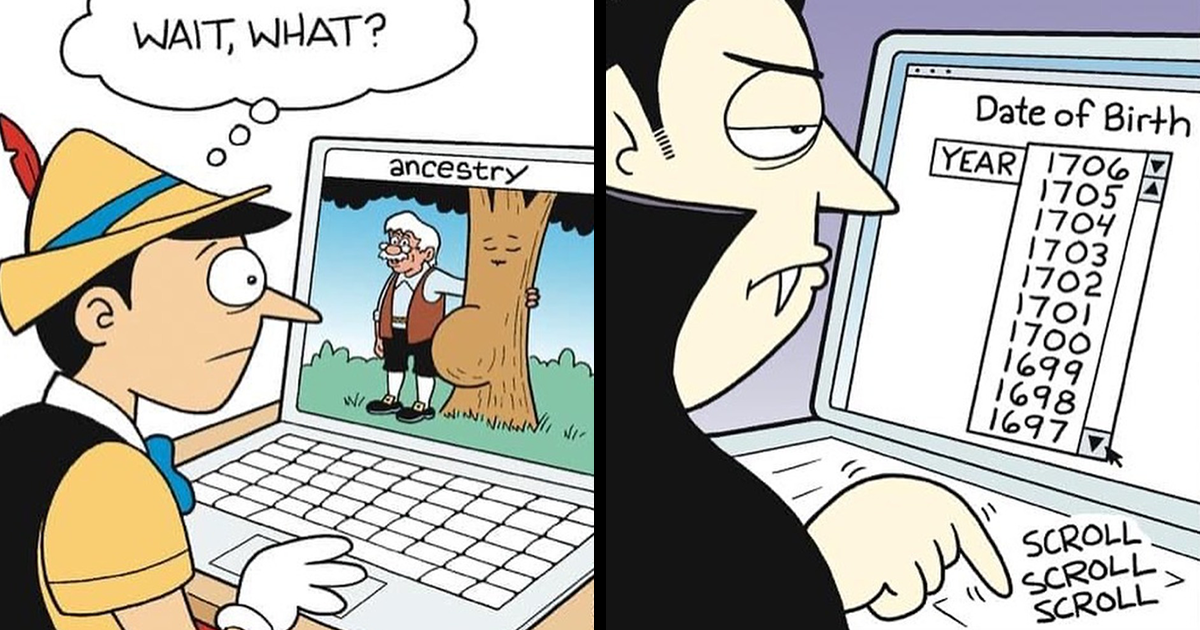
His big trick is that he does not limit the internet to humans. In these comics, animals, mythical creatures, historical figures, produce, and random objects behave like internet users with suspiciously believable motivations. A cat does not simply exist online; it becomes exactly the sort of chaotic little goblin you always suspected it was. A fictional character using a genealogy site becomes a joke not just about technology, but about identity, ego, and the weird confidence of online self-discovery. A support group for confused smartphones says more about modern frustration than a thousand think pieces ever could.
That is why the “internet edition” does not read like a bunch of generic jokes about screens. It feels inventive. It treats the web as a stage where anything can log on, embarrass itself, and accidentally reveal its deepest insecurities. Frankly, that is also what most comment sections do, but with less charm and more caps lock.
What Makes These 35 Mark Parisi Comics So Funny?
1. They Turn Search Bars Into Personality Tests
One of the smartest ideas in this collection is using internet searches as character reveals. A good search query is basically a confession wearing sweatpants. Parisi understands that perfectly. When he imagines what animals, monsters, or famous figures might look up online, the humor lands because the search itself exposes exactly who they are.
That premise gives him endless room to play. Instead of building a joke through long dialogue, he lets a single digital behavior do the heavy lifting. The result feels quick, modern, and painfully recognizable. Everyone has typed something into a search bar that made them pause and think, “If my laptop gains consciousness, I’m finished.” Parisi simply gives that anxiety a spotlight and a punchline.
2. Pets And Technology Are A Comedy Gold Mine
Parisi has long been brilliant with pet humor, and the internet-themed batch gives him even more toys to break. Cats sprawled across keyboards, random strings of letters appearing on screens, birds turning language-learning into a species-level misunderstanding, and animals behaving like baffled digital citizens all fit naturally into his world.
These jokes succeed because pets already act like tiny, judgmental roommates. Add laptops, phones, or online behavior, and suddenly the whole thing becomes a documentary about domestic sabotage. Readers laugh because they have seen some version of it in real life: the cat blocking the monitor during a meeting, the dog interrupting a video call, the pet who somehow becomes the main character the moment technology enters the room.
3. Pop Culture References Never Overpower The Joke
One underrated strength of Mark Parisi’s comics is restraint. Even when he uses recognizable figures or pop culture setups, the cartoon does not become a lazy “Hey, remember this character?” routine. The reference is only the doorway. The joke still has to walk through it.
That is why a panel involving a famous villain guessing someone’s password works. It is not funny simply because the character is famous. It is funny because password logic itself is dumb, universal, and instantly relatable. Likewise, a biblical or fairy-tale figure using modern internet tools becomes funny because the old-world identity collides with today’s ridiculous digital habits. The reference gives the panel extra flavor, but the joke still survives on its own legs.
4. The Panels Feel Fast Without Feeling Throwaway
There is a major difference between a joke that is quick and a joke that is cheap. Parisi’s panels are quick, but they are not disposable. You read them fast, yet many stick around longer than expected because the idea is doing more than one job at once. A single image about a spam call, for example, can also be a joke about suspicion, branding, language, and how we all now instinctively distrust our phones.
That layered simplicity is harder than it looks. One-panel humor lives or dies by clarity. If the reader has to stop and excavate the premise like an archaeologist brushing dirt off a spoon, the laugh is gone. Parisi’s strength is delivering the setup so cleanly that the joke feels effortless. Of course, “effortless” usually means “someone worked ridiculously hard so you could laugh in three seconds.”
5. The Collection Understands The Internet As Shared Human Weirdness
What makes this roundup especially successful is that it never treats the internet as cold machinery. The web is presented as an extension of our impulses: vanity, confusion, insecurity, curiosity, laziness, competitiveness, and occasional stupidity. In one comic, a tutorial-inspired craft result goes gloriously wrong. In another, online ancestry or friend requests create the kind of awkwardness that can only happen when software opens doors nobody asked for.
Parisi is not lecturing readers about how bad technology is. He is doing something much smarter. He is showing that humans bring their old habits into every new tool. We did not become more rational online. We just got faster Wi-Fi and more embarrassing ways to prove otherwise.
A Guided Tour Of The Humor Inside The 35-Comic Roundup
Without reproducing the comics themselves, the easiest way to appreciate this collection is to look at the kinds of jokes it serves up. Think of it as a buffet of digital nonsense, except better seasoned and less likely to crash your browser.
There are search-based jokes that reveal what different creatures or characters would obsess over online. These are built on instinct, vanity, fear, and curiosity. The genius is that the search query becomes the punchline engine.
There are pet-tech jokes involving cats, birds, and other animals colliding with screens, keyboards, and digital behavior. These panels feel instantly relatable because modern households are basically small co-working spaces run by pets who refuse to acknowledge corporate structure.
There are mythology-and-history collision jokes where ancient, fictional, or iconic figures use very modern internet tools. A genealogy website, friend requests, or search results suddenly become comic devices that expose old stories in a new way.
There are social-media jokes about performance, presentation, and the deeply unserious business of appearing impressive online. Even when Parisi goes silly, he is clearly poking at a real modern instinct: the urge to curate your life like a confused brand manager with low battery.
There are device jokes that turn phones, laptops, and digital systems into emotional participants. A support group for confused smartphones is funny because it humanizes gadgets in a way that mirrors how we already talk about them. We say our computers hate us because, frankly, the evidence keeps piling up.
There are language jokes where online communication creates misunderstandings that are both clever and delightfully dumb. The internet speeds communication up, but it also gives misunderstandings a jetpack. Parisi knows exactly how to mine that.
And there are identity jokes where the web exposes truths, contradictions, or secret motivations. Whether the subject is a platypus on a family-history site or a character discovering too much with one click, the joke works because the internet now functions like a nosy neighbor with unlimited data.
Why Off The Mark Thrives In The Age Of Scrolling
One-panel comics are built for speed, and that gives Parisi a huge advantage in the digital age. Online readers skim. They scroll. They pause for whatever hits fast and hits clean. Off The Mark was practically made for that rhythm. Each panel is compact enough for social sharing but smart enough to reward attention.
That does not mean the strip feels disposable. Quite the opposite. In a crowded online landscape where many jokes disappear the second you flick your thumb upward, Parisi’s cartoons feel stable. They have shape. They have craft. They are not just reactions to trends; they are observations about behavior. That is why they remain readable even when the exact gadget or app changes. The technology may evolve, but the human weirdness underneath it stays beautifully consistent.
The Experience Of Reading These Comics Online
There is a special kind of pleasure in reading a Mark Parisi comic on the internet while the internet itself is actively annoying you. Maybe your browser has twelve tabs open. Maybe one of them is playing audio from nowhere. Maybe your phone is at 9 percent battery and acting like that is somehow your fault. Then you land on one of these Off The Mark panels, and suddenly the chaos becomes funny instead of merely irritating.
That experience matters. Humor about technology often becomes either smug or tired. It can sound like “kids these days and their phones,” or it can become a lazy pile of jokes about autocorrect. Parisi avoids both traps. His internet humor is playful instead of preachy. He is not standing outside modern life shaking his fist at it. He is right in the middle of it, laughing along with the rest of us while also quietly admitting that yes, we are all a little ridiculous now.
What I love most about this kind of comic collection is how familiar the emotional beats feel. You see a joke about a keyboard hijacked by a cat and instantly remember your own pet stepping on your laptop as if sending cryptic emails were a valid career choice. You see a joke built around passwords or spam calls and remember every single time your devices made you feel like the least competent person in your own home. You see a character using an online tool in exactly the wrong way, and instead of judging them, you think, “Honestly, fair.”
That is the sweet spot. These comics do not make readers feel dumb. They make readers feel seen. And in an age where the internet often makes people feel overwhelmed, manipulated, distracted, or mildly haunted, being seen is surprisingly comforting.
There is also something deeply satisfying about the format itself. A one-panel comic says, “I respect your time, but I’m still going to make this count.” It offers a clean setup, a visual clue, and one strong payoff. No rambling thread. No explainer video. No ten-minute preamble begging you to smash the subscribe button. Just joke, laugh, move on, maybe send it to a friend. That efficiency feels almost luxurious now.
And because Parisi’s humor is rooted in behavior instead of outrage, the comics age well. They are not trying to win the daily culture-war cage match. They are trying to find the absurd little truth inside an everyday moment. That makes them feel lighter, but not shallow. In fact, there is real craft in making a joke feel this easy. The panel has to be clear, the idea has to be original, and the timing has to land instantly. When it works, it feels almost invisible. The laugh just arrives.
Reading this internet-themed edition also reminds me why newspaper-style cartooning still matters online. In theory, the web should have buried old comic traditions under memes, hot takes, and low-resolution nonsense. Instead, it gave strong cartoonists a bigger stage. Parisi’s work proves that classic gag construction still thrives when paired with modern subject matter. Good humor does not expire because the platform changes. It just finds new places to ambush people during coffee breaks.
So yes, these 35 comics are hilarious. But they are also oddly reassuring. They suggest that even as technology becomes more invasive, more absurd, and more intertwined with daily life, we can still step back and laugh at it. Maybe that will not fix the group text, the frozen app, or the mystery tab making noise somewhere in the digital basement of your browser. But it does make the whole mess feel a little more human.
Final Thoughts
“Off The Mark”: 35 Hilarious Comics By Mark Parisi, Internet Edition succeeds because it does what the best humor always does: it notices the truth hiding inside routine behavior and then exaggerates it just enough to make you laugh out loud. Mark Parisi’s comics are sharp without being cruel, modern without trying too hard, and weird in exactly the right proportion. The internet theme gives him a huge playground, but the real secret is his understanding of people, pets, habits, vanity, frustration, and the many small ways technology exposes who we really are.
That is why this collection works so well. It is not just about devices or websites. It is about us. Our habits. Our glitches. Our irrational little rituals. And if a cartoon can make all of that feel funny instead of exhausting, that is not just a win. That is excellent bandwidth management.