If you’ve ever saved a dreamy travel reel, booked a flight, and then arrived to discover the “hidden gem” has a
gift shop the size of an aircraft hangar… welcome. This is the part of the internet where we gently roast
overhyped places, laugh at our own “bucket list” mistakes, and learn how to travel smarter without becoming the
villain in someone else’s local-news story.
“Overrated” doesn’t mean “awful.” It usually means the hype-to-reality ratio is off. Maybe the
photos are better than the experience. Maybe the crowds are louder than the history. Maybe your wallet cries
louder than you do. And sometimes, the destination is genuinely incredibleyou just tried to do it at the worst
time, in the worst way, with the worst expectations (aka “We’ll wing it in July!”).
Below are 30 “pics” worth of the most commonly side-eyed travel spotsplus what people say goes
wrong, and how to make the trip better if you still want to go. Because you’re not banned from Paris just
because someone called the Eiffel Tower “a big metal triangle.” You’re simply allowed to plan like an adult.
Why “Overrated” Usually Means “Mismatched Expectations”
Most destinations earn their fame for a reason. The problem is what happens after fame:
crowds, price spikes, long lines, copycat experiences, and a thousand people trying to take the exact same photo.
When travelers complain that a place is overrated, they’re often reacting to one (or more) of these:
- Overtourism pressure: locals get pushed out, rules get stricter, and visitors feel “managed.”
- Tourist-trap economics: mediocre food priced like a mortgage payment.
- Instagram geography: one famous angle, 50,000 tripods.
- Time-of-day pain: arriving at noon, competing with cruise buses and tour groups.
- Under-planned logistics: tickets sell out, timed-entry is required, or you need reservations.
The good news: you can keep the landmark and lose the misery. Usually with earlier mornings, better neighborhoods,
a “one-icon-per-day” mentality, and the radical act of walking three blocks away from the main square.
People Share What Travel Destinations Are Absolutely Overrated (30 Pics)
Think of each item as a “photo caption” you’d see in a community thread: quick, honest, occasionally spicy
and followed by a reality check and a better way to do it.
-
Times Square, New York City
Why people call it overrated: It’s bright, loud, and packedlike a flashing billboard learned to walk.
Try this instead: Treat it as a 15-minute “see it once” stop, then head to Bryant Park, the High Line, or a neighborhood food crawl where your ears can heal.
-
Hollywood Walk of Fame, Los Angeles
Why people call it overrated: The mental image is glam; the sidewalk reality is… a sidewalk.
Try this instead: If you want “movie magic,” do a studio tour, see a screening at a historic theater, or hike Griffith Park for the kind of view that actually feels cinematic.
-
The Las Vegas Strip, Nevada
Why people call it overrated: Sensory overload, pricey everything, and a strong sense that your hotel lobby is nicer than your bank account.
Try this instead: Pick one signature show, one great meal, and one weird museum, then escape to Red Rock Canyon or the Arts District for calmer fun.
-
Fisherman’s Wharf, San Francisco
Why people call it overrated: You came for coastal charm and got crowds plus souvenirs.
Try this instead: Get your waterfront fix at the Ferry Building, walk along Crissy Field, or explore neighborhoods where the food feels like it belongs to real humans.
-
South Beach (peak season), Miami
Why people call it overrated: Expensive, chaotic, and sometimes more “scene” than “vacation.”
Try this instead: Go for the Art Deco architecture and a morning beach walk, then explore Little Havana or Wynwood when you want culture (and better snacks).
-
Bourbon Street, New Orleans
Why people call it overrated: It’s a partyjust not always the kind you asked for.
Try this instead: Catch live jazz on Frenchmen Street, eat your way through local classics, and do a daytime architecture stroll when the city feels more like itself.
-
Mount Rushmore (as a full-day “main event”)
Why people call it overrated: The monument is impressive, but the time investment can feel disproportionate.
Try this instead: Pair it with Badlands scenery, local history sites, or a scenic drive so the day has texturenot just a parking lot and a viewpoint.
-
Venice as a rushed day trip
Why people call it overrated: You spend more time navigating crowds than enjoying the city’s quieter magic.
Try this instead: Stay overnight if you can, walk early or later in the day, and aim for overlooked neighborhoods. Also, plan ahead: Venice has used an access-fee system on peak days with online registration and QR-code checks during limited hours.
-
Paris: only doing the “Top 5” checklist
Why people call it overrated: If your entire itinerary is lines, you’ll remember Paris as “waiting with a croissant.”
Try this instead: Build your days around neighborhoods, markets, and parksthen add one iconic attraction as the cherry on top.
-
Rome: the Trevi Fountain crush
Why people call it overrated: It can feel like you’re attending a fountain’s concert tour.
Try this instead: Visit very early, then spend your “best energy” hours in quieter ruins, museums, or side streets where Rome’s personality shows up.
-
Santorini’s Oia at sunset
Why people call it overrated: Gorgeous views, but the crowd can turn it into a competitive sport.
Try this instead: Catch sunset from less jammed viewpoints and plan around cruise influx. Santorini has discussed/implemented measures to manage cruise passenger volume, including an 8,000-per-day cap for cruise visitors.
-
Mykonos (if you’re not here for the party)
Why people call it overrated: Prices and nightlife energy can dominate the experience.
Try this instead: Pick a calmer island vibe nearby, or treat Mykonos as a short stop focused on beaches and a single standout meal.
-
Dubrovnik’s Old Town when cruise ships arrive
Why people call it overrated: The city is stunning, but crowd waves can make it feel like a theme park.
Try this instead: Check ship schedules if possible, go early, and spend time beyond the wallsviews and local life get better as you step away from the bottleneck.
-
Barcelona: the “Instagram hotspots only” route
Why people call it overrated: Overcrowding and tension around tourism can affect the vibe.
Try this instead: Travel respectfully, avoid short-term-rental churn when possible, and build in quieter neighborhoods and off-peak times. (Pro tip: your best photo is the one you didn’t elbow someone for.)
-
Amsterdam’s Red Light District (as your main activity)
Why people call it overrated: It’s crowded, heavily regulated, and can feel uncomfortable or purely performative.
Try this instead: Focus on canals, museums, and local neighborhoods. Amsterdam has introduced multiple measures to curb nuisance tourism, including restrictions related to hotels and tourist-focused businesses.
-
London: “I did the Eye, the clock tower, and left”
Why people call it overrated: The icons are fine, but the city’s charm lives in its neighborhoods.
Try this instead: Pick a few districts (markets, parks, bookshops, pubs), then add one landmark as a bonuslike a souvenir that doesn’t clutter your apartment.
-
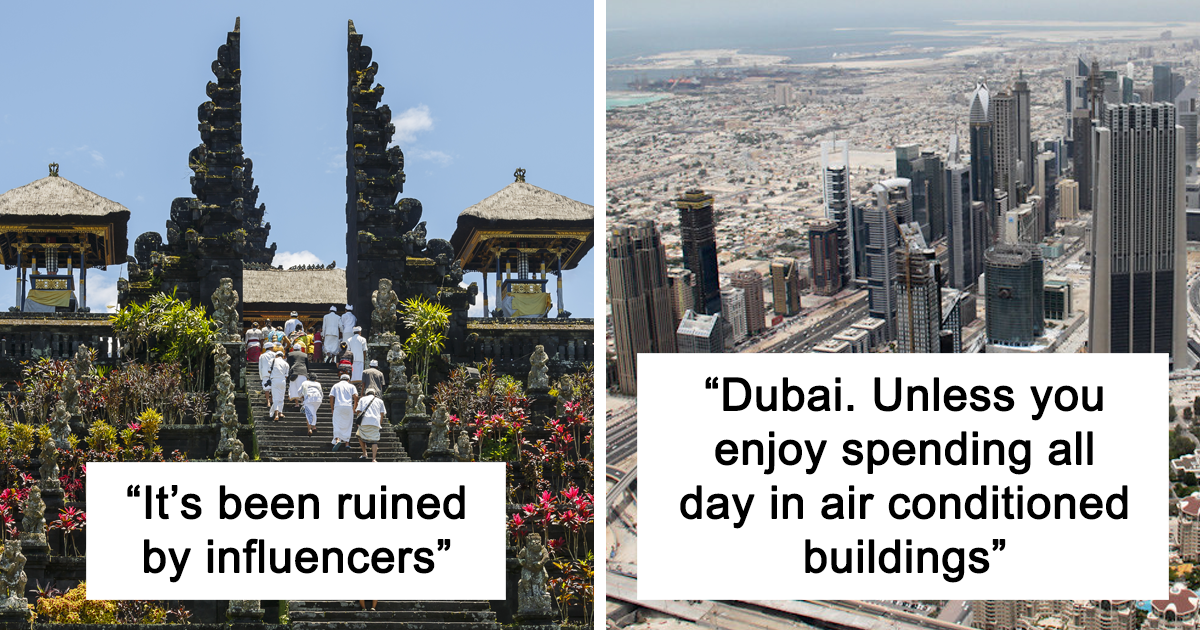
Dubai’s biggest “everything” experiences
Why people call it overrated: Flash can outrun substance if you only do malls and observation decks.
Try this instead: Pair modern highlights with heritage neighborhoods, desert experiences, and local foodvariety makes the place feel real.
-
Bali: Kuta during peak crowds
Why people call it overrated: Traffic, party zones, and environmental strain can clash with the “zen paradise” fantasy.
Try this instead: Choose areas that match your goal (quiet beaches, culture, hiking) and be mindful about wasteBali has long battled plastic and trash challenges alongside tourism growth.
-
Phuket’s Patong (if you wanted “relaxing”)
Why people call it overrated: It’s high-energy and heavily touristed.
Try this instead: Use Patong for nightlife if that’s your thing; otherwise base yourself somewhere calmer and do day trips strategically.
-
Machu Picchu at midday without a plan
Why people call it overrated: It’s spectacular, but strict entry logistics and peak-time congestion can feel like a controlled shuffle.
Try this instead: Book ahead, pick the circuit that fits your goals, and build buffer time. The wonder is realyour schedule just has to cooperate.
-
Egypt’s pyramids: expecting “empty desert solitude”
Why people call it overrated: The history is mind-blowing, but the surrounding urban reality surprises people.
Try this instead: Go with a reputable guide, set expectations, and pair the site with museums and quieter historical stops so the day isn’t one long sensory ambush.
-
Thailand’s most famous beaches in peak months
Why people call it overrated: The beaches are beautiful, but closures and crowd management happen for a reason.
Try this instead: Research seasonal access, respect environmental rules, and consider less-hyped islands where the water is still blue and your towel has personal space.
-
Swiss “most-photographed” villages at noon
Why people call it overrated: You came for quiet and found tour buses playing musical chairs.
Try this instead: Stay overnight or visit early/late. The same mountains hit different when you can actually hear the cowbells.
-
Hawaii: chasing one viral beach photo all day
Why people call it overrated: The “photo mission” can replace the actual experience, and crowded spots can strain local resources.
Try this instead: Build an itinerary around respectful, lower-impact experiences: hikes, cultural sites, local eateries, and fewer “must-post” moments.
-
Orlando theme parks (without a strategy)
Why people call it overrated: Lines, heat, and prices can turn into a three-day cardio event you didn’t train for.
Try this instead: Use timed reservations and early entry if available, schedule breaks, and accept that doing “everything” is a myth created by gift shops.
-
Las Ramblas, Barcelona (as your dining plan)
Why people call it overrated: It’s iconic, but the restaurants can be more tourist-oriented than tasty.
Try this instead: Walk a few blocks away and eat where menus don’t look like they were designed by a printer running out of ink.
-
Rome’s “skip all neighborhoods, only monuments” plan
Why people call it overrated: You end up with a highlight reel and no story.
Try this instead: Make time for a long dinner, a neighborhood stroll, and at least one “I have no idea what this is, but I love it” moment.
-
“Just one day” in a mega-city (Tokyo, London, NYC)
Why people call it overrated: The city didn’t disappointyour timeline did.
Try this instead: Choose one area, go deep, and skip the cross-town sprint. Your feet will send a thank-you note.
-
“Hidden gems” that aren’t hidden anymore
Why people call it overrated: Once a spot is in every “secret” list, it becomes a very public secret.
Try this instead: Use the list as a starting point, then ask locals, explore side streets, and let your trip be shaped by curiositynot just algorithms.
-
“The most famous viewpoint” in any city
Why people call it overrated: You can’t enjoy a view while being gently pushed by the next person’s selfie stick.
Try this instead: Seek second-best viewpointsoften better, cheaper, and dramatically less chaotic.
-
U.S. National Parks at peak hours without reservations
Why people call it overrated: The scenery is legendary; the parking lot is not.
Try this instead: Learn the timed-entry rules ahead of time. Some parks use timed-entry windows in busy seasons (for example, Arches has required timed-entry tickets during specific dates and hours in 2025).
How to Avoid the “Overrated” Feeling Without Skipping Great Places
1) Upgrade your goal: from “I saw it” to “I experienced it”
If your plan is “arrive, take photo, leave,” you’ll feel like a human screenshot. Instead, pair the icon with
something that adds meaning: a neighborhood walk, a museum, a local meal, a short guided tour, or even a quiet
park bench. (Yes, sitting counts. You’re allowed.)
2) Choose your crowd battle
Most “overrated” complaints are actually “I went at the busiest possible time.” Try:
weekday mornings, shoulder season, late afternoons, or
evenings. Many places feel totally different outside the noon rush.
3) Assume tickets, timed-entry, or rules existand check early
Destinations worldwide are managing demand with caps, fees, and reservations. Venice has used a peak-day access
fee and registration approach for day visitors during limited hours, while some places (like Santorini) have
moved toward managing cruise passenger volume. In the U.S., popular national parks increasingly use timed-entry
systems during busy windows.
4) Walk 10 minutes away from the “main” zone
This is the simplest travel hack that feels like cheating. The moment you step away from the prime photo corner,
food gets better, prices drop, and you hear languages that aren’t 80% “Do you have a charger?”
5) Protect your money and your mood
Tourist-heavy areas attract tourist-heavy nonsense. Keep your valuables secure, be cautious with deals that feel
too good, and learn basic scam tacticsbecause nothing makes a destination feel overrated like losing your wallet
to a “helpful stranger.” The U.S. State Department recommends learning common scam strategies and staying alert to
tactics designed to separate you from your money.
Extra : Real-World “Overrated Destination” Experiences (and What They Teach)
Travelers describe a surprisingly consistent pattern: the destination isn’t the problemthe moment and the method are.
Here are a few “you can practically hear the group chat” experiences people often share after visiting famous places,
plus the lesson hiding underneath the complaint.
The “I waited two hours for a photo” moment: A couple arrives at a legendary viewpoint right after lunch,
only to find a queue that looks like a theme-park ride. They spend most of their time inching forward, rehearsing smiles,
and deleting the same blurry shot 17 times. When they finally get the photo, it’s a quick victorythen they’re rushed off
by the next eager tripod. Later, they realize the best part of the day was the random bakery they stumbled into while
trying to “kill time.” Lesson: A famous photo spot should be a quick stop, not the centerpiece of your identity.
If the line is wild, pivot. Your trip is not an exam.
The “This doesn’t look like Instagram” surprise: Someone visits a beach that went viral for turquoise water
and perfect sand. In real life, the tide is different, the lighting is harsher, and the shoreline has the normal evidence
of humans existingfootprints, noise, and sometimes litter. They feel cheated until they take a short walk to a quieter
stretch and start noticing the things a 6-second clip can’t capture: the smell of salt, the sound of waves, the way the
horizon makes your brain unclench. Lesson: Social media shows a highlight, not the whole scene. Treat viral content
like a trailer, not a contract.
The “I only saw tourists” complaint: A family plans a whole day around the most famous street in a city, then
wonders why everything feels generic. They’ve essentially visited the city’s “tourism showroom.” The next morning, they
take public transit to a less-known neighborhood, eat breakfast where menus aren’t laminated, and accidentally catch a
local festival. They come back glowing like they found a secret level in a video game. Lesson: If you want a place to
feel authentic, you have to leave the most curated parts of it.
The “I didn’t know I needed a reservation” meltdown: A traveler arrives at a famous park or historic site and
learns the hard way that timed-entry, capacity limits, or ticket windows exist. Their frustration gets labeled as
“overrated,” but the real culprit is logistics. The next day, they book the right time slot, arrive early, and suddenly the
same place feels incredible. Lesson: Modern travel rewards planning. Not because spontaneity is badbut because crowds
are real.
The “We did too much” fatigue: A group tries to pack five landmarks into one day and ends up with sore feet and
zero memories beyond “we walked.” The trip feels disappointing until they slow down, choose one main goal, and let the day
include small joys: a long lunch, a museum they didn’t research, a sunset they didn’t schedule. Lesson: The best trips
aren’t the most efficient. They’re the most felt.
If there’s one universal truth, it’s this: a destination becomes “overrated” when it’s treated like a trophy. Treat it like a
place where people live, work, and eat lunchand it suddenly gets a lot more interesting.