Science has a funny habit of sounding like mythology right when it gets most practical. Say the word chimera and most people picture a fire-breathing beast stitched together by an overcaffeinated ancient poet. In modern biology, though, a chimera is much less dramatic-looking and much more important: an organism made of cells from two different genetic lineages. No wings, no snake tail, no villain monologue. Just cells, embryos, and some very big questions.
That is why headlines about pigs born with monkey cells or talk of pig-human chimeras grab attention so fast. They sound like science fiction wearing muddy boots. But behind the eyebrow-raising terminology is a serious biomedical goal: finding better ways to study disease, understand development, and perhaps one day grow transplantable human tissues or organs in animals. In a world where organ shortages remain severe, that goal is not just futuristic. It is deeply human.
Still, chimera research sits at the intersection of hope, discomfort, and ethics. People hear “pig with monkey cells” and immediately wonder whether scientists are building a creature from a late-night lab dare. They are not. What researchers are usually trying to do is far more controlled: introduce a small number of cells from one species into the embryo of another, then observe how those cells behave, survive, and contribute to tissues.
This article breaks down what happened in the much-discussed pig-monkey chimera work, how it relates to pig-human chimera research, why pigs are often used in these experiments, what the science can and cannot do yet, and why the ethical debate remains as lively as ever.
What Is a Chimera, Exactly?
In biology, a chimera is an organism that contains cells from more than one genetically distinct source. That can happen naturally in rare cases, but when scientists use the term in research, they usually mean a deliberately created combination. The key detail is that a chimera is not the same thing as a hybrid. A hybrid comes from the mixing of sperm and egg from two species or lineages. A chimera, by contrast, is more like a cellular collaboration, where cells from one source are introduced into a developing embryo or animal made from another source.
That distinction matters because “pig-human chimera” does not mean a pig that suddenly starts filing taxes or asking for oat milk. It usually means a pig embryo or fetus containing a limited number of human cells. Likewise, pigs born with monkey cells were still overwhelmingly pigs. The monkey contribution was small, but scientifically meaningful.
Why Scientists Keep Coming Back to Pigs
If chimera research had a favorite farm animal, it would absolutely be the pig. There are good reasons for that. Pig organs are closer to human organs in size than mouse organs, and pigs are already central to many areas of biomedical research. Their anatomy and physiology make them attractive candidates for studies aimed at future transplantation strategies.
That matters because the United States still has a massive organ shortage. More than 100,000 people are on the national transplant waiting list, and the pressure on the system remains intense. When researchers talk about growing human-compatible tissues in pigs, they are not trying to win the weirdest-lab-contest trophy. They are trying to solve a brutal supply problem that costs lives.
Pigs Born with Monkey Cells: What Actually Happened?
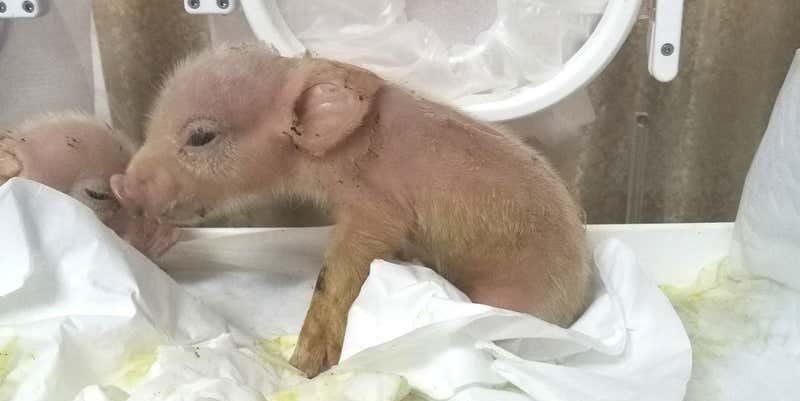
One of the most attention-grabbing milestones in chimera research came when scientists reported live-born piglets containing monkey cells. In this work, researchers introduced stem cells from cynomolgus monkeys into pig embryos. Thousands of embryos were created and transferred into surrogate sows. A small number of piglets were born, and two of them were identified as interspecies chimeras.
Those piglets were not half-monkey in appearance. They looked like piglets. The monkey cells represented only a tiny fraction of the total cells, but researchers found them in several tissues, including the heart, liver, spleen, lungs, and skin. In other words, the monkey cells had not simply vanished. They survived, integrated, and contributed to multiple parts of the animal’s body.
That was a genuine scientific milestone because it showed that primate cells could persist in a pig all the way to birth. Unfortunately, the piglets did not live long. Reports indicated that all the piglets in that experiment died within about a week, and the researchers suggested that the deaths were likely related to the in vitro fertilization process rather than the chimerism itself. Even so, the outcome showed how technically fragile this field still is. Making an embryo is one thing. Making a healthy, viable animal is a much harder challenge.
From a research perspective, the pig-monkey work mattered for another reason: monkey cells can serve as a stand-in for certain questions that cannot ethically be pursued as far with human cells. Scientists can study whether primate cells survive, where they travel, and what tissues they contribute to, without crossing all the same lines that human-animal experiments might trigger.
How This Connects to Pig-Human Chimeras
The pig-monkey experiments did not appear out of nowhere. They fit into a larger scientific effort to understand interspecies chimerism, including the better-known work on pig-human chimeras. In 2017, researchers reported early-stage pig embryos that had been injected with human pluripotent stem cells. These embryos were transferred into surrogate pigs and allowed to develop for several weeks before analysis.
That study was important because it showed that human cells could survive in pig embryos. But it also revealed a major obstacle: the human contribution was extremely low. In plain English, the human cells were present, but not exactly taking over the place. The result was scientifically exciting and medically humbling at the same time.
Why was that low contribution such a big deal? Because the dream behind some of this research is called blastocyst complementation. The idea is elegant: disable an animal embryo’s ability to form a specific organ, then add donor stem cells that fill the developmental gap and build that organ instead. In theory, one day those donor cells could be human cells, creating a human-compatible organ inside a pig. In practice, biology has responded with a polite but firm, “That’s harder than it sounds.”
Species are separated by evolutionary distance, developmental timing, molecular signaling differences, and lots of tiny cellular incompatibilities that do not care about our deadlines. Human cells and pig embryos do not run on the same schedule. One is trying to dance a slow waltz, the other is doing speed chess.
What Researchers Learned from Human-Monkey Embryo Studies
Another major step came when researchers created embryos containing both human and monkey cells in the lab. This work did not involve implanting the embryos into a uterus or producing live-born animals, but it did show something important: human cells appeared to survive and integrate better in monkey embryos than they had in pig embryos.
That finding reinforced a key lesson in chimera biology. The closer two species are evolutionarily, the easier it may be for their cells to communicate and develop together. From a purely scientific standpoint, that is useful information. From an ethical standpoint, it is precisely why people get nervous. The more successful the biology becomes, the more serious the moral questions become too.
The Real Medical Goal: Organs, Disease Models, and Better Science
Let’s address the giant pig in the room: why do this at all?
The biggest long-term goal is to help address organ failure and transplant shortages. If researchers could reliably generate human-compatible tissues in animals, it could transform transplantation medicine. Patients with end-stage kidney, liver, heart, or pancreatic disease might someday have more options than waiting, deteriorating, and hoping the phone rings in time.
But organ generation is not the only possible use. Chimeras may also help scientists model diseases more accurately, test therapies, and understand how cells develop inside living systems. A mouse dish or organoid can teach a lot, but it cannot capture every aspect of a whole body. Chimeras may offer a bridge between petri-dish biology and real physiology.
Researchers are also learning practical lessons about stem cell states, developmental barriers, immune compatibility, and tissue targeting. Sometimes a study that seems strange from the outside is actually answering a very basic question: can these cells survive there at all? Before anyone grows an organ, they first have to solve the less glamorous mystery of why one cell population thrives while another quietly gives up.
Why the Ethics Debate Is So Intense
If chimera science is the engine, ethics is the steering wheel. And frankly, the steering wheel is doing some heavy lifting.
Concerns about chimera research usually cluster around a few major themes. First, there is animal welfare. Even if the scientific goal is noble, animals used in research must be protected from unnecessary suffering. Second, there is the question of boundary crossing. Some people feel deep unease about mixing human and animal biological material, especially in ways that touch the brain or reproductive tissues.
That leads to the two most-discussed red-flag zones: the central nervous system and the germline. If human cells were to contribute significantly to an animal’s brain, could that alter cognition in ethically meaningful ways? If human cells contributed to sperm or eggs, what additional safeguards would be needed? These are not just thought experiments for philosophers in elbow-patch jackets. They are active oversight questions.
That is one reason U.S. policy discussions have been cautious. The NIH announced a funding pause in 2015 for certain types of human-animal chimera research while it considered revised oversight. Later discussions proposed more specialized review rather than a free-for-all. Meanwhile, professional guidance such as ISSCR recommendations has emphasized case-by-case oversight, especially for experiments involving likely human contribution to brains or germ cells.
National Academies discussions have echoed similar concerns, especially where neural tissues are involved. In short, the field is not operating in a regulatory vacuum, even if the rules are still evolving alongside the science.
What the Public Usually Gets Wrong
The public conversation around chimeras often swings between two extremes. On one side is panic: “Scientists are making monster animals.” On the other side is overconfidence: “Great, custom organs next Thursday.” Neither is accurate.
Most chimera experiments involve very low levels of donor-cell contribution. Many embryos do not develop far. Even fewer lead to live birth. And a successful experiment in a paper does not mean a therapy is ready for a hospital. The field is progressing, but it is still wrestling with low efficiency, biological incompatibility, ethical constraints, and long safety timelines.
At the same time, dismissing the field as pure fantasy would also be a mistake. The research has already demonstrated real principles: donor cells can survive in foreign embryos, can contribute to multiple tissues, and can reveal important rules of development. These are not imaginary gains. They are early bricks in a very unfinished building.
Could Pig-Human Chimeras Ever Become Routine?
Routine? Not anytime soon. Plausible in some form someday? Yes, that remains a serious possibility.
For that to happen, scientists would need to improve the efficiency of human cell integration, guide those cells into the desired organ rather than random tissues, minimize off-target contribution, ensure safety, prevent infection risks, and satisfy rigorous ethical oversight. That is a long list, which is science’s favorite kind of list because it guarantees more grant applications.
Even if full organ generation proves more difficult than hoped, chimera research could still deliver value through better disease models and developmental insights. Scientific fields do not always arrive where they first intended. Sometimes they set out to build an organ farm and end up revolutionizing stem cell biology instead.
Final Thoughts: Weird Science, Serious Purpose
Pigs born with monkey cells were not a circus act from the future. They were a proof of principle in one of the most ethically charged and medically ambitious areas of modern biology. Pig-human chimeras, likewise, are not about creating bizarre creatures for shock value. They are part of an effort to understand whether human cells can one day be used to grow tissues or organs in animals, potentially helping patients who have run out of time and options.
The science is real, but so are the limitations. The hope is real, but so is the discomfort. Chimera research lives in that uneasy middle ground where medicine, philosophy, and developmental biology all show up to the same meeting and nobody agrees on the snacks.
Still, one thing is clear: this field matters. It matters because people are still dying while waiting for organs. It matters because biology still keeps many of its deepest secrets under lock and key. And it matters because the future of medicine will likely be shaped not only by what we can do, but by what we decide we should do.
Experiences Related to “Pigs Born with Monkey Cells – Chimeras – Pig-Human Chimeras”
One of the most revealing “experiences” around chimera research is not a single lab moment but the emotional whiplash it creates in different groups of people. For scientists, these experiments often feel painstaking, technical, and incremental. A tiny percentage of donor cells surviving in the right tissue can be a thrilling result after years of failures. For the public, the exact same result may sound alarming because it arrives packaged in language that feels dramatic. “Pig with monkey cells” is technically accurate, but it lands in the brain like the trailer for a very questionable streaming series.
Patients and families facing organ failure often experience the topic very differently. Someone waiting for a kidney or liver transplant may hear about pig-human chimera research and feel something closer to cautious hope. The details about stem cell states, embryo timing, or chimeric efficiency may not matter nearly as much as the larger possibility: could this someday help people like me? In that sense, chimera research is experienced not just as science, but as a measure of how far medicine is willing to go to solve unbearable shortages.
Bioethicists, meanwhile, tend to experience the field as a moving target. Every new technical advance forces old questions to be sharpened. It is one thing to debate a hypothetical pig embryo with a trace amount of human cells. It is another to confront experiments showing broader cell survival, or primate-related work that raises sharper concerns about brain contribution and moral status. The ethical experience here is not static. It evolves as the science becomes more capable.
Researchers themselves also describe a practical experience of constant restraint. Chimera science is often discussed as if scientists are sprinting toward a shocking end point, but much of the day-to-day reality is the opposite. There are oversight committees, funding limits, embryo-stage restrictions, animal welfare rules, and extensive protocol review. The lived experience of the field is frequently less “mad science” and more “please complete section 14b of the ethics paperwork before touching anything.”
There is also the experience of public misunderstanding, which has shaped the field from the beginning. Scientists have repeatedly had to explain that a chimera is not a monster, not a hybrid in the cartoon sense, and not evidence that species boundaries are casually being erased in a secret basement. That communication challenge is real, and it matters. Public trust can influence funding, regulation, and whether promising research moves forward responsibly or gets buried under panic.
Perhaps the most important experience of all is the tension between fascination and caution. Chimera research makes people pause because it forces a rare kind of honesty. We want medical breakthroughs, but we also want moral limits. We admire scientific ingenuity, but we distrust it when it gets too comfortable near biological boundaries. Pigs born with monkey cells and discussions of pig-human chimeras sit right in that uncomfortable zone. That is exactly why the topic remains so compelling. It is not just about what cells can do inside an embryo. It is about what humans do when science gives them a tool powerful enough to save lives and strange enough to make them nervous.
{ “@context”: “https://schema.org”, “@type”: “BlogPosting”, “headline”: “Pigs Born with Monkey Cells – Chimeras – Pig-Human Chimeras”, “description”: “An in-depth look at pig-monkey chimeras, pig-human chimera research, organ-growing science, ethics, and what these experiments really mean.”, “author”: { “@type”: “Person”, “name”: “ChatGPT” }, “inLanguage”: “en-US”, “keywords”: [ “pig-human chimeras”, “pigs born with monkey cells”, “chimera research”, “human-animal chimeras”, “organ transplantation research”, “stem cell science”, “bioethics” ] }