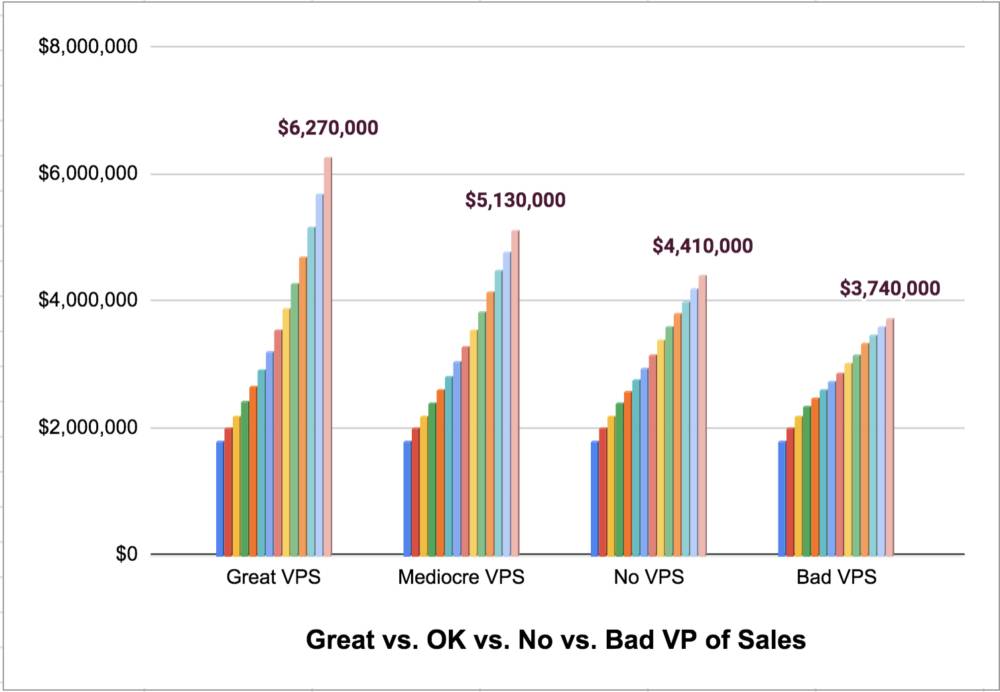
There’s a special kind of frustration reserved for the “OK-but-not-great” VP of Sales. Not the disastrous one who turns your pipeline into a ghost town. Not the superstar who makes revenue graphs look like ski jumps. The middle one. The one who’s… fine. Deals close. The team shows up. Forecasts are only a little bit fictional. And yet you keep thinking, “If we had someone better, we’d be unstoppable.”
Here’s the uncomfortable truth: firing a merely-OK VP of Sales is often how companies trade a steady (if unsexy) revenue engine for a chaotic quarter of “all-hands pipeline therapy” and a founder who’s suddenly back to doing demos like it’s 2019.
This updated guide is about making the decision like a grown-up: separating “they’re not amazing” from “they’re actively holding us back,” and figuring out what to do when your VP of Sales is delivering results that are acceptable… but not inspiring.
First, Define “OK-but-Not-Great” (Because Your Feelings Are Not a KPI)
Founders and CEOs often label a VP of Sales “OK” when reality is messier. “OK” can mean:
- Bookings are up compared to founder-led sales, but growth isn’t accelerating.
- Some things improved (process, reporting, hiring), but other things got worse (rep quality, morale, win rates).
- The team can execute a known motion, but struggles to level up to a new segment, new ACV, or new buyer.
- The VP is competent at managing, but not transformative at coaching or strategy.
In other words: the business isn’t on fire, but it’s also not flying. That’s exactly why this decision is hard. You’re not choosing between “keep the plane in the air” and “stop the crash.” You’re choosing between “reliable engine” and “potential rocket”and rockets have a higher explosion rate than LinkedIn success stories would have you believe.
Why You Probably Shouldn’t Fire Them (Yet)
1) The replacement risk is real, and the cost is usually under-estimated
A VP of Sales isn’t a plug-and-play hire. Even a great one needs time to learn your market, messaging, pricing, internal politics, product gaps, and the weird reason your best customers keep buying (it’s never the reason your homepage headline says).
If you fire an “OK” VP without a truly better replacement lined up, you often create a leadership vacuum that the org fills with:
- reps improvising their own process (spoiler: none of them choose “accurate CRM hygiene”),
- pipeline reviews turning into blame festivals,
- and the CEO becoming the emergency closer, trainer, and therapist.
2) “OK” can still compound
Revenue organizations often grow through compounding habits: cleaner stages, tighter qualification, consistent coaching, better hiring, clearer territories, smarter handoffs. A not-amazing VP who runs the basics well can still create steady improvement over timeespecially if your product is getting better and marketing is strengthening demand.
Translation: a good-but-not-great VP can be “good enough for now,” particularly when the bigger bottleneck isn’t sales leadershipit’s positioning, product gaps, pricing, or lead quality.
3) Your company might be blaming the VP for a system problem
A classic mistake is treating the VP of Sales like a human patch note for an unfinished go-to-market system. Before you reach for the “Terminate” button, ask: what exactly are they supposed to be selling… and to whom?
If your ICP is fuzzy, your messaging is generic, your product is still evolving, or your marketing pipeline is inconsistent, even a strong VP may look merely “OK” because the inputs are unstable.
4) Leadership turnover has a “hidden tax”
Executive turnover doesn’t just cost recruiting fees. It costs:
- Rep attrition (“New boss, new rules, new comp… I’m out.”)
- Customer confidence (especially in enterprise, where stability matters)
- Internal alignment (sales vs. marketing vs. product becomes a group project nobody wanted)
- Time (your most expensive resource, and yes, your calendar is screaming)
The Better Question: Are They “OK,” or Are They Miscast?
Sometimes the VP is fine, but the role is wrong. A VP who’s excellent at scaling a proven motion may struggle if your company actually needs a builder who can invent the motion. Or the reverse: a builder who thrives in messy early-stage selling may feel average when you need operational rigor at scale.
Think about the job your business needs done in the next 12 months. Is it:
- Build: define ICP, tighten messaging, design a repeatable sales process, prove unit economics.
- Scale: hire and ramp teams, create forecasting discipline, improve conversion, expand segments.
- Transform: move upmarket, shift to enterprise, change packaging/pricing, add a new channel, retool GTM.
An “OK” VP might be a mismatch for the phasenot a failure as a leader.
A Practical Decision Framework (Use This Before You Do Something Expensive)
If you want a clear-headed answer, run your VP through a scorecard that blends outcomes and controllable inputs. Here are seven questions that cut through the noise:
- Do we have predictable activity and pipeline hygiene?
Not “everyone is busy,” but “we can explain what’s in pipeline, why it’s there, and what happens next.” - Is the VP coachable?
Do they adapt when you surface gaps, or do they defend the status quo like it’s a treasured family heirloom? - Can they hire and retain solid performers?
If rep quality is deteriorating and good people keep leaving, that’s rarely a coincidence. - Do they create cross-functional trust?
Sales leadership should align with marketing, product, and customer successwithout treating them as obstacles. - Is forecasting improving?
Nobody expects perfect. But if every month is a surprise party and you hate surprises, that’s data. - Do they understand your buyer?
“We sell to everyone” is not a strategy. It’s a cry for help. - Are results improving relative to resources?
If headcount and spend keep rising while output stays flat, you don’t have “OK.” You have “quietly expensive.”
If most of these are trending positive, you likely shouldn’t fire them. You should upgrade themby making the role more structured and the expectations painfully clear.
What to Do Instead of Firing: The 90-Day “Make Them Better” Plan
If your VP is competent, ethical, and respected, your first move should be a focused improvement plannot a surprise layoff meeting that ruins everyone’s Thursday.
Step 1: Clarify the job with a one-page VP of Sales scorecard
Pick 5–7 outcomes for the next quarter and make them measurable. Example categories:
- Pipeline quality: stage definitions, exit criteria, aging rules, and consistent updates
- Team health: hiring plan, onboarding plan, attrition risks, performance distribution
- Execution: conversion rate improvements, deal review cadence, better qualification
- Forecasting discipline: weekly process, accuracy trends, visibility into risks
- Cross-functional alignment: handoffs, SLAs, feedback loops
Step 2: Fix the meeting ecosystem (because calendars create culture)
Most sales orgs don’t need more meetings. They need fewer meetings that are less chaotic. Consider a clean cadence:
- Weekly pipeline inspection: facts, next steps, deal strategyno storytelling contests
- Weekly coaching session: skills and execution, not just “what’s the number?”
- Monthly metrics review: conversion, cycle time, win/loss themes, funnel leaks
- Quarterly planning: hiring, territories, quota-setting logic, enablement priorities
Step 3: Add support where “OK” VPs often struggle
Sometimes your VP isn’t failingthey’re doing three jobs. A strong fix can be adding:
- RevOps / Sales Ops to tighten process, tools, and reporting
- Enablement to improve onboarding, messaging consistency, and skill development
- A strong Sales Director to manage frontline execution while the VP focuses on strategy
Step 4: Tighten the ICP and qualification (yes, again)
If your sales team is chasing deals that don’t close, your VP can look mediocre while doing heroic work. Reconfirm:
- who buys fastest,
- who retains best,
- who expands most,
- and who looks exciting in pipeline but always “needs to think about it.”
Step 5: Create title and org design options (without humiliating anyone)
A smart moveespecially for growth-stage companiesis building “title headroom.” Instead of firing the VP, consider hiring a more senior revenue leader (CRO or SVP) above them only if you can do it without turning the current VP into a public cautionary tale. When handled well, it preserves stability while raising the ceiling.
When You Should Fire an OK VP of Sales
“Probably not” doesn’t mean “never.” There are scenarios where keeping them is the bigger risk. Here are the red flags that should move you from “coach” to “replace”:
Non-negotiables (move fast)
- Integrity issues: dishonesty, unethical pressure, or manipulating results.
- Toxic leadership: fear-based management, harassment, chronic disrespect.
- Reality distortion: hiding pipeline problems, sandbagging, or constant excuses without learning.
Strategic failure (move thoughtfully, but don’t ignore it)
- They cannot hire: months go by, key roles stay open, and rep quality drops.
- They cannot develop talent: reps stagnate, managers don’t coach, performance distribution collapses.
- They cannot adapt: new segment, new buyer behavior, new channelsame old playbook, same old misses.
- They break cross-functional trust: marketing and product avoid meetings because they feel attacked.
If you’re seeing these patterns and they’re not improving after clear feedback and real support, you’re not dealing with “OK.” You’re dealing with “nice person, wrong seat,” and the kindest thing may be to stop dragging it out.
If You Do Replace Them, Don’t Do It Like a Reality Show
Replacing a VP of Sales is a transition, not an event. The best outcomes come from planning the sequence:
1) Line up coverage before the announcement
Decide who owns: forecast calls, rep 1:1s, pricing approvals, executive outreach, key customer relationships. If you can’t answer this in writing, you’re not ready to push the button.
2) Keep customers and reps stable
Customers don’t care about your org chart. They care about whether you still deliver. Reps don’t care about your “exciting new chapter.” They care about comp, territory, and whether the next leader will rewrite the rules mid-quarter.
3) Exit with professionalism and documentation
Even when performance is the reason, handle the conversation with clarity and empathy. Preserve dignity. Avoid vague, personal critiques. A sloppy executive termination can create internal fear, external gossip, and legal risknone of which helps your Q2 number.
What’s Changed in the “Updated” Version (2026 Reality Check)
The VP of Sales job got harder. Buyers do more research without talking to reps. Committees are bigger. Attention is more expensive. And teams are often distributed across time zones, which makes coaching and accountability more intentional.
The result: “OK” can look worse than it used to, because the market punishes sloppy execution faster. But it also means the right fix is often systems: tighter qualification, clearer messaging, better stage discipline, and sharper collaboration between sales and marketing.
In this environment, firing an OK VP can be an emotional shortcutan attempt to buy certainty. Unfortunately, certainty is not sold in the executive hiring aisle. It’s built.
Conclusion: Don’t Confuse “Not Great” With “Replace Now”
If your VP of Sales is ethical, respected, and producing steady growth, you’re usually better off improving the system around them (and upgrading their expectations) than gambling on a replacement you haven’t met yet.
The smartest move is often:
- tighten the scorecard,
- fix pipeline discipline and coaching cadence,
- add the right support (RevOps/enablement),
- and build a succession plan quietlywithout blowing up your current momentum.
Fire “bad.” Upgrade “OK.” And remember: the goal isn’t to win an org-chart beauty contest. The goal is predictable, scalable revenue… with fewer 11:58 PM “why is this deal slipping again?” messages in your life.
Experiences From the Field (500+ Words, Composite Stories)
The most common “VP of Sales dilemma” stories tend to follow a few patterns. The names, numbers, and industries below are blended composites of what founders and revenue leaders commonly describebecause nobody wants to be recognized in a story about pipeline hygiene (and honestly, nobody should be).
Story #1: The VP Was “OK” Until the CEO Stopped Moving the Goalposts
One founder described a VP who was constantly labeled “not strategic enough.” The VP was running weekly deal reviews, improving CRM cleanliness, and steadily hiring competent repsbut the CEO kept changing what “good” looked like. One month it was “enterprise logos,” the next it was “higher ACV,” then it was “shorter sales cycles,” then it was “more outbound,” then it was “why are we discounting?”
Nothing was wrong with ambition. The issue was a lack of priorities. Once they agreed on a single quarterly scorecard (pipeline quality, forecast discipline, and two hiring targets), the VP’s performance suddenly looked a lot betterbecause the company could actually focus. The lesson: sometimes “OK” is just “confused expectations with a side of whiplash.”
Story #2: The Replacement Was “Amazing” On Paperand Then the Quarter Went Silent
Another team replaced an OK VP with a big-name hire. The new leader had a famous logo on their resume and a confident pitch that could sell sunscreen to a vampire. The company expected instant acceleration. Instead, the first two quarters were dominated by rebuild work: new territories, new stages, new forecasting rules, new comp plan. Reps spent more time learning the new system than selling. A few strong performers left. And leadership discovered that the prior VP, while not brilliant, had been quietly holding together a fragile motion with duct tape and relentless follow-up.
The new VP eventually improved the orgbut the company paid for the transition with a painful dip that could have been avoided if they had lined up coverage, communicated better, and staged the changes instead of launching a full reset. The lesson: “better hire” does not automatically mean “better quarter.”
Story #3: The VP Was Likable, but the Forecast Was a Work of Fiction
A different founder waited too long to act because they genuinely liked their VP. The VP worked hard, cared about the team, and always had a “reasonable explanation” for misses. But the same patterns kept repeating: deals pushed, pipeline was inflated, and risk was identified only after the quarter was already on life support.
They tried support: added RevOps, brought in enablement, improved marketing alignment. The numbers still didn’t stabilize. The breaking point wasn’t a single missed quarter; it was the lack of learning. The VP wasn’t coachable, and the org was exhausted from constant late-stage surprises. The exit, while painful, immediately improved clarity. Reps trusted leadership again because reality became discussable.
Story #4: The Best “Fix” Was Adding a Senior Leader Above the VP
In one of the cleaner outcomes, the company didn’t fire the OK VP at all. Instead, they hired a more senior revenue leader who could set strategy across sales, marketing, and customer success. The existing VP stayed focused on execution: hiring frontline managers, running cadence, keeping standards tight. The org stabilized, and growth improved without the shock of a full leadership swap.
The key detail: they handled it with dignity. The CEO explained the change as “expanding leadership capacity,” not “replacing you because you’re disappointing.” That framing preserved trust and avoided the internal panic that often follows executive transitions.
If you take anything from these experiences, take this: “OK” is often fixable when expectations are clear, systems are strong, and coaching is real. But “OK” becomes dangerous when it’s masking integrity issues, chronic uncoachability, or a leadership style that drives away talent. The trick is not being dramaticit’s being specific.