Korean fantasy movies are what happen when folklore, ghosts, time travel, and melodrama all get
invited to the same party. One minute you’re sobbing over a lonely werewolf boy, the next you’re
watching grim reapers sprint through CGI hellscapes or a grandma wake up in her 20-something body.
If you love supernatural worlds but still want sharp social commentary and big emotions, the best
Korean fantasy films deliver it all.
This ranked guide pulls from fan polls, critic roundups, and film databases in the U.S. to highlight
the most beloved and influential Korean fantasy movies of all time.
Expect a mix of blockbuster hits, cult favorites, and a few under-the-radar gems that deserve a spot
on your watchlist.
How This Korean Fantasy Movie Ranking Works
To build this list, we looked at:
- Fan-voted rankings of Korean fantasy films, especially those focusing on supernatural plots and afterlife mythology.
- Editorial lists from movie sites that highlight South Korean fantasy and genre-bending cinema.
- Film databases and category pages that classify “K-fantasy films,” ensuring each title has a strong supernatural or speculative element.
- Horror and sci-fi lists where the fantasy component is unmistakable, like monsters, curses, or magical abilities.
The ranking reflects a mix of popularity, critical acclaim, cultural impact, and sheer “wow, that was wild” factor.
You may rank them differently (that’s half the fun), but every movie here earns its place in the Korean fantasy hall of fame.
The Best Korean Fantasy Movies Of All Time, Ranked
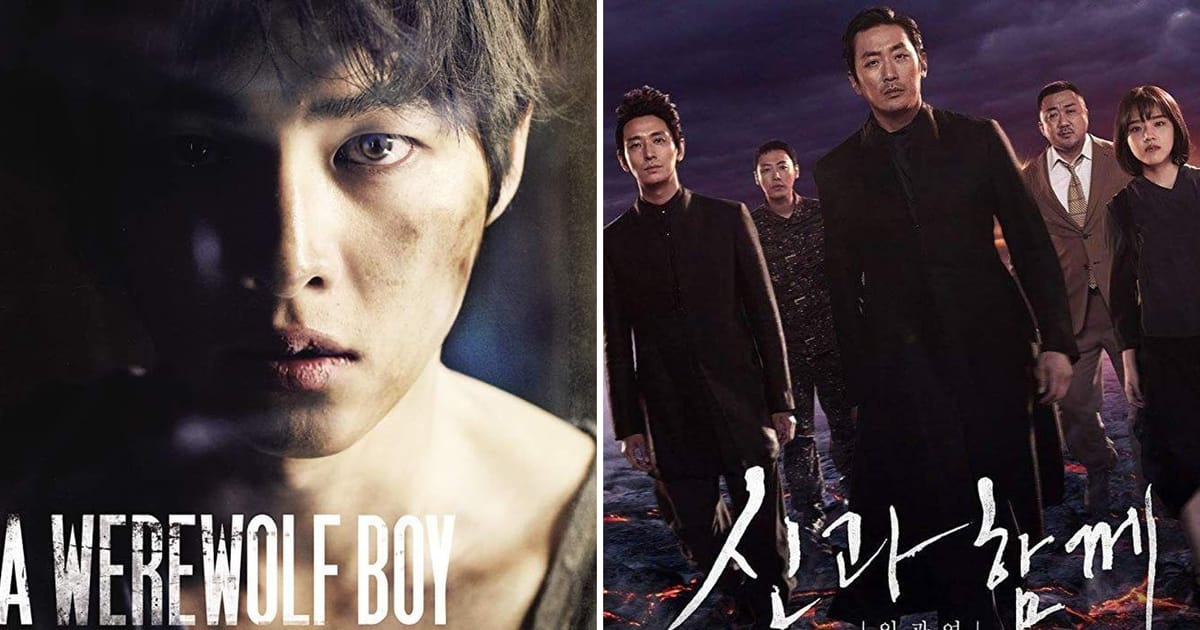
1. Along with the Gods: The Two Worlds (2017)
If you watch just one Korean fantasy blockbuster, make it Along with the Gods: The Two Worlds.
Based on a popular webtoon, this fantasy action epic follows a firefighter who dies in the line of duty
and is escorted through the afterlife by three grim-reaper-like guardians. To be reincarnated, he must
pass seven trials over 49 days, each revealing moral choices and family secrets.
The movie blends dazzling VFX, courtroom drama in hell, tear-jerking family melodrama, and jokes that land
even through subtitles. No surprise it became a box office phenomenon in Korea, pulling in over 10 million
admissions and opening the floodgates for more large-scale fantasy films.
2. Along with the Gods: The Last 49 Days (2018)
The sequel doubles down on everything audiences loved: the same trio of afterlife guardians, bigger
world-building, and deeper dives into their thousand-year backstories.
While the first film focuses more on the human soul on trial, The Last 49 Days shifts the emotional
center to the guardians themselves and a household god on Earth.
It’s rare for a sequel to feel this essential, but here the mythology clicks into place. Think of the
two movies as one long fantasy saga about guilt, forgiveness, and how even gods have unresolved trauma.
3. A Werewolf Boy (2012)
Somewhere between fairy tale and heartbreak, A Werewolf Boy tells the story of a feral boy with
supernatural strength who is taken in by a rural family and slowly forms a bond with their teenage daughter.
It’s more tragic romance than monster horror, and the fantasy element exists mainly to ask: what happens
when unconditional love meets a world that doesn’t know what to do with something different?
The film became one of Korea’s most successful melodramas and helped cement Song Joong-ki as a major star
all while proving that fantasy doesn’t need massive CGI if the emotional core is strong.
4. The Witch: Part 1 – The Subversion (2018)
File this under “X-Men gone very, very Korean.” The Witch: Part 1 – The Subversion follows a seemingly
ordinary high school girl with amnesia who turns out to be an engineered weapon with terrifying psychic and
physical powers.
The movie starts like a small-town drama, then shifts gears into full-blown superhuman carnage.
It’s technically action-thriller, but the superpowered experimentation and mysterious lab backstory give it
a strong sci-fi fantasy vibe. If you like your fantasy bloody and stylish, this one is a must.
5. The Host (2006)
Bong Joon-ho’s iconic monster movie might be shelved as “horror,” but its mutated river creature and
eco-nightmare premise sit squarely in the realm of dark fantasy.
When a toxic-waste-spawned beast emerges from Seoul’s Han River and snatches a young girl, her deeply
dysfunctional family launches a desperate rescue mission.
The film is legendary for blending monster thrills with political satire and family drama. It’s also
one of the key titles that introduced global audiences to the idea that Korean genre cinema doesn’t
respect boundaries and is better for it.
6. Train to Busan (2016)
Yes, it’s a zombie movie. But zombies are classic dark-fantasy creatures, and Train to Busan uses
them to turn a simple train ride into an apocalyptic obstacle course. The story follows a father and
daughter trapped on a speeding train as a viral outbreak turns passengers into ravenous undead.
What lifts it into “all-time best” territory is the way it balances character arcs, social commentary,
and action set pieces. By the end, you’re not just terrified you’re emotionally wrecked.
7. Thirst (2009)
Park Chan-wook’s Thirst reimagines the vampire myth as a darkly comic, morally tangled love story.
A Catholic priest volunteers for a medical experiment, dies, and then returns with a thirst for blood and a
very inconvenient lack of self-control.
The fantasy element here is classic vampirism but the execution is singularly Korean: stylized violence,
pitch-black humor, and anguished questions about faith, desire, and guilt.
8. Save the Green Planet! (2003)
This cult gem is the kind of movie you compare other movies to, not the other way around.
Save the Green Planet! centers on an unstable man convinced that a corporate executive is actually
an alien trying to destroy Earth. Kidnapping, torture, and cosmic paranoia follow with a twist that
leans heavily into sci-fi fantasy.
It’s wild, weird, and not for the faint of heart, but its genre-blending ambition has made it a long-standing
favorite among Korean cinema fans.
9. Psychokinesis (2018)
From the director of Train to Busan, Psychokinesis is basically “what if a deadbeat dad suddenly
got superhero powers?” After drinking water from a meteor site (as one does), a security guard develops
telekinesis and tries to use it to help his estranged daughter fight ruthless developers.
It’s a lighter, more comedic take on superhero tropes, with grounded family drama anchoring the flying cars
and floating furniture.
10. Il Mare (2000)
If time travel romances are your weakness, Il Mare is essential viewing. The film follows two people
living in the same lakeside house but separated by two years, who begin exchanging letters through a
mysterious mailbox that bridges time.
It’s a quiet, melancholic fantasy about timing, missed chances, and the idea that the right person may be
in the wrong year. Hollywood loved it enough to remake it as The Lake House, but the original keeps
its own distinct magic.
11. The Beauty Inside (2015)
In The Beauty Inside, the protagonist wakes up every day in a completely different body different age,
gender, and face but with the same memories and personality.
This magical-realist premise sets up a romance that questions what really makes someone who they are.
The fantasy hook is high-concept, but the film stays emotionally grounded, exploring identity, intimacy, and
the exhausting logistics of dating when you literally look like a stranger every morning.
12. Spellbound (2011)
Equal parts rom-com and ghost story, Spellbound follows a stage magician who hires a socially awkward woman
for his show, only to discover she’s haunted by a vengeful spirit that scares away anyone who gets too close.
The movie has genuine jump scares, but it’s the offbeat humor and slow-burn chemistry that keep it charming.
Think “date night, but the third wheel is a ghost with boundary issues.”
13. Hello Ghost (2010)
After a man’s failed suicide attempt, he begins seeing four ghosts who refuse to leave him alone until he
fulfills their wishes.
Hello Ghost wraps its supernatural premise around themes of loneliness, found family, and healing, with a
twist ending that hits much harder than you expect.
14. Miss Granny (2014)
One of the most popular Korean fantasy comedies, Miss Granny follows a 70-year-old woman who steps into a
mysterious photo studio and walks out in her 20-year-old body.
She seizes the chance to chase youthful dreams and low-key meddle in her family’s lives under a new identity.
The movie is pure comfort viewing, combining body-swap hijinks with surprisingly sharp commentary on ageism
and regret.
15. Wonderful Nightmare (2015)
In Wonderful Nightmare, a tough, single, high-powered lawyer dies in a car accident only for heaven’s
clerks to realize there’s been a clerical error. To fix it, they send her back to Earth… but in the life of a
suburban housewife with a husband and child.
The fantasy setup fuels a classic “second chance at life” story, packed with culture shock comedy and genuine
emotional growth.
16. Woochi: The Taoist Wizard (2009)
Woochi (also known as Jeon Woochi: The Taoist Wizard) is a sprawling fantasy romp about a mischievous
wizard from the Joseon era who is sealed away in a scroll then accidentally released into modern Seoul,
where he has to battle goblins and other supernatural threats.
It’s energetic, goofy, and packed with special-effects-driven set pieces. If you want something that feels like
a Korean superhero movie mashed with folklore, this is it.
17. Arahan (2004)
A clumsy traffic cop discovers he has the potential to become a martial arts master when he’s drawn into a group
of hidden Taoist warriors protecting the city. Arahan mixes wuxia-style powers, slapstick humor, and
urban fantasy world-building.
18. Space Sweepers (2021)
Often labeled sci-fi, Space Sweepers scratches the same itch as big Western space fantasies. Set in 2092,
it follows a ragtag crew of junk collectors in orbit who stumble across a mysterious child android linked to a
weapons scandal and a mega-corporation.
You get found family vibes, space chases, and sleek world-building plus a reminder that Korean cinema is just
as comfortable among the stars as it is in haunted houses.
19. Monstrum (2018)
Set during the Joseon era, Monstrum follows a royal investigator hunting down a mysterious creature blamed
for a deadly plague. The film brings old-school monster-movie energy into a historical setting, blending court
intrigue with creature-feature thrills.
20. The Dude in Me (2019)
Body-swap fantasy meets high-school comedy in The Dude in Me. When a timid student and a hardened gangster
swap bodies after an accident, chaos naturally ensues.
The movie is packed with physical comedy and a surprisingly sweet emotional core.
21. Beautiful Vampire (2018)
Beautiful Vampire centers on a 500-year-old vampire who runs a quiet makeup shop and has sworn off drinking
human blood until she meets a human whose scent is dangerously tempting.
It’s a small, charming indie that leans more on mood and romance than jump scares.
22. Yobi, the Five-Tailed Fox (2007)
This animated fantasy reimagines the Korean folk legend of the gumiho (nine-tailed fox, here with five tails) as a
poetic coming-of-age story. A fox spirit taking on human form enrolls in a village school and slowly learns about
love, loss, and what it means to be human.
23. Ditto (2000)
Another time-bending romance, Ditto follows college students from different decades who communicate via
ham radio, unknowingly living years apart.
The film uses its fantasy mechanic to explore generational differences and the ache of relationships that can
never quite exist in the same moment.
24. Calla (1999)
In Calla, a man begins receiving messages and flowers from a mysterious woman messages that seem to come
from the past. When tragedy strikes, he uses a time-loop-like opportunity to try to change fate.
It’s a classic late-’90s Korean melodrama with a supernatural twist.
25. The Mimic (2017)
Loosely inspired by Korean myths about a spirit that mimics human voices, The Mimic follows a family who
encounters a strange child and eerie forest entity that may be more than it appears.
Strong atmospheric horror and folklore elements make this a must for fans of darker fantasy.
26. The Divine Fury (2019)
The Divine Fury shakes up the exorcism genre with MMA punches and glowing stigmata. After losing his faith
as a child, a champion fighter begins manifesting supernatural wounds and joins forces with a veteran priest to
battle demons in modern Seoul.
It’s part action movie, part religious dark fantasy.
27. Because I Love You (2017)
Rounding out the list is Because I Love You, a gentler body-hopping fantasy about a songwriter whose spirit
begins possessing different people involved in love-related problems.
Each “possession” becomes a mini story about empathy, romance, and second chances.
Why Korean Fantasy Movies Feel So Different
What makes Korean fantasy cinema stand out from Western fantasy isn’t just the monsters or magic it’s the tone.
Many of these films juggle genres: slapstick comedy next to tragedy, romance next to creature horror, theological
musings right beside superhero brawls. That tonal mix is especially clear in films like Along with the Gods,
Miss Granny, and Save the Green Planet!, where you might laugh, gasp, and ugly-cry within the same scene.
Another key ingredient is folklore. Fox spirits, grim reapers, household gods, and afterlife courts come directly
from Korean myth and shamanistic beliefs, then get updated with modern themes like labor precarity, urbanization,
and social isolation. Even when the story moves into space or onto a runaway train, there’s usually a grounded
human question at the center: What does family mean? How much guilt can a person carry? What are we willing to
sacrifice for someone we love?
For fantasy fans, that combination of world-building and emotional realism is the sweet spot which is why these
movies have developed such devoted global followings through streaming platforms, festivals, and late-night
“you have to watch this” recommendations.
Personal-Style Viewing Tips & Experiences With Korean Fantasy Films
So how do you actually dive into this list without getting overwhelmed? Think of Korean fantasy movies as a
buffet not a syllabus. You don’t have to watch them in strict ranking order. Instead, start with the mood
you’re in and pick accordingly.
If you’re in the mood for huge spectacle, loud sound design, and end-of-the-world stakes, queue up
Along with the Gods: The Two Worlds or Space Sweepers. Both feel like big-screen events even on a
laptop. They’re also good “gateway movies” for friends who claim they “don’t really do subtitles” by the time
they remember they’re reading, the film will have already thrown them into hell trials or space dogfights.
Want something that emotionally wrecks you in a gentle, poetic way? That’s where A Werewolf Boy, Il Mare,
Ditto, or Miss Granny shine. These films use fantasy as a soft filter over very human stories about
aging, regret, and the version of ourselves we wish we could meet. They’re ideal for quiet nights, rainy weather,
and anyone who likes to stare at the ceiling rethinking their life choices after the credits roll.
Horror-leaning titles like The Host, Train to Busan, The Mimic, and Thirst are best watched with the
lights off and snacks in hand. The scares are there, but what sticks with you is the way they smuggle in social
commentary from environmental disasters to class divides and religious hypocrisy. You may come for the zombies
and monsters, but you’ll leave thinking about government responses, corporate greed, and what people owe each
other in a crisis.
One fun way to experience these films is to build mini double features:
- “Afterlife Court Night”: Along with the Gods: The Two Worlds + Along with the Gods: The Last 49 Days
- “Time-Crossed Romance Night”: Il Mare + Ditto
- “Monsters & Metaphors Night”: The Host + Train to Busan
- “Body-Swap Chaos Night”: Miss Granny + The Dude in Me
Watching them back-to-back makes it easier to notice recurring themes: how Korean filmmakers use time travel to
talk about regret, or body swaps to critique gender roles and social expectations. It’s like a crash course in
storytelling tricks.
If you’re completely new to Korean cinema, don’t worry about picking the “perfect” starting point. The key is
to go in open-minded and let the tonal shifts wash over you. Scenes might switch from absurd humor to raw grief
in seconds that’s intentional. Many viewers who fall in love with these movies say the same thing: once you
get used to that rhythm, everything else can feel a little flat by comparison.
Finally, treat these movies as invitations into a broader culture. When a film references afterlife trials,
grim reapers, fox spirits, or shamanistic rituals, a quick search after the credits can turn a cool fantasy
sequence into a gateway to Korean myths and beliefs. Over time, that extra context makes rewatches richer and
helps you catch details like symbolic numbers, colors, or family dynamics that flew past the first time.
Whether you’re here for the tears, the jump scares, or the cosmic metaphysics, Korean fantasy movies reward
repeat visits. Build your own ranking, argue with friends about whether a certain title is “really” fantasy,
and most importantly, have fun getting lost in stories where anything time travel, reincarnation, magical
foxes, even space-trash crews is possible.
Conclusion
Korean fantasy cinema proves that magic doesn’t have to be confined to medieval castles or Western mythology.
From afterlife trials to body-swap comedies and time-crossed romances, these 25+ films show just how flexible
and emotionally potent the genre can be. Whether you’re a longtime K-movie fan or just starting your journey,
this list gives you plenty of portals to step through.