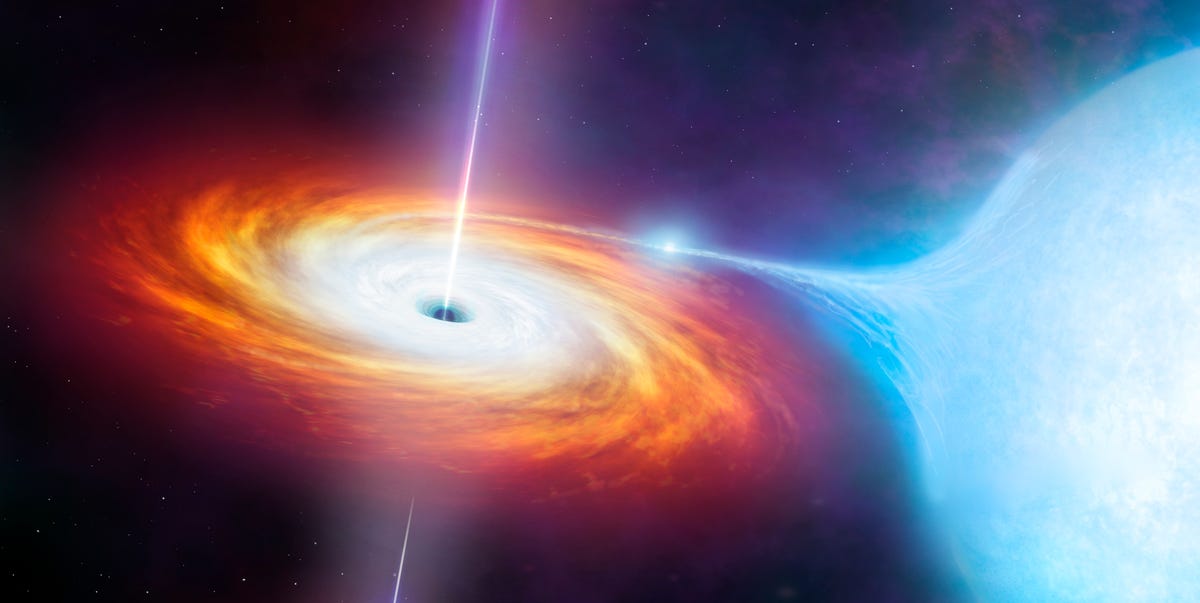
Black holes already have a reputation problem. They do not shine, they do not send postcards, and they have the table manners of a cosmic vacuum cleaner. Yet somehow, the biggest ones make the mystery even stranger. Supermassive black holes can weigh millions or billions of times more than the Sun, and many sit in the centers of galaxies like quiet landlords with terrifying gravity clauses.
The real puzzle is not simply that giant black holes exist. The puzzle is that some of them appear to have existed shockingly early in cosmic history. Astronomers have found evidence for enormous black holes when the universe was only a few hundred million to about a billion years old. In cosmic terms, that is not old age. That is toddlerhood with a beard, a mortgage, and a suspiciously large bank account.
So how did some black holes get so big so fast? The best answer may be that not all black holes started small. Some may have been born as heavy “seeds” when huge clouds of gas collapsed directly into black holes, skipping the normal route through stars. Others may have grown through short, wild feeding episodes that broke the usual speed limit. Add in black hole mergers, dense early galaxies, and the James Webb Space Telescope’s talent for finding weird red specks, and the story gets wonderfully messy.
The Big Black Hole Problem
In the modern universe, most large galaxies appear to host supermassive black holes at their centers. Our own Milky Way has Sagittarius A*, a black hole of about four million solar masses. That sounds dramatic until you meet the true heavyweights: monsters with masses hundreds of millions or billions of times that of the Sun.
Normally, scientists expect galaxies and their central black holes to grow together. A galaxy gathers gas, forms stars, merges with neighbors, and feeds its central black hole along the way. Over billions of years, the black hole fattens up through accretion, which is the polite scientific word for “eating nearby material with extreme gravitational enthusiasm.”
But early-universe observations have complicated that tidy picture. Some young galaxies seem to contain black holes that are much too massive for their hosts. In the nearby universe, the mass of a central black hole usually follows a rough relationship with the mass of the galaxy around it. In some early galaxies observed with Webb, however, the black hole can look wildly overbuilt, like finding a jet engine attached to a bicycle.
How Black Holes Usually Form
To understand the mystery, start with the ordinary pathway. A massive star burns through its nuclear fuel, loses the battle against gravity, and collapses. If the leftover core is heavy enough, it forms a stellar-mass black hole. These black holes may weigh several to dozens of solar masses.
That is impressive, but it is not enough to easily explain billion-solar-mass black holes in the early universe. Growing from a 10- or 100-solar-mass seed to a billion solar masses takes time, fuel, and very efficient feeding. The universe may be generous, but it is not a buffet with unlimited refills and no physics.
Black holes can also grow by merging. When two black holes spiral together, they release gravitational waves and form a larger black hole. LIGO and Virgo have detected such mergers, including events that produced intermediate-mass black holes. This proves that black holes can build upward by collision. Still, mergers alone may not explain the earliest supermassive black holes unless the young universe was running an extremely aggressive cosmic matchmaking service.
The Heavy Seed Idea
One of the most exciting explanations is the “heavy seed” model. Instead of beginning as the corpse of one massive star, a black hole might form from the direct collapse of a giant cloud of pristine gas. In this scenario, the cloud avoids fragmenting into many normal stars. It collapses as one enormous object and creates a black hole far larger than an ordinary stellar remnant.
That matters because the starting line changes everything. A black hole seed of 10,000 to 100,000 solar masses has a much easier path to becoming supermassive than a seed of 100 solar masses. Imagine two runners trying to reach the same finish line, except one begins the race five miles ahead and the other is still tying its shoes.
Direct collapse may have been possible in special early-universe environments. The first gas clouds were mostly hydrogen and helium, with very few heavier elements. Under the right conditions, radiation from nearby young stars may have prevented the gas from cooling and breaking into smaller star-forming clumps. Instead of making many stars, the cloud could have collapsed into a massive black hole seed.
Webb’s Little Red Dots Are Making Things Interesting
The James Webb Space Telescope has become the detective in this story, and its clue board is covered with red string. Webb has found compact, faint, reddish objects in the early universe often called “Little Red Dots.” They are small, distant, and strange enough to make astronomers reach for both coffee and new theories.
Some Little Red Dots may contain actively growing black holes. Others may be dense stellar systems or unusual objects surrounded by thick gas. Recent work has even suggested that some could be “black hole stars,” giant envelopes of gas powered by black holes at their centers rather than by ordinary nuclear fusion. That sounds like science fiction, but it is being discussed because the data demand creative explanations.
The important point for the black hole growth mystery is this: Webb is finding signs that some early black holes were already large when their host galaxies were still small. In some cases, the black hole may have grown before the galaxy fully assembled around it. That flips the classic chicken-and-egg question into a cosmic breakfast argument: did the galaxy come first, or did the black hole?
A Case Study: A Black Hole That May Have Formed Before Its Galaxy
One especially fascinating Webb result involves a Little Red Dot known as Abell2744-QSO1, seen as it existed about 700 million years after the Big Bang. Because it is magnified by gravitational lensing from a massive galaxy cluster, astronomers can study it in unusual detail. The object appears tiny, but the evidence points to a central black hole of tens of millions of solar masses.
That is startling because the surrounding system does not look like a mature, massive galaxy that had plenty of time to feed such a black hole. Instead, the black hole may be overmassive compared with its host. If confirmed, this supports the idea that some black holes did not patiently wait for galaxies to build them. They may have started big and shaped their neighborhoods afterward.
Another Route: Eating Faster Than Expected
Heavy seeds are not the only possible answer. Some black holes may begin smaller but grow during brief episodes of extreme feeding. Astronomers call this super-Eddington accretion. The Eddington limit is the point where the outward pressure from radiation balances the inward pull of gravity. In simple terms, it is the black hole cafeteria’s official speed limit.
But nature enjoys loopholes. If gas flows in unevenly, if radiation escapes in certain directions, or if the surrounding environment is dense enough, a black hole may swallow matter faster than the classic limit suggests. NASA’s Chandra X-ray Observatory and Webb have helped identify an early black hole called LID-568 that appears to be feeding at more than 40 times its theoretical limit. That kind of growth spurt, even if short-lived, could help explain how early black holes bulked up so quickly.
This does not mean black holes can ignore physics. It means the real universe is more complicated than a neat classroom diagram. Gas can be clumpy. Magnetic fields can matter. Outflows can carry energy away. Accretion disks can change shape. A black hole may not eat steadily like a polite diner; it may binge, burp cosmic winds, go quiet, and then start again.
Mergers Still Matter
Black hole mergers remain an essential part of the story. LIGO and Virgo have shown that black holes collide and combine, forming heavier objects. The gravitational-wave event GW190521 produced a black hole of about 142 solar masses, placing it in the intermediate-mass range. Some scientists think the black holes involved may themselves have been products of earlier mergers.
This “hierarchical merger” pathway could build black holes step by step, especially in dense environments such as star clusters, galactic nuclei, or disks around active galactic centers. One merger makes a bigger black hole. That bigger black hole merges again. Repeat enough times, and the universe starts playing gravitational Jenga.
However, mergers are probably not the whole explanation for the earliest supermassive black holes. Mergers take time, and the early universe did not offer much of it. The most likely picture may involve several channels working together: heavy seeds, rapid accretion, and mergers all contributing under different conditions.
Quasars: The Bright Clue Around a Dark Object
Black holes themselves do not emit light, but the material falling toward them can become spectacularly bright. When huge amounts of gas spiral into a supermassive black hole, they form a hot accretion disk. The disk can shine so intensely that the galaxy’s center becomes a quasar, one of the brightest types of active galactic nucleus.
Quasars are useful because they reveal feeding black holes across vast distances. Their light can travel for billions of years before reaching us, letting astronomers look back into the young universe. When scientists find extremely luminous quasars very early in cosmic history, they are essentially finding black holes that have already won the growth lottery.
The problem is that some of these quasars appear too mature too soon. Their existence suggests that black hole growth began early, perhaps with unusually massive seeds or unusually efficient feeding. Every new distant quasar is not just a bright object; it is a challenge to the cosmic timeline.
Why This Changes Our Picture of Galaxies
If some supermassive black holes formed before their galaxies fully grew, then black holes may not be passive passengers in galaxy evolution. They may be early architects. A growing black hole can heat gas, drive winds, regulate star formation, and reshape its host galaxy.
That is a big deal. For decades, galaxies were often treated as the main stage and black holes as the intense central actors. Webb’s early results suggest the actor may sometimes help build the stage. In the young universe, a powerful black hole inside a small galaxy could have an outsized influence, because the galaxy itself was compact and vulnerable to feedback.
This feedback can be constructive or destructive. In some cases, outflows from black holes may compress gas and encourage star formation. In others, the energy may blow gas away and shut star formation down. Either way, the relationship between galaxies and black holes looks less like a calm partnership and more like a dramatic roommate situation involving gravity, radiation, and someone definitely not doing the dishes.
What Scientists Still Need to Prove
The heavy seed theory is exciting, but it is not settled. Astronomers still need more observations, better spectra, deeper X-ray data, and improved models. Little Red Dots are especially tricky because several different scenarios can explain parts of the evidence. A compact galaxy packed with stars, a black hole wrapped in gas, a direct-collapse object, or a black hole star can sometimes mimic similar colors and brightness patterns.
That is why spectroscopy matters. By splitting light into its component wavelengths, Webb can identify chemical fingerprints, measure gas speeds, and estimate black hole masses. Chandra adds X-ray information, while Hubble helps with optical and near-infrared context. Future gravitational-wave observatories may eventually detect mergers of massive black hole seeds directly, giving scientists an entirely new way to test these ideas.
The Most Likely Answer: There Is More Than One Answer
So, how do some black holes get so big? The most honest answer is probably: several ways, depending on where and when they formed.
Some black holes may have started as light seeds from the first stars and grown through repeated feeding. Some may have started as heavy seeds from direct-collapse gas clouds. Some may have experienced brief super-Eddington growth spurts. Some may have grown through mergers in dense cosmic neighborhoods. The biggest early black holes may have used more than one of these routes, because apparently the universe loves a combination platter.
What makes the current moment so exciting is that scientists are no longer relying only on theory. Webb is finding possible early seed populations. Chandra is revealing hidden feeding activity. LIGO and Virgo are showing that black holes merge into heavier black holes. Hubble’s decades of quasar and galaxy studies provide the long view. The mystery is not solved, but the suspects are finally lining up.
Experience: What This Mystery Feels Like From Earth
Thinking about giant black holes can feel abstract at first, because no one is exactly bumping into one on the way to the grocery store. But the experience becomes more personal when you imagine what astronomers are really doing. They are not watching black holes grow in real time like plants on a windowsill. They are collecting ancient light, decoding faint signals, and reconstructing events from a universe that no longer exists in that form.
Picture standing outside on a clear night and looking at the sky. Most stars you see belong to our own galaxy, but beyond them are galaxies so distant that their light began traveling before Earth had humans, mammals, dinosaurs, or even complex life. Now imagine using a telescope powerful enough to catch light from galaxies that existed near the beginning of cosmic time. That is the emotional punch of Webb. It turns astronomy into archaeology, except the ruins are made of light and the artifacts are baby galaxies with suspiciously giant black holes inside.
The experience of learning about black holes also changes how scale feels. A black hole of ten solar masses is already difficult to picture. A black hole of a billion solar masses is almost rude. It stretches ordinary intuition until it snaps like an old rubber band. Yet these objects are not fantasy. They affect galaxies, launch jets, stir gas, and leave fingerprints in radiation that telescopes can measure.
There is also something oddly comforting about the uncertainty. Science often gets presented as a finished textbook, but black hole research shows science in motion. Astronomers find Little Red Dots and initially wonder whether they have broken cosmology. Then new spectra arrive. A better model appears. Another observation complicates that model. Someone proposes a black hole star, and suddenly the universe has become weirder, but also more understandable.
For readers, this is a reminder that curiosity does not require a Ph.D. You can follow the logic: if a black hole is too big too early, then either it started bigger, grew faster, merged more often, or some combination of all three. That simple reasoning opens the door to some of the most advanced research in astrophysics.
The next time you see a telescope image of a tiny red dot, do not dismiss it as a pixel with ambition. That dot may be a clue to how the first cosmic giants were born. It may represent a black hole wrapped in gas, a young galaxy in disguise, or a seed that grew into one of the gravitational monsters anchoring galaxies today. In other words, the universe may be whispering one of its origin stories in red.
Conclusion
The mystery of how some black holes get so big is one of the most important questions in modern astronomy. The old explanationsmall black holes slowly growing over billions of yearsstill works for many cases, but it struggles with the enormous black holes seen in the early universe. New observations suggest a richer picture. Some black holes may have been born massive through direct collapse. Others may have grown through brief episodes of extreme feeding. Still others may have bulked up through mergers.
The most exciting possibility is that supermassive black holes were not always the final product of galaxy evolution. In some early systems, they may have arrived first and helped shape the galaxies around them. Thanks to Webb, Chandra, Hubble, LIGO, and the next generation of observatories, scientists are finally getting closer to understanding how the universe built its most extreme objects. The answer may not be simple, but when the subject is a billion-solar-mass black hole, simple was probably never on the menu.
Note: This article is based on real astronomical research and public science reporting. Because early-universe black hole studies are developing quickly, future Webb, Chandra, Hubble, and gravitational-wave observations may refine or change some interpretations.