Scroll through any tattoo studio’s Instagram feed and you’ll see it: bold black curves,
interlocking lines, and patterns that look like they’ve wrapped around a warrior’s arm
for centuries. Tribal tattoos are striking, timeless, and seriously photogenic. But
behind every “cool tribal sleeve” on your screen, there’s a lot of history, culture,
and meaning you don’t see at first glance.
This guide is your picture-led walk-through of popular tribal tattoo designs, how
they’re typically placed, what many of the patterns represent, and how to approach
tribal ink with respect. Imagine you’re flipping through a massive lookbook: sleeves,
armbands, back pieces, and small accent tattoos, all in bold black. We’ll describe
what those photos would show, so you can build a design that looks great and
feels right.
What People Mean When They Say “Tribal Tattoo”
The term “tribal tattoo” is used everywhere, but it’s not one single style. Traditionally,
it refers to tattooing practices developed by Indigenous cultures across Polynesia,
the Pacific Islands, parts of Southeast Asia, Africa, and the Americas. These markings
were (and are) tied to identity, lineage, social standing, spirituality, and life
milestones.
In modern Western tattoo studios, “tribal” often gets used as shorthand for:
- Polynesian-inspired designs with flowing curves and geometric motifs.
- Maori or Samoan influenced pieces that wrap around the arm, chest, or leg.
- Modern blackwork that borrows the look of tribal patterns but isn’t tied to a specific culture.
- Celtic knots and black linework sometimes (loosely) labeled as tribal.
The key takeaway: real tribal tattooing comes from living cultures, not just a Pinterest
aesthetic. That doesn’t mean you can’t get a bold black design, but it does mean you
should know where the ideas come from and avoid copying sacred symbols you don’t
understand.
A Short History Woven in Ink
Ancient Roots Around the World
Archeologists have found tattooed mummies thousands of years old, with patterns believed
to reflect protection, social status, or spiritual power. In many societies, tattoos
marked adulthood, bravery in battle, or important life achievements. Far from being
“just decoration,” they were visual passports to who you were in your community.
Polynesian and Maori Traditions
In Polynesia, Samoan tatau and Maori ta moko are deeply tied to ancestry
and tribal identity. Full-body or large-area tattoos might tell stories about family,
rank, and the wearer’s role. Designs use repeated motifsshark teeth, spearheads,
enata (human figures), waves, and moreeach placed carefully for meaning, not just
aesthetics.
Native Traditions and Other Lineages
Many Native American peoples historically used tattoos to mark life stages, clan ties,
or spiritual experiences. Elsewhere, cultures in Borneo, the Philippines, and parts of
Africa used stylized animals, rosettes, and geometric motifs as talismans of strength,
fertility, or protection.
Today, there’s a visible revival of traditional tattooing in several Indigenous
communities. For them, these aren’t “trends” at allthey’re acts of cultural survival
and pride.
The Modern “Tribal” Look
In the 1990s and 2000s, tribal armbands and shoulder pieces exploded in mainstream
fashion. Much of what spread through malls and magazines then was a simplified,
decontextualized version of Polynesian and other traditional styles. Contemporary
artists have since pushed toward two healthier paths:
-
Authentic cultural work, done by or with artists who deeply understand
the tradition and often work with clients from that culture. -
Modern blackwork, which uses abstract geometry and bold shapes inspired
by tribal aesthetics without directly copying sacred symbols.
Picture List of Popular Tribal Tattoo Designs
Since we can’t physically hand you a photo album here, think of this as a “verbal
picture list.” Each entry describes the kind of image you’d see in a portfolio, plus
where it usually sits on the body and what vibe it gives.
1. Polynesian Tribal Sleeve (Arm or Leg)
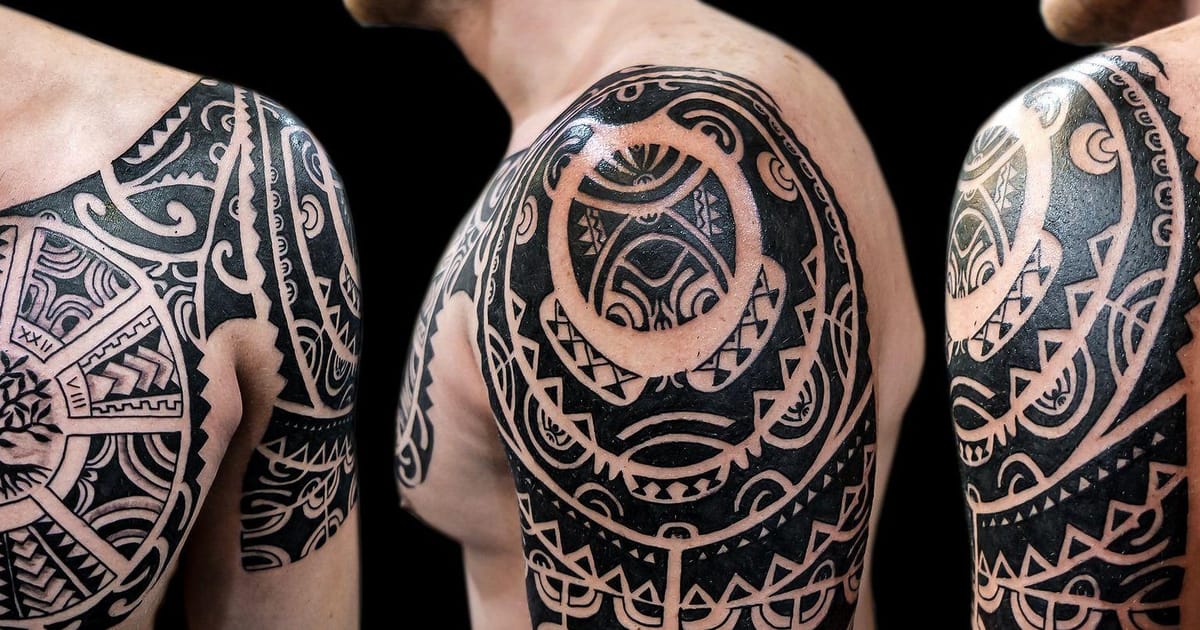
Picture a full sleeve wrapping from shoulder to wrist: thick black bands, triangles,
flowing curves, and repeating motifs stacked like architectural layers. The negative
(uninked) skin is as important as the black ink, creating a rhythm of light and dark.
On the leg, you might see similar patterns spiraling around the calf like armor.
These designs are often customized to a person’s story. Even when someone wants a
“Polynesian style” without specific cultural claims, skilled artists will avoid
copying sacred family or tribal marks and instead build a unique, respectful
composition.
2. Maori-Inspired Shoulder and Chest Panels
Imagine a photo of a shoulder and upper chest covered in flowing curves that look like
carved wood: spirals, hook shapes, and intricate linework that radiates from the
collarbone. The design usually follows the body’s muscle lines, emphasizing strength
and movement.
Important: Real ta moko is highly personal and tied to Maori identity.
Non-Maori getting “Maori tattoos” should stick to generic inspired patterns crafted by
an educated artist, not direct copies of someone’s sacred facial or head markings.
3. Samoan-Style Bands and Panels
Visualize a black band encircling the thigh or midsection, made of tiny repeating
triangles, lines, and symbolic elements. Traditional Samoan pe’a (for men)
and malu (for women) are large, often painful rites of passage, done by
cultural experts and meant for people within that community.
In modern studios, you’ll see smaller Samoan-inspired bands on the arm, forearm, or
calf. Good artists acknowledge the tradition, simplify the motifs, and explain what
they are and aren’t willing to tattoo if a client is not Samoan.
4. Celtic Tribal Knots and Crosses
Think of an image showing a blackwork Celtic cross on the upper arm: intertwined
knotwork forming endless loops, sometimes combined with animals or tree motifs. While
technically different from Polynesian tribal styles, people often categorize Celtic
knotwork under the same broad “tribal” umbrella because of its bold, patterned look.
These designs are common as:
- Upper arm badges or shields.
- Back-of-the-neck or spine pieces.
- Forearm wraps using knots as decorative borders.
5. Modern Blackwork Tribal Sleeves
Now picture a minimalist black sleeve: thick blocks of ink, crisp geometric shapes,
maybe a few organic curves, but not tied to any specific culture. It still feels
powerful and “tribal,” but the artist intentionally avoids sacred motifs from living
traditions.
These designs are popular for:
- People who love bold, abstract art.
- Covering old tattoos with dense black sections.
- Creating futuristic, armor-like patterns across the arms and chest.
6. Animal-Inspired Tribal Tattoos
Imagine a wolf head made of black, angular lines instead of realistic fur, or a dragon
built entirely from swirling tribal curves. Animal tribal tattoos typically show:
- A strong silhouette (wolf, lion, eagle, turtle, shark).
- Interior filled with tribal-style curves and spikes.
- Placement on the upper arm, back, chest, or calf.
For many people, the animal symbolizes traits they want to embodycourage, wisdom,
loyaltywhile the tribal style adds intensity and motion.
7. Feminine Tribal Accents: Spine, Hip, and Sternum
Look at any curated gallery and you’ll see more delicate tribal-inspired pieces:
flowing lines hugging the hip, a vertical design down the spine, or a small sternum
tattoo peeking out from under a top. These often:
- Use thinner lines and more negative space.
- Incorporate curves that echo flowers, waves, or filigree.
- Complement the body’s shapes instead of filling entire limbs.
While they may be “lighter” visually, the placement (especially spine or sternum) can
be quite sensitive, so don’t underestimate the pain factor.
Meanings Behind Common Tribal Tattoo Motifs
Every culture has its own visual language, but some themes appear again and again in
tribal-inspired designs:
-
Triangles and shark teeth: Often associated with protection,
strength, or warrior energy. -
Waves and ocean motifs: Journey, change, connection to the sea or
nature. - Interlocking bands: Unity, continuity, family, or community.
-
Animal shapes: Embodying specific qualities like courage (lion),
guidance (eagle), or adaptability (octopus). - Spirals and curves: Growth, life paths, and cycles.
If you’re getting a design influenced by a particular culture, ask your artist what
the individual elements usually symbolize and whether any of them are considered
sacred or restricted.
Cultural Respect: Avoiding Appropriation With Tribal Tattoos
Let’s talk about the elephant in the tattoo studio: cultural appropriation. Tribal
tattoos come from specific communities that have survived colonization, bans on their
traditions, and heavy stigma. Treating those designs as cheap aesthetic “skins” is
understandably upsetting.
A respectful approach includes:
-
Doing your homework: Learn where the style originated and how it’s
used. -
Avoiding sacred or highly specific designs: Facial Maori patterns,
Samoan pe’a/malu, or community-specific marks are not generic clip art. -
Choosing the right artist: Many studios specialize in particular
traditions and can tell you what is appropriate for you and what isn’t. -
Listening if someone says “no”: If an artist declines to tattoo a
certain symbol on you, they’re probably protecting their culture and their own
ethics.
You can absolutely have bold blackwork that nods to tribal aesthetics without copying
sacred designs. The key is transparency and respect: you’re inspired by a style, not
claiming a heritage that isn’t yours.
Planning Your Own Tribal Tattoo Design
Choosing Placement
Placement changes the entire “picture” of a tribal tattoo. Think about:
-
Arms and shoulders: Great for sleeves, bands, and panels that
follow muscle lines. -
Chest and back: Ideal canvases for large story-driven pieces or
symmetrical designs. -
Legs: Perfect for wraps and vertical panels, especially calf and
thigh. -
Smaller areas: Wrists, ankles, behind the ear, or the side of the
ribcage for small symbolic marks.
Working With a Tattoo Artist
Showing up with 50 screenshots is a good start, but the best tribal pieces happen when
you let your artist actually design for your body. Here’s how to build a good
collaboration:
-
Bring reference photos and explain what you like: the flow, the density, the level
of detail, the placement. - Be honest about your background and what you’re comfortable representing.
-
Ask the artist what styles they specialize in; a blackwork or Polynesian specialist
will do better work than someone who mostly does delicate watercolor tattoos. -
Give them room to adapt the design around your anatomy rather than forcing a
Pinterest image onto a completely different body shape.
Pain, Healing, and Long-Term Care
Tribal tattoos are almost always solid black, which means lots of filling. Even if the
linework itself is simple, packing in all that ink takes time and persistence. Expect:
-
Moderate to high pain on bony areas (ribs, spine, ankles) and
sensitive zones (sternum, inner arm). -
Multiple sessions for large sleeves, backs, or chest/shoulder
combinations. -
High impact aging: Large black areas usually age well, but you still
need sunscreen and moisturizer to prevent fading and drying.
Follow your artist’s aftercare instructions (wash gently, avoid soaking, no picking at
scabs) and you’ll have sharp, crisp lines that still look good in your “picture list”
decades from now.
Real-World Experiences With Tribal Tattoos: Stories and Lessons
Reading about tribal tattoos is one thing; living with one is a whole different
adventure. Here are some common experiences people report once they commit to a bold
tribal piece.
The First Big Session Reality Check
Many people walk into the studio thinking, “It’s just black lines, this will be quick.”
Then they realize: those “simple” patterns are made of miles of linework and heavy
shading. A full tribal sleeve can easily take multiple sessions of three to five hours
each. The experience is part physical challenge, part meditation. You learn your
limits, discover which songs help you zone out, and find out exactly how much you
appreciate numbing spray.
Conversations With Strangers
Big tribal tattoos act like conversation magnets. At the gym, in line at the grocery
store, or on the beach, people will ask:
- “What does it mean?”
- “Is it Polynesian?”
- “Did it hurt?”
If your piece is culturally specific, you may also get questions (or comments) about
your background. Some people enjoy explaining their heritage or the story behind
their tattoo. Others realize they prefer to keep it short and sweet: “It’s personal,
but thanks for asking.” Either way, it’s worth thinking ahead about what you want to
share.
Learning About Culture After the Tattoo
A surprisingly common story: someone gets a “tribal” tattoo because they love the
look, then later learns how deeply rooted these designs are in specific cultures.
That can be uncomfortablebut it can also be a turning point. Many people respond by
educating themselves, supporting Indigenous artists, or being more thoughtful about
future tattoos.
Ideally, you do that research beforehand. But if you’re reading this with a decade-old
tribal band around your bicep, don’t panic. You can still be respectful now: learn the
history, acknowledge any missteps, and be more intentional going forward.
Falling in Love With the Process
Once you get a well-designed tribal tattoo, there’s a good chance you’ll want more.
People often start with an arm band and end up extending it into a half sleeve, then a
chest panel. The high contrast, the way the patterns wrap around muscles, the sense of
wearing permanent “armor”it’s addictive in the best way.
Long-Term Relationship With Your Design
Years down the line, the biggest factor in whether someone still loves their tribal
tattoo isn’t the trend cycleit’s how well the piece fits their body and values. A
carefully planned, respectful design that flows with your physique and means something
to you will age beautifully, even as styles shift. A rushed copy of a random image,
not so much.
That’s why it’s worth taking your time now: build a picture list of tribal tattoo
designs you truly love, learn where they come from, and then partner with an artist who
can translate that inspiration into something uniquely yours. When the ink settles and
you catch your reflection years from today, you’ll be glad you did the homework.
Conclusion: Building Your Own Tribal Tattoo Story
Tribal tattoos aren’t just about sharp lines and bold black ink; they’re about stories,
identities, and visual power that has traveled through centuries. Whether you’re drawn
to Polynesian-inspired sleeves, Celtic knots, or modern blackwork, the goal is to
create a design that honors both the cultures that inspired it and the life you’re
actually living.
Use this guide as your mental picture list: a starting point for imagining what your
future tattoo photos might look likehow they wrap around your arm, frame your chest,
or flow down your spine. Then take the next step: research, reflect, and work with an
artist who respects the tradition as much as you respect your own skin. The result
will be more than just a trend; it’ll be a piece of art you’re proud to wear every
single day.