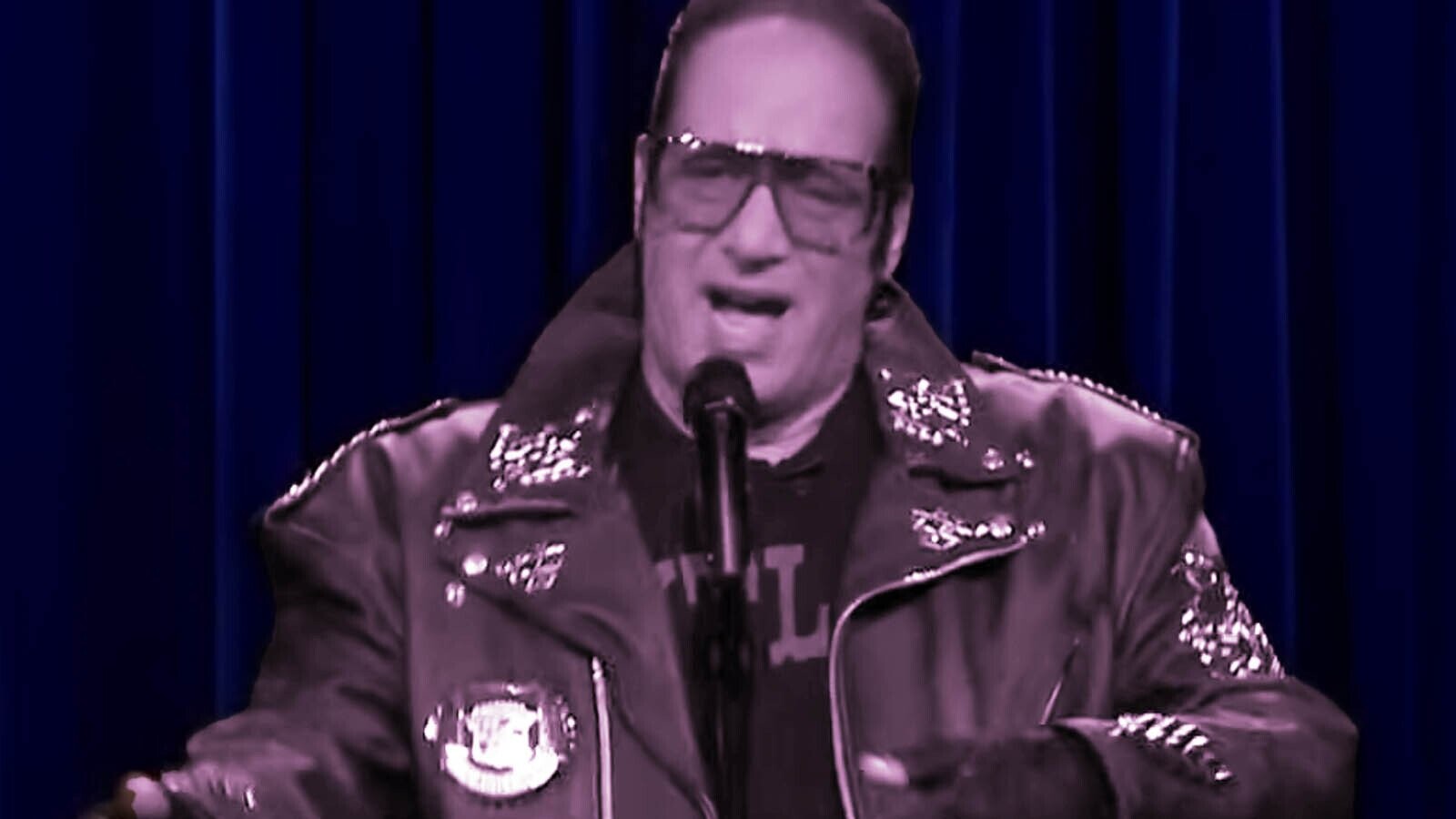
Andrew Dice Clay is famous for a stage persona that hits like a leather jacket to the face: loud, brash, deliberately outrageous, and historically very, very not safe for “bring your parents” night.
Which is why the idea of Dice trying to go cleanspecifically with dad materiallands like a unicorn ordering a black coffee and asking to talk about 529 plans.
And yet: it happened. At least once, in a comedy-club moment that’s become stand-up lorepart cautionary tale, part reminder that the audience is always a voting booth, and laughter is the only ballot that counts.
A Quick Primer: The Diceman vs. “Dad, Where’s the Wrench?”
Andrew Dice Clay (born Andrew Clay Silverstein) became a cultural lightning rod in the late ’80s and early ’90s by committing hard to “The Diceman”a cartoonishly hyper-macho, street-tough character
who treated shock as a sport. The persona sold tickets, sparked protests, and made him famous enough to be discussed like a social problem and marketed like a rock tour.
Over time, Clay also developed a parallel public identity: the working comic and actor who could deliver surprising dramatic turns, show up in TV and film, and talk about family with genuine pride.
That contrast matters here, because “doing clean jokes about being a dad” isn’t just changing vocabularyit’s changing the entire agreement between performer and audience.
In stand-up, your persona is the container. Your jokes are the liquid. If you change containers mid-pour, you’re going to mop. A lot.
The Night Dice Went Clean (And the Room Went… Quiet)
The story most people repeat comes through comic Jay Mohr, who described watching Clay attempt a clean set at the Laugh Factory. The premise was disarmingly normal:
Clay talked about taking his kids to the parkand the kids insisting they should bring their bikes.
It’s classic parent comedy territory: the optimism of children, the mild logistics panic of adults, and that uniquely parental feeling of thinking you’re doing “the thing,” only to discover the thing was never needed.
In the bit, the bikes become a symbol of wasted effort, and Clay circles back to the same lineessentially: “What about the bikes?”
Here’s the problem: instead of laughter, he got silence. Not heckling. Not groans. The worst kind of responsepolite nothing. So he repeated the line again.
Still nothing.
And thenbecause this is an Andrew Dice Clay storyhe snapped back into his proven language and persona, turning his attention to a front-row audience member with a crude remark.
The crowd exploded. Not because the earlier “bikes” idea was impossible to understand, but because the audience was finally hearing the product they believed they purchased.
The clean dad joke didn’t fail because dad jokes are weak. It failed because the room had been trained to laugh at a specific rhythm, character, and level of aggressionand he briefly took away their map.
Why “Clean Dad Dice” Bombed: A Comedy Autopsy (No Lab Coat Required)
1) The Audience Contract Is Real (Even When Nobody Signed Anything)
Every comic has an unspoken contract with the audience: “This is who I am tonight, and this is the kind of ride we’re taking.”
For Dice, the contract historically included bravado, provocation, and language that hit like drum fillssharp, percussive, sometimes deliberately abrasive.
A clean parenting story can absolutely kill in a club. But when the audience expects danger and you give them minivan logistics,
you’re asking them to recalibrate in real time. Some crowds can do it. Some can’t. Some won’t even try.
2) The Persona-Premise Mismatch
The “Diceman” persona is built on exaggerated confidence and dominance. A dad bitespecially a clean oneoften relies on mild vulnerability:
“I tried my best, my kids ignored me, the world is chaos, please send snacks.”
Vulnerability doesn’t weaken a comicdone right, it makes the room trust you. But if your persona is a bulldozer,
switching to “tired dad holding a greasy bike chain” can feel like the bulldozer is suddenly asking for gentle feedback.
The audience doesn’t know which emotional channel to tune into.
3) Rhythm and Language Are Part of the Punchline
In blue comedy, profanity often functions like drum hits: punctuation, emphasis, cadence. Remove it and you don’t just “sanitize”you change timing.
Clean comedy usually replaces that punch with structure: clearer escalation, sharper misdirection, more precise imagery.
A repeated line like “What about the bikes?” can be funnyif it’s attached to a pattern that escalates.
But if the repetition is the main engine and the crowd isn’t already leaning in, it can sound like a confused dad in a parking lot (which is relatable, yes,
but relatability alone isn’t a punchline).
4) Expectation Management: You Can’t Whisper the First Chorus at a Rock Concert
If an audience came for arena-level energy, you can’t open with a soft acoustic version of your greatest hit and act surprised they’re checking their phones.
(They’re not bad people. They’re just confused mammals.)
“Going clean” works best when you guide the room into it: you acknowledge the shift, you frame it, you build momentum.
Dropping clean dad material with no runway is like landing a plane in a cul-de-sac.
Clean Dad Comedy That Actually Works (And Why It’s Harder Than It Looks)
The dirty-vs-clean debate is usually framed like this: “Dirty is easy, clean is classy.”
In reality, both are hardjust in different ways.
Clean parenting comedy has to squeeze laughs out of everyday life without the shortcut of shock. That means:
- Specificity: “My kid made a mess” is nothing. “My kid turned a granola bar into drywall paste” is something.
- Escalation: Start with a normal annoyance, then raise the stakes: time, embarrassment, consequences.
- Surprise: The audience thinks you’ll complain about the kid; you complain about yourself.
- Act-outs: Parenting is physical comedy disguised as responsibility.
In other words, clean jokes don’t need to be gentle. They need to be engineered.
If Dice had wanted the “bikes” premise to land clean, the easiest fix wouldn’t be “tell it nicer.” It would be “build a stronger staircase.”
Add sharper turns, bigger reveals, and a final escalation that doesn’t rely on a sudden insult to rescue the room.
The Real Dad Behind the Persona
One reason the “clean dad” attempt is so fascinating is that Clay’s real life includes actual fatherhoodand by many accounts, he takes it seriously.
In interviews, he’s spoken with pride about raising his sons (both musicians), emphasizing old-school values, closeness, and being hands-on.
That contrast shows up in the most interesting detail: people close to him have described a clear separation between “Andrew” at home and “Dice” onstage
to the point where the household rules don’t always match the act’s reputation.
This isn’t unusual for character comics. The public sometimes assumes the persona is a confession.
But in stand-upespecially character-driven stand-upthe persona can be a mask that lets you say things you don’t endorse, to provoke a reaction you do want.
Whether you find that clever, offensive, or both, the technique is real.
When “Dad” Became a Role, Not a Bit
Interestingly, Clay’s fatherhood has also been part of his acting narrative. He played Lady Gaga’s father in A Star Is Born,
and multiple interviews around that film highlighted how naturally he fit the “protective, grounded dad” energy onscreen.
That’s a key point: he clearly can do “dad.” He just can’t necessarily do “dad” in a way that satisfies a crowd expecting the Dicemanwithout changing the crowd’s expectations.
Around the same era, profiles and interviews also framed his broader career evolution: dramatic acting turns, a semi-autobiographical Showtime series,
and a modern social-media presence that introduced him to younger audiences who know him less as “the ’90s controversy” and more as “the guy doing bits on the street.”
In other words, the public’s relationship with Clay has been shifting for years. The “clean dad joke” story is like a time capsule from a moment when the shift was still awkwardand very loud when it snapped back.
The Cultural Context: Why “Clean” Became a Topic at All
If you’re writing about Andrew Dice Clay, you can’t dodge the history: the act drew major backlash at its peak,
including high-profile television controversy and public criticism tied to misogyny and homophobia.
That era matters because it’s the backdrop for the “clean set” story. As mainstream standards changedand as comedy audiences diversified
the old model of “shock them until they laugh” became less universally effective.
But comedy doesn’t evolve like a software update. It evolves like a neighborhood: slowly, unevenly, with a few loud arguments in the street.
Some comics adapt by rewriting their voice. Others adapt by reframing the same voice, adding self-awareness, context, or new targets.
Some don’t adapt and instead rely on the audience that still wants the original product.
The “bikes at the park” set is memorable because it dramatizes the central question in one short moment:
can a persona built on profanity and provocation create the same impact with everyday dad problems?
The answer that nightat least according to the storywas: not without rebuilding the act from the inside out.
What Comedians (and Parents) Can Learn From “What About the Bikes?”
Even if you’ve never told a joke onstage in your life, this story resonates because it’s basically parenting:
you try one approach, nobody responds, you try again, still nothing, and then you say something you regret and suddenly everyone pays attention.
(Congratulations, you’ve now headlined the living room.)
The broader lessons:
- Don’t confuse “clean” with “different.” You can be clean and still be intense, specific, and edgywithout being crude.
- Train the room. If you want to change gears, you need a ramp: framing, pacing, and an early laugh that proves the new direction works.
- Keep your voice. Audiences forgive a lot when they recognize the performer. They don’t forgive confusion.
- Parenting material is universalbut universality isn’t a punchline. The punchline is in the angle, the detail, the escalation.
In a weird way, the “clean dad Dice” moment isn’t a failure. It’s a demonstration of how precise stand-up really is.
One missing ingredienttone, timing, expectation, languageand the whole recipe collapses.
Conclusion: The Funniest Part Isn’t the Clean JokeIt’s the Attempt
The legend of Andrew Dice Clay trying to do clean jokes about being a dad endures because it’s a perfect comedy parable:
a performer known for one extreme briefly tries the other, discovers the physics are different, and snaps back to what the audience will reward.
It also hints at something more human: behind the persona, there’s a guy who’s been a working father, a working comic, andat timesa working actor in roles that show warmth.
“Clean” isn’t impossible for him. It just wasn’t the easiest path in that room, on that night, with that crowd.
And honestly? Every parent has their own version of this story.
You tried the calm explanation. Your kid stared through your soul. You repeated it. Nothing.
Then you used The Voicemaybe not vulgar, but definitely not gentleand suddenly the universe remembered you exist.
So yes, the key line might be “What about the bikes?” But the real punchline is the same one parenting has been telling forever:
you can plan all you wantsomeone else still controls the room.
Extra: of “Going Clean” Experiences (Dad Edition)
If you’ve ever tried to “clean up” your own humor after becoming a parent, you already understand the emotional math.
Before kids, your jokes can be pure self-expression: spicy, chaotic, midnight-friendly, built for friends who voluntarily stayed out late.
After kids, the audience changes. Now you’re surrounded by school staff, other parents, grandparents, and tiny humans who repeat everything like they’re paid by the syllable.
The first time many new dads try “clean comedy,” it isn’t even on purpose. It happens at a birthday party. You crack a joke that would have been harmless in your old life,
and suddenly there are eight toddlers staring at you like you just announced taxes. Your brain does a hard pivot: “Okay, we’re doing gentle today.”
You reach for the safest material you can findsnacks, bedtime, Legos, the weird number of pockets in a diaper bagand you discover a cruel truth:
clean jokes need structure. You can’t just remove the spicy words and expect the joke to stand up like a chair with all four legs missing.
There’s also the “work clean” momentwhen your office asks you to give a toast, or lead a team meeting, or host the holiday party.
You tell yourself, “I’ll do light parenting humor.” Great planuntil you’re holding the microphone and realize parenting humor is mostly about desperation.
The clean version requires translation: instead of saying the day was a disaster, you paint a picture. The stroller won’t fold.
The child insists on wearing the superhero cape to the grocery store. You negotiate over apples like you’re brokering international peace.
Suddenly the room is laughingnot because you swore, but because you were painfully specific.
Then there’s the family-friendly performance that sneaks up on you: a school fundraiser, a neighborhood cookout, a “quick announcement” at your kid’s sports game.
This is where “clean” becomes less about language and more about intent. You’re not trying to shock anyone.
You’re trying to connect. You’re trying to say, “We’re all exhausted, right?” without sounding like you’re applying for a nap scholarship.
The funniest part is that kids themselves force you to become a better writer.
They don’t laugh because you’re edgy. They laugh because you’re weird in a way they can see.
The best clean dad jokes come from physical reality: the mountain of tiny shoes by the door, the sticky steering wheel, the mysterious crayon that appears in the laundry.
You start noticing details because your life is now a scavenger hunt designed by raccoons.
So when people talk about a comic “going clean,” what they’re really talking about is learning a new craft:
trading shock for specificity, trading profanity for rhythm, trading aggression for precision.
If that sounds hard, it is. But the payoff is hugebecause once you can make people laugh clean, you can make them laugh anywhere.
Even at the park. Even with the bikes.