Some concerts are simply loud nights with overpriced nachos. Others become landmarks: the kind of live music events people talk about for decades, even if they were not there and have only watched grainy footage on YouTube while pretending they were born in the wrong era. The biggest concerts ever are not always measured by ticket sales alone. Some drew millions to beaches, parks, airfields, and festivals. Some changed how concerts were filmed, streamed, promoted, or used for social causes. Some were glorious. Some were messy. A few were so chaotic they became cautionary tales with amplifiers.
This list looks at 29 historic concerts that rocked music history through massive attendance, cultural influence, broadcast reach, technical innovation, or pure once-in-a-lifetime energy. From Woodstock and Live Aid to Beyoncé at Coachella and Taylor Swift’s record-breaking Eras Tour, these shows prove one thing: when music gets big enough, it stops being entertainment and starts becoming public memory.
What Makes a Concert One of the Biggest Ever?
A “biggest concert” can mean a crowd so large it looks like a city decided to stand still. It can also mean a broadcast watched around the world, a charity show that rewrote the rules, or a performance that permanently changed what artists dared to do onstage. Attendance figures for free outdoor concerts are often estimates, especially when beaches and public parks are involved. Still, the following concerts are widely recognized as some of the most important, influential, and jaw-dropping live music moments ever staged.
29 Historic Concerts That Shook the World
1. Rod Stewart at Copacabana Beach, 1994
Rod Stewart’s New Year’s Eve performance on Copacabana Beach in Rio de Janeiro is often cited among the largest concerts in history, with estimates around 3.5 million people. Part concert, part citywide celebration, part “where did I park?” nightmare, it turned the beach into a living ocean of fans. The scale was almost absurd, but Stewart’s raspy charm was built for absurdity.
2. Jean-Michel Jarre in Moscow, 1997
French electronic composer Jean-Michel Jarre performed in Moscow during the city’s 850th anniversary celebrations, attracting a reported crowd in the millions. Jarre was already famous for staging enormous outdoor spectacles, but Moscow pushed the idea of a concert into civic ceremony territory. Lights, synths, architecture, and history collided in a futuristic public celebration.
3. Jorge Ben Jor at Copacabana Beach, 1993
Before Rod Stewart’s famous Copacabana mega-show, Brazilian legend Jorge Ben Jor reportedly drew an enormous New Year’s Eve crowd on the same beach. His performance showed how Rio’s public celebrations could transform concerts into national gatherings. When Brazilian rhythm meets an open beach and a holiday crowd, subtlety politely leaves the building.
4. Jean-Michel Jarre at La Défense, Paris, 1990
Jarre’s Bastille Day concert at La Défense in Paris reportedly attracted more than two million people. The show used the city itself as a stage, blending electronic music with monumental urban design. It was not just a concert; it was a glowing sci-fi postcard mailed to the future.
5. Madonna at Copacabana Beach, 2024
Madonna ended her Celebration Tour with a free concert on Copacabana Beach, drawing an estimated 1.6 million fans. For an artist whose career has constantly reinvented pop spectacle, the show felt like a victory lap in high heels. It also proved that Madonna’s catalog can still turn a beach into a global dance floor.
6. The Rolling Stones at Copacabana Beach, 2006
The Rolling Stones performed a massive free concert on Copacabana Beach during their A Bigger Bang Tour, with estimates around 1.5 million attendees. Few bands understand stadium swagger like the Stones, and in Rio they scaled it up to beach civilization. The stage was huge, the crowd was endless, and Mick Jagger moved like rent was due.
7. Monsters of Rock in Moscow, 1991
Held at Tushino Airfield shortly after the failed Soviet coup, Monsters of Rock Moscow featured AC/DC, Metallica, Pantera, and other heavy acts before a massive crowd often estimated in the hundreds of thousands. Beyond the attendance, its meaning was enormous: Western rock and metal blasting through a society in political transition.
8. Woodstock, 1969
Woodstock was not the biggest concert by attendance, but it may be the biggest by mythology. Held in Bethel, New York, it drew more than 400,000 people and featured Jimi Hendrix, Janis Joplin, The Who, Santana, and many more. Mud, rain, traffic, and peace signs became part of its legend. It was messy, idealistic, and impossible to duplicate.
9. Isle of Wight Festival, 1970
The 1970 Isle of Wight Festival in England attracted a huge crowd, commonly estimated around 600,000. Its lineup included Jimi Hendrix, The Doors, The Who, Joni Mitchell, Miles Davis, and Leonard Cohen. The festival became a symbol of the era’s peak counterculture ambitionand also of the logistical headaches that come when half a million people arrive with sleeping bags and big feelings.
10. Summer Jam at Watkins Glen, 1973
Featuring the Grateful Dead, the Allman Brothers Band, and The Band, Summer Jam at Watkins Glen drew an estimated 600,000 people to a raceway in upstate New York. It became one of the largest pop festival audiences ever. With only three acts, it proved that jam-band loyalty could basically create a temporary nation.
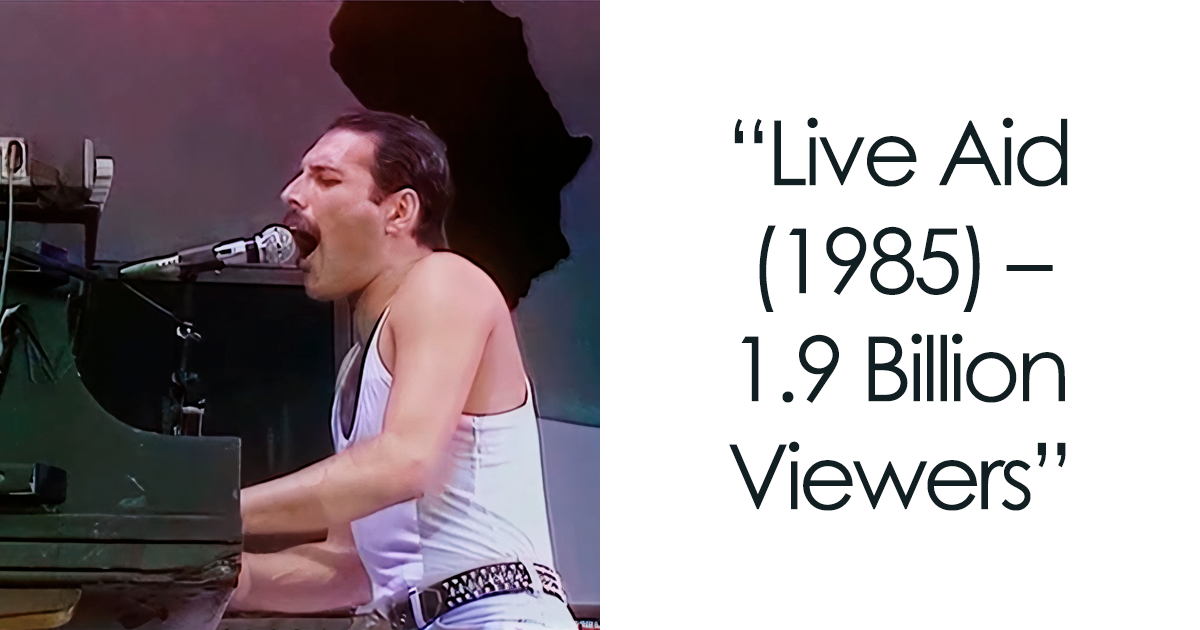
11. Live Aid, 1985
Live Aid was not only a concert; it was a global broadcast event. Organized by Bob Geldof and Midge Ure to raise funds for famine relief in Ethiopia, it took place mainly at Wembley Stadium in London and JFK Stadium in Philadelphia. Its television reach made it one of the defining music events of the 1980s and a template for future benefit concerts.
12. Queen at Live Aid, 1985
Queen’s 21-minute Live Aid set at Wembley is often called one of the greatest live rock performances ever. Freddie Mercury treated 72,000 people like backup singers and somehow got them to obey. “Radio Ga Ga,” “We Are the Champions,” and his legendary crowd call-and-response turned a charity slot into rock royalty’s final examand Queen passed with fireworks.
13. The Beatles at Shea Stadium, 1965
The Beatles’ Shea Stadium concert in New York helped invent the modern stadium rock show. More than 55,000 fans packed the venue, screaming so loudly that the band could barely hear itself. The sound system was laughably underpowered by today’s standards, but the cultural signal was deafening: pop music had outgrown theaters.
14. Garth Brooks in Central Park, 1997
Garth Brooks’ free Central Park concert drew an estimated crowd close to one million and was broadcast by HBO. It was a landmark for country music, proving the genre could command a massive urban audience far beyond traditional expectations. Brooks brought arena charisma to the Great Lawn and turned New York into Nashville for a night.
15. Simon & Garfunkel in Central Park, 1981
Simon & Garfunkel reunited for a free Central Park benefit concert in front of roughly 500,000 people. The performance helped raise awareness and funds for the park while reviving public love for one of folk rock’s most delicate partnerships. The harmonies were beautiful; the interpersonal tension was probably available in surround sound.
16. Diana Ross in Central Park, 1983
Diana Ross performed in Central Park before a huge crowd, but the first night was interrupted by a violent thunderstorm. In a move worthy of diva legend status, she returned the next day for a second show. The event remains famous not just for the crowd size, but for Ross’s poise under weather conditions that would make most performers sprint toward a towel.
17. Elvis Presley’s Aloha from Hawaii, 1973
Elvis Presley’s Aloha from Hawaii was a landmark satellite concert, broadcast internationally and later aired in the United States. With the white jumpsuit, the cape, the voice, and the global reach, Elvis transformed a Honolulu performance into one of the earliest examples of the worldwide concert-as-media-event. The King did not just enter the building; he entered living rooms around the world.
18. Monterey Pop Festival, 1967
The Monterey Pop Festival helped define the Summer of Love and introduced wider audiences to Jimi Hendrix, Janis Joplin, Otis Redding, and The Who. It was one of the first major American rock festivals and a blueprint for everything that followed. Hendrix burning his guitar became one of rock’s most theatrical “please do not try this at home” moments.
19. Altamont Free Concert, 1969
Altamont is remembered for tragic reasons. The free Rolling Stones-headlined concert drew hundreds of thousands but became infamous for violence, poor planning, and the death of Meredith Hunter. Often described as the dark end of the 1960s counterculture dream, Altamont remains a reminder that big concerts need more than big bands; they need safety, structure, and responsibility.
20. The Concert for Bangladesh, 1971
Organized by George Harrison and Ravi Shankar at Madison Square Garden, The Concert for Bangladesh helped establish the modern benefit concert model. With Bob Dylan, Ringo Starr, Eric Clapton, Billy Preston, and others, it proved rock stars could use their fame for humanitarian attention. It was Live Aid before Live Aid had a name.
21. US Festival, 1983
Backed by Apple co-founder Steve Wozniak, the 1983 US Festival in California drew a massive multi-day crowd and featured acts including Van Halen, David Bowie, The Clash, U2, and Willie Nelson. It combined music, technology, and enormous ambition. In spirit, it was part rock festival, part tech expo, part “what happens when a computer genius books the loudest weekend imaginable?”
22. Roger Waters’ The Wall in Berlin, 1990
Performed near the former Berlin Wall less than a year after its fall, Roger Waters’ The Wall in Berlin was loaded with symbolism. The production featured massive staging and guest performers, turning Pink Floyd’s concept album into a political and theatrical statement. Few concerts have matched its combination of history, location, and emotional architecture.
23. U2 at the Rose Bowl, 2009
U2’s 360° Tour stop at the Rose Bowl drew more than 97,000 people and was streamed live on YouTube to millions more. The claw-shaped stage looked like an alien had landed and decided to play “Where the Streets Have No Name.” It marked a turning point for large-scale concert streaming and digital access.
24. Daft Punk at Coachella, 2006
Daft Punk’s pyramid set at Coachella changed electronic dance music’s visual language. The crowd was not the largest on this list, but the influence was gigantic. After that glowing pyramid, DJs could no longer just stand behind laptops like mysterious accountants. The EDM spectacle era had officially clocked in.
25. Prince at the Super Bowl Halftime Show, 2007
Prince performing “Purple Rain” in actual rain at the Super Bowl is one of live music’s perfect accidents. The weather could have ruined the show; instead, it made the performance immortal. His guitar solo, silhouette staging, and fearless command of the storm turned twelve minutes into a masterclass in cool.
26. Dr. Dre and Snoop Dogg at Coachella, 2012
Dr. Dre and Snoop Dogg’s Coachella set became instantly famous for the virtual appearance of Tupac Shakur. The “hologram” performance sparked debates about technology, legacy, and whether deceased artists should be digitally recreated. Like it or not, the moment expanded the conversation about what a live concert could be in the digital age.
27. Beyoncé at Coachella, 2018
Beyoncé’s Coachella performance, later celebrated as “Beychella,” was historic, precise, and culturally rich. As the first Black woman to headline the festival, she built a show around HBCU marching bands, Black Southern culture, step choreography, and pop perfection. It was not just a headlining set; it was a thesis with better choreography than most award shows.
28. Taylor Swift’s Eras Tour, 2023–2024
Taylor Swift’s Eras Tour became the highest-grossing concert tour in history and sold more than 10 million tickets across 149 shows. Its scale, fan demand, economic impact, and theatrical structure made it a defining event of modern pop. It was less a tour than a three-hour friendship bracelet economy with bridges, ballads, and emotional cardio.
29. Nirvana’s MTV Unplugged in New York, 1993
Nirvana’s MTV Unplugged was small in attendance but enormous in legacy. Recorded at Sony Music Studios, the acoustic set revealed a haunted, fragile side of the band. Its power came from restraint rather than volume. In a list full of millions, this concert earns its place by proving intimacy can be just as seismic as a stadium.
Why These Concerts Still Matter
The biggest concerts ever are more than numbers. They show how music gathers people during moments of celebration, grief, protest, technological change, and cultural transformation. Woodstock captured the dreams of a generation. Live Aid showed the power of global broadcasting. Beyoncé at Coachella reframed festival headlining as cultural scholarship. Taylor Swift’s Eras Tour proved that modern pop can dominate not just charts, but cities, economies, and friendship-bracelet supply chains.
These historic concerts also reveal the risks of scale. Altamont showed what can happen when planning fails. Woodstock showed that chaos can become legend, but only because disaster somehow did not fully win. Massive concerts are complicated machines: sound, security, transportation, weather, crowd control, broadcast rights, staging, and artist stamina all have to work together. When they do, the result feels magical. When they do not, history still remembersbut not always kindly.
Experiences and Lessons From the World’s Biggest Concerts
Anyone who has attended a truly massive concert knows the experience begins long before the first note. It starts with the journey: the traffic, the subway crush, the confusing gate signs, the strangers in band shirts walking in the same direction like pilgrims heading toward a very loud temple. You may arrive thinking you are going to watch an artist. By the time the lights drop, you realize you are part of something larger than your own playlist.
The magic of huge concerts is partly physical. You feel bass through your ribs. You see thousands of phone screens rise like artificial stars. You hear a crowd sing a chorus so loudly that the artist can stop singing and simply smile. In that moment, live music becomes communal proof that strangers can agree on at least one thing: this song rules. That agreement may last only four minutes, but during those four minutes, it feels like civilization is doing surprisingly well.
There is also a strange intimacy inside giant concerts. That sounds impossible, but it is true. A performer on a stage 200 feet away can still make a person feel individually addressed. Freddie Mercury did it at Live Aid with a few vocal warmups and one raised fist. Beyoncé did it at Coachella through precision and purpose. Taylor Swift does it by turning autobiographical songs into shared emotional landmarks. The biggest artists understand that scale alone is not enough; the audience must feel seen from the cheap seats.
Of course, the experience is not always glamorous. There are long bathroom lines, expensive water bottles, sore feet, weather surprises, and at least one tall person who appears directly in front of you as if summoned by a curse. Outdoor mega-concerts add dust, mud, heat, rain, and the deep philosophical question of whether leaving early to beat traffic is wisdom or betrayal. Yet people return because the discomfort becomes part of the story. Nobody says, “Remember that perfectly convenient concert?” They say, “Remember when it rained during ‘Purple Rain’?”
The greatest concerts also teach us that live music is unpredictable in a way streaming never can be. A studio recording is polished and repeatable. A concert is alive. The singer may change a lyric. The crowd may overpower the speakers. A storm may roll in. A guest may appear. A technical problem may become a legendary improvisation. The best concert experiences feel unrepeatable because they are. Even if the same artist plays the same setlist the next night, the emotional weather changes.
For fans, these concerts become personal time capsules. People remember who they went with, what they wore, how young they felt, how tired they were afterward, and which song made them unexpectedly emotional. For culture, they become milestones that reveal what a generation valued: freedom, charity, spectacle, identity, rebellion, nostalgia, or connection. That is why the biggest concerts in music history still matter. They remind us that songs are not only heard. Sometimes, they are gathered around like fires.
Conclusion
The 29 biggest concerts ever that rocked the history of music prove that a live show can be more than entertainment. It can be a movement, a memorial, a technological leap, a cultural reset, or a glorious excuse for millions of people to sing out of tune together. From Copacabana Beach to Central Park, from Wembley Stadium to Coachella, these concerts shaped how audiences experience music and how artists imagine the stage.
Some of these events were huge because of crowd size. Others were huge because of meaning. The best were both. They changed careers, inspired future festivals, raised money, challenged technology, and gave fans stories worth retelling. In the end, the biggest concerts are not only measured in attendance figures. They are measured in echoes.
Note: Attendance figures for large free concerts and historic festivals are often estimates, so this article uses widely reported figures and focuses on both scale and cultural impact.