-5.4 Thinking
If chemistry has ever made you stare at the periodic table like it personally offended you, take a breath. Finding the number of protons, neutrons, and electrons in an atom is actually one of the most useful and easiest skills in basic chemistry. Once you know the rules, it feels less like decoding alien symbols and more like solving a tiny science puzzle.
In this guide, you’ll learn how to find protons, neutrons, and electrons using the periodic table, isotope notation, mass number, atomic number, and ionic charge. We’ll also walk through examples, common mistakes, and a few real-life learning experiences that make the whole topic stick. No robotic explanations. No chemistry drama. Just clear steps that work.
What Are Protons, Neutrons, and Electrons?
Before doing the math, you need to know who the players are.
Protons
Protons are positively charged particles found in the nucleus of an atom. The number of protons determines the element itself. If an atom has 6 protons, it is carbon. If it has 8, it is oxygen. If it has 79, congratulations, you’ve found gold and your chemistry homework just got fancy.
Neutrons
Neutrons live in the nucleus too, but they have no charge. They add mass to the atom and help explain why atoms of the same element can have different versions, called isotopes.
Electrons
Electrons are negatively charged particles that move around the nucleus. In a neutral atom, the number of electrons equals the number of protons. In ions, that number changes depending on whether the atom has gained or lost electrons.
That’s the core idea: protons identify the element, neutrons help define the isotope, and electrons affect the charge.
The Two Numbers That Matter Most
To find the number of protons, neutrons, and electrons, you usually need two values:
1. Atomic Number
The atomic number tells you how many protons an atom has. It appears on the periodic table and is the most reliable number in the whole operation. It never changes for a given element.
Example: Oxygen has an atomic number of 8, so every oxygen atom has 8 protons.
2. Mass Number
The mass number is the total number of protons and neutrons in the nucleus.
Formula:
Mass number = protons + neutrons
This matters because once you know the mass number and the atomic number, you can find neutrons.
Formula:
Neutrons = mass number – atomic number
Easy, right? Chemistry is occasionally kind enough to let us subtract small integers instead of writing lab reports.
How to Find the Number of Protons
This is the easiest part.
Rule: The number of protons equals the atomic number.
That’s it. No plot twists.
Examples:
- Hydrogen: atomic number 1 = 1 proton
- Carbon: atomic number 6 = 6 protons
- Sodium: atomic number 11 = 11 protons
- Iron: atomic number 26 = 26 protons
If you remember only one thing from this article, remember this: atomic number = number of protons.
How to Find the Number of Electrons
Finding electrons depends on whether the atom is neutral or charged.
Neutral Atoms
In a neutral atom, the positive charge from protons is balanced by the negative charge from electrons.
Rule: In a neutral atom, electrons = protons.
Examples:
- Magnesium has atomic number 12, so a neutral magnesium atom has 12 electrons.
- Chlorine has atomic number 17, so a neutral chlorine atom has 17 electrons.
Positive Ions (Cations)
If an atom loses electrons, it becomes positively charged. That means it has fewer electrons than protons.
Rule: For a positive ion, subtract the charge from the number of protons.
Examples:
- Na+: sodium has 11 protons, so it has 10 electrons
- Ca2+: calcium has 20 protons, so it has 18 electrons
- Al3+: aluminum has 13 protons, so it has 10 electrons
Negative Ions (Anions)
If an atom gains electrons, it becomes negatively charged. That means it has more electrons than protons.
Rule: For a negative ion, add the charge to the number of protons.
Examples:
- Cl–: chlorine has 17 protons, so it has 18 electrons
- O2-: oxygen has 8 protons, so it has 10 electrons
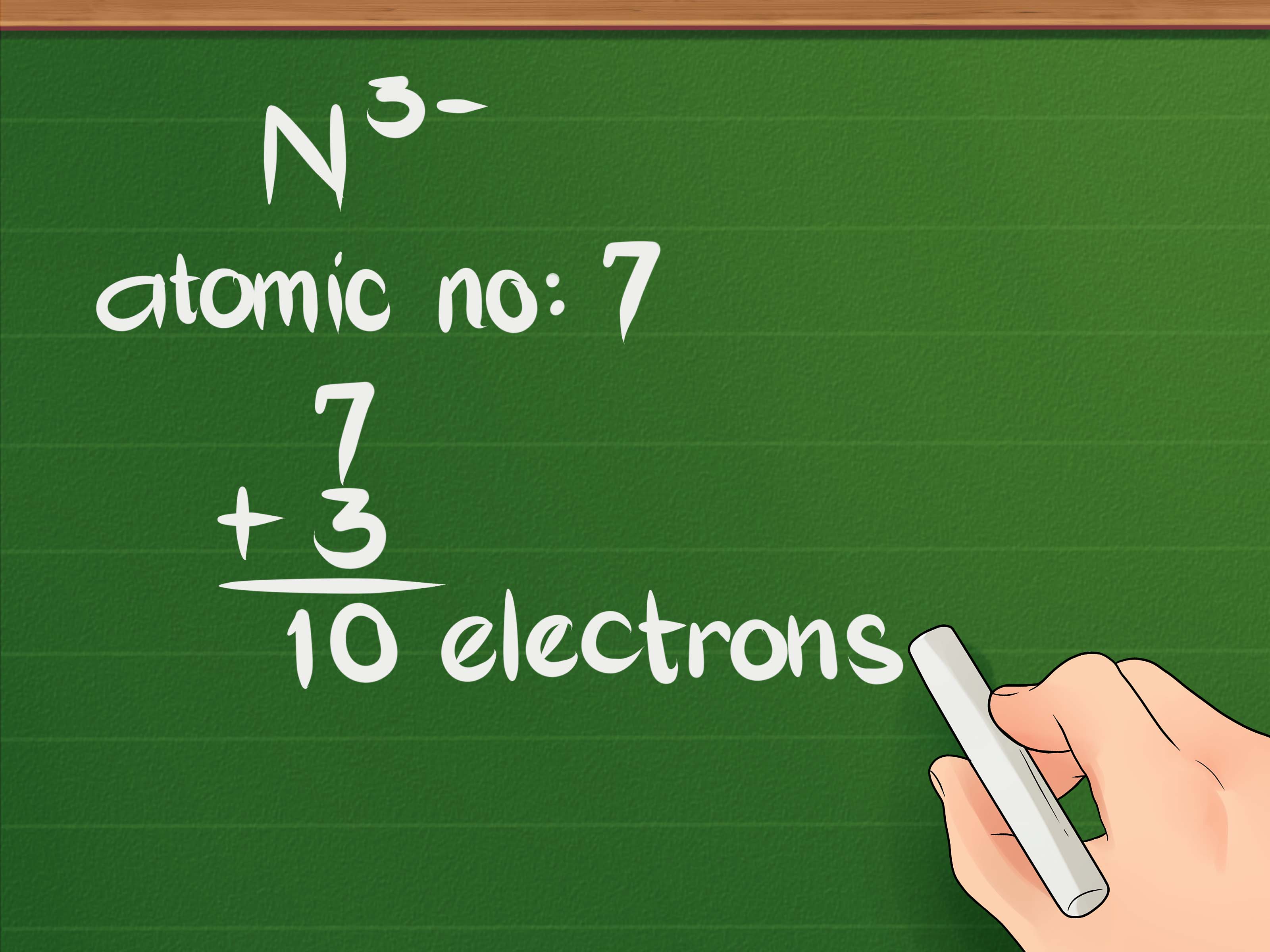
- N3-: nitrogen has 7 protons, so it has 10 electrons
A good memory trick: positive ions have lost electrons, negative ions have gained electrons. The sign tells you what happened to the electrons, not the protons.
How to Find the Number of Neutrons
Neutrons are slightly trickier, but only because students sometimes confuse atomic mass with mass number.
Main formula:
Neutrons = mass number – atomic number
Using Isotope Notation
If an element is written like carbon-14 or oxygen-18, the number after the dash is the mass number.
Examples:
- Carbon-14: 14 – 6 = 8 neutrons
- Oxygen-18: 18 – 8 = 10 neutrons
- Sodium-23: 23 – 11 = 12 neutrons
Using Nuclear Symbol Notation
You may also see isotopes written in a format like this:
AZX
Where:
- A = mass number
- Z = atomic number
- X = element symbol
For example, 2311Na means sodium has:
- 11 protons
- 23 – 11 = 12 neutrons
- 11 electrons if neutral
Using the Periodic Table’s Atomic Mass
Here’s where students often trip over their own shoelaces. The periodic table usually shows atomic mass, which is a weighted average of isotopes. It is often a decimal, like chlorine at about 35.45.
You usually cannot use that decimal directly as the mass number of one specific atom. In many classroom problems, you round the atomic mass to the nearest whole number to estimate the most common mass number.
Example:
Chlorine has atomic number 17 and atomic mass about 35.45.
Round 35.45 to 35.
Estimated neutrons = 35 – 17 = 18
That works for a common classroom estimate, but remember: real elements can have multiple isotopes, so the decimal on the periodic table is not always the exact mass number of one atom.
Step-by-Step Examples
Example 1: Carbon-12
Carbon has atomic number 6.
- Protons = 6
- Electrons = 6 if neutral
- Neutrons = 12 – 6 = 6
Example 2: Sodium-23
Sodium has atomic number 11.
- Protons = 11
- Electrons = 11 if neutral
- Neutrons = 23 – 11 = 12
Example 3: Chloride Ion, Cl–
Chlorine has atomic number 17.
- Protons = 17
- Electrons = 18 because of the -1 charge
- Neutrons depend on the isotope; if chlorine-35, then 35 – 17 = 18
Example 4: Calcium Ion, Ca2+
Calcium has atomic number 20.
- Protons = 20
- Electrons = 18 because it lost 2 electrons
- Neutrons depend on the isotope; for calcium-40, neutrons = 20
Example 5: Iron-56
Iron has atomic number 26.
- Protons = 26
- Electrons = 26 if neutral
- Neutrons = 56 – 26 = 30
Example 6: Aluminum Ion, Al3+
Aluminum has atomic number 13 and a common mass number of 27.
- Protons = 13
- Electrons = 10
- Neutrons = 27 – 13 = 14
Common Mistakes to Avoid
Mixing Up Atomic Number and Mass Number
The atomic number is protons only. The mass number is protons plus neutrons. They are not interchangeable, no matter how determined your calculator looks.
Forgetting That Ions Change Electrons, Not Protons
When atoms become ions, the number of protons stays the same. Otherwise, the element would change. Sodium does not become neon just because chemistry got exciting.
Using Decimal Atomic Mass as an Exact Mass Number
The decimal value on the periodic table is an average. Round it only when your teacher or problem expects an estimate. If a question gives a specific isotope, use that isotope’s mass number instead.
Ignoring the Charge Sign
A positive charge means fewer electrons. A negative charge means more electrons. The sign is your clue, not decoration.
Quick Cheat Sheet
- Protons = atomic number
- Electrons in a neutral atom = atomic number
- Electrons in a positive ion = protons – charge
- Electrons in a negative ion = protons + charge
- Neutrons = mass number – atomic number
If you can remember those five lines, you can solve most beginner chemistry questions on this topic.
Why This Skill Matters
Learning how to find the number of protons, neutrons, and electrons is not just a quiz trick. It helps you understand the structure of matter, why isotopes exist, how ions form, and why elements behave differently in chemical reactions. This skill connects directly to chemistry, physics, biology, environmental science, and even medical imaging.
For example, isotopes matter in radiocarbon dating, nuclear medicine, and environmental tracing. Ions matter in table salt, batteries, nerve signals, and the minerals your body needs. So yes, the humble proton-neutron-electron trio quietly runs a lot of the world while asking for very little credit.
Real Learning Experiences With Protons, Neutrons, and Electrons
One of the most common experiences students have with this topic is the moment everything suddenly clicks after looking at a periodic table the right way. At first, the table can feel like a giant wall of boxes, tiny numbers, and chemical symbols designed by someone who clearly enjoyed confusing ninth graders. But once you realize that the atomic number is the key to the whole system, the chaos becomes organized. Students often say the first breakthrough happens when they stop trying to memorize random facts and start reading the periodic table as a map.
Another real classroom experience comes from working through isotope examples. A student may look at carbon-12, carbon-13, and carbon-14 and assume they are completely different elements because the numbers change. Then the teacher points out that they all have 6 protons, which means they are all carbon. The only difference is the number of neutrons. That tiny shift in understanding is powerful because it helps students separate the identity of an element from the version of the element. Suddenly, isotopes stop sounding like science fiction and start feeling logical.
Hands-on activities make this even more memorable. In many science classes, students use colored beads, candy pieces, or paper cutouts to build model atoms. Red pieces become protons, blue pieces become neutrons, and green pieces become electrons. It sounds simple, but it works. When students physically add one more electron to make a negative ion or remove one to make a positive ion, they can see the charge change in a way that a textbook sentence sometimes fails to explain. Chemistry becomes less abstract and more like building with rules.
There is also the classic homework experience: getting a problem wrong because of the charge. This happens constantly. A student correctly finds the number of protons in calcium, correctly finds the neutrons in calcium-40, and then confidently writes 20 electrons for Ca2+. Not quite. That little 2+ means calcium lost two electrons, so the answer should be 18. It is such a common mistake that many students remember it forever after missing it once. Sometimes the best chemistry lesson is a very polite academic ambush.
Lab settings add another layer of meaning. Even when students are not directly counting subatomic particles, they begin to see why these numbers matter. They learn that ionic compounds form because atoms gain or lose electrons, that isotopes can behave similarly in chemistry but differ in mass, and that atomic structure is not just trivia. It explains real patterns. It explains why sodium is reactive, why noble gases are stable, and why some atoms form charges more easily than others.
Outside the classroom, this topic becomes surprisingly practical in test prep. Whether students are studying for a chemistry unit test, SAT Subject-style material, AP-level work, or general science exams, the questions often follow the same patterns. Once students practice a few examples, they begin to answer faster and with more confidence. That confidence matters. Instead of guessing, they know exactly where to look, what to subtract, and when to adjust for ionic charge.
In the end, most people remember this topic not because it was hard, but because it was one of the first times chemistry started making sense. And honestly, that is a pretty great experience for a bunch of tiny particles you cannot even see.
Conclusion
Finding the number of protons, neutrons, and electrons is one of the most important foundation skills in chemistry. Start with the atomic number to find protons. Use the charge to adjust electrons. Use the mass number to calculate neutrons. Once you know those rules, the periodic table becomes far less intimidating and a lot more useful.
Whether you are studying for class, reviewing chemistry basics, or helping someone else understand atoms, this is one topic worth mastering early. It shows up everywhere, and fortunately, it follows rules that are consistent, logical, and refreshingly free of emotional baggage.