The periodic table is one of the few classroom posters that can make a room feel smarter just by hanging on the wall. It organizes hydrogen, oxygen, gold, uranium, and every other confirmed chemical element into a tidy grid that looks calm, logical, and slightly intimidating. But science has a habit of walking up to tidy things and asking, “What if we made this weirder?”
That is exactly what is happening with the idea of a new periodic table. Scientists are not throwing away Mendeleev’s masterpiece, and chemistry teachers can put down the emergency coffee. Instead, researchers are exploring a new kind of “periodic table” built around quantum dots, tiny semiconductor particles often described as artificial atoms. These nanoscale materials can behave in atom-like ways, but their properties can be tuned by changing their size, shape, surface, and composition.
In plain English: scientists are learning how to design tiny building blocks that act a bit like atoms, link them into artificial molecules, and possibly organize them into a new map of materials. It is not a replacement for the periodic table of elements. It is more like a new neighborhood being built next door, where the houses are smaller than viruses and the residents obey quantum mechanics with suspicious enthusiasm.
What Does “A New Periodic Table” Actually Mean?
The phrase “new periodic table” can sound dramatic, as if someone discovered element 119 under a couch cushion. In reality, it refers to a new way of organizing matter at the nanoscale. The traditional periodic table arranges elements by atomic number, which is the number of protons in an atom’s nucleus. That number defines the element. Hydrogen has one proton. Carbon has six. Gold has 79. If gold had 80 protons, it would not be gold anymore; it would be mercury, which is a terrible surprise if you were planning to buy a necklace.
Quantum dots are different. They are not new chemical elements. They are extremely small particles, usually made from semiconductor materials. Because they are so tiny, often just a few nanometers wide, electrons inside them are confined in a way that produces quantum effects. Change the size of the dot, and you can change how it absorbs and emits light. A smaller quantum dot may glow toward the blue or green part of the spectrum, while a larger one may emit redder light. The material matters, but size matters too.
This tunability is why researchers call quantum dots artificial atoms. Like atoms, they can have discrete energy states. Like atoms, they can be combined into larger structures. Unlike ordinary atoms, scientists can adjust their properties with a kind of nanoscale design freedom that nature did not hand to Dmitri Mendeleev in 1869.
The Classic Periodic Table: Still the Boss
Before diving into artificial atoms, it helps to appreciate why the original periodic table remains so powerful. The periodic table organizes elements into rows called periods and columns called groups. Elements in the same group often share similar chemical behaviors because of how their electrons are arranged. This is why sodium and potassium both react enthusiastically with water, as if water personally insulted them.
The table is not just a chart of names. It is a prediction machine. It helps scientists estimate atomic radius, ionization energy, electronegativity, metallic character, bonding behavior, and other properties. Its real genius is that it turns a messy universe into a pattern. Once you understand the pattern, chemistry becomes less like memorizing trivia and more like reading a map.
The official periodic table currently includes 118 confirmed elements. The seventh row was completed with the recognition and naming of nihonium, moscovium, tennessine, and oganesson. Meanwhile, nuclear scientists continue to investigate the possibility of elements 119 and 120, which would open an eighth row. That is one frontier. The quantum-dot periodic table is another frontier entirely.
Quantum Dots: Tiny Particles With Big Personalities
Quantum dots are nanocrystals, commonly made from semiconductor compounds such as cadmium selenide, cadmium sulfide, indium phosphide, or newer alternative materials. Their small size creates quantum confinement, meaning electrons and holes are restricted in space. That restriction changes the energy levels available inside the particle.
Think of it like a guitar string. A long string produces a lower note. A shorter string produces a higher note. Quantum dots are not guitar strings, of course, and they will not help your garage band unless your band needs better display technology. But the analogy works: changing the size changes the energy. In quantum dots, changing energy changes color, conductivity, and optical behavior.
This is why quantum dots are already important in modern technology. They can be used in display screens, LEDs, lasers, sensors, photodetectors, solar-energy research, biological imaging, and emerging quantum devices. Their colors can be sharp and bright, which is excellent for screens and mildly insulting to older televisions that thought they were doing their best.
How Scientists Make Artificial Atoms Act Like Molecules
The most exciting part of this research is not simply making individual quantum dots. Scientists have been doing that for years. The bigger step is connecting quantum dots in controlled ways so that they behave like artificial molecules. In ordinary chemistry, atoms bond to form molecules. Hydrogen and oxygen can form water. Carbon can form long chains and complex structures. Molecules are where chemistry gets its personality.
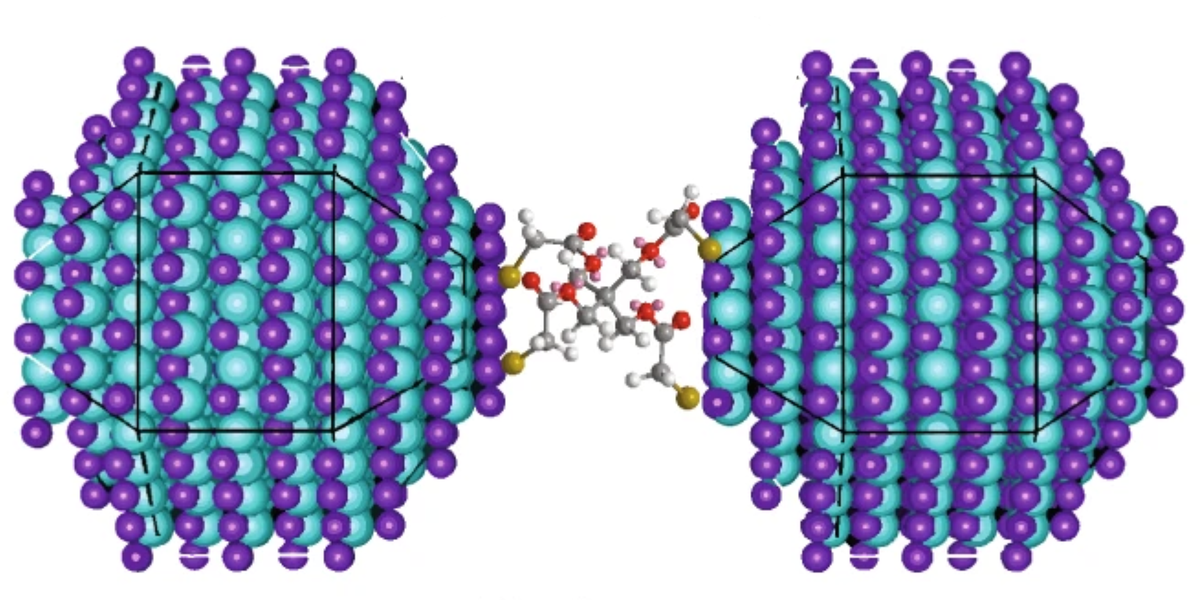
Researchers led by Professor Uri Banin and colleagues demonstrated that semiconductor nanocrystals could be linked and fused into structures that show electronic coupling at room temperature. In other words, the dots were not merely sitting next to one another like strangers in an elevator. Their electronic states interacted. The resulting artificial molecules showed signs of wavefunction hybridization, a quantum-mechanical way of saying that the particles began sharing behavior as a combined system.
This matters because a single quantum dot is useful, but a controlled quantum-dot molecule could be much more powerful. It could allow scientists to design materials with specific optical, electronic, or quantum properties. Instead of discovering materials one accident at a time, researchers could build them with a plan.
Why a Periodic Table for Quantum Dots Makes Sense
The traditional periodic table works because elements have predictable relationships. A quantum-dot periodic table would aim to do something similar for artificial atoms. It would help scientists organize quantum dots by their size, shape, composition, structure, surface chemistry, electronic behavior, and ability to connect with other dots.
Such a table would not be as simple as “one proton equals one element.” Quantum dots are more flexible and more complicated. Two dots made of the same material can behave differently if one is larger than the other. A dot can change behavior based on its shell, coating, ligands, crystal facets, or neighboring particles. This makes the project harder, but also more exciting. It is like trying to organize a library where every book can change font size, cover color, and plot twist depending on the shelf.
A practical quantum-dot table might group artificial atoms by emission color, band gap, charge behavior, stability, toxicity profile, coupling potential, and compatibility with manufacturing methods. It could become a design guide for scientists building new materials for displays, clean energy, sensing, medical imaging, and quantum information technologies.
The Difference Between New Elements and New Artificial Atoms
It is easy to confuse the search for new superheavy elements with the creation of artificial atoms from quantum dots. Both sound futuristic. Both involve advanced laboratories. Both make the periodic table feel less finished than it looked in high school.
But they are not the same. New superheavy elements are created by nuclear reactions, often by smashing atomic nuclei together in particle accelerators. These experiments aim to produce atoms with more protons than any known element. Elements 119 and 120, if confirmed, would extend the official periodic table itself.
Quantum dots, by contrast, do not add new boxes to the element table. They are made from existing elements arranged into nanoscale structures. Their “artificial atom” behavior comes from quantum confinement and engineered design, not from a new number of protons. If superheavy-element research is like discovering new letters of the alphabet, quantum-dot research is like inventing a new way to write poetry with the letters we already have.
Real-World Applications: Why This Research Matters
Better Displays and Lighting
Quantum dots are already famous for their role in high-color-quality displays. Their narrow emission bands can create vivid reds, greens, and blues. A better understanding of artificial atoms and artificial molecules could lead to brighter, more efficient screens and lighting systems. Your future TV may not know quantum mechanics, but it may benefit from it while showing cooking shows in alarming clarity.
Solar Energy and Photocatalysis
Because quantum dots interact strongly with light, they are being studied for solar cells and light-driven chemical reactions. Designer quantum-dot molecules could improve how materials capture sunlight, separate charges, or drive reactions. This could matter for renewable energy, hydrogen production, and environmental technologies.
Medical Imaging and Biosensing
Some quantum dots can be used as fluorescent markers in biological research. Their brightness and tunable color make them attractive for imaging and sensing. However, medical uses require careful attention to toxicity, stability, clearance from the body, and safe material design. In science, “glows beautifully” is not enough. The material also has to behave politely.
Quantum Technologies
Quantum dots are also studied for single-photon sources, quantum communication, and quantum computing components. Controlled coupling between dots could help researchers build more sophisticated quantum devices. The same artificial-molecule concept that sounds poetic in chemistry may become practical in information science.
The Challenges: Tiny Materials, Giant Headaches
Creating a useful new periodic table for quantum dots will not be easy. The first challenge is control. At the nanoscale, small differences can create large changes. A dot that is slightly larger, slightly misshapen, or slightly different on the surface may behave differently. Scientists need reliable methods to produce quantum dots with consistent properties.
The second challenge is stability. Some quantum dots degrade when exposed to oxygen, moisture, heat, or light. For commercial products, a material must do more than perform well in a lab demonstration. It has to survive manufacturing, shipping, customer use, and the occasional human tendency to leave electronics in hot cars.
The third challenge is safety. Some high-performing quantum dots contain cadmium or other elements that raise environmental and health concerns. Researchers are actively studying safer alternatives, but performance, durability, cost, and sustainability must all be balanced.
The fourth challenge is classification. A periodic table for ordinary elements has a clean organizing principle: atomic number. A quantum-dot table may need multiple dimensions. Size, composition, shell structure, surface chemistry, shape, and coupling behavior may all matter. A simple wall poster may not be enough. The future table may look more like an interactive database than a classroom chart.
Why Scientists Love Building New Tables
Scientific tables are not just decorations. They are thinking tools. The periodic table helped chemists see relationships that were not obvious from isolated facts. A quantum-dot table could do the same for nanomaterials. It could reveal patterns, guide experiments, reduce trial-and-error, and help researchers communicate complex information quickly.
This is especially important because materials science is entering a design-driven era. Scientists are not only asking, “What materials exist?” They are asking, “What materials can we build?” Artificial atoms fit beautifully into that question. By controlling quantum dots and their connections, researchers can imagine materials with properties that do not appear naturally in bulk matter.
That is the big idea behind scientists starting a new periodic table. It is not a rebellion against chemistry. It is chemistry growing a new branch. The original periodic table organized nature’s elements. A quantum-dot periodic table could organize human-designed building blocks.
Experience: What This New Periodic Table Feels Like in the Real World
The first time many people learn the periodic table, it feels like a giant cheat sheet written in secret code. There are symbols, numbers, colors, rows, groups, and names that sound like ancient wizards: dysprosium, praseodymium, molybdenum. Students memorize enough to survive the quiz, then quietly hope no one asks them to explain electron orbitals at dinner.
But the idea of a new periodic table changes the emotional experience of science. It makes the table feel alive again. Instead of being a finished monument, it becomes a model for discovery. When students hear that scientists are building “artificial atoms” from quantum dots, the periodic table stops being only a historical chart and becomes a launchpad. It says, “Here is how nature organizes matter. Now, what can humans design?”
In a classroom, this topic creates a wonderful moment because it connects familiar chemistry with modern technology. A student may not care deeply about atomic radius, but they probably care about phone screens, medical imaging, solar energy, or future computers. Quantum dots connect those everyday technologies to the strange rules of quantum mechanics. That connection can make abstract science feel less like a locked door and more like a backstage pass.
There is also a creative experience here. The classic periodic table is elegant because it shows order. The quantum-dot version is exciting because it shows possibility. A researcher can ask: What happens if this dot is larger? What happens if we change the shell? What happens if two dots are fused? What happens if we build chains, clusters, or networks? Each question is a tiny invitation to invent.
For science writers, the topic is a gift. It has history, mystery, technology, and just enough weirdness to keep readers awake. You can begin with Mendeleev, leap to nanocrystals, visit artificial molecules, and end with future materials that may improve screens, sensors, and quantum devices. That is not a boring commute; that is a roller coaster with lab goggles.
For everyday readers, the biggest takeaway is simple: the periodic table is not “done” in the way a printed poster looks done. The official table may have 118 confirmed elements, and nuclear scientists may continue chasing heavier ones, but the deeper lesson is broader. Science keeps finding new ways to classify, design, and understand matter. Sometimes that means adding elements. Sometimes it means arranging artificial atoms into patterns nature never tried.
The experience of learning about this new periodic table is a reminder that discovery is not limited to finding things in the ground. It can also mean building new things from known ingredients. A quantum dot is made of ordinary atoms, but when those atoms are arranged at the nanoscale, they can behave in extraordinary ways. That is the magic trick of materials science: the ingredients matter, but the arrangement can steal the show.
Conclusion: A New Table for a New Materials Age
Scientists starting a new periodic table does not mean the old one is heading for retirement with a gold watch and a box of chalk. The traditional periodic table remains one of the greatest achievements in science. It still organizes the elements, guides chemistry, and helps researchers understand matter from the simplest atom to the heaviest confirmed element.
The new idea is different and deeply exciting. Quantum dots, as artificial atoms, offer a way to design matter with tunable properties. When scientists connect them into artificial molecules, they open a new kind of chemistry built from nanoscale building blocks. A periodic table for these structures could help researchers predict behavior, compare materials, and create technologies that are brighter, cleaner, faster, and more precise.
In the end, the story is not about replacing Mendeleev. It is about extending the spirit of Mendeleev: find the pattern, organize the chaos, and use the map to discover what comes next. The periodic table taught us that matter has order. Quantum dots may teach us that matter also has a design menu. And yes, the menu is written in quantum mechanics, so maybe bring coffee.
Note: This HTML body is prepared for web publishing and intentionally excludes raw source links or citation placeholders.