Note: Body-only HTML, ready for web publishing.
If your family game shelf is full of chaos, cardboard, and at least one missing rulebook, Sleeping Queens is here to save the day like a tiny royal superhero in a metal tin. This fast, imaginative card game looks cute on the surface, but once the dragons, knights, jesters, and sleeping potions start flying around the table, things get delightfully dramatic. One minute you are peacefully building your little queen collection, and the next minute someone steals your best queen and acts like it was “just strategy.” Sure, Chad. Sure.
If you want a clear guide to Sleeping Queens rules, this article walks through everything you need to know: setup, turn order, card powers, scoring, special queens, beginner mistakes, and a few smart tips to help you play better without sounding like a smug wizard. Whether you are teaching kids, learning the game yourself, or settling an argument over whether the Wand can be played late, this guide has you covered.
What Is Sleeping Queens?
Sleeping Queens is a light strategy card game for kids and families in which players try to wake sleeping queens and collect enough of them to win. The game combines memory, quick decision-making, a little luck, and simple arithmetic. That last part sneaks in so quietly that many kids barely notice they are doing math. Parents, feel free to grin mysteriously.
The theme is wonderfully silly. Queens nap in the middle of the table while kings wake them, knights steal them, dragons defend them, potions send them back to sleep, and wands stop the potions. There is even a jester who can either help you or create table-wide suspense in about two seconds flat. In other words, it is exactly the kind of game that turns “Let’s play one round” into “Why are we still here forty minutes later?”
Sleeping Queens Setup
What You Need to Start
Before the game begins, separate the queen cards from the rest of the deck. In the classic setup, the sleeping queens are placed face down in the middle of the table in four rows of three. Some deluxe editions include additional queens, but the standard play area still centers on twelve face-down sleeping queens unless your edition instructions say otherwise.
Next, shuffle the red-backed deck and deal five cards to each player. Put the remaining cards face down in the center as a draw pile. Leave space nearby for a face-up discard pile. The player to the left of the dealer goes first.
Quick Setup Checklist
- Place 12 queen cards face down in the center.
- Shuffle the action-and-number deck.
- Deal 5 cards to each player.
- Put the rest in a face-down draw pile.
- Create room for a discard pile.
- Start with the player to the dealer’s left.
The Goal of the Game
The goal in Sleeping Queens is to collect enough queens or enough points before everyone else does.
- In a 2- or 3-player game, you win by collecting 5 queens or 50 points.
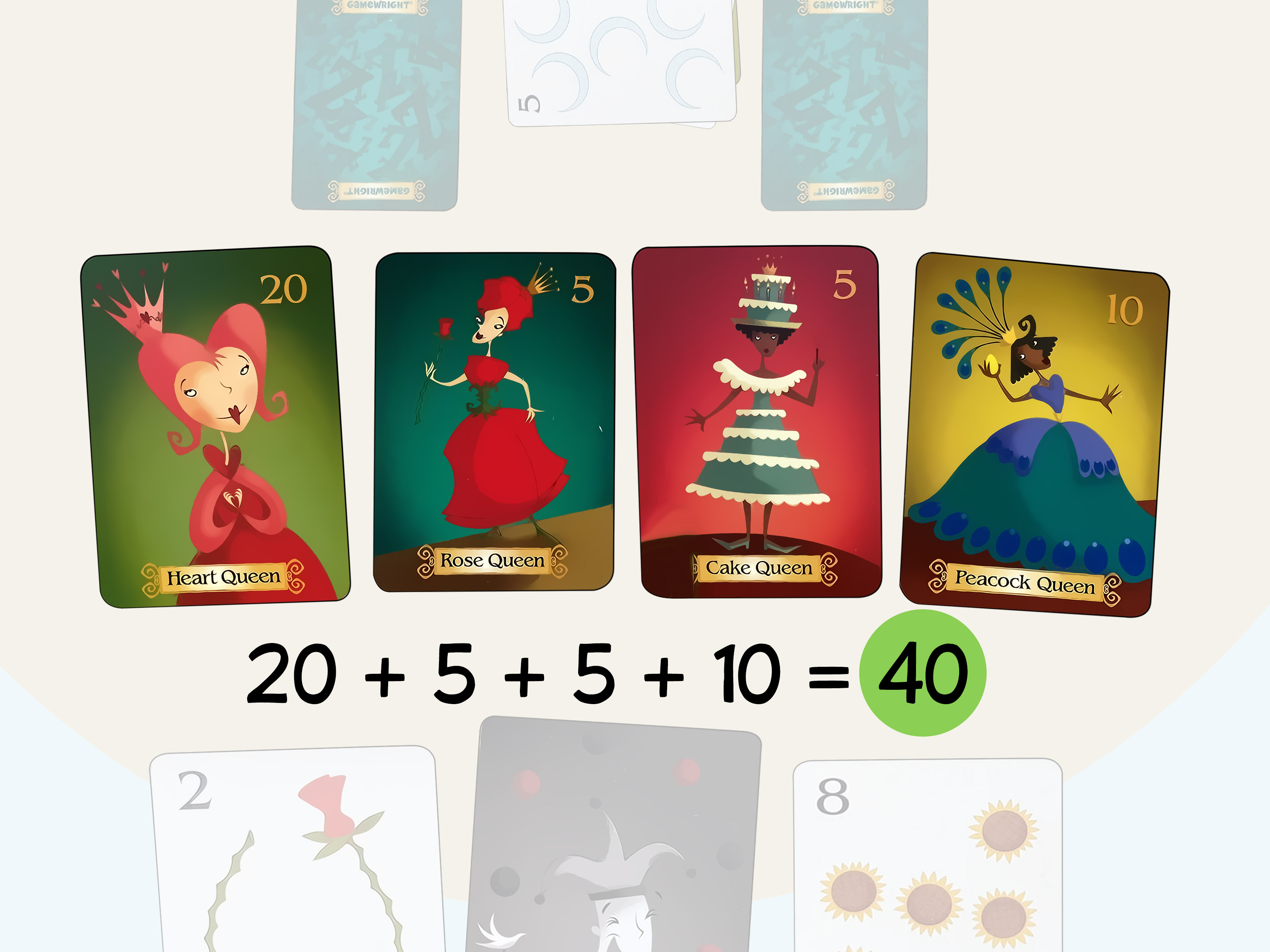
- In a 4- or 5-player game, you win by collecting 4 queens or 40 points.
- If all the queens in the center have been awakened and no one has hit a winning total yet, the player with the most points wins.
Important detail: you do not need the exact point total. If your queens add up to more than the winning score, you still win. No one gets sent back to royal kindergarten for overshooting.
How a Turn Works in Sleeping Queens
On your turn, you do one of two things:
- Play one card, or
- Discard card(s) to draw new ones.
After you finish that single action, draw enough cards to bring your hand back up to five cards. That rule matters. A lot. Forgetting to refill your hand is one of the easiest ways to throw off the game.
Option 1: Play One Card
When you choose to play a card, you may play only one card on your turn. Here is what each card does.
King
Play a King to wake up one sleeping queen from the center. Reveal any queen you want and place her face up in front of you. If the queen you reveal is the Rose Queen, you immediately get to wake up one additional queen from the center. That is the kind of royal bonus that makes everybody else suddenly very interested in the discard pile.
Knight
Play a Knight to steal one awakened queen from another player. Choose any queen in front of an opponent and move it to your collection.
Dragon
If someone plays a Knight against you, you may defend yourself immediately with a Dragon card from your hand. The Dragon cancels the Knight. Both cards are discarded, both players draw a replacement card, and your queen stays put.
The keyword here is immediately. If you hesitate, get distracted, or suddenly remember your Dragon after three people have already gasped, it is too late.
Sleeping Potion
Play a Sleeping Potion to send one of your opponent’s awakened queens back to sleep. Put that queen face down into any open space among the sleeping queens in the center. This creates a sneaky memory element because players may try to remember where the high-value queens are now hiding.
Wand
If someone uses a Sleeping Potion against you, you may defend with a Wand. Just like the Dragon, the Wand must be played right away. The Wand cancels the potion, both cards are discarded, and both players draw replacement cards.
Jester
The Jester is where things get spicy. Play it and reveal the top card of the draw pile.
- If the revealed card is a power card such as a King, Knight, Dragon, Potion, Wand, or another Jester, add it to your hand and take another turn.
- If the revealed card is a number card, start counting players beginning with yourself and moving to the left. Count as many players as the number on the card. The player who gets the last count awakens and keeps a queen from the center.
This means a Jester can help you, help someone else, or make the whole table lean in like they are watching the final seconds of a playoff game. Not bad for a card wearing bells.
Option 2: Discard Cards to Draw New Ones
If you do not want to play a power card, you can discard cards and replace them. There are three official ways to do this:
- Discard one card of any kind and draw one new card.
- Discard a pair of identical number cards and draw two new cards.
- Discard three or more number cards that make an addition equation, then draw the same number of cards you discarded.
Examples of legal equations include:
- 2 + 3 = 5
- 2 + 3 + 4 = 9
When you use the equation rule, say the equation out loud. This is both part of the fun and an easy way to keep the table honest. Nobody wants to lose a queen because someone tried to convince the room that 2 + 2 = banana.
Special Queen Powers
A few queens have abilities that make them more than just point cards.
Rose Queen
The Rose Queen is worth only 5 points, but when you wake her from the center, she lets you wake one more queen. That makes her much stronger than her point value suggests.
One important rule detail: if you steal the Rose Queen from another player with a Knight, you do not get the extra queen. Her bonus happens only when she is awakened from the middle.
Strawberry Queen
The Strawberry Queen is the royal tank of the game. Once you wake her, she cannot be stolen by a Knight and cannot be put back to sleep with a Sleeping Potion. She is yours for the rest of the game. That is a fancy way of saying everybody else will immediately become jealous.
Cat Queen and Dog Queen
You cannot hold both the Cat Queen and the Dog Queen at the same time. If you already have one and wake the other, the newly awakened queen must go back face down and your turn ends. Yes, they still fight like cats and dogs. The theme commits, and we respect that.
A Simple Example Round
Let’s say it is your turn and you have a King, a Knight, a 2, a 3, and a 5 in your hand.
You could play the King and wake a queen from the center. If it is the Rose Queen, congratulations, you just got a two-for-one royal special.
Or you could discard the 2, 3, and 5 because they form the equation 2 + 3 = 5, then draw three fresh cards and hope for better action cards.
That is part of what makes how to play Sleeping Queens so engaging. Almost every turn gives you a choice between immediate action and long-term hand improvement. It is simple enough for kids to understand, but not so shallow that adults feel like decorative houseplants.
How to Win More Often
Do Not Ignore Point Values
It is easy to focus only on how many queens you have, but the point total matters just as much. A player with fewer queens can still win if those queens are worth enough points. Keep a mental tally when possible.
Use Potions on High-Value Targets
If an opponent has a queen worth a lot of points, especially one that gets them close to the win, sending her back to sleep can be more effective than using a Knight elsewhere.
Hold Defense Cards When the Table Turns Mean
Dragons and Wands are not flashy, but they are incredibly useful. A well-timed defense can stop a swingy move and frustrate the player who thought they were being clever. Delicious.
Remember Where Queens Go
When a queen gets put back to sleep, try to remember where she lands. This is especially helpful for high-value queens and the Rose Queen. Your future self will thank you.
Use Number Discards Wisely
If your hand is clogged with numbers and no action cards, build equations and cycle your hand. Sitting there with a fistful of math and no plan is not a winning strategy.
Common Rules Questions and Beginner Mistakes
Can You Play a Dragon or Wand Later?
No. Defense cards must be played immediately. Miss the moment, and the attack goes through.
What Happens If the Draw Pile Runs Out?
Shuffle the discard pile to make a new draw pile. The game continues.
Do You Need Exact Points to Win?
No. You may go over the required score.
Can You Play More Than One Card on a Turn?
No. You either play one card or use the discard-and-draw option. The exception is when a Jester reveals a power card and grants you another turn.
Can the Rose Queen Trigger When Stolen?
No. Her extra-queen power works only when she is awakened from the center.
Why Families Love Sleeping Queens
One reason this game stays popular is that it strikes a lovely balance. It is light enough for younger players, fast enough to keep attention, and interactive enough that nobody zones out waiting for their next turn. It also sneaks in memory skills, addition practice, score tracking, and basic tactical choices without ever feeling like homework in a costume.
Just as important, the game has personality. The queens are quirky, the art is playful, and the card effects are easy to remember because they make thematic sense. Kings wake queens. Knights steal them. Dragons stop knights. Wands stop potions. Even kids who normally bounce off rule-heavy games tend to catch on quickly.
Experience Section: What Playing Sleeping Queens Really Feels Like
Reading the rules tells you how the game works, but it does not fully capture what Sleeping Queens feels like once real people are around the table. In actual play, the game develops a rhythm that is part strategy, part suspense, and part “Who stole my queen and why are they smiling like that?” It is one of those games where the emotional swings are small enough for kids to handle but dramatic enough to make every turn feel important.
Early in the game, the table usually feels hopeful and polite. Everyone is waking queens, admiring the art, and pretending they are above petty revenge. Then the first Knight appears. Suddenly, the vibe changes. Alliances are imaginary, trust evaporates, and every player starts glancing around like a tiny medieval detective. The best part is that the game is still lighthearted. Nobody is managing a 14-step strategy engine. You are just trying to protect your queens and quietly judge anyone holding a suspiciously full hand of cards.
For families, one of the most rewarding experiences is watching different ages engage with the game in different ways. Younger kids often focus on the excitement of waking queens and using the obvious power cards. Older kids start paying attention to points, timing, and hand management. Adults usually begin by “just helping” and then, five minutes later, become fully committed to winning like they are defending the honor of the kingdom. That shift is one of the game’s secret charms: it invites everyone in without making anyone feel bored.
The math element also lands better in real play than it sounds on paper. On a rules sheet, “discard number cards that form an addition equation” can seem like a modest mechanic. At the table, it becomes a surprisingly fun moment. Players scan their hands, spot combinations, announce equations out loud, and feel clever for turning a weak hand into a fresh one. It is simple, but it gives the game texture. Instead of staring helplessly at bad cards, you have something useful to do.
Another memorable part of the experience is the defense timing. When a player slaps down a Knight or a Sleeping Potion, the target has a tiny window to answer with a Dragon or a Wand. That moment creates a burst of tension every single time. If the defense appears, everyone reacts. If it does not, there is usually a chorus of groans, laughter, or dramatic accusations of betrayal. It is great family-game energy: interactive, silly, and just competitive enough to make stories afterward.
Perhaps the strongest experience people take away from Sleeping Queens rules is how approachable the game feels. The turns are short. The goals are clear. The artwork does a lot of teaching for you. Even when someone forgets a detail, it is easy to correct without derailing the whole round. That makes it a wonderful repeat-play game. You can pull it out after dinner, during a weekend game night, or whenever you want something quick that still feels satisfying. In a hobby full of giant boxes and tiny print, Sleeping Queens remains refreshingly simple, charming, and replayable.
Final Thoughts
If you were looking for a straightforward guide to Sleeping Queens: how to play, the big idea is simple: wake queens, protect your collection, use action cards smartly, and watch the score. The rules are easy to learn, but the interaction keeps the game lively from start to finish. That makes it a strong pick for families, classrooms, casual game nights, and anyone who enjoys a little strategy served with a side of royal nonsense.
Best of all, it is one of those rare children’s games that does not feel like adults are volunteering for mild suffering. The turns move fast, the table talk is fun, and even the math has charm. Long live the queens. Except the ones your cousin just stole. Those queens are currently under review.