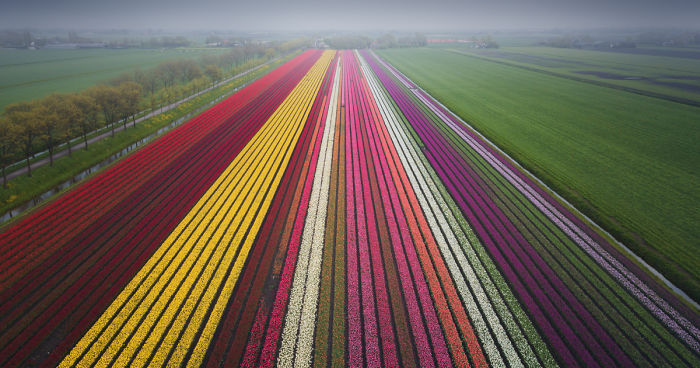
Every spring, the Netherlands becomes the internet’s favorite kind of chaos: the wholesome, pastel, “wait… is that real?” kind.
The kind where your camera roll suddenly contains 47 near-identical photos of a single tulip and you’re emotionally attached to all of them.
If you’ve ever scrolled a tulip photo set on Bored Panda and felt your soul quietly whisper, book the flightwelcome. This article is for you.
Here’s the thing: tulips aren’t just “pretty flowers” here. They’re a full-on national flex.
We do tulips the way Italy does pasta and Texas does “bigger”: with commitment, tradition, and enough color to make your phone’s screen time report feel judgmental.
Below is a practical (and slightly giddy) guide to seeing the Dutch tulip season at its bestwhere to go, when to go, how to get the photos,
and how to enjoy the fields without becoming That Tourist.
Why the Netherlands does tulips better than anyone
It’s not “just flowers”it’s an industry, a tradition, and a national mood
Tulips are a Dutch calling card for a reason: the Netherlands is a global powerhouse in tulip production, bulb farming, and flower exports.
That’s why the spring landscape can look unrealstriped fields that stretch like rainbow barcode lines, neat rows running toward the horizon,
and the occasional windmill showing up like it’s fulfilling a contractual obligation to be “very Dutch.”
The best photos happen because the setting is both natural and engineered: farmland geometry, wide skies, and serious horticultural know-how.
Even if you don’t know a “parrot tulip” from a “triumph tulip,” you’ll feel the difference the moment you step outside Amsterdam and see
color blocks glowing against dark soil like someone boosted saturation in real life.
A quick origin story: how tulips became Dutch royalty
Tulips aren’t native to the Netherlands; they arrived in Europe through trade routes tied to the Ottoman Empire, then found a second home in Dutch soil.
A key turning point came in the late 1500s when botanist Carolus Clusius cultivated tulips in Leidenan early spark in the country’s lasting obsession.
That fascination eventually fed into the famous 17th-century “tulip mania,” a period that later became a go-to cautionary tale about speculative bubbles.
(Yes, the story is often exaggerated. No, the flowers were not responsible for your modern-day cryptocurrency choices.)
When to visit for peak tulip season
The bloom calendar (and why Mother Nature ignores your plans)
Tulip season in the Netherlands usually runs from late March into early May, with peak field color often arriving in mid-to-late April.
The catch: blooming depends on the weather. A warm early spring can push blooms earlier; a cold spell can delay them.
The smartest plan is to pick a window (late April is a strong bet) and stay flexible within it.
Keukenhof’s limited-time magic
Keukenhof Gardens in Lisse is the headline actan intensely curated spring park with huge displays of tulips and other bulb flowers,
open for only a short stretch each year. For example, Keukenhof has announced it will be open from March 19 to May 10 in 2026.
That “short season” reality is part of the allure: you’re not visiting a place, you’re catching a phenomenon.
Expect crowds (popular for a reason), immaculate paths, themed plantings, and enough photo angles to make you consider buying extra cloud storage.
If you want a calmer visit, aim for weekdays and go early. If you want the flowers to look like they’re performing for you personally,
show up when the gates open and walk with purpose like a wildlife documentarian tracking a rare species called “Empty Bench.”
Where the “wow” tulip photos are taken
Keukenhof Gardens (Lisse): curated color overload
If your mental image of Dutch tulips includes perfect framing, tidy borders, and a windmill appearing exactly when you need itKeukenhof.
It’s designed to deliver “photo gratification” on demand: bold beds, layered textures, and variety on variety.
This is where you go for close-ups, detailed compositions, and portraits where the background looks like a living screensaver.
The Bollenstreek: the classic ribbon of fields
Just outside the city, the Bollenstreek (bulb region) is where you’ll see the famous commercial fieldsbands of color laid out across farmland.
The fields here are working agriculture, which means the most photogenic spots are also someone’s livelihood.
The best experiences come from viewing respectfully: look for designated viewpoints, roadside pull-offs where allowed,
and flower farms that welcome visitors for photos.
Flevoland and Noordoostpolder: big skies, fewer elbows
Want that “endless fields” look with more breathing room? Many travelers head to the newer polders in Flevoland and the Noordoostpolder area,
where fields can feel bigger and the roads quieter. The scenery here leans cinematiclong horizons, modern farmland geometry,
and fewer “excuse me, can you move your selfie stick?” moments.
Photo-friendly farms and show fields: the ethical hack
If you want photos that look like you’re standing among blooms without harming crops or trespassing, seek out tulip experiences and farms that
explicitly welcome visitors. These places often have paths, viewing platforms, and “yes, please take photos here” setups.
Your pictures still look dreamy, and you don’t become a villain in a farmer’s group chat.
How to plan a tulip day trip from Amsterdam
Option A: the easy modetransport + gardens
The simplest tulip day is built around Keukenhof: go from Amsterdam (or Schiphol) to Lisse, spend a half-day in the gardens,
then add a short countryside loop. This is great if you’re traveling with family, short on time, or allergic to logistical chaos.
Book timed entry when available and plan around peak hours to avoid standing in “the world’s most colorful line.”
Option B: train + bike for the “Dutch local” vibe
The Netherlands is made for bicyclesflat routes, bike culture, and scenery that rewards slow travel.
Pair a train ride to a nearby town (think Haarlem, Leiden, or the bulb-region area) with a bike rental,
and you’ll get the kind of tulip photos that feel more personal: fields in the distance, canals and farm roads,
and the occasional sheep acting like it’s posing.
Option C: rent a car, but don’t let it ruin your mood
Driving gives flexibility, especially if you’re targeting quieter polder regions. But spring weekends can mean traffic and limited parking near popular spots.
If you drive, build your route around places that handle visitors well (gardens, official farms, designated viewpoints), and keep your plans light.
Nothing kills tulip joy like an hour arguing with a GPS while your passenger says, “It’s fine, I’ll just walk from here.”
How to take tulip photos that don’t look like everyone else’s
Use light like a secret ingredient
Tulips love soft light. Sunrise and late afternoon give you richer color and fewer harsh shadowsplus fewer crowds.
Overcast days are also excellent because clouds act like a giant diffuser, making petals look velvety instead of glossy.
If it’s sunny at midday, lean into detail shots and use shadows creatively instead of trying to photograph entire fields head-on.
Compose with lines, layers, and “Dutch scale”
The classic field photo works because of perspective: get low, align your frame with the rows, and let the lines pull the viewer into the distance.
For variety, add a foreground element (a single tulip head, a fence line, a canal edge), then let the fields become the background.
And yes, if you can safely include a windmill or farmhouse in the distance, do it. It’s not clichéit’s context.
Portrait tips that look natural (and stay respectful)
The best portraits near tulips look candid: walking along a path, looking off-frame, holding a small bouquet from a legal pick spot.
Match your outfit to the palette (neutrals pop against saturated color; a single bright jacket can look intentional).
Most importantly: don’t climb into fields for “the shot.” You can get plenty of “immersive” images from designated photo areas,
and your conscience will remain delightfully unburdened.
Be a good flower guest
Remember: these fields are farms
Commercial tulip fields are not public parks. Farmers have dealt with crop damage from visitors chasing social-media photos,
and it’s a real issueespecially in peak season. Treat fields like you’d treat someone’s front yard: admire from the edge,
use official walkways, and choose visitor-friendly farms when you want up-close photos.
Leave no trace, even if your snack is “tiny”
Wind carries wrappers. Mud carries seeds. Crowds multiply small impacts fast.
Bring a small bag for trash, stick to paths, and assume every “just for a second” shortcut gets repeated a thousand times after you.
The goal is simple: your tulip memories should outlast your footprint.
Make it a whole Netherlands trip, not just a flower sprint
Pair tulips with canals, museums, and small towns
A perfect tulip trip has contrast. Do flowers in the morning, then switch to Amsterdam’s canals and museums in the afternoon,
or spend the evening in Haarlem or Leiden for a slower, less tourist-saturated vibe.
The Netherlands rewards “small itinerary” travelshort distances, easy trains, and towns that feel like you accidentally walked onto a postcard.
Don’t miss the Bloemencorso flower parade
If you want springtime spectacle beyond fields, the Bloemencorso Bollenstreek (flower parade) is a classic.
Floats covered in flowers roll through towns in the bulb region, and the event lands right around peak bloom season.
For example, the parade is scheduled for April 18 in 2026an easy way to stack your trip with both fields and festivities.
National Tulip Day: the January teaser trailer
Tulips in January? In Amsterdam, yesat least for a day. National Tulip Day is typically held on the third Saturday in January,
when a large temporary tulip garden appears in the city and visitors can pick a free bunch.
It’s not “fields in bloom,” but it is a fun, very Dutch way to kick off tulip season energy while winter is still doing its thing.
Experience add-on: of tulip-season moments you’ll actually remember
Imagine this: you wake up in Amsterdam to that clean, bright spring light that makes even a plain sidewalk look cinematic.
The city smells like coffee and fresh bakery air, and the canals are glassyuntil a duck decides it’s time to create modern art with ripples.
You grab something warm and portable (because tulip season is not the time for a sit-down breakfast that turns into a two-hour event),
then head out with your camera, a fully-charged phone, and the unrealistic confidence of someone who thinks they’ll “only take a few photos.”
The best part of leaving the city is how quickly the scenery changes. One minute you’re passing brick buildings and bike bells;
the next, you’re watching the landscape flatten into open farmland where the sky feels bigger than your plans.
You start noticing the Dutch details people don’t always post: the tidy drainage canals, the small bridges,
the way farm roads curve gently like they’re guiding you toward something colorful. And thenthere it is:
a sudden stripe of red, then yellow, then purple, laid across the earth with such precision it looks designed by a graphic artist with a ruler.
If you bike, the experience becomes even more vivid. You feel the wind, you hear birds instead of traffic,
and you learn quickly that “flat” does not mean “effortless” when you’re pedaling into a headwind while trying to hold onto your dignity.
Every few minutes you stopnot because you’re tired (okay, sometimes because you’re tired), but because the views keep changing.
One field glows like molten orange; the next looks soft and pastel, like a watercolor wash.
You find yourself laughing at how absurdly pretty it all is, like nature is showing off.
Then there’s the human side of tulip season: the little clusters of people quietly gasping when they turn a corner,
the couples negotiating who gets to stand where (“No, the other leftyour other left!”),
the families trying to keep kids from treating a flower bed like a playground. In a place like Keukenhof,
you’ll also catch those slow-motion moments that feel strangely peaceful despite the crowds: a person leaning in to smell a bloom,
a photographer waiting patiently for a clear shot, someone sitting on a bench just staring like they’ve forgotten their phone exists.
By afternoon, you’re sun-kissed (or wind-chilled), your shoes have a thin layer of honest Dutch mud,
and your camera roll is a masterpiece of “I swear this color is real.” You head back toward the city feeling the kind of tired that’s actually satisfying.
Maybe you end the day with a canal walk and a snack, scrolling through photos and realizing half of them don’t do the place justice.
And that’s the final tulip-season truth: the pictures are amazing, but the experiencethe air, the scale, the sheer improbability of all that color
is what makes you start planning your return before you’ve even left.
Conclusion
Tulip season in the Netherlands is a limited-edition version of the countrybrighter, busier, and honestly kind of surreal.
Go for the photos, stay for the feeling: the wide skies, the tidy countryside, the spring festivals, and that joyful sense that the world
can still surprise you with something as simple as a flower field done extremely well.
Plan around peak bloom, pick visitor-friendly spots, respect the farms, and let the tulips do what they do best: make you want to book a trip.