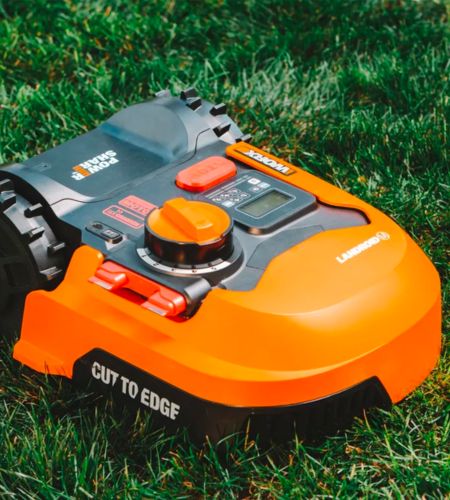
Robotic lawn mowers have a reputation in America that’s… complicated. On one hand, they’re the “set it and forget it” dream:
a Roomba for grass. On the other hand, they’re pricey, a little weird, and they require you to spend quality time
with something called a boundary wirewhich sounds less like a yard tool and more like a plot point from a spy movie.
The Worx Landroid line sits right in the middle of this love-hate relationship: it’s widely available, frequently compared
to the category giant (Husqvarna Automower), and packed with genuinely useful featuresplus a few that feel like your lawn
is about to start earning a cybersecurity certificate.
Bob Vila’s hands-on test of the Worx Landroid is one of the more convincing “robot mowers can actually work” write-ups in the
U.S. market, because it’s not just specs and hypeit’s real yard time, real terrain, real hiccups, and real outcomes. Let’s
break down what the Landroid does well, where it can annoy you, and whether it’s worth the money for your lawn.
Quick Verdict
A Worx Landroid can be absolutely worth it if you have a small-to-midsize yard, you’re okay installing a boundary wire,
and you want a consistently tidy lawn with less weekly effort. In Bob Vila testing, the Landroid delivered reliable mowing,
solid cut quality, and surprisingly smart schedulingafter the dock placement was dialed in.
It’s not ideal if your yard is split into disconnected sections, has lots of tight landscaping traps, or you
aren’t willing to do a careful setup. The robot is good at mowing. The human still has to be good at planning.
What Bob Vila Found in Real-World Testing
The Bob Vila review tested a Worx Landroid in a real yard with mixed grass types and varied terrain. The takeaway:
once it was set up properly, it consistently mowed on schedule, stayed within the boundary wire, navigated obstacles and
uneven spots, and produced an even cut. The biggest issue wasn’t mowingit was docking.
Highlights from the test
- Strong overall performance: consistent mowing, good cut quality, reliable boundary containment.
- App control that’s genuinely useful: start/pause/home controls, edge cut, “party mode,” one-time schedules, logs, stats.
- Auto-scheduling that improves over time: the mower adjusted frequency and duration after observing lawn needs.
- Main “gotcha”: the charging station needs to be flat/level with a straight approach, or docking can fail.
One especially practical observation: the tester started with manual scheduling and then switched to auto scheduling.
Auto scheduling ended up mowing slightly less often but achieving a better cut, while also reducing total mow time.
That’s the kind of “smart” you actually feel in day-to-day ownership: less babysitting, better results.
Meet the Landroid Family: S, M, and L
Worx offers multiple Landroid models sized for different lawns. In the Bob Vila review, the M model was tested, but the logic
applies across the range: choose the smallest model that comfortably covers your yard (oversizing costs money; undersizing
costs patience).
- Landroid S: for small yards (around 1/8 acre class).
- Landroid M: midsize yards (around 1/4 acre class).
- Landroid L: larger yards (up to about 1/2 acre class).
Example: the Landroid L (WR155) is marketed for up to 1/2 acre (21,780 sq ft) and includes features like
multi-zone management, Cut-to-Edge, rain sensing, and over-the-air updates. It also lists a 59 dB noise level
(conversation-quiet) and a 30% max slope ratingimportant if your lawn has even mild hill drama.
How a Robotic Mower Actually “Mows” (and Why It Still Works)
Most boundary-wire robot mowers (including Landroid) don’t mow in perfect stripes. They typically move in a
semi-random pattern, trimming a little at a time, and rely on frequency rather than “one big weekly haircut.”
Over the course of several days, the whole lawn gets covered, and the yard stays consistently short.
Think of it less like “Saturday morning mower day” and more like “daily micro-maintenance.” That’s why robot mower owners
often say the lawn looks constantly good instead of “good for 48 hours and then slowly feral.”
Setup: The Real Price of Admission
Here’s the truth no robot mower ad wants to put in bold letters: you are not just buying a moweryou are buying a small
one-time yard project.
Boundary wire installation (yes, it’s a thing)
With classic Landroid models, you lay a boundary wire around the mowing area so the mower knows where it’s allowed to roam.
This can take a couple hours for some yards, longer for complex perimeters, and it rewards careful planning.
Tom’s Guide calls this the biggest “pain point” for robot mowers in the U.S.: running a wire around your property and dealing
with the fact that a broken wire can be frustrating to track down.
Practical tip: Lowe’s guidance recommends leaving extra wire at the charging station and following your manual closely for
spacing, distances from edges, and corner handling. Translation: don’t eyeball it like you’re hanging a picture frame.
Eyeballing is how you end up with a mower that thinks your flower bed is “just spicy grass.”
Dock placement matters more than you expect
Bob Vila’s test found the Landroid’s main challenge was docking when the charging base wasn’t straight, flat, and aligned
with a level approach. After adjustments, the docking problem resolved. This isn’t a minor detail: if docking fails,
a robot mower becomes a confused turtle doing laps along the perimeter wire.
Performance: Cut Quality, Slopes, Obstacles, and Edges
Cut quality: better than you’d think
In Bob Vila testing, the mower delivered an even, consistent cut and handled moderate slopes and uneven terrain well.
If you’re used to a push mower’s “one-and-done” finish, the robot’s results may surprise youespecially after the first week,
when frequent mowing starts smoothing out the lawn’s look.
Obstacles: sensors plus optional upgrades
Landroid includes sensors to bump away from obstacles and pause for rain. The Bob Vila review also points out the optional
Anti-Collision System add-on, designed to help the mower avoid objects (like toys and patio furniture) more gracefully.
If you have a yard that constantly contains kid gear, dog gear, sports gear, and “mystery gear,” obstacle avoidance matters.
Edges: “Cut-to-Edge” helps, but don’t expect miracles
Worx emphasizes Cut-to-Edge border cutting and an offset blade design. In the Bob Vila review, the offset blade was noted as
cutting closer to the edge than many other robot mowers, reducing cleanup. That said, all robot mowers still tend to
leave some edge touch-up depending on your hardscapes, fences, and how your boundary wire is placed.
The healthiest expectation is this: Landroid can meaningfully reduce trimming, not eliminate trimming. You’ll still want an
edger or string trimmer occasionallyjust not as a weekly punishment ritual.
App & Smart Features: The Stuff You’ll Actually Use
A robot mower’s app can be either a helpful control center or a chaotic collection of buttons that feels like it was designed
by a committee of squirrels. The Bob Vila tester found the Landroid app intuitive and used “mow on demand” frequently even with
schedules available.
Standout app features mentioned in real testing
- Start / Pause / Home: instant control when life happens (delivery, guests, sprinklers, surprise backyard soccer).
- Edge Cut: focused perimeter cleanup runs.
- Party Mode: temporarily suspends mowing (because nobody wants a robot photobombing the cookout).
- One-Time Schedule: extra mowing outside normal routine.
- Logs & stats: helpful for spotting patterns and troubleshooting.
- Multi-zone settings: useful if your yard has sections connected by a path.
- “Save the Hedgehogs” mode: prevents nocturnal mowing to protect nighttime wildlife.
On the smart scheduling front, Worx describes auto-programming that factors in growth rate variables and weather.
In Bob Vila testing, the auto scheduler settled into shorter, more frequent cuts plus weekly edge cyclesbetter cut quality
with less total mowing time than the initial manual schedule.
Maintenance: Less Than a Gas Mower, More Than “Nothing”
Robot mowers reduce labor, not responsibility. The good news: there’s no gas, no oil changes, no yanking cords, and far less
“why does it smell like a haunted garage?”
What you’ll do regularly
- Blade swaps: small razor blades are consumables. Many guides recommend replacing at least seasonally (sometimes more often with heavy use).
- Cleaning: BHG recommends cleaning a robot mower at least weekly if used regularly; more if it’s muddy. The WR155 listing also notes the underside can be rinsed with a hose.
- Boundary wire checks: especially after aeration, edging, animals digging, or any landscaping work.
- Dock area tidying: keeping the approach clear and stable helps reliability.
Longevity depends on care, usage, and environment. BHG notes robot mowers can last a long time if maintained properly and
suggests considering warranty coverage when investing.
Noise, Safety, and “Will It Attack My Dog?”
Robot mowers are generally far quieter than gas mowers. For example, Worx lists the WR155 at 59 dBaround normal conversation.
That’s why many owners run them early in the morning or in the evening without igniting neighborhood feuds.
Safety-wise, modern robot mowers are designed with recessed blades and automatic shutoffs. The Spruce highlights automatic
shutoff and deeply recessed blades as key safety features across tested models, and Worx notes the blade disk stops if the
mower is lifted. Still, common-sense rules apply: supervise around small kids, keep the yard cleared of debris, and treat it
like any powered cutting toolnot a pet.
The Real Math: Is It Worth the Money?
The “worth it” question isn’t only about sticker priceit’s about time, consistency, and what you’d otherwise spend.
Bob Vila’s review points out that weekly lawn service for a typical suburban lot can run roughly $40–$60+ per visit, which
can total over a season. Under that math, a robot mower can pay for itself quickly if you were already paying for service.
If you mow yourself, the value is time. Even saving one hour per week adds up over a season. The hidden bonus is consistency:
robot mowers are at their best when they mow often. The lawn tends to look “maintained” more days of the week, not just the
day after you mow.
How Landroid Compares to Other Robotic Mowers
In the U.S., the main comparison is often Worx vs Husqvarna. Bob Vila’s review notes that Husqvarna’s entry models can be a
strong value for basic mowing, but connectivity and monitoring can vary by model. Meanwhile, Landroid’s app control and Wi-Fi
features are a big part of its appeal at its price tier.
The bigger market shift is also happening above and around Landroid: newer premium mowers are moving toward GPS/RTK, LiDAR,
and camera-based navigation that can reduce (or eliminate) boundary wire installation. The Spruce notes GPS-enabled models can
be much faster to set up than wired models, even if wired boundaries remain reliable and give direct control. Esquire also
frames robot mowers as best for flatter, less cluttered lawnsterrain and obstacles still separate “cool gadget” from “daily helper.”
Bottom line: Landroid is compelling because it offers a lot of real-world functionality without forcing you into the most
expensive tier of boundary-wire-free robots. You “pay” with setup effort instead of only dollars.
Who Should Buy a Worx Landroid?
You’re a great fit if:
- You have a small to midsize lawn and want it consistently trimmed.
- You can install (or pay to install) a boundary wire and place a stable charging dock.
- You like the idea of app scheduling, quick “mow now” control, and automated daily maintenance.
- You want a quieter mower and prefer battery-powered equipment.
You might want to skip it if:
- Your yard has disconnected sections or complicated boundaries (Reviewed flags difficulty with connecting yards).
- You frequently do yard projects that disturb the perimeter wire (aeration, edging, digging, re-landscaping).
- Your lawn is very steep, very rough, or packed with obstacles that change daily.
- You want perfect stripes and one-pass precision. Robot mowers are more “consistent maintenance” than “instant makeover.”
FAQ: Common Questions Before You Buy
Do I still need to trim?
Usually, yesjust less. Cut-to-Edge and offset blade designs can reduce trimming, but hard edges, fences, and tight corners
often still need occasional cleanup.
Can it mow in rain?
Many robot mowers are weather-resistant. Some have rain sensors that send them home when precipitation begins; Worx lists a rain
sensor and notes the mower can pause during rain (and that this can be adjusted via app). BHG also notes that rain response
varies by model.
What about sprinklers?
Bob Vila’s test raised a smart concern: if the mower uses a rain sensor, automated irrigation might trigger “go home” behavior.
The workaround is scheduling coordination, adjusting rain delay settings, or customizing behavior so sprinklers and mowing
don’t fight like two roommates sharing one bathroom.
Is it hard to set up?
The mowing part is easy. The setup is the project. If you can follow instructions, plan your boundary carefully, and take time
to level the dock, you’re fine. If you rush it, you’ll spend more time troubleshooting than mowing.
Real-Life Ownership: of “Okay, But What’s It Like?”
Let’s talk about the part nobody puts in the product listing: the day-to-day vibe of having a robot mower. Not the marketing
fantasy where your lawn is always perfect and you’re always sipping lemonade in slow motion. The real versionwhere you’re
occasionally crouched by a charging dock like you’re trying to negotiate peace between two tiny metal diplomats.
Week one is mostly about setup, and setup is a personality test. If you enjoy organizing cables, leveling things, and
reading instructions like they’re sacred scrolls, you’ll feel oddly satisfied. If you’re more of a “close enough is fine”
person, the Landroid may gently coach you into becoming a “measure twice, peg once” person. The boundary wire goes down,
you connect the dock, and you do that first run where you watch it like a proud parent watching a toddler take wobbly steps.
It’s both adorable and slightly stressful, because your brain keeps whispering, “What if it escapes?”
Once it starts mowing regularly, the lawn changes in a subtle way. Instead of a dramatic weekly haircut, you get a steady,
always-managed look. The clippings are tiny, so the lawn tends to look cleanerlike it’s being maintained continuously rather
than rescued periodically. This is where the “worth it” feeling begins: you walk outside on a random Tuesday and realize you
haven’t thought about mowing in days. That’s the magic.
The app becomes your remote control and your notification center. You’ll use “mow now” more than you expect, because life is
chaotic. A delivery arrives. Guests show up. Sprinklers run. Somebody drops a soccer net in the yard. Being able to pause,
send it home, or run an extra session is the difference between “helpful robot” and “tiny orange coworker with no social cues.”
And yes, you may use Party Mode at least once and laugh because it’s absurd that your lawn mower has a party setting.
The most common “owner moments” are small: you tweak the schedule after seeing how fast your grass grows; you adjust the
boundary wire near a tricky corner; you learn that the dock approach must be stable and clean; you replace blades and feel
strangely competent doing something so tiny that has a big effect. If you have a multi-zone yard, you’ll learn the art of
guiding a robot through your landscape like it’s playing a real-life video game.
Then there are the occasional annoyances: a boundary wire gets nicked during yard work, and you suddenly understand why people
talk about wire troubleshooting like it’s a rite of passage. Or the mower gets confused by a new objectlike a garden hose
that was not there yesterdayand you remember that robots are amazing, but they’re also literal-minded little machines.
Still, when it’s dialed in, the Landroid shifts mowing from a weekly chore to an occasional check-in. You stop thinking of it
as “a mower” and start thinking of it as “lawn maintenance on autopilot,” which is the whole point.
Conclusion
The Worx Landroid isn’t a gimmickit’s a legitimately useful tool for the right yard. Bob Vila’s test shows it can deliver
reliable mowing, good cut quality, and smart scheduling that adapts over time, with the main caveat that dock placement and
boundary setup need care.
If you want to buy back your weekends, keep your lawn consistently trimmed, and don’t mind a one-time setup project, a Landroid
can feel like a luxury that quickly becomes normallike dishwashers, GPS, and not having to rewind VHS tapes.