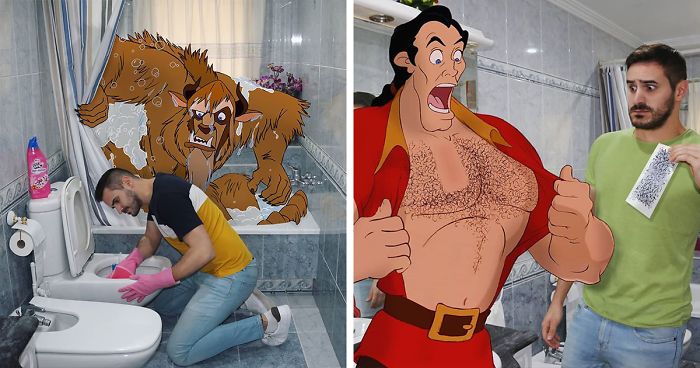
Some people take vacation photos. Some people take gym selfies. And then there is Samuel MB, the digital artist who looked at ordinary life and thought, “You know what this kitchen needs? A cartoon tiger, a princess, and maybe a suspiciously dramatic villain in the corner.” His wildly charming photo edits place Disney characters into everyday scenes so naturally that the images feel less like Photoshop experiments and more like lost snapshots from a very magical roommate situation.
The series, often shared under titles such as “Guy Edits Disney Characters Into His Photos And The Result Looks Like They’re Having A Blast”, became popular because it taps into a simple fantasy: what if the animated characters we grew up loving could step out of the screen and join us for breakfast, laundry day, road trips, or a lazy afternoon on the couch? The answer, judging by Samuel’s work, is that they would make normal life much funnier, more chaotic, and significantly harder to explain to neighbors.
At the center of the appeal is not just nostalgia. It is the way these Disney character photo edits combine humor, technical skill, storytelling, and the universal desire to keep a little childhood wonder alive. Samuel MB, known online as samuelmb1991, is described as an artist, actor, and primary school teacher. That combination makes perfect sense: the photos have the timing of performance, the construction of digital art, and the playful imagination of someone who spends time around kids who still believe a good story can change the room.
Who Is Samuel MB, the Artist Behind the Disney Photo Edits?
Samuel MB is a creative artist who uses Photoshop to merge real-life photography with animated characters. His work frequently features beloved Disney figures such as Simba, Ariel, Hercules, Mulan, Tarzan, Tinker Bell, Lady and the Tramp, and other familiar faces from animated classics. Instead of placing them in grand fantasy landscapes, he brings them into the most relatable human settings possible: bedrooms, kitchens, living rooms, bathrooms, and casual outdoor scenes.
That ordinary setting is the secret sauce. A Disney character in a castle is expected. A Disney character helping raid the refrigerator at midnight? That is comedy with a sprinkle of pixie dust. Samuel’s images work because the fantasy is not treated as distant or untouchable. It becomes domestic. These characters are not posing like museum pieces; they are playing, eating, teasing, lounging, and getting involved in the kind of tiny daily disasters that make real life memorable.
Why These Disney Character Photo Edits Feel So Fun
The best digital art does more than show off technique. It creates a feeling. Samuel’s images feel joyful because they are built around interaction. He does not simply paste a character into a corner and call it a day. He poses his body, changes his expression, adjusts his environment, and builds the scene so it looks like the character is actually reacting to him.
They Turn Everyday Moments Into Mini-Movies
Many of the edits look like a single frame from a larger story. Maybe Samuel is sharing spaghetti with animated dogs, hanging out with Simba, or trying to survive the emotional energy of a room full of cartoon friends. The viewer immediately understands the joke because each image has a setup, a relationship, and a punchline. It is not only “look, a character.” It is “look, this character clearly belongs in this ridiculous situation.”
They Use Nostalgia Without Getting Stuck in the Past
Disney characters are deeply tied to childhood memories for many people. They remind viewers of VHS tapes, Saturday mornings, family movie nights, theme park dreams, and songs that somehow still live rent-free in the brain decades later. Samuel’s art uses that emotional connection, but it does not simply repeat the original movie scenes. Instead, it asks what would happen if those characters wandered into adulthood and helped make daily life less boring.
They Are Funny Because They Are Specific
Good humor often comes from details. A character standing beside Samuel is cute. A character behaving as if it has always lived in his apartment is hilarious. The edits feel like inside jokes between the artist, the characters, and the audience. The more seriously the scene treats the impossible situation, the funnier it becomes. That is why a casual kitchen scene can feel more entertaining than a giant fantasy battle.
The Photoshop Magic: Why the Edits Look Convincing
Photoshop compositing is the art of combining separate visual elements into one believable image. In Samuel’s case, the challenge is especially tricky because he is blending two very different visual languages: real photography and hand-drawn or computer-animated characters. If the scale, angle, lighting, shadows, or color temperature feels wrong, the illusion collapses faster than a pumpkin carriage after midnight.
Lighting and Shadows Do the Heavy Lifting
One of the most important reasons these Disney Photoshop edits work is attention to light. If Samuel is standing beside a character, both need to appear lit by the same source. If the room light comes from the left, the character should not look like it was lit from a magical sunbeam on the right. Shadows also matter. A character needs contact shadows near the floor, couch, table, or wall to feel physically present.
That may sound technical, but viewers notice it instinctively. They may not say, “Ah, yes, the ambient occlusion is convincing.” They will simply think, “That looks real.” In digital art, believability often comes from invisible effort. The more carefully the artist handles shadow and light, the less the audience thinks about the editing.
Perspective Makes the Characters Feel Present
Perspective is another key piece. A character placed too high, too low, too large, or too small can look like a sticker. Samuel’s strongest images match the character’s position to the camera angle of the real photo. If the camera looks slightly downward, the character needs to follow that angle. If Samuel is sitting on a couch, the character’s feet, body, or gestures must match the plane of the room.
Expression and Body Language Sell the Joke
Samuel often acts inside the frame. His expression matters just as much as the character placement. If he looks surprised, annoyed, delighted, exhausted, or suspicious, the photo gains a story. The cartoon character becomes a scene partner. This is where his background as an actor appears to influence the work. He is not just editing images; he is performing with imaginary co-stars.
Why Disney Characters Work So Well in Real-Life Photo Manipulation
Disney characters are built for emotional clarity. Their silhouettes are recognizable, their expressions are readable, and their personalities are usually understood within seconds. Simba brings curiosity and mischief. Ariel brings wonder. Hercules brings big heroic energy. Mulan brings courage and calm strength. Tinker Bell brings sparkle and attitude in equal measure. Put any of them into a real-life scene, and the audience instantly knows what kind of energy has entered the room.
This instant recognition gives Samuel a storytelling shortcut. He does not need to explain who the characters are or why they matter. The audience arrives with memories already loaded. That allows each image to jump straight into the fun.
Fan Art, Copyright, and Creative Respect
Because Samuel’s work uses famous characters, it also sits in the broader world of fan art and transformative digital creativity. Fan art has long been a major part of online culture. People draw, remix, cosplay, edit, parody, and reinterpret the stories they love. These works can be affectionate, humorous, critical, or simply playful.
At the same time, famous characters are protected intellectual property. In the United States, fair use depends on several factors, including the purpose of the work, how much of the original is used, and whether the new work affects the market for the original. That means fan artists should be thoughtful, especially when moving from personal or editorial sharing into commercial products. A playful Photoshop post is one thing; selling unauthorized merchandise with protected characters is another castle entirely.
For readers and creators, the takeaway is simple: celebrate creativity, credit artists, avoid stealing work, and be careful when using copyrighted characters for profit. The internet loves magic, but lawyers still own calendars.
What Other Creators Can Learn From These 30 Disney Photo Edits
Samuel’s work is entertaining, but it is also a useful lesson in visual storytelling. Anyone interested in digital art, Photoshop composites, fan art, or social media creativity can learn from how his images are built.
Start With a Strong Concept
The idea comes first. A technically perfect edit with no joke or emotion will not travel far. Before opening editing software, ask: what is happening in this scene? Why is it funny, sweet, strange, or surprising? The best images can be described in one sentence: “What if Simba took a nap with me?” or “What if Mulan helped me inspect the fridge?” Simple concepts are often the most shareable.
Use the Real Photo as the Foundation
A good composite begins with a good base photo. The pose, lighting, camera angle, and empty space must leave room for the character. Samuel often photographs himself as if the character is already there. That preparation makes the final image feel interactive rather than pasted together after the fact.
Match the Mood, Not Just the Image
The character should fit the emotional tone of the scene. A chaotic character belongs in a chaotic room. A romantic character works in a warm, soft scene. A villain can make an ordinary setting instantly funnier if everyone else is acting like nothing unusual is happening. Mood matching is what turns editing into storytelling.
Why These Photos Became So Shareable
Social media rewards images that make people pause, smile, and tag a friend. Samuel’s Disney edits do all three. They are visual enough to understand instantly, nostalgic enough to trigger emotion, and funny enough to invite comments. They also work across languages because the core idea is universal: cartoons have entered real life, and everyone is having a blast.
Another reason the series travels well is that it is positive. Much of the internet is built on outrage, arguments, and people explaining why someone else is wrong in twelve paragraphs. Samuel’s edits offer a break. They are cheerful, clever, and low-stress. Nobody needs a survival guide to enjoy a picture of a grown man casually hanging out with animated legends.
The Deeper Appeal: Adults Still Want Magic
One reason this series resonates is that adults are not nearly as finished with fantasy as they pretend to be. People may pay bills, answer emails, and compare vacuum cleaners online, but somewhere inside, many still want the talking animals, flying carpets, enchanted objects, and dramatic musical numbers. Samuel’s photos make that feeling visible.
His edits suggest that imagination does not disappear after childhood. It just changes rooms. Instead of living only in movie theaters or bedtime stories, it can appear in a kitchen, a hallway, or a messy living room. The message is not childish. It is creative. Life becomes more interesting when you allow ordinary places to hold extraordinary possibilities.
Experience Notes: What It Feels Like to Step Into a Disney-Style Edit
Looking at these Disney character photo edits can make you imagine what the process feels like from the inside. Picture setting up a camera in your living room, moving a chair six inches to the left, checking the light, and then posing beside absolutely nothing while pretending a famous animated character is standing right next to you. To anyone walking in, you probably look like you are losing an argument with invisible furniture. But in your mind, the scene is already alive.
That is the fun of this kind of creative work. It requires a strange mix of planning and play. You have to think like a photographer, actor, editor, and comedian at the same time. You need to know where the character will stand, where their eyes will look, how tall they should be, and what your own body language should communicate. If the character is supposed to be pulling you, you must lean as if someone is actually tugging your arm. If they are surprising you, your face has to react before they even exist in the image.
The editing stage can feel like solving a puzzle. First comes the cutout or frame selection. Then scale. Then color. Then shadow. Then tiny fixes that nobody will consciously notice but everyone will feel if they are missing. A shadow under a foot, a warm highlight on a character’s cheek, a slight blur to match the camera focusthese are the little details that transform a fun idea into a believable fantasy.
There is also an emotional reward in making something that gives people a quick burst of happiness. A viewer might be tired after work, scrolling without much interest, and suddenly see a Disney character causing harmless chaos in a real apartment. For a second, the day gets lighter. That matters. Not every artwork needs to be heavy to be meaningful. Sometimes making people grin is the whole mission, and frankly, that mission deserves a cape.
For creators, Samuel’s series is a reminder that inspiration does not always require exotic locations, expensive gear, or dramatic themes. Your home can become a movie set. Your couch can become a stage. Your favorite childhood characters can become imaginary collaborators. The real magic is not only in Photoshop. It is in the decision to look at ordinary life and ask, “What would make this more fun?” Once that question appears, even doing the dishes can become a scene worthy of animation.
Conclusion
“Guy Edits Disney Characters Into His Photos And The Result Looks Like They’re Having A Blast” is more than a funny collection of digital edits. It is a celebration of imagination, nostalgia, technical skill, and the joy of blending fantasy with everyday life. Samuel MB’s work succeeds because it understands something simple: people do not only love characters because of how they look. They love them because of how those characters make the world feel.
By placing Disney characters into kitchens, bedrooms, living rooms, and casual daily moments, Samuel turns ordinary reality into a playful crossover episode. The results are funny, charming, and surprisingly warm. They remind us that creativity does not always need to shout. Sometimes it just needs a good idea, a camera, careful editing, and a cartoon lion casually making your day better.