Note: This review is based on current public product information, retailer listings, and independent test coverage. Pricing and promotions can change faster than your neighbor says, “Do you have an extension cord?”
Portable power stations used to be a simple shopping category. You picked a famous brand, stared at a giant battery brick, winced at the price, and told yourself it was an “investment.” Now the market is packed with familiar names like EcoFlow, Bluetti, Jackery, and Anker, plus a growing crowd of lesser-known brands trying to elbow their way into the party. Oupes is one of those brands. And the Oupes Mega 1 is the kind of product that makes you stop scrolling and say, “Wait… this thing does what for how much?”
On paper, the Mega 1 is a seriously ambitious portable power station. It pairs a 1,024Wh LiFePO4 battery with a 2,000W pure sine wave inverter, up to 4,500W surge capacity, fast AC charging, strong solar input, app connectivity, UPS functionality, and expansion support up to 5.12kWh. That is a lot of spec-sheet swagger for a brand that still doesn’t enjoy the mainstream name recognition of the big dogs.
So is the Oupes Mega 1 the real deal, or just another budget-friendly box with big promises and tiny follow-through? After comparing its specs, features, category benchmarks, and independent test impressions, the answer is surprisingly encouraging: yes, this lesser-known brand can compete. But it competes in a very specific way.
What the Oupes Mega 1 Gets Right Immediately
The Mega 1’s headline feature is not its battery size. It is the unusual combination of high output and relatively low weight. A lot of power stations around the 1kWh class settle into the 1,500W to 1,800W range. Oupes decided to stuff a full 2,000W inverter into a unit that weighs about 28 pounds. That matters more than it sounds.
Why? Because output determines what you can run right now. A power station can have decent capacity and still disappoint if it chokes on appliances with higher wattage demands. The Mega 1’s 2,000W rated output gives it the confidence to run more demanding home and camping gear than many similarly sized competitors. That makes it more useful in an outage, more flexible on a road trip, and a lot less likely to become an expensive phone charger with a superiority complex.
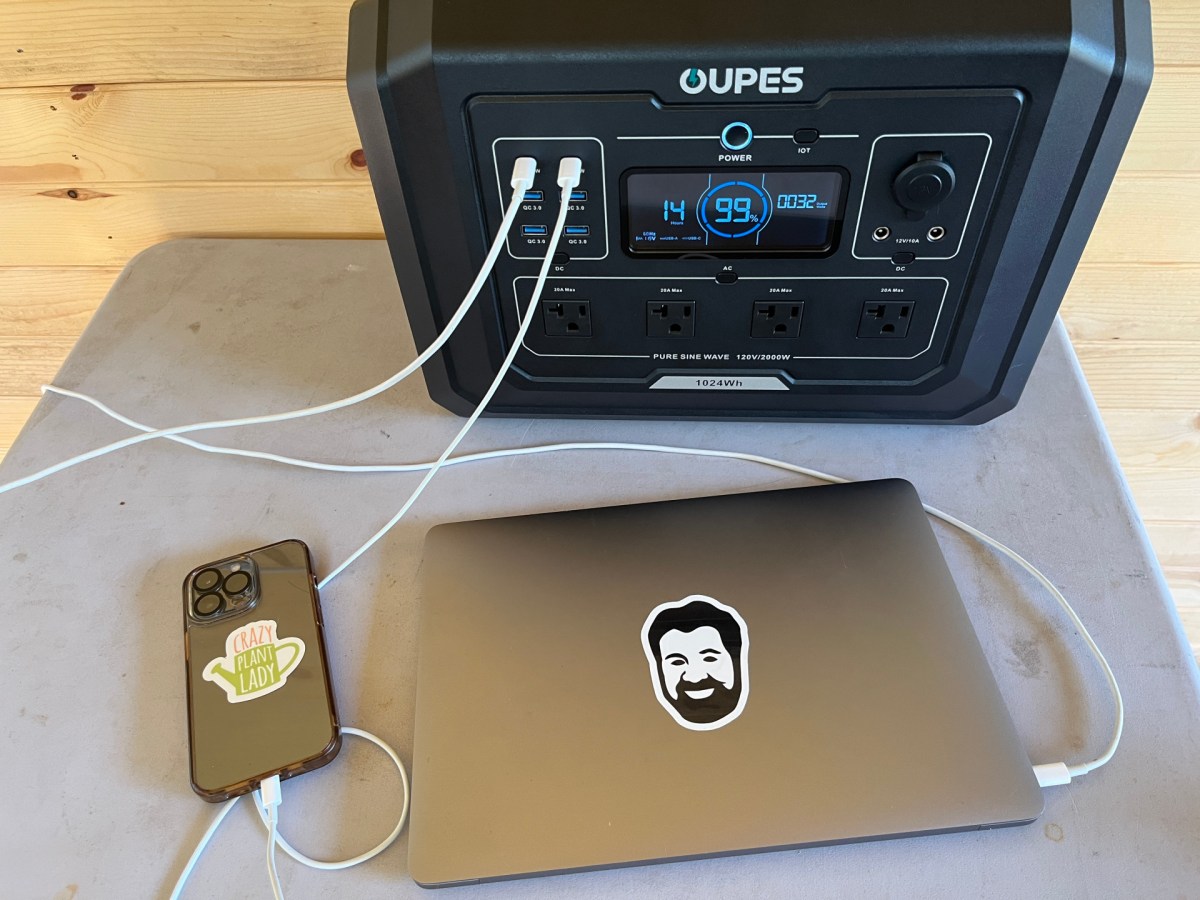
Oupes also deserves credit for giving the Mega 1 a genuinely practical port setup. You get four AC outlets, dual 100W USB-C ports, four USB-A ports, two DC barrel outputs, and a 12V car socket. In plain English, that means it can serve phones, tablets, laptops, cameras, lights, routers, mini-fridges, CPAPs, and a small parade of camping gadgets without turning your setup into a dongle museum.
Specs Snapshot: Why the Mega 1 Looks So Competitive
Core numbers that matter
- Battery capacity: 1,024Wh
- Battery chemistry: LiFePO4
- Rated AC output: 2,000W
- Surge power: up to 4,500W
- Cycle life: 3,500+ cycles to 80%
- Solar input: up to 800W
- AC charging: up to 1,400W
- AC + solar combined input: up to 2,200W
- Expansion capacity: up to 5.12kWh with extra batteries
- UPS/EPS switchover: under 20ms
- Connectivity: Wi-Fi and Bluetooth app control
- Weight: about 27.8 pounds
- Warranty: up to 6 years with registration
That spec sheet puts the Mega 1 squarely in the same conversation as category favorites like the EcoFlow Delta 2, Bluetti AC180, Anker SOLIX C1000, and Jackery Explorer 1000 v2. And that is the most important point in this review: the Mega 1 is not competing with cheap toy-grade power stations. It is competing with serious mid-size units from much more established brands.
How It Stacks Up Against Better-Known Rivals
Here is where things get interesting. The EcoFlow Delta 2 offers 1,024Wh and 1,800W output, with famously fast charging. The Bluetti AC180 gives you 1,152Wh and 1,800W output. The Anker SOLIX C1000 lands at 1,056Wh and 1,800W output. Jackery’s Explorer 1000 v2 gives you 1,070Wh and 1,500W output in a lighter body. Those are all excellent products from brands with strong reputations.
But the Oupes Mega 1 punches back in several important ways. First, it matches or beats many of them on rated output. Second, its 800W solar input is especially aggressive for this size class. Third, its expandability up to 5.12kWh gives it room to grow beyond “weekend camping buddy” status. Fourth, it stays impressively portable for what it offers.
That does not automatically make it the best buy. Brand reputation, app polish, service history, and real-world refinement still matter. But from a pure value-and-features angle, Oupes is not showing up to this fight empty-handed. It is showing up with brass knuckles and a sales pitch.
Performance: Strong Output, But Know the Trade-Off
The Mega 1’s 2,000W inverter is its superpower, but it also creates the product’s biggest reality check. A 1,024Wh battery paired with that much output can run hungry appliances, but it cannot run them forever. That sounds obvious, yet it is the difference between a smart purchase and a disappointed one.
This is not the power station you buy because you want to run heavy loads all night. It is the power station you buy because you want the ability to run heavier loads at all. That is a meaningful distinction.
For example, the Mega 1 makes more sense for short bursts of real appliance use than for marathon sessions. It is great for powering a coffee maker in the morning, a microwave in a pinch, a laptop workstation during an outage, or a portable fridge while traveling. It is not the ideal pick for users who expect endless runtime on high-draw appliances without adding expansion batteries or solar input.
That output-first personality is actually one reason the Mega 1 feels more “home backup ready” than some 1kWh units. It gives you more confidence that the appliance will start. The trade-off is that you still need to be realistic about how long it will run.
Charging Speed and Solar Input Are a Big Deal Here
This is one of the clearest areas where Oupes makes its case. The Mega 1 supports up to 1,400W AC charging, 800W solar input, and up to 2,200W combined AC-plus-solar charging. Oupes advertises very fast recharge times, including a full charge in well under an hour under combined input conditions.
Even if you treat brand-advertised charging claims with the healthy skepticism usually reserved for miracle mops and “free” trial subscriptions, the Mega 1 still looks strong. In this class, 800W solar input is not a throwaway spec. It means the unit has a better shot at quick daytime recovery than many similarly sized rivals, especially if you actually plan to use solar instead of just admiring it in marketing photos.
That makes the Mega 1 appealing for campers, van users, and anyone building a modest backup setup around portability and fast recharge. If a storm knocks out power, speed matters. If you are off-grid for a weekend, speed matters. If you forgot to charge the thing until the last minute because life is chaos, speed really matters.
Design, Portability, and Everyday Use
At roughly 28 pounds, the Mega 1 lands in a sweet spot. It is not featherweight, but it is still manageable enough to move around the house, toss in a vehicle, or carry to a campsite without needing emotional support. Compared with chunkier competitors in the same performance neighborhood, that portability is a legitimate advantage.
Independent impressions also suggest that the handles and overall form factor make it feel easier to carry than the raw number implies. That is not a tiny detail. Portable power stations live or die by whether people actually want to move them. A unit can have all the watts in the world, but if it feels like carrying a stubborn cinder block, it stops being portable and starts being furniture.
The onboard display and app support add convenience, too. Wi-Fi and Bluetooth connectivity help the Mega 1 feel more modern than bargain-bin options that still behave like they were designed during the flip-phone era. You can monitor usage, check remaining power, and manage some functions remotely. That said, this is one area where Oupes still feels more “good enough” than truly premium.
Where the Mega 1 Still Falls Behind the Big Names
For all its strengths, the Mega 1 is not a flawless underdog hero. Some independent testing and review impressions point to a few caveats.
1. The app and interface are not class leaders
Oupes includes app control, which is good. But the experience does not appear as polished as the software ecosystems from brands like EcoFlow, Anker, or Bluetti. In other words, it works, but it may not exactly inspire you to write it a love letter.
2. Fan noise may annoy some users
One independent review criticized the cooling fans for being very loud under demanding use. That is not a dealbreaker for garage use, storm prep, or outdoor jobs. But it could be annoying in a quiet room, a tent, or a late-night blackout when every sound suddenly feels like a personal attack.
3. Heavy-load efficiency looks solid, not spectacular
In one independent heavy-load test, the Mega 1 posted efficiency around 79%. That is not terrible at all for a budget-friendly power station running near its limit, but it is not magical either. It reinforces the idea that this is a practical value machine, not a perfectionist’s trophy piece.
4. Surge handling deserves a little caution
Some testing suggests the unit may reduce voltage during demanding surge events rather than gracefully overpowering through them. That matters most for sensitive electronics and for shoppers who focus too much on surge ratings. Rated continuous output remains the more important number, and thankfully the Mega 1’s 2,000W figure is still very competitive.
5. Brand confidence is still catching up
Oupes has momentum, but it does not yet have the same long-term brand trust, broad public familiarity, or accessory ecosystem depth as the market leaders. Buying a lesser-known brand often means accepting a little more uncertainty in exchange for better value. Some shoppers are perfectly fine with that. Others would rather pay extra for a familiar badge and sleep better at night.
Who Should Buy the Oupes Mega 1?
The Mega 1 makes the most sense for shoppers who want serious output in a compact, reasonably priced package. It is a strong fit for:
- Apartment or suburban homeowners who want a compact outage backup
- Campers who need more than basic phone-and-light power
- Road-trippers and tailgaters who value portability
- Users who want fast recharging and meaningful solar input
- People open to a value-oriented brand if the specs are compelling
It is less ideal for buyers who prioritize whisper-quiet operation, top-tier app refinement, or the comfort of buying from an ultra-established household name. It is also not the best single-box answer for people who want long-duration backup on high-draw appliances without ever thinking about expansion.
Experience Section: What Living With the Oupes Mega 1 Is Probably Like in the Real World
The most interesting thing about the Oupes Mega 1 is not the spec sheet itself. It is the experience the spec sheet creates. In everyday life, this looks like a power station that feels more capable than its size suggests. You pick it up expecting a standard 1kWh unit, and then you remember it is carrying a 2,000W inverter. That changes how you think about it immediately.
In a home outage scenario, the Mega 1 would likely feel reassuring because it can handle a broader range of essentials without instantly forcing you into wattage math panic. You can keep the router on, charge your phones, run a lamp, top off laptops, and still feel like you have enough headroom for a practical kitchen or medical device need. It is the kind of machine that reduces the “What can I safely plug in?” stress that smaller, weaker units often create.
For camping or car travel, the Mega 1 experience is probably even better. The form factor is manageable, the DC options are useful, and the stronger-than-average solar input gives it a more realistic path to staying relevant during multi-day use. That matters because a lot of portable power stations are technically solar-compatible but recharge so slowly that the feature feels more decorative than functional. The Mega 1 seems built for people who might actually use solar in a meaningful way.
There is also something appealing about the Mega 1’s personality. It does not feel like a minimalist, ultra-premium status object. It feels like a hardworking utility tool that is trying to overdeliver for the money. That kind of product has a different emotional appeal. It is less “luxury battery for digital nomads with perfect cable organizers” and more “practical power box that wants to earn its keep.” Plenty of buyers will prefer that vibe.
Of course, the daily experience would not be flawless. If fan noise ramps up under heavy use, you will notice it. If the display is not perfect from every angle, you will notice that too. If you are used to the polished apps and mature ecosystems of bigger brands, Oupes may feel a little rougher around the edges. Those details matter because real product satisfaction often lives in the small annoyances, not the giant headline specs.
Still, the Mega 1 seems like the kind of unit that could win people over after a week of actual use. Not because it is glamorous, but because it keeps proving useful. It is easy to imagine owners starting with a little skepticism, then slowly getting impressed when it powers the appliance they expected it to hate, recharges faster than they assumed, and fits into routines more naturally than a much larger backup box would. That is how underrated products build fans: not with hype, but with repeated little victories.
And that may be the Mega 1’s biggest strength. It does not need to beat every famous competitor in every category. It just needs to make enough people say, “Honestly, this thing is better than I expected.” Based on its output, charging profile, portability, and expansion options, it has a very good chance of doing exactly that.
Final Verdict
The Oupes Mega 1 is not just a cheaper alternative. It is a legitimately competitive portable power station with a smart mix of output, speed, portability, and expandability. Its biggest win is simple: it gives buyers access to a 2,000W-class experience in a lighter, more affordable-looking package than many shoppers expect from a lesser-known brand.
It does not beat the category leaders on polish, reputation, or refinement. But it absolutely earns a seat at the table. If your priority is getting strong real-world capability without automatically defaulting to the usual brand names, the Oupes Mega 1 deserves serious consideration.
In other words, this is not a bargain-bin gamble pretending to be premium. It is a real contender from a smaller brand that seems to understand exactly how to compete: offer lots of useful power, recharge quickly, stay portable, and keep the value proposition spicy enough to make shoppers look twice.