Street photography is many things at once: documentary, art, anthropology, urban archaeology, and occasionally a perfectly timed visual prank delivered by a pigeon, a billboard, or a stranger wearing exactly the wrong shirt in exactly the right place. That is a big reason people keep flocking to Street Photographers Foundation, the Instagram account behind one of those delightfully bingeable photo roundups that makes you say, “I’ll just look at three,” and then, 47 images later, you’ve emotionally adopted a traffic cone and laughed at a shadow.
The account’s appeal is simple on the surface but surprisingly rich underneath. It curates candid street images from photographers around the world, and the best of them turn ordinary public life into something much sharper: a joke, a tiny mystery, a coincidence so perfect it feels scripted by the universe after two espressos. The 50-image roundup associated with this title works because it reminds us of a truth that every strong street photographer knows: everyday life is already weird, funny, touching, and visually chaotic. A good camera just helps us notice it.
And that is what makes these images so sticky. They are not fake. They are not polished into oblivion. They are not trying too hard to become “content.” They capture the split-second when a sign lines up with a face, a gesture collides with a background, or a person wanders into the frame at the exact moment the visual punchline lands. Street photography at its funniest is less about forcing humor and more about recognizing that public life is full of accidental comedy. The city is basically an improv stage with buses.
What Makes This Account So Addictive?
Street Photographers Foundation stands out because it doesn’t just post random city snapshots. The curation leans into images with tension, timing, wit, and visual surprise. Some photos are funny because of juxtaposition. Others are amusing because the composition makes two unrelated things appear connected. A dog looks judgmental. A mannequin seems alive. A passerby accidentally “wears” part of a billboard. Suddenly, the street stops looking like background noise and starts behaving like a comic strip drawn by reality itself.
That is why the best images in a roundup like this do more than get a quick chuckle. They reward a second look. First you laugh at the obvious visual joke. Then you notice the background expression, the reflection in the window, the extra figure in the corner, or the odd symmetry that makes the whole thing click. Great street photos often have layers, and humor is only the front door.
There is also something democratic about this kind of photography. These are not staged celebrity portraits or heavily art-directed campaigns. They are pieces of public life. The raw material is available to anyone willing to walk slowly, pay attention, and wait for the world to briefly arrange itself into visual poetry with a side of nonsense.
Why Funny Street Photos Work So Well
1. Timing Is the Invisible Punchline
In comedy, timing matters. In street photography, timing matters so much it might as well have its own trailer and management team. A second too early and the joke hasn’t formed. A second too late and the magic is gone. The funniest street photos depend on that blink-and-you-miss-it alignment when body language, light, movement, and background details fuse into one clean idea.
That is why these photos feel so satisfying. They are not merely “caught on camera.” They are caught at the exact right instant. The person stepping into the frame, the shape of a shadow, the tilt of a head, or the swing of a shopping bag can transform a regular scene into something unforgettable. The result feels spontaneous, but it also reveals skill. Someone had to see the possibility before it happened.
2. Juxtaposition Does the Heavy Lifting
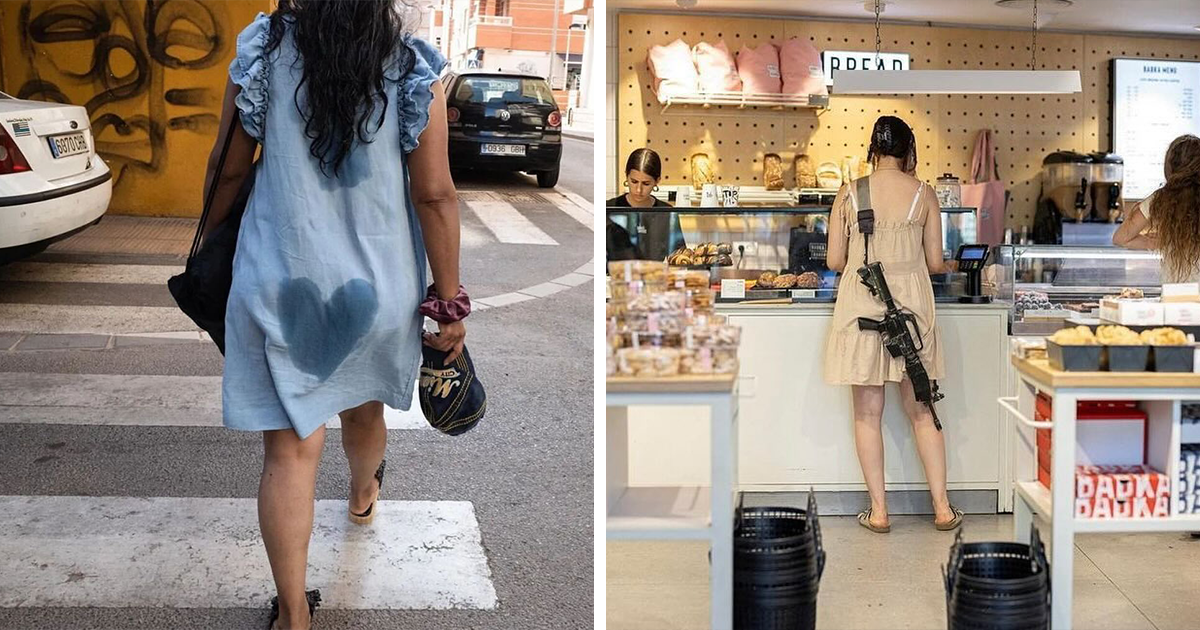
Many of the strongest images in collections like this rely on juxtaposition: two elements that should not belong together but suddenly do. A serious face next to a ridiculous ad. A formal suit beneath a chaotic mural. A tiny dog under a giant statue. Humor emerges from contrast, and the street offers endless pairings because cities are giant collages made of commerce, fashion, mood, architecture, exhaustion, and people trying to carry groceries with dignity.
When photographers notice these combinations, they are not just being lucky. They are reading the environment. They understand signs, colors, reflections, patterns, and human behavior. They know where to stand, what to exclude, and how long to wait. In other words, the joke may be accidental for the subject, but it is often intentional for the photographer.
3. Cities Are Full of Accidental Surrealism
The reason urban environments produce so many amusing images is because they are visually crowded. Store windows reflect traffic. Posters compete with pedestrians. Advertisements turn walls into giant faces. Construction barriers, umbrellas, glass, puddles, and public transit all add extra drama. The city is never just one thing; it is always layered. That layered quality gives photographers more chances to create images that feel surreal without becoming fake.
One of the joys of the 50-photo roundup is seeing how different photographers exploit this same visual chaos in different ways. Some chase color. Some use black-and-white contrast. Some get close to the action, while others let the scene breathe. But they all understand the same basic principle: the street is not messy in a bad way. It is messy in a useful way.
What You’ll Notice in These 50 New Selections
Even without reproducing each image here, a pattern emerges from the names and frames featured in the roundup. The selected photographers do not all shoot alike, but the images often share a family resemblance: sharp observation, clean composition, and a willingness to let ordinary life remain gloriously unpredictable.
Some images are built around facial expression. Others hinge on scale, like a tiny human figure swallowed by an absurdly loud visual backdrop. A few depend on graphic design in the wild: stripes, circles, shadows, or posters that turn a street corner into a ready-made set. Several work because they flirt with visual illusion, making your brain briefly misread what it is seeing. That split second of confusion is often where the laugh lives.
The roundup also benefits from variety. You are not getting 50 copies of the same joke. Instead, you move from elegant irony to pure coincidence to warm human observation. A photograph can be amusing without being cruel, and the better images in this kind of collection understand that difference. They laugh with the street, not just at it.
A Few Standout Names From the Roundup
The featured selection includes photographers such as Paolo Tinari, Tavepong Pratoomwong, Bert Hardy, Ron Terner, Frank Azine, Vineet Vohra, Waldemar Walczak, Gilbert Kan, Roy Kahmann Amsterdam, and others. That lineup alone signals the range of the collection. Some photographers are known for witty visual construction, others for classic documentary instincts, and others for finding that sweet spot where elegance and absurdity shake hands.
This variety matters because it keeps the feed from becoming formulaic. Street photography can easily fall into cliché if every image relies on the same trick. But when different eyes interpret the same public world, the result is richer. One photographer sees geometry. Another sees tenderness. Another sees a human face perfectly aligned with a giant cartoon eye on a bus stop ad and thinks, “Yes, today is my day.”
That is part of the pleasure of browsing a curated street-photography account. You are not just following one person’s city walk. You are seeing many visual brains at work, each solving the same creative puzzle in a different way: how do you turn the ordinary into the unforgettable?
The Real Genius Is in Making the Ordinary Look Extraordinary
The strongest argument for accounts like this is that they train viewers to become more observant. After spending time with these photos, you do not walk down the street the same way. You begin to notice reflections in bus windows, weird overlaps in storefronts, oddly expressive shadows, and the secret comedy of public signage. You realize that the everyday world is not boring; it is just under-edited by our attention spans.
This is where funny street photography becomes more than entertainment. It becomes a way of seeing. It teaches you to recognize visual rhythm, coincidence, and narrative. It reminds you that humor does not always need a setup and a punchline in words. Sometimes it only needs a yellow wall, a passing cyclist, and a very determined pigeon.
There is also a little generosity in this approach. Amid endless doomscrolling, outrage bait, and algorithmically optimized chaos, these photos offer a gentler kind of surprise. They say: look, the world is still strange in a way that can make you smile. Not everything online has to be loud to be memorable.
The Ethical Side of Street Photography
Of course, street photography is not all laughs and lucky timing. It also raises real questions about privacy, consent, and dignity. That tension is part of the genre’s long history. Photographing people in public can produce truthful, moving work, but it can also cross a line if the subject is reduced to a joke or stripped of humanity.
The best street photographers understand that ethical awareness is not optional. Funny does not mean careless. A strong image can be candid and still respectful. In fact, many of the most memorable street photos succeed because they preserve the subject’s mystery and personhood rather than turning them into a cheap punchline. The humor comes from the frame, the timing, or the urban environment, not from humiliating someone.
That balance is one reason thoughtful viewers keep returning to curated collections instead of random “gotcha” images online. A good street-photography account knows the difference between observational wit and exploitation. It recognizes that the street is public, but people are still people.
Why This Kind of Visual Humor Thrives on Instagram
Instagram is almost absurdly well-suited to amusing street photography. The platform rewards images that are instantly legible, visually strong, and emotionally quick to process. A funny street photo delivers all three. It stops the scroll because the composition is clear, the surprise is immediate, and the viewer feels clever for “getting it.”
But the better accounts do not stop at scroll-stopping visuals. They create a rhythm. The feed becomes a living archive of human coincidence. Over time, viewers begin to trust the account as a source of delight. That trust matters. It is the difference between a random viral image and a destination feed people actively seek out when they want something inventive, human, and just a little ridiculous.
In that sense, Street Photographers Foundation is not merely posting photos. It is curating a mood: alertness, amusement, empathy, and visual curiosity. That combination keeps a niche art form accessible. You do not need to know the full history of photography to enjoy a frame where reality accidentally develops a punchline.
The Experience of Falling Into a Street-Photo Rabbit Hole
There is a very specific experience that comes with browsing an account like this, and if you know, you know. You open the post planning to be efficient. You are a serious internet user. You have tasks. Deadlines. Maybe even a beverage that still believes in you. Then the first image gets you. The second confirms the first was not a fluke. By the seventh, you are leaning toward the screen like a detective trying to solve a crime made entirely of reflections, hats, and weird timing.
That experience is part amusement, part admiration, and part low-key jealousy. Not toxic jealousy, just the kind that whispers, “How did they even see that?” You begin to realize that great street photographers are not simply wandering around waiting for chaos. They are reading a scene before it completes itself. They notice visual ingredients the rest of us miss: a bold sign, a shaft of light, a repeating shape, a face approaching from the edge of the frame. Then they wait. Or they move two steps left. Or they don’t panic when the moment finally arrives and the city briefly turns into a perfect one-panel comic.
There is also something oddly comforting about these images. They suggest that public life, for all its stress and mess, still contains unscripted joy. Not every funny street photo is laugh-out-loud hilarious. Some are simply lightly absurd, the visual equivalent of raising an eyebrow and smiling to yourself on the subway. That matters. Small delight has value.
For photographers, the experience can be even more personal. Collections like this tend to spark the dangerous but beautiful thought: maybe I should go outside with my camera more often. Maybe the walk to the grocery store is not just a walk to the grocery store. Maybe the city is handing out visual material all day and I have been rushing past it like a fool with headphones on. Suddenly, a boring block becomes a possible stage set. A bus shelter becomes a framing device. A puddle becomes a mirror with commitment issues.
For non-photographers, the experience is still powerful because it sharpens attention. After looking at enough strong street photos, you start seeing your own surroundings differently. The world appears more theatrical, more layered, more mischievous. You catch small alignments you previously ignored. You notice how people, advertisements, architecture, and weather constantly interact. Even if you never touch a camera, you become more visually awake.
And maybe that is the best thing this kind of account offers. Not just a collection of amusing images, but a subtle reset of perception. It reminds us that wonder is not always hidden in exotic places or major events. Sometimes it is on a sidewalk, next to a storefront, underneath a badly timed umbrella, waiting for someone observant enough to laugh and click the shutter.
Final Thoughts
This roundup works because it celebrates the funniest side of attentive looking. The 50 featured images are not just amusing street photos; they are proof that the ordinary world is much stranger, smarter, and more cinematic than we usually give it credit for. Street Photographers Foundation succeeds by collecting those fleeting moments when life accidentally composes itself better than most people ever could on purpose.
In a crowded social media landscape, that kind of curation feels refreshing. It is visual entertainment with craft behind it, humor with observation behind it, and spontaneity with discipline behind it. You laugh, but you also respect the eye that caught the moment. And that combination is what keeps these images memorable long after the scroll ends.
So yes, come for the accidental comedy. Stay for the timing, the composition, the humanity, and the delightful reminder that the street is never just a street. It is a stage, a mirror, a puzzle, and once in a while, the funniest place on the internet.