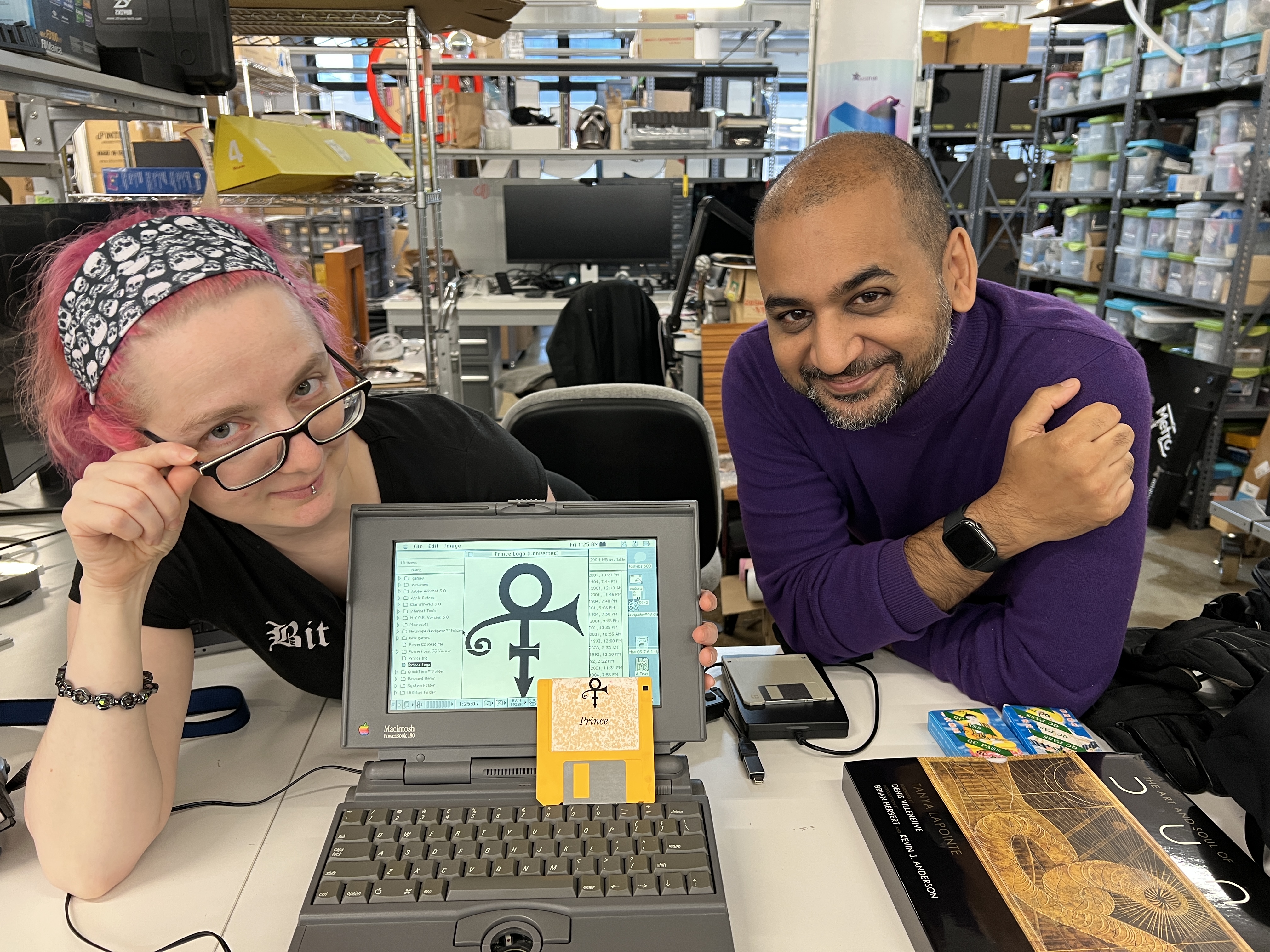
Some cultural artifacts arrive with trumpets. Others arrive with a quiet plastic click. Prince’s media floppy belongs in the second category: a humble 3.5-inch disk that somehow managed to hold rebellion, branding, typography, and a little controlled chaos in one tiny square. It was born in the aftermath of Prince’s biggest era, when the glow of Purple Rain still hung over pop culture, but the artist himself was already busy refusing to become a museum piece in his own lifetime.
That refusal is what makes the Prince floppy so fascinating. On the surface, it looks like an oddball relic from the age of whirring drives and beige computers. Dig a little deeper, though, and it becomes a perfect symbol of Prince’s post-Purple Rain identity: brilliant, confrontational, funny, difficult, and miles ahead of the systems trying to contain him. This was not just a disk. It was a message. Maybe even a prank with a purpose. And like many of Prince’s best moves, it forced the rest of the world to catch up.
The Story Starts After the Crown Was Already Won
By the early 1990s, Prince was no struggling artist trying to get the room’s attention. He had already conquered radio, MTV, arenas, fashion, guitar mythology, and that rare air where a musician becomes shorthand for a color. The problem was that success did not make him feel free. His conflict with Warner Bros. grew more public as he pushed for more control over his output, release schedule, and artistic direction. Prince believed he was creating faster than the label wanted to release material, and the tension turned into one of the most famous power struggles in pop music.
Then came the move that still feels like equal parts protest, performance art, and legal stress test: in 1993, Prince changed his name to the unpronounceable Love Symbol. The symbol had already appeared in his visual world, but now it became his official identity. Suddenly, editors, marketers, record executives, and fans all had the same practical problem. How exactly do you write about someone whose name is a glyph?
Prince’s answer was gloriously analog for a man who always seemed to be operating one decade ahead of everyone else. He sent media outlets a floppy disk. Inside was a way to reproduce the symbol correctly. It was part style guide, part branding kit, part challenge to the machinery of publicity. If the world wanted to talk about him, it would have to do the work. Prince was not merely changing his name. He was exposing the limits of the media systems that claimed to define artists in the first place.
A Floppy Disk as a Weaponized Press Release
That is what makes the Prince floppy more than a cute piece of retro-tech nostalgia. It was a distribution strategy. At a time before social media profiles, before artist-controlled feeds, before every celebrity had a direct line to millions of followers, Prince created a physical workaround for a very modern problem: how do you control your identity when the platforms belong to somebody else?
The floppy solved that problem in the most 1993 way imaginable. Instead of asking journalists to approximate the symbol, Prince’s camp gave them the tool to reproduce it. That was wildly practical, but it was also mischievous. Newsrooms had to wrestle with fonts, layout programs, compatibility issues, and style guides that were never designed for a superstar who had turned himself into a piece of custom iconography. Somewhere in America, at least one tired copy editor probably stared at that disk and whispered something unprintable. Prince would have appreciated the drama.
And that is the point. The disk forced everyone else to participate in Prince’s reinvention. It made his identity harder to flatten, harder to standardize, and harder to own. In retrospect, it feels like a precursor to the creator economy: a star insisting that brand, language, visual design, and distribution all belong to the artist, not just the company shipping the albums.
What Was Actually on the Prince Floppy?
Here is where the story gets even more charmingly weird. The floppy became famous because it represented a custom typographic workaround for the Love Symbol, but the recovered disk later uploaded online was preserved as image files. The Internet Archive listing for the recovered item describes the exact contents as two TIFF files. That detail matters because it reminds us that old media artifacts are often messy, versioned, and platform-specific. The Prince symbol was not just one neat little universal file waiting patiently for the future. It lived across formats, operating systems, and distribution channels, including press materials, downloadable assets, and CD-ROM-era media.
In other words, the disk tells a story not only about Prince, but about the untidy reality of digital culture in the 1990s. We like to imagine the past as simpler. It was not. It was full of half-compatible file types, system quirks, mysterious formatting decisions, and enough platform fragmentation to make modern app developers feel slightly better about themselves.
That is why the recovered Prince floppy feels so valuable. It captures a moment when identity itself had to be translated through hardware. Prince did not just invent a symbol and move on. He had to package that symbol so printers, editors, designers, and fans could actually use it. The floppy is proof that even icons need file management.
Why the 2021 Recovery Was More Than a Retro Curiosity
When a surviving copy of the disk was recovered and uploaded to the Internet Archive in 2021, the story quickly spread across tech and culture sites. On one level, the appeal was obvious: old disk, famous artist, rare object, delightful weirdness. That alone is catnip for anyone who misses the era when software arrived in cardboard boxes and disks felt like tiny vaults. But the recovery mattered for a more serious reason. Legacy media degrades. Hardware disappears. Formats become unreadable. If you do not migrate old digital objects, they stop being accessible and start becoming silent plastic souvenirs.
The Prince floppy is a perfect example of why digital preservation is not just for corporations, governments, or giant libraries. It is cultural memory work. The Library of Congress has been explicit about the risks tied to floppy disks and other external media: aging carriers, scarce hardware, obsolete formats, and the need to safely transfer content into managed digital storage. That broader preservation context turns the Prince floppy from a novelty into a case study. It is not simply “look at this old thing.” It is “look how easily a piece of culture can vanish if nobody bothers to rescue it.”
And there is something deeply fitting about Prince ending up in that conversation. He spent years fighting for control over his music, his name, his release strategy, and the terms under which the world consumed his art. Preserving the floppy is, in a strange way, preserving one of the cleanest physical expressions of that fight.
The Floppy as a Symbol of the Artist Formerly Known as Easy to Market
Prince’s symbol era has often been reduced to a punchline, as if the whole thing were merely an eccentric celebrity stunt. That reading misses the depth of what he was doing. The name change was tied to power, ownership, and frustration with an industry structure that treated artists like assets to be managed. The floppy disk, then, was not some random trinket from the merch table of confusion. It was evidence that Prince understood something essential: if the old system insists on standardizing you, make standardization as inconvenient as possible.
That move now looks surprisingly contemporary. Today, artists obsess over handles, logos, metadata, platform control, audience ownership, and direct distribution. Prince did not have those exact tools, but he understood the same battle. His floppy was an early identity package, a media kit with attitude, a physical file that said, “No, you do not get to rename me just because your software is lazy.”
There is also a lovely irony here. Prince used dead-serious artistic conviction to create a branding problem so absurd that the culture had to invent workarounds like “The Artist Formerly Known as Prince.” He turned friction into mythology. Plenty of stars build brands. Prince built a legend by making the brand harder to process. That is not bad marketing. That is elite-level chaos management.
What Creators Can Learn from the Prince Floppy Today
The biggest lesson from the Prince floppy is not about nostalgia. It is about authorship. Prince treated every layer of presentation as creative territory: the name, the symbol, the packaging, the press instructions, the attitude behind the release. He understood that identity in public culture is not separate from the work. It is part of the work.
Modern creators can steal a page from that playbook, preferably without mailing obsolete media to half the press corps. First, presentation matters. A visual identity is not decoration; it shapes how audiences remember and discuss the work. Second, distribution matters. The way content travels can reinforce the story you are trying to tell. Third, preservation matters. If your files, assets, masters, and source materials are not organized and backed up, your legacy can become a scavenger hunt for future archivists with patience and old adapters.
Prince’s floppy also reminds us that technical limitations can become artistic opportunities. He turned a compatibility headache into a cultural event. He made the media machinery reveal its seams. And he did it with a piece of plastic that now looks quaint enough to fit in a museum gift shop next to pencils and postcards. Honestly, that is a pretty Prince move: elegant, annoying, unforgettable.
After the Purple Reign, the Disk Keeps Spinning
What survives after a superstar’s peak? The hits, of course. The wardrobe. The guitar silhouettes. The concert footage. The mythology. But sometimes what survives best is the artifact that captures how the artist thought. That is why the Prince floppy still matters. It is not just memorabilia from a famous name change. It is a compact lesson in resistance, media design, and the material history of digital culture.
After Purple Rain, Prince did not settle into heritage status. He became stranger, bolder, more self-protective, and more inventive about the space between art and industry. The floppy belongs to that chapter. It is a tiny machine-readable declaration that Prince would not be reduced to a line item, a label strategy, or a file-name convenience. He insisted on being difficult in exactly the way great artists often are: productively, memorably, and with better aesthetics than everybody else in the room.
So yes, cracking open the Prince floppy after the purple reign is a tech story. It is a music story. It is a preservation story. Mostly, though, it is a control story. Prince wanted control over how he was seen, named, printed, and remembered. Decades later, that little disk still does what it was built to do. It interrupts the easy version of the narrative and replaces it with the real one: Prince was never just a pop star. He was a system problem with excellent taste.
Extra Perspective: The Human Experience of the Prince Floppy
One reason this story keeps resonating is that the Prince floppy sits at the intersection of several different lived experiences. For music fans, it recalls the confusion and excitement of the symbol era, when magazines, MTV hosts, and radio people all seemed to be improvising their way around a name they could not pronounce and a symbol they could not easily print. For some fans, that period felt rebellious and thrilling. For others, it felt baffling. For everyone, it was impossible to ignore. The floppy becomes a physical reminder of what it felt like when one artist could throw the entire media ecosystem slightly off balance just by refusing the usual rules.
For journalists and designers, the story hits a different nerve. The floppy represents the practical reality of making culture visible. Before cloud drives and instant downloads, newsroom production depended on whatever tools were physically available, and a custom symbol was not a cute inconvenience. It meant new processes, extra troubleshooting, and the possibility of a deadline turning into a small typographic emergency. There is something almost funny about imagining the disk making its way through editorial offices, where people were probably muttering about compatibility while Prince quietly won the argument by forcing them to take his chosen identity seriously.
For collectors, the Prince floppy has the thrill of rare-object history. It is small, tangible, and deeply specific. You can hold it in your hand and feel the strangeness of an era when celebrity branding could arrive as physical software. Collectors love that kind of thing because it collapses distance. It turns a famous story into an object with edges, label text, and storage risk. It makes the myth touchable.
For archivists and preservation specialists, though, the experience is less romantic and more urgent. Old media does not politely wait forever. Floppy disks wear out. Drives fail. Connectors disappear. Formats become unreadable. So the experience of recovering something like the Prince floppy is part detective work, part technical rescue, and part cultural stewardship. The goal is not merely to save files. It is to save context: why this disk existed, who needed it, what problem it solved, and what that says about the relationship between technology and fame in the early 1990s.
Younger readers often experience the Prince floppy differently again. To them, a 3.5-inch disk can look almost fictional, like a save icon that somehow escaped from the screen and became an object. That generational gap is part of the floppy’s magic. It makes visible the fact that digital culture has a physical history. Files once had homes you could misplace in a desk drawer. Symbols traveled by mail. Media kits made noise when they loaded. The Prince floppy helps newer audiences grasp that the internet did not arrive fully formed. It was assembled through many awkward little bridges between art, hardware, and human labor.
And maybe that is the biggest experience tied to this story: delight. Not shallow nostalgia, but genuine delight that something so small can carry so much meaning. The disk is funny because it is fussy. It is moving because it survived. It is culturally rich because it captures Prince at a moment when he refused simplification. In a world that prefers frictionless branding, the Prince floppy reminds us that sometimes the most memorable identity is the one that makes everybody pause, squint, and ask, “Wait, how are we supposed to print this?” Prince, naturally, had already thought of that.