Brave New World is one of those novels that smiles politely while quietly stealing the furniture from your comfort zone. Published in 1932, Aldous Huxley’s dystopian classic imagines a future World State where people are engineered, conditioned, entertained, drugged, and gently bullied into happiness. No messy families. No unpredictable emotions. No inconvenient truth. No one has to suffer, which sounds lovely until you notice that no one is fully free either.
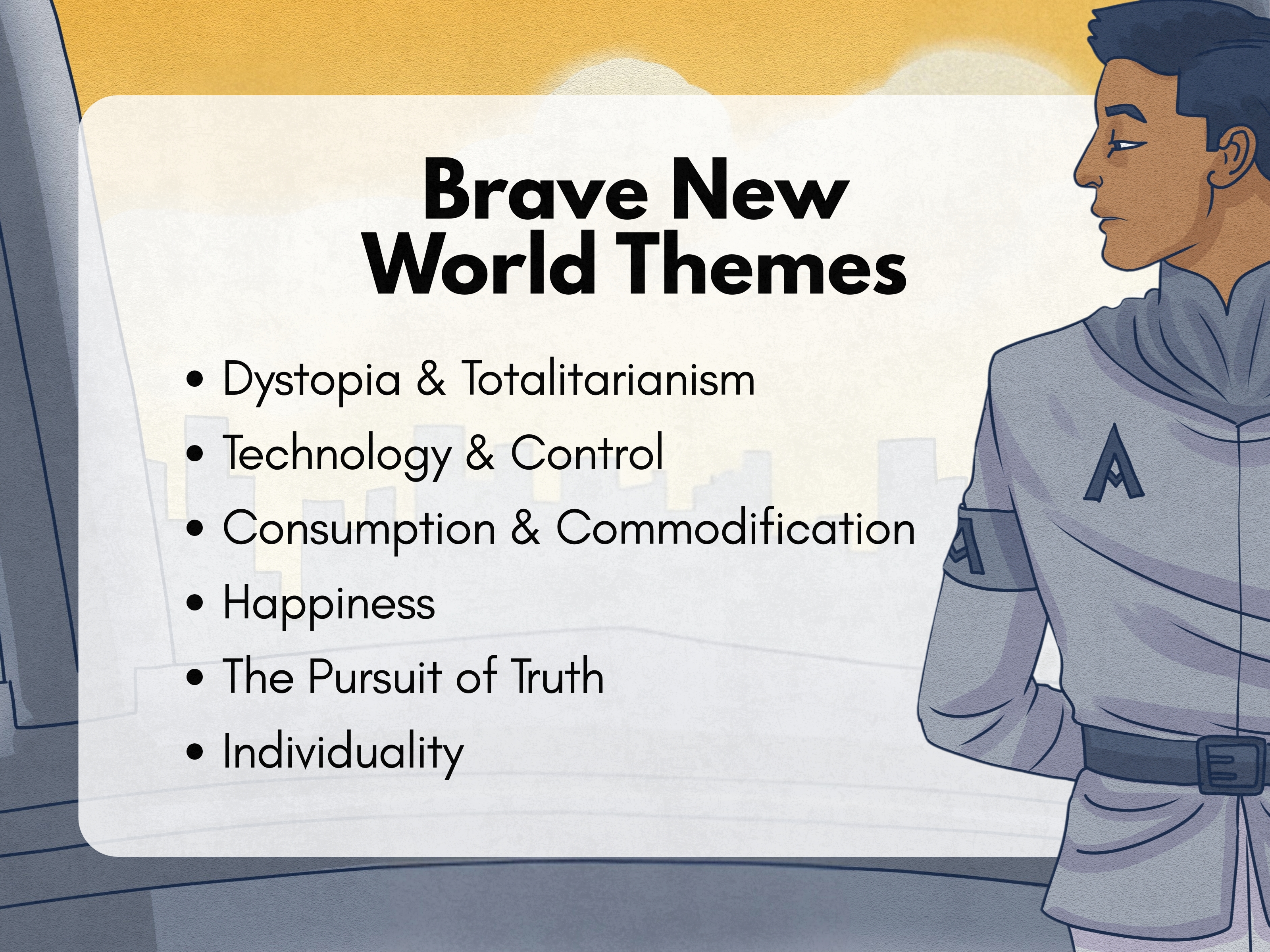
This literary guide explores the major Brave New World themes that make the novel so durable: technology and control, happiness versus truth, consumerism, social conditioning, individuality, caste systems, sexuality, religion, art, and the strange relationship between comfort and freedom. Huxley does not present a dystopia of chains and prison bars. His nightmare is softer, cleaner, and much better organized. The cage has music, snacks, slogans, and a reliable supply of soma. That is exactly what makes it so unsettling.
Why the Themes of Brave New World Still Matter
At first glance, Brave New World may look like a futuristic satire stuffed with test tubes, sleep-teaching, flying machines, and social rules that make modern dating apps look emotionally stable. But beneath the science-fiction surface, Huxley is asking a serious question: What happens when society decides that comfort is more important than freedom?
The World State is built on the motto “Community, Identity, Stability.” Each word sounds positive, almost like something printed on an inspirational office poster. Yet the slogan hides a brutal truth. Community means everyone must fit into the same social machine. Identity means a person’s role is assigned before birth. Stability means nothing meaningful can be allowed to disrupt the system. Huxley’s genius is that he makes oppression look efficient, cheerful, and strangely convenient.
Technology and Control
One of the most important themes in Brave New World is the use of technology as a tool of political and psychological control. In the World State, science is not used primarily to discover truth or improve human dignity. It is used to manage people. Human beings are produced in Hatcheries, sorted into castes, conditioned from infancy, and trained to accept their place in society.
The Bokanovsky Process
The Bokanovsky Process is one of the novel’s most chilling examples of technological control. Instead of natural reproduction, embryos are divided and mass-produced. Human life becomes industrial output. People are no longer born; they are manufactured. This process reflects Huxley’s anxiety about applying factory logic to humanity. If a car can be standardized, why not a person? The answer, of course, is that people are not cars, although the World State would very much appreciate it if everyone stopped bringing that up.
Through reproductive technology, the government controls not only how people live but also what they are capable of becoming. Alphas are designed for leadership and intellectual work. Betas hold comfortable middle positions. Gammas, Deltas, and Epsilons are chemically and biologically limited before they can ever make a choice. This is not equality; it is destiny disguised as social planning.
Conditioning as Invisible Power
Huxley’s most disturbing insight is that control works best when people do not recognize it as control. The World State conditions children through repetition, shock, suggestion, and sleep-teaching. Hypnopaedic slogans teach citizens what to desire, what to dislike, and how to think. By adulthood, most people believe the system’s values are their own.
This makes Brave New World different from many dystopian novels. The citizens are not constantly afraid of being punished. Most are genuinely happy because they have been trained to want only what the state allows. Huxley suggests that the most powerful prison is the one people mistake for personal preference.
Happiness Versus Truth
The conflict between happiness and truth is the philosophical heart of Brave New World. The World State promises happiness, but only by removing anything that might cause pain, depth, conflict, or growth. Citizens are protected from grief, loneliness, passionate love, spiritual longing, and serious thought. That protection comes at a terrible price: they lose access to the full range of human experience.
Soma and the Easy Escape
Soma, the state-approved drug, symbolizes artificial happiness. Whenever citizens feel discomfort, anxiety, sadness, or moral confusion, they take soma and float away from reality. It is not just a recreational drug; it is a political tool. Soma prevents reflection. It turns emotional pain into a technical problem with a chemical solution.
Huxley is not saying that happiness is bad. He is asking whether happiness still matters when it is purchased by surrendering freedom, truth, and emotional honesty. Real happiness often requires effort, risk, disappointment, and self-knowledge. The happiness of the World State is more like a screensaver for the soul: pleasant, colorful, and designed to appear whenever things get complicated.
Mustapha Mond’s Choice
Mustapha Mond, one of the World Controllers, understands the trade-off better than almost anyone. He knows about Shakespeare, religion, science, beauty, and tragedy. He has chosen stability over truth. In his conversations with John, Mond explains that great art, deep religion, and independent science are too dangerous for a perfectly stable society.
This makes Mond an especially fascinating antagonist. He is not ignorant. He is cultured, intelligent, and calm. He knows exactly what has been sacrificed. That knowledge makes his defense of the World State even more disturbing. Huxley uses Mond to show that tyranny does not always come from stupidity. Sometimes it comes from brilliant people who believe they can improve humanity by editing out the inconvenient parts.
Consumerism and Industrial Society
Brave New World is also a sharp satire of consumer culture. The World State depends on constant consumption. Citizens are conditioned to buy new things, dislike old things, and participate in activities that require equipment. “Ending is better than mending” is one of the novel’s famous slogans, and it captures the economy’s basic logic: repair is bad because it slows consumption.
Huxley connects consumerism with emotional shallowness. People are encouraged to seek pleasure through products, entertainment, and distraction. They do not form lasting attachments because attachment might interfere with consumption and social stability. Even leisure is organized to support the economy. The result is a society that looks busy, prosperous, and cheerful but is spiritually malnourished.
Fordism as a Religion
The World State replaces traditional religion with Fordism. Henry Ford, associated with mass production and the assembly line, becomes a symbolic god. The calendar is measured “After Ford,” and citizens use phrases like “Our Ford” in place of religious expressions. This detail is funny in a bleak way, like discovering that the national anthem has been replaced by a car commercial.
Fordism reveals how deeply industrial values have shaped the World State. Efficiency, standardization, speed, and production are treated as sacred principles. Human beings are valued according to how well they fit into the system. Huxley’s satire warns that when society worships efficiency, it may begin to view individuality as a design flaw.
Individuality Versus Conformity
Individuality is one of the most powerful themes in Brave New World. The World State does not want unique people. It wants predictable people. Individual thought is dangerous because it might lead to dissatisfaction, and dissatisfaction might lead to change. Therefore, the system trains citizens to avoid solitude, reject deep emotions, and conform to social expectations.
Bernard Marx and the Desire to Be Different
Bernard Marx is uncomfortable in the World State because he feels different. He is physically smaller than other Alphas, socially awkward, and resentful of the culture around him. At first, he seems like a rebel. Yet Bernard’s rebellion is complicated. He often wants not true freedom but social recognition. When he gains popularity through his association with John, he enjoys the very system he previously criticized.
Bernard shows that feeling alienated does not automatically make someone morally courageous. Sometimes people oppose society only because society has not rewarded them yet. Huxley gives Bernard enough insecurity to be sympathetic and enough vanity to be painfully human.
Helmholtz Watson and the Hunger for Meaning
Helmholtz Watson is a stronger example of authentic individuality. Unlike Bernard, Helmholtz is successful, attractive, and socially accepted. Yet he feels that his work as a writer is empty. He senses that language should do more than produce catchy propaganda. He wants words to carry emotional weight, danger, and truth.
Through Helmholtz, Huxley suggests that creativity requires conflict, limitation, and emotional depth. A perfectly comfortable world may produce slogans, but it cannot produce Shakespeare. Art needs friction. Without sorrow, longing, and moral struggle, language becomes decorative packaging.
The Caste System and Social Inequality
The World State’s caste system is one of the clearest examples of institutionalized inequality in the novel. People are divided into Alphas, Betas, Gammas, Deltas, and Epsilons before birth. Each caste is conditioned to enjoy its assigned status. Lower castes are not encouraged to rise; they are engineered not to want to rise.
This is social control at its most efficient. The World State does not need to convince oppressed people to accept injustice through argument. It designs them to experience that injustice as happiness. Huxley’s point is deeply unsettling: inequality becomes more stable when people are trained to love the system that limits them.
The caste system also challenges the idea that social harmony is always good. The World State has almost no class conflict because people are conditioned into obedience. But peace without justice is not a moral achievement. It is merely a quiet form of domination.
Sex, Family, and Emotional Attachment
In Brave New World, the family has been abolished. Words like “mother” and “father” are considered obscene or embarrassing. Romantic exclusivity is discouraged. Citizens are taught that “everyone belongs to everyone else.” Sexual freedom appears to be everywhere, but emotional intimacy is almost nowhere.
Huxley separates physical pleasure from love, loyalty, and responsibility. The World State encourages casual sex not because it values freedom, but because it wants to prevent deep attachment. Family bonds create private loyalties, and private loyalties compete with loyalty to the state. Love is dangerous because it makes people care about something more than social stability.
Lenina and Emotional Conditioning
Lenina Crowne is a useful example of how deeply conditioning shapes desire. She is not cruel, but she struggles to understand love, sacrifice, or emotional exclusivity. Her attraction to John is filtered through the values of her society. She wants him, but she cannot fully understand his moral and emotional language.
Lenina’s tragedy is that she has feelings but lacks the framework to interpret them deeply. She is not a villain. She is a person whose emotional vocabulary has been narrowed by design. Huxley invites readers to pity her as much as criticize her.
Art, Literature, and the Power of Shakespeare
Art is dangerous in Brave New World because it tells the truth about human complexity. Shakespeare becomes especially important through John, who learned language and emotion partly through Shakespeare’s plays. For John, Shakespeare provides words for love, jealousy, grief, wonder, and moral conflict.
The World State bans old literature because great art destabilizes easy happiness. A tragedy like Othello or King Lear would make no sense in a society that avoids suffering at all costs. More importantly, it might awaken desires that the state cannot satisfy. Literature reminds people that human life is larger than comfort.
John’s Shakespearean imagination makes him capable of moral seriousness, but it also makes him vulnerable. He judges the World State through a language of purity, sin, nobility, and tragedy. His ideals give him depth, yet they also isolate him. Huxley does not present literature as an easy cure. Art gives John a soul, but it cannot save him from a world that has forgotten what souls are for.
Religion, Spirituality, and the Need for Transcendence
The World State has eliminated traditional religion because religion often emerges from suffering, mortality, longing, and the search for meaning. In a society that hides death, removes hardship, and provides instant pleasure, religion seems unnecessary. Mustapha Mond argues that people do not need God when they are young, healthy, entertained, and comfortable.
Huxley challenges that assumption. The absence of religion in the World State does not create true freedom of thought. Instead, it leaves citizens with a shallow substitute: worship of Ford, consumption, and social stability. The novel suggests that human beings may need some relationship with mystery, limitation, and transcendence. Without it, life becomes efficient but spiritually flat.
Nature, Suffering, and the Human Condition
Nature is another major theme in Brave New World. Citizens are conditioned to dislike nature unless outdoor activities involve consumption. The natural world is too independent, too quiet, and too emotionally suggestive. It does not obey the logic of production.
John’s background on the Savage Reservation exposes him to birth, aging, religion, pain, and death. His world is imperfect and often harsh, but it includes experiences the World State has erased. Through the contrast between the Reservation and London, Huxley asks whether suffering is merely a problem to eliminate or an essential part of becoming fully human.
The novel does not romanticize suffering. The Reservation contains cruelty, poverty, and exclusion. But the World State’s attempt to abolish suffering creates a different kind of poverty: emotional and spiritual emptiness. Huxley’s argument is not that pain is good. It is that a life designed to avoid all pain may also avoid courage, compassion, art, love, and truth.
Language, Propaganda, and Thought
Language in Brave New World is engineered to limit thought. Hypnopaedic slogans replace independent reasoning. Phrases like “A gramme is better than a damn” are catchy, memorable, and intellectually tiny. They work because they are easy to repeat and hard to examine.
This theme remains one of the novel’s most relevant warnings. When language becomes a tool of control, people may mistake repeated slogans for personal beliefs. Huxley shows that propaganda does not need to be sophisticated to be effective. Sometimes the most powerful ideas are the ones drilled into people before they are old enough to question them.
John the Savage and the Tragedy of Moral Absolutism
John is the novel’s most dramatic outsider. He rejects the World State’s shallow pleasures and demands the right to suffer, love, pray, grow old, and seek truth. His famous demand for unhappiness is not a desire for misery but a defense of full humanity. He wants the right to experience life without being chemically cushioned and socially programmed.
Yet John is not a simple hero. His ideals are intense, sometimes rigid, and often shaped by shame. He cannot reconcile desire with purity, especially in his relationship with Lenina. His tragedy comes from being caught between two broken worlds: the harsh world of the Reservation and the sanitized emptiness of the World State. He can reject both, but he cannot build a livable alternative.
Experiences Related to Reading Brave New World
Reading Brave New World can feel like opening a time capsule and finding a mirror inside. Many readers begin the novel expecting an old-fashioned dystopia, something historically interesting but safely distant. Then the World State starts to feel uncomfortably familiar. The constant entertainment, the fear of silence, the pressure to consume, the suspicion of solitude, the preference for convenience over reflectionnone of these belong only to Huxley’s imagined future. They echo ordinary modern habits in ways that are hard to ignore.
One common reading experience is surprise. The novel does not shock only through violence or obvious cruelty. It shocks through pleasantness. The World State is clean, organized, and full of people who insist they are happy. That can be more disturbing than a world of visible suffering because it forces readers to ask whether comfort can become its own form of control. A classroom discussion of the book often begins with students saying, “This society is horrible,” and then slowly admitting, “Actually, parts of it sound convenient.” That awkward pause is where the novel does its best work.
Another experience many readers have is frustration with the characters. Bernard can be petty. Lenina can seem shallow. John can be judgmental. Mustapha Mond can sound almost reasonable. But this complexity is the point. Huxley does not give us cartoon heroes and villains. He gives us people shaped by systems, desires, fears, and contradictions. The reader’s changing reaction to them becomes part of the lesson. It is easy to condemn a society from a distance; it is harder to recognize how people adapt to the world that feeds them.
The novel also creates a powerful emotional experience around silence and solitude. In the World State, being alone is suspicious because solitude allows thought to deepen. Many readers notice how rare true quiet has become in their own lives. Phones buzz. Videos autoplay. Notifications multiply like caffeinated rabbits. Huxley’s world exaggerates this condition, but not by much. The book encourages readers to treat silence not as emptiness but as a space where independent thought can survive.
For students, writers, and literature lovers, the Shakespeare theme often becomes a doorway into the novel’s deeper meaning. John’s love of Shakespeare shows how literature gives language to emotions that society may prefer to simplify. After reading Brave New World, many people become more aware of why difficult books matter. Great literature does not always make us comfortable. Sometimes it makes us more awake.
The most lasting experience of reading Brave New World is the question it leaves behind: What would we trade for a painless life? The novel does not offer a tidy answer because tidy answers are exactly what Huxley distrusts. Instead, it asks readers to defend the messy parts of being human: love, grief, doubt, art, aging, longing, and the freedom to be unhappy for meaningful reasons. That is why the book remains so alive. It does not merely predict the future. It challenges the present to explain itself.
Conclusion: The Warning Behind the Comfort
Brave New World endures because its dystopia is not built on terror alone. It is built on pleasure, convenience, and the promise that no one ever has to feel bad. Huxley’s central warning is that a society can lose its humanity not only through violence but also through comfort without conscience, technology without wisdom, and happiness without truth.
The major themes of Brave New Worldtechnology and control, consumerism, social conditioning, individuality, art, religion, caste, sexuality, and freedomwork together to create a literary guide to modern anxieties. The novel asks whether people can remain fully human if every rough edge of life is smoothed away. Its answer is unsettling but necessary: a painless world may also be a shallow one, and freedom is worth protecting even when it makes life complicated.
In the end, Huxley’s brave new world is not frightening because it is impossible. It is frightening because parts of it are tempting. The book reminds readers that the good life is not the same as the comfortable life. Sometimes the right to think, love, suffer, question, and create is worth more than perfect stability. Even if it comes without soma, which, admittedly, would make Monday mornings a little less dramatic.
Note: This article is written as an original literary analysis for web publication, based on established information about Aldous Huxley’s Brave New World, its historical context, major themes, characters, and critical interpretations.