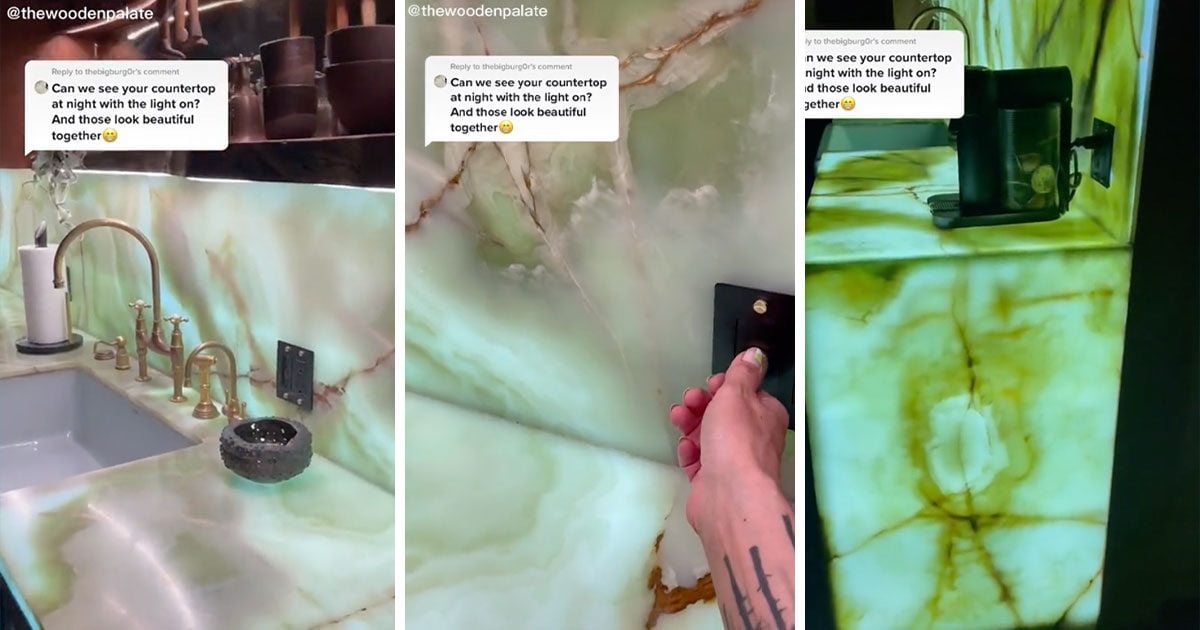
For years, kitchen countertops were expected to do three things: survive coffee spills, tolerate aggressive chopping, and politely support a bowl of bananas. Now they are being asked to perform a fourth jobglow like a glamorous piece of geological artwork.
Backlit countertops are rapidly becoming one of the most memorable features in luxury and design-forward kitchens. By installing an LED lighting system beneath a translucent surface, designers can reveal colors, veins, crystals, and patterns that remain subtle during the day but become spectacular after sunset. The result is part countertop, part mood lighting, and part conversation starter.
The timing makes sense. Current kitchen design is moving toward natural stone, personalized interiors, statement islands, warm materials, and layered lighting rather than anonymous all-white rooms. Backlit counter tops combine all of those ideas in one dramatic feature. Natural quartzite is gaining attention, kitchen islands are becoming sculptural centerpieces, and designers increasingly treat accent lighting as an essential layer rather than an optional decoration.
What Is a Backlit Countertop?
A backlit countertop is made by placing a lighting system behind or beneath a material that allows at least some light to pass through it. When the lights are switched on, the surface appears to glow from within.
The effect is very different from ordinary under-counter lighting. LED strips installed beneath an island overhang illuminate the floor or seating area. A true backlit countertop sends light through the countertop material itself, revealing details inside the slab.
The Basic Layers of the System
Although every installation is customized, most backlit countertop systems include several essential components:
- A translucent or semi-translucent countertop slab
- LED panels, sheets, tape lights, or edge-lighting modules
- A diffuser or light-distribution layer
- A support structure engineered for the slab
- Drivers, wiring, dimmers, and accessible electrical connections
- Ventilation and service access for future maintenance
The countertop may look simple once completed, but the hidden construction requires unusually close coordination among the designer, stone supplier, fabricator, cabinetmaker, lighting specialist, and electrician. This is not a “buy some LED tape on Friday and surprise the family on Sunday” project.
Why Backlit Counter Tops Feel So Current
The modern kitchen has become a social space, home office, breakfast bar, homework station, cocktail lounge, and occasional location of actual cooking. Because kitchens are increasingly visible from nearby living and dining areas, homeowners want them to look attractive even when nobody is preparing food.
A glowing island works especially well in an open floor plan. During the day, it functions as a practical work surface. In the evening, dimmed backlighting transforms it into ambient illumination. Instead of staring at a large dark block in the center of the room, you see softly illuminated stone.
Backlighting also responds to the growing demand for individuality. Two slabs from the same natural-stone category can have dramatically different veins, clouding, mineral deposits, and translucent sections. Once illuminated, those differences become even more noticeable. The countertop feels custom because, in a very literal sense, no other slab is exactly the same.
The Best Materials for Backlit Countertops
The success of a backlit counter depends heavily on material selection. A beautiful opaque slab will remain beautiful, but it will not suddenly become translucent through optimism and an expensive electrician.
Onyx: The Classic Showstopper
Onyx is perhaps the material most closely associated with illuminated surfaces. Its layered structure, sweeping bands, rich colors, and natural translucency can produce an extraordinary glow. Honey, white, green, amber, and pink varieties are especially dramatic when lit from behind.
The trade-off is practicality. Onyx is softer and more fragile than many common countertop materials. It can scratch, etch, chip, and stain more easily, so it is often better suited to a serving island, raised bar, beverage station, or decorative section than to the kitchen’s hardest-working food-preparation zone.
Its delicacy does not make it unusable. It simply means the layout and lifestyle should be considered honestly. A household that treats the kitchen like a restaurant during dinner service may want to illuminate onyx vertically or use it on a low-impact island panel rather than beside the range.
Translucent Quartzite: Natural Drama with More Strength
Certain quartzites, particularly pale slabs with crystalline structures, can transmit enough light to create a striking effect. Cristallo quartzite is among the best-known choices, although translucency varies considerably from slab to slab.
Quartzite is generally valued for its durability and natural movement. It can offer the glowing depth people love in onyx while providing a surface better suited to an active kitchen. However, the word “quartzite” alone does not guarantee that a slab will backlight well. Each candidate must be tested.
Hold a strong light behind a sample or inspect the entire slab on a professional light table. Areas that appear creamy white under showroom lighting may reveal cloudy patches, shadows, reinforcement, filled fissures, or dramatic crystalline details when illuminated.
Engineered Quartz: Greater Pattern Control
Selected engineered quartz designs can also be backlit. Manufacturers may identify particular patterns and thicknesses that create a mildly translucent appearance when installed over light panels. Compared with natural stone, engineered quartz offers more consistency in color and pattern, along with a nonporous surface that generally does not require sealing.
The effect is usually softer than intensely translucent onyx. That can be an advantage in a contemporary kitchen where the goal is a refined glow rather than a countertop that appears ready to launch into space.
Translucent Solid Surface
Some solid-surface products are specifically designed to interact with light. They can produce smooth, controlled illumination and may be formed into curves, engraved patterns, seamless-looking shapes, or sculptural panels. Corian, for example, identifies several translucent colors intended for lighting applications and recommends evaluating seams under lighting conditions similar to the final installation.
This option is useful when predictable diffusion, repairability, and complex fabrication matter more than the one-of-a-kind character of natural stone.
Glass, Resin, and Other Specialty Surfaces
Tempered glass, cast resin, recycled glass, and other engineered translucent panels can create effects ranging from frosted minimalism to bold embedded textures. These materials may suit modern kitchens, bars, reception areas, or islands where lighting is the primary design concept.
The important questions involve heat resistance, scratch resistance, structural support, food-contact suitability, and the manufacturer’s installation requirements. “It looks amazing in a photograph” is useful information, but it is not a technical specification.
The Lighting System Matters as Much as the Stone
A premium slab can still look disappointing when paired with the wrong lighting. Bright dots, dark bands, visible wiring, and inconsistent color are common symptoms of inadequate planning.
LED Panels Versus LED Strips
Custom LED panels or illuminated sheets usually produce the most even result because light is distributed across a broad area. LED strips can work, but they generally require appropriate spacing, diffusion, and sufficient distance from the stone to prevent visible hotspots.
The shallower the cavity beneath the countertop, the harder it becomes to blend individual light sources. A full-scale mock-up is therefore invaluable. It reveals whether the LEDs create stripes, whether the diffuser works, and whether seams or structural components suddenly become visible.
Choose the Right Color Temperature
Color temperature can completely change the appearance of a slab. Warm white light in the 2700K to 3000K range can enrich honey, gold, cream, beige, and amber tones. A neutral white around 3500K may suit pale quartzite or contemporary cabinetry. Cooler light can emphasize blue and gray tones but may make a warm kitchen feel clinical.
Consistency matters. If the pendants are warm white, the under-cabinet lights are neutral, and the island glows icy blue, the kitchen may look less “carefully layered” and more “lighting aisle after a minor earthquake.” Current professional design guidance commonly treats ambient, task, accent, and decorative lighting as coordinated layers.
Pay Attention to CRI
The Color Rendering Index, or CRI, indicates how accurately a light source renders colors compared with a reference source. The U.S. Department of Energy notes that a minimum CRI of 80 is generally recommended for interior lighting, while higher-quality applications may benefit from a CRI of 90 or more.
For an expensive decorative stone, higher color quality is usually worth considering. Poor-quality LEDs can flatten subtle colors or introduce an unpleasant green or pink cast.
Always Add Dimming
A dimmer allows the countertop to shift from a bright display feature to a gentle evening glow. Without dimming, the effect may feel overpowering after dark, particularly in a smaller kitchen.
Confirm that the LED modules, drivers, dimmer, and control system are compatible. Flickering, buzzing, limited dimming range, and delayed switching often come from components that were never meant to become close friends.
Installation Challenges You Should Plan for Early
Anything Beneath the Slab May Become Visible
Metal supports, reinforcement rods, adhesive, seams, brackets, and uneven backing can cast shadows through a translucent surface. These details might be invisible when the lights are off and glaringly obvious when they are on.
The fabricator and lighting specialist should inspect the slab together before cutting. Sink clips, cooktop supports, outlets, and structural framing must be positioned with both strength and appearance in mind.
Sinks and Cooktops Complicate the Effect
A sink blocks light and requires mounting hardware, plumbing, and waterproofing. A cooktop introduces heat, electrical or gas connections, ventilation requirements, and manufacturer-mandated clearances. Neither feature automatically rules out backlighting, but both interrupt the glowing surface.
For the cleanest visual result, many homeowners backlight a seating or serving island without a sink or cooktop. When appliances are necessary, lighting zones can be designed around them.
The Electronics Must Remain Accessible
LEDs can last a long time, but drivers, connectors, dimmers, and control equipment can eventually require service. ENERGY STAR explains that LEDs typically fade gradually rather than suddenly burning out, making long-term component planning important.
Drivers should not be permanently entombed beneath stone. Removable cabinet panels, accessible toe kicks, or service compartments can prevent a future repair from becoming an archaeological excavation.
Use Properly Rated Electrical Components
Kitchens contain water, condensation, heat, and frequent cleaning. Lighting components should be selected for their intended environment and installed according to applicable electrical codes and manufacturer instructions. UL warns that improper lighting installations can create shock or fire hazards and recommends qualified installation using certified components.
How to Avoid Hotspots, Shadows, and Disappointing Results
- Test the actual slab. A small showroom sample cannot reveal every vein, fissure, repair, or opaque section.
- Build a mock-up. Test the proposed slab thickness, light source, spacing, diffuser, cavity depth, and color temperature together.
- Inspect the surface with the lights on and off. A countertop should still look attractive during daylight when the LEDs are less noticeable.
- Plan every support. Structural framing must be strong without creating random dark lines.
- Use multiple lighting zones when necessary. Large or irregular islands may need separate circuits for balanced illumination.
- Provide ventilation. LEDs produce less heat than incandescent sources, but drivers and enclosed systems still need appropriate thermal management.
- Preserve service access. Every replaceable electronic component should be reachable without removing the countertop.
How to Style a Glowing Kitchen Island
Let the Countertop Be the Star
A highly patterned backlit slab already supplies color, movement, texture, and illumination. Pairing it with equally dramatic cabinets, floors, pendants, hardware, and backsplashes can create visual competition.
Simple cabinetry in warm white, walnut, pale oak, charcoal, or muted green allows the illuminated surface to remain the focal point. Warm wood is especially effective because it softens the technological quality of the LEDs.
Use Metal Finishes to Echo the Stone
Brushed brass can highlight gold and honey veining. Polished nickel complements cool white quartzite. Matte black provides contrast around pale glowing materials. The metal does not need to match every color in the slab; it only needs to feel related.
Do Not Eliminate Functional Lighting
A glowing countertop is accent lighting, not a complete kitchen-lighting plan. You still need adequate ambient light for circulation and task light for food preparation. Pendants, recessed fixtures, and under-cabinet lighting should support the room without overwhelming the illuminated stone.
Are Backlit Counter Tops Practical?
They can be, provided the material and location match the household.
An engineered quartz or suitable quartzite surface may function as a primary island countertop. Delicate onyx may perform better as a decorative bar, raised eating ledge, waterfall panel, backsplash, or side surface. Translucent solid surface can be useful when seamless fabrication and predictable illumination are priorities.
Maintenance also depends on the chosen material. Natural Stone Institute guidance notes that sealing makes certain stones more stain resistant, not stain proof, and that not every natural stone requires the same sealing treatment. Homeowners should follow recommendations specific to their slab and use food-safe products in preparation areas.
As a general rule, wipe spills promptly, avoid abrasive cleaners, use cutting boards and trivets, and do not assume that an expensive stone has developed emotional immunity to lemon juice.
What Does a Backlit Countertop Cost?
There is no dependable one-price answer because the total depends on the slab, fabrication complexity, lighting technology, electrical work, structural modifications, controls, shipping, and installation conditions.
The countertop material may already be premium, especially when rare onyx or high-quality translucent quartzite is selected. The project then requires custom lighting, diffusion, cabinetry alterations, mock-ups, and coordination among several trades.
A smaller illuminated bar top or waterfall panel is usually more approachable than lighting an oversized kitchen island. Homeowners who love the effect but need to control spending can use backlighting selectively:
- Illuminate only the seating end of an island.
- Backlight a vertical waterfall panel instead of the entire worktop.
- Create a glowing beverage or coffee bar.
- Use translucent solid surface rather than rare natural stone.
- Add an illuminated backsplash or display shelf.
The most economical strategy is not simply choosing the cheapest LEDs. An uneven lighting system beneath an expensive slab is a particularly efficient way to spend money twice.
Experiences That Reveal What Living with a Backlit Countertop Is Really Like
The first real-world surprise is that a backlit countertop has two personalities. During daylight, it behaves much like any other premium stone or engineered surface. The veins may be attractive, but strong sunlight and ceiling illumination reduce the visible glow. At night, the same counter can appear deeper, warmer, and much more dramatic.
This day-to-night transformation is often the feature homeowners enjoy most. The island does not have to remain illuminated while someone is chopping onions at noon. Its strongest moment arrives after dinner, when the overhead lights are dimmed and the counter becomes part of the room’s ambient lighting.
The second common experience is that visitors immediately notice it. People may ignore a premium faucet, custom drawer inserts, or an exceptionally quiet dishwasher. They rarely ignore a glowing slab of stone. Guests tend to walk closer, inspect the veins, place a hand on the surface, and ask how the light gets inside. Apparently, even sophisticated adults remain fascinated by shiny things.
Homeowners also learn quickly that dimming is not optional. At full brightness, a large illuminated island can dominate the room. This may be useful during a party, but it can feel intense during an ordinary evening. A dimmer allows the counter to provide a gentle glow while people watch television, eat dessert, or move through the kitchen without switching on brighter ceiling lights.
Another practical lesson involves fingerprints and crumbs. Backlighting can make certain marks more visible, particularly on polished glass, resin, pale quartz, or translucent solid surfaces. A crumb that once enjoyed a quiet private life may suddenly appear in silhouette. Matte or honed finishes can reduce some reflections, while regular cleaning keeps the illuminated surface looking intentional rather than forensic.
Natural slabs may also reveal characteristics that were barely visible before installation. Filled fissures, cloudy regions, mesh backing, reinforcement, mineral inclusions, and differences in thickness can influence how light travels through the material. These are not necessarily defects. In many cases, they are part of the stone’s character. However, they should be discovered during testing, not during the grand reveal.
Service access becomes important only when something stops working, which is precisely why it is easy to overlook. Thoughtful owners make sure drivers and connections can be reached through removable panels. Less fortunate owners discover that “maintenance-free lighting cavity” was optimistic marketing language rather than a construction plan.
Finally, living with a backlit countertop changes how the kitchen is used socially. The island becomes a natural gathering point for drinks, snacks, conversation, and photographs. Because it looks especially inviting in the evening, family members may leave it illuminated instead of using harsher overhead fixtures. The room feels less like a work zone and more like an extension of the living space.
That emotional effect is the strongest argument for the trend. A backlit counter does not improve the flavor of dinner or make dishes wash themselves. What it does is change the atmosphere of the room. It turns an ordinary architectural surface into an experience, making the kitchen feel warmer, more personal, and memorable long after the novelty has worn off.
Final Verdict: Brilliant Feature or Passing Fashion?
Backlit counter tops are fashionable, but the best installations are more than a short-lived visual trick. They reflect several lasting design priorities: personalized kitchens, natural materials, layered lighting, multifunctional islands, and rooms that transition gracefully from daytime work to evening relaxation.
The idea works best when illumination is integrated from the beginning rather than added as an afterthought. Select a genuinely translucent material, test the complete assembly, specify high-quality dimmable LEDs, conceal supports carefully, and preserve access to every electrical component.
Most importantly, use restraint. One glowing island can be breathtaking. An illuminated island, backsplash, ceiling, sink, pantry, and fruit bowl may cause the kitchen to resemble a boutique nightclub with excellent storage.
Done well, a backlit countertop offers something increasingly valuable in home design: a feature that is functional in daylight, atmospheric after dark, and unmistakably personal at every hour.
Note: This article synthesizes current American kitchen-design reporting, manufacturer guidance, natural-stone care recommendations, lighting research, and electrical-safety information. Material translucency and installation requirements vary, so every final design should be tested and reviewed by qualified fabricators, lighting professionals, and licensed electricians.