Freckles and moles are two of the most common skin spots people notice when they look in the mirror, apply sunscreen, or suddenly discover a tiny brown dot that definitely was not invited to the face party. Most of the time, both are harmless. Still, knowing the difference between freckles and moles is important because some skin changes deserve more attention than a casual “huh, interesting.”
In simple terms, freckles are usually flat patches of extra pigment that become more visible with sun exposure. Moles, also called nevi, are small growths made from clusters of pigment-producing cells called melanocytes. They may be flat, raised, smooth, rough, light, dark, round, oval, or somewhere in between. Both can appear brown. Both can be influenced by genetics and sun exposure. And both can make people wonder: “Is this normal, or should I call a dermatologist?”
This guide explains freckles vs. moles in plain American English, with a little humor and a lot of practical detail. You will learn what causes them, how they look, how they are similar, how they differ, when to worry, and how to protect your skin without turning your bathroom counter into a sunscreen museum.
What Are Freckles?
Freckles are small, flat, tan, light brown, reddish-brown, or dark brown spots caused by increased melanin, the pigment that gives skin, hair, and eyes their color. They are not raised growths. They do not usually have texture. If you close your eyes and run your finger over a freckle, you generally should not feel a bump.
The classic freckle is called an ephelide. These freckles often show up in childhood, especially in people with lighter skin, red or blond hair, and a genetic tendency to freckle. They tend to darken during sunny months and fade when sun exposure decreases. In other words, freckles are a bit like tiny solar-powered decorations: the more ultraviolet light they get, the more visible they become.
Common Traits of Freckles
Freckles are usually:
- Flat and smooth
- Small, often only a few millimeters wide
- Light brown, tan, reddish, or medium brown
- More common on the face, shoulders, arms, chest, and other sun-exposed areas
- More noticeable in summer and lighter in winter
- Harmless in most cases
Freckles themselves are not cancer. However, having many freckles can be a clue that your skin is sensitive to ultraviolet radiation. That does not mean you need to panic. It does mean your skin may appreciate sunscreen, hats, shade, and fewer “I forgot SPF” beach days.
What Are Moles?
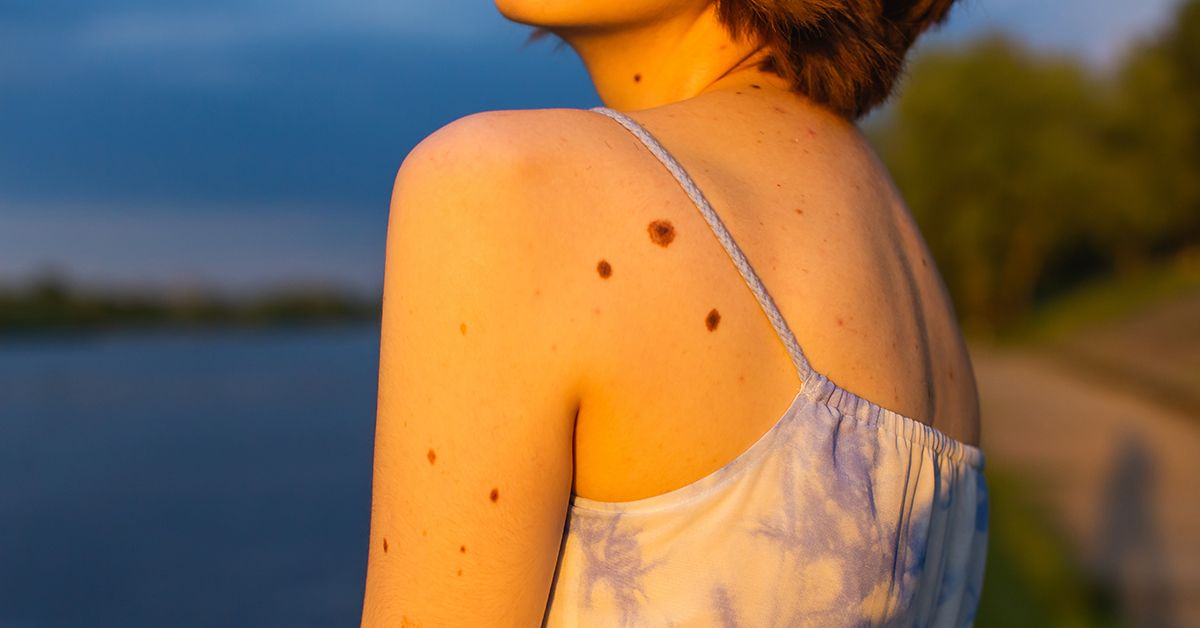
Moles are skin growths that happen when melanocytes grow in clusters instead of spreading evenly through the skin. Their medical name is nevi. Unlike freckles, moles may be flat or raised. They can be flesh-colored, pink, tan, brown, dark brown, blue-black, or almost black. Some are smooth and round. Others are slightly textured. Some even grow hair, which feels unfair but is usually harmless.
Moles may be present at birth, but many develop during childhood, adolescence, and early adulthood. It is common for adults to have several moles. Many people have between 10 and 40 ordinary moles, though the number can vary widely. Most moles remain stable for years. A mole that changes quickly, bleeds, itches, develops irregular colors, or looks very different from the others deserves professional evaluation.
Common Traits of Moles
Moles are often:
- Flat, slightly raised, or clearly raised
- Round or oval
- One consistent color, especially when benign
- Present for many years with little change
- Located anywhere on the body, including areas not regularly exposed to the sun
- Usually harmless, but sometimes worth monitoring
The main reason moles get more medical attention than freckles is that melanoma, the most serious form of skin cancer, can sometimes begin in or resemble a mole. That does not make every mole suspicious. It simply means moles are worth knowing, tracking, and respecting, like tiny tenants on your skin lease.
Freckles vs. Moles: The Biggest Differences
Freckles and moles can look similar at first glance, especially when both are brown and small. But they are not the same thing. The biggest differences involve structure, texture, cause, behavior, and health significance.
1. Freckles Are Pigment; Moles Are Cell Clusters
A freckle is mainly an area where skin cells produce extra melanin. A mole is a growth formed by clustered melanocytes. This is the core biological difference. Freckles are more like pigment “sprinkles” on the skin. Moles are more like tiny organized communities of pigment cells.
2. Freckles Are Usually Flat
Freckles are almost always flat. Moles may be flat or raised. A raised brown spot is more likely to be a mole, skin tag, seborrheic keratosis, or another type of lesion rather than a true freckle. When in doubt, let a dermatologist be the referee.
3. Freckles Often Change With Sun Exposure
Freckles commonly darken after sun exposure and fade during months with less sunlight. Moles may darken slowly over time or change with hormones, age, or irritation, but they generally do not fade and reappear seasonally in the same way classic freckles do.
4. Moles Can Appear Anywhere
Freckles prefer sun-exposed areas: nose, cheeks, shoulders, forearms, upper back, and chest. Moles can appear almost anywhere, including the scalp, soles, palms, under nails, between toes, or places that rarely see daylight. Skin is very creative. Sometimes too creative.
5. Moles Need More Careful Monitoring
Most freckles are harmless and mainly cosmetic. Most moles are harmless too, but certain moles can be atypical or suspicious. A mole that changes in size, color, shape, border, height, or sensation should be checked. A new dark spot in adulthood should also be taken seriously, especially if it grows or looks different from your other spots.
Freckles vs. Moles: Key Similarities
Despite their differences, freckles and moles also share several similarities. Both involve pigment. Both can be influenced by genetics. Both can become more noticeable after sun exposure. Both can appear on visible areas of the body and affect how people feel about their skin.
Both Are Common
Freckles and moles are extremely common. Having them does not automatically mean something is wrong. Human skin is not a blank sheet of paper. It is more like a living map, with dots, tones, marks, scars, and stories.
Both Can Be Brown
Color alone is not enough to tell the difference. A small brown spot may be a freckle, mole, sun spot, age spot, or another skin condition. Shape, texture, location, history, and change over time matter more than color alone.
Both Can Be Affected by UV Exposure
Ultraviolet radiation from the sun and tanning beds can darken freckles, influence mole appearance, and increase the risk of skin damage. This is why sun protection matters whether you have two freckles, 200 freckles, one mole, or a constellation that looks like it could qualify for its own astronomy club.
Both Should Be Watched for Changes
Although moles are usually the bigger concern, any spot that changes quickly deserves attention. A “freckle” that becomes raised, bleeds, develops multiple colors, forms an irregular border, or looks unlike your usual freckles should be evaluated.
How to Tell If a Spot Is a Freckle or a Mole
Here is a practical way to compare them at home. This is not a diagnosis, but it can help you decide whether a spot seems typical or needs a professional look.
| Feature | Freckle | Mole |
|---|---|---|
| Texture | Flat and smooth | Flat, raised, smooth, rough, or dome-shaped |
| Cause | Extra melanin production | Clusters of melanocytes |
| Sun response | Often darkens with sun and fades with less sun | Usually more stable, though changes can happen |
| Common areas | Face, arms, shoulders, chest | Anywhere on the body |
| Health concern | Usually harmless but signals sun sensitivity | Usually harmless but should be monitored for melanoma warning signs |
If the spot is flat, tiny, light brown, appears in sun-exposed areas, and fades in winter, it is more likely a freckle. If it is raised, round or oval, long-lasting, and does not fade seasonally, it may be a mole. If it is changing, bleeding, painful, itchy, irregular, or just giving you a strange feeling, book a dermatology visit. Your intuition is not a microscope, but it can be a useful alarm bell.
When Should You Worry About a Mole or Freckle?
The most useful warning system for suspicious spots is the ABCDE rule. Dermatologists often use it to help people recognize possible melanoma signs.
A: Asymmetry
If one half of the spot does not match the other half, that may be concerning. Ordinary moles are often fairly symmetrical. Melanoma may look uneven, lopsided, or oddly shaped.
B: Border
Benign spots usually have smooth, clear borders. A suspicious mole may have jagged, blurred, scalloped, notched, or poorly defined edges.
C: Color
A single even color is usually less concerning. Multiple colors in one spot, such as brown, black, red, white, gray, or blue, can be a warning sign.
D: Diameter
Spots larger than about 6 millimeters, roughly the size of a pencil eraser, deserve extra attention. However, melanoma can be smaller, so diameter is only one clue.
E: Evolving
This is the big one. Any mole, freckle, or skin spot that changes in size, shape, color, height, texture, or symptoms should be checked. Evolution is the skin’s way of saying, “Please do not ignore this plot twist.”
The Ugly Duckling Sign
The “ugly duckling” sign means one spot looks different from your other spots. For example, if all your moles are small and light brown but one is dark, irregular, and growing, that odd one deserves attention. Your skin often has patterns. A spot that breaks the pattern may be worth examining.
Can Freckles Turn Into Moles?
Freckles do not turn into moles. They are different types of skin markings. A freckle is increased pigment; a mole is a cluster of melanocytes. However, a new mole may appear near freckles, or a suspicious spot may be mistaken for a freckle. That is why changes matter more than labels.
If you have had the same tiny freckles for years and they behave the same way every summer, they are probably ordinary freckles. But if one “freckle” suddenly grows, becomes raised, gets darker, bleeds, or develops an irregular border, do not assume it is still just a freckle. Skin spots do not always introduce themselves correctly.
Can Moles Turn Into Cancer?
Most moles never become cancer. Ordinary moles are common and usually harmless. However, some melanomas develop in existing moles, and others appear as new spots on otherwise normal skin. Atypical moles, also called dysplastic nevi, may have a higher risk profile than ordinary moles, especially when someone has many of them or a family history of melanoma.
This does not mean you should fear every mole. It means you should know your baseline. Take note of what your moles look like now so you can recognize meaningful changes later. A monthly skin self-check can help, especially if you have many moles, many freckles, fair skin, a history of sunburns, indoor tanning history, or a family history of skin cancer.
Sun Exposure, Freckles, Moles, and Skin Risk
Sun exposure is a major theme in the freckles vs. moles conversation. Ultraviolet radiation can trigger freckling, darken existing pigment, damage skin cells, and increase skin cancer risk over time. Sunburns, especially repeated or blistering sunburns, are particularly important risk factors.
People with lighter natural skin color, red or blond hair, blue or green eyes, skin that burns or freckles easily, many moles, atypical moles, or a family history of skin cancer should be especially careful. But people with deeper skin tones also need sun protection. Skin cancer can affect all skin tones, and it is sometimes diagnosed later in darker skin because warning signs may be missed.
Smart Sun Protection Tips
- Use broad-spectrum sunscreen with SPF 30 or higher.
- Reapply sunscreen every two hours when outdoors, and after swimming or heavy sweating.
- Wear a wide-brimmed hat and UV-protective sunglasses.
- Choose shade when the sun is strongest.
- Wear protective clothing when spending long periods outside.
- Avoid tanning beds, which expose skin to damaging UV radiation.
- Check often-missed areas: scalp, ears, lips, neck, feet, between toes, and under nails.
Sunscreen is not a magical force field. It works best as part of a full sun-safety plan. Think of it as one member of the protection team, not the entire superhero squad.
Should You Remove Freckles or Moles?
Freckles do not need to be removed for medical reasons unless a spot is not actually a freckle or has suspicious changes. Some people choose cosmetic treatments to lighten freckles, such as laser therapy, chemical peels, or topical brightening products. These should be discussed with a qualified dermatologist, especially because aggressive treatments can irritate skin or worsen discoloration.
Moles may be removed for cosmetic reasons, irritation, or medical evaluation. If a mole looks suspicious, a dermatologist may remove part or all of it for a biopsy. Do not try to remove a mole at home. Cutting, burning, scraping, or using internet “mole removal” hacks can cause infection, scarring, delayed diagnosis, and a very bad afternoon.
How Dermatologists Evaluate Skin Spots
A dermatologist can examine freckles, moles, and other spots using visual inspection and a tool called a dermatoscope, which magnifies skin structures. If a spot appears suspicious, the dermatologist may perform a biopsy. The tissue is then checked under a microscope to determine whether it is benign, atypical, or cancerous.
For people with many moles or a higher risk of melanoma, dermatologists may recommend regular professional skin exams. Some patients benefit from total-body photography or digital mole mapping, which helps track subtle changes over time.
Practical Skin Self-Check Routine
Once a month, scan your skin in good lighting. Use a full-length mirror and a hand mirror. Check your face, ears, scalp line, neck, chest, arms, hands, back, legs, feet, soles, and between toes. Ask a partner, friend, or family member to look at areas you cannot see well, such as your back or scalp.
Look for new spots, changing spots, sores that do not heal, or anything that looks unlike your usual pattern. Taking clear photos of moles can help you compare changes over time. Just make sure your camera roll does not become 700 close-up photos of your left shoulder without context. Labeling photos by date and body area is surprisingly helpful.
Common Myths About Freckles and Moles
Myth 1: Freckles Mean Skin Damage Is Already Severe
Not always. Freckles often reflect genetic tendency plus sun exposure. They can be harmless. However, frequent freckling may suggest your skin is sensitive to UV radiation, so sun protection is wise.
Myth 2: Hairy Moles Are Always Cancerous
A mole with hair is not automatically dangerous. Many benign moles grow hair. Changes in the mole matter more than hair itself.
Myth 3: Only Dark Moles Are Suspicious
Melanoma can be dark, multicolored, pink, red, or even lightly pigmented. Color is only one part of the puzzle.
Myth 4: If a Mole Has Been There Forever, It Cannot Become a Problem
Long-standing moles are often harmless, but any mole that starts changing should be evaluated, even if it has been around since your awkward middle school haircut.
500 More Words: Real-Life Experiences With Freckles vs. Moles
One of the most common experiences people have with freckles is seasonal surprise. In March, the face looks calm. By July, after a few sunny weekends, tiny brown spots appear across the nose and cheeks like nature added cinnamon. Many people with freckles say they grew up hearing comments such as “Your freckles are cute” or “You got more sun!” That can be charming, but it can also make people forget that freckles are connected to UV exposure. Cute does not cancel out sunscreen.
A typical freckle experience might look like this: someone spends Saturday gardening, hiking, or watching a baseball game. The next morning, they notice their freckles look darker. Nothing is raised, painful, bleeding, or changing shape. The spots are familiar and scattered across sun-exposed areas. In this case, the freckles are probably behaving like ordinary freckles. The useful lesson is not panic; it is prevention. Wear sunscreen, add a hat, and reapply before your skin starts filing complaints.
Moles create a different kind of experience because they often feel more individual. A person may know the exact mole on their shoulder, the one on their neck that catches on necklaces, or the tiny one on their cheek that relatives have pointed out since childhood. Many moles become part of a person’s appearance. The key is noticing when a familiar mole changes its personality. A mole that used to be round and even but becomes irregular, darker on one side, itchy, or larger should not be ignored.
For example, imagine someone who has many small brown moles on their arms. Most look similar: round, even, and stable. Then one mole on the upper arm starts looking darker and blurrier at the edge. It is not huge, but it is different from the others. That “different from the crowd” quality is exactly why the ugly duckling sign is useful. The person does not need to diagnose it at home. They simply need to schedule a dermatologist appointment and let the expert evaluate it.
Another common experience involves confusing sun spots, freckles, and moles. Adults may notice flat brown spots on the backs of the hands, chest, or face and assume they are new freckles. Some may be solar lentigines, often called sun spots or age spots. These are usually harmless but reflect long-term sun exposure. Others may be moles or different skin lesions. Because many spots can look similar, a professional skin exam can bring peace of mind.
People also experience emotional reactions to freckles and moles. Some love their freckles and consider them part of their identity. Others try to cover them with makeup. Some people like a beauty mark; others want a raised mole removed because it gets irritated while shaving or wearing clothing. These preferences are personal and valid. The important distinction is cosmetic concern versus medical concern. Cosmetic treatments are optional. Suspicious changes are not something to postpone indefinitely.
The best long-term experience is becoming familiar with your own skin without obsessing over every dot. Think of skin checks like checking your car tires. You do not need to panic every time you see rubber, but you should notice if one tire is suddenly flat. Freckles and moles are usually normal, but your awareness can help catch problems early.
Conclusion: Freckles and Moles Are Similar, But Not Identical Twins
Freckles and moles may both appear as brown spots, but they come from different processes. Freckles are flat areas of increased pigment that often darken with sun exposure. Moles are clusters of melanocytes that may be flat or raised and can appear almost anywhere on the body. Both are usually harmless, but both deserve attention if they change.
The most important takeaway is simple: know your skin. Use the ABCDE rule, remember the ugly duckling sign, protect yourself from UV radiation, and see a dermatologist for spots that grow, bleed, itch, change color, develop irregular borders, or look unusual. Your skin is allowed to have character. It is not allowed to send mysterious warning signals while you pretend not to notice.
Note: This article is for educational purposes only and is not a medical diagnosis. Any new, changing, bleeding, painful, itchy, or unusual skin spot should be evaluated by a qualified healthcare professional or dermatologist.