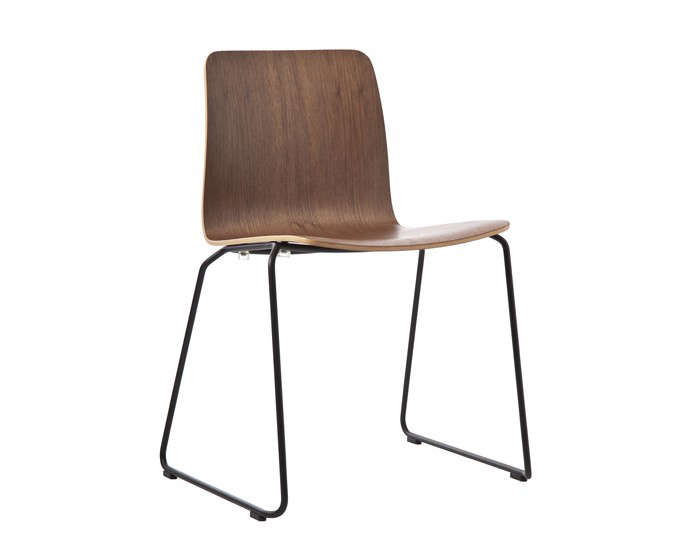
Some chairs enter a room and immediately start shouting. They have sculptural arms, heroic curves, impossible cantilevers, or enough upholstery to qualify as a small sofa. Jakob Wagner and HAY’s JW01 Chair takes the opposite approach. It arrives quietly, sits neatly at the table, and lets proportion, material, and engineering do the talking.
Designed by Danish designer Jakob Wagner during HAY’s formative years, the JW01 is a remarkably restrained dining and conference chair built around a molded plywood shell and a slender sled-style metal base. Its visual language is simple enough to disappear into a room, yet the details reveal a much more ambitious idea: create a lightweight, stackable chair that can move comfortably between domestic and professional settings without looking like generic contract furniture.
That combination explains why the JW01 remains interesting even though it is now more commonly encountered through archives and the secondary market. It represents a particularly pure strand of contemporary Scandinavian designless interested in decoration than in finding the exact point where comfort, manufacturing, durability, and visual calm meet.
A Quick Profile of the JW01 Chair
The JW01 is best understood as a multipurpose side chair rather than a dramatic statement piece. HAY’s product literature described it for dining and conference use and qualified it for contract environments, while design publications and retailers emphasized its lightweight appearance, flexible veneer back, stackability, and ability to work in both private and public interiors.
- Designer: Jakob Wagner
- Manufacturer: HAY
- Design period: Stylepark dates the design to 2003
- Primary construction: Molded plywood shell with veneer and a slender metal sled base
- Dimensions: Approximately 21.26 inches wide, 19.29 inches deep, and 30.71 inches high
- Seat height: Approximately 18.11 inches
- Stackability: HAY literature specified stacking up to eight non-upholstered chairs or four upholstered versions
Those numbers are ordinary in the best possible way. The JW01 does not demand an oversized dining room or a conference table the length of an airport runway. Its roughly 21-inch width allows several chairs to sit together without creating visual or physical congestion.
Jakob Wagner: Engineering Discipline Meets Scandinavian Restraint
The JW01 makes more sense when viewed through Jakob Wagner’s background. Born in Copenhagen in 1963, Wagner studied design engineering before completing further education in product design. His early professional work involved technically demanding products for sports, professional, and medical applications before his studio expanded further into furniture and objects for the home.
That history matters because the JW01 feels like a chair designed by someone who thinks about forces, joints, materials, and repeated use before reaching for decorative effects. Wagner’s work has been described by several manufacturers as minimalist yet playful, with close attention to the complete user experience. His broader career has included collaborations with major international design brands, while the Museum of Modern Art in New York includes one of his technical product designs in its collection.
The JW01 distills that approach into an everyday object. Nothing looks especially complicated, which is exactly why the design is difficult to execute well. When a chair has no ornamental distractions, every radius, edge, angle, and connection suddenly becomes highly visible. Minimalism is not the absence of decisions. It is what happens after a designer has made a suspiciously large number of decisions and hidden most of the evidence.
An Early Chapter in HAY’s Modern Danish Design Story
HAY was established in 2002 and introduced its first furniture collection in 2003. The company’s broader philosophy has centered on working with international designers to create contemporary products that combine strong design thinking with wider accessibility. The JW01 emerged during this early period, and Stylepark identifies 2003 as its design year. Core77 later documented the chair as part of HAY’s presence during Milan Design Week in 2006.
That timing gives the JW01 historical interest beyond its physical form. It belongs to a period when HAY was still defining what a new Danish furniture company could look like in the twenty-first century. Rather than simply reproducing midcentury classics, the brand worked with contemporary designers to reinterpret familiar furniture categories for modern homes, workplaces, cafés, and shared spaces.
The JW01 fits that mission beautifully. It is recognizably Scandinavian without pretending that the calendar stopped in 1960. The materials are familiarwood veneer and metalbut the thin sled base, stackable construction, and contract-ready versatility place it firmly in a more contemporary world.
The Design Anatomy of the JW01 Chair
A Molded Plywood Shell That Does More Than Look Slim
The chair’s visual center is its plywood shell. HAY’s technical literature specified a molded plywood seat with an ash top veneer and a shell thickness of about 9 millimeters. Earlier retail descriptions also documented versions involving stained ash, walnut veneer, and different finish combinations, suggesting that available expressions varied across production periods.
From the front, the shell looks almost like one continuous gesture. The seat rises into the back with very little visual interruption. That continuity is important because it makes the chair feel lighter than a conventional dining chair assembled from separate legs, seat rails, back posts, and splats.
The back is also described as flexible bent veneer. Rather than behaving like a rigid board attached to a frame, it provides a degree of responsive movement. That small amount of give is one of those features that barely announces itself in photographs but matters once someone actually sits down. A chair can look perfectly proportioned and still feel like punishment after dessert; the JW01 was designed to avoid that particular Scandinavian crime.
A Sled Base That Keeps the Silhouette Open
The base gives the JW01 much of its distinctive character. HAY’s later technical sheet specified a sled base made from 12-millimeter solid steel, offered in brushed stainless steel or black powder-coated steel. The thin metal structure traces the floor rather than filling the space beneath the seat with four visually separate legs.
This creates two advantages. First, the chair appears airy. Light passes through it, so a group of six or eight JW01 chairs does not become a forest of heavy wooden legs. Second, the base supports the chair’s professional versatility. Sled-base seating has long been useful in meeting, event, hospitality, and educational spaces because it can create a consistent rhythm when multiple chairs are arranged together.
Some archival descriptions differ on whether specific versions used steel, stainless steel, or aluminum framing, which likely reflects different descriptions or production references. HAY’s detailed product sheet for the version documented there specifies solid steel, making that the clearest technical reference for the later configuration.
Comfort Without Turning the Chair Into a Recliner
The JW01 is not a lounge chair, and judging it as one would be like criticizing a bicycle for lacking cup holders. Its job is upright, attentive seating for dining, conversation, meetings, and other activities where people want support without sinking into a cushion crater.
Its approximately 18-inch seat height falls within familiar dining-chair territory, while the molded shell and flexible back provide support with fewer components. The seat depth is about 15.35 inches according to HAY’s technical sheet, helping maintain a compact overall footprint.
Available upholstery options broadened the chair’s personality and comfort level. HAY documented versions with the plain molded shell as well as upholstered and quilted treatments using a range of textiles and leathers. The unupholstered version emphasizes the architecture of the design. Upholstery softens the experience and can provide a more appropriate specification for conference rooms, restaurants, or spaces where users remain seated longer.
The result is not exaggerated ergonomic theater. There are no levers, synchronized mechanisms, or adjustable lumbar modules. Instead, comfort comes from proportion, the shaped shell, rounded edges, and a back that can respond subtly to the sitter.
Stackability: The Feature That Changes How a Chair Lives
A beautiful chair is useful. A beautiful chair that can also get out of the way is even more useful.
HAY specified that the non-upholstered JW01 could be stacked in groups of up to eight, while upholstered examples were listed for stacking in smaller groups of four. This transforms the chair from a purely residential object into a practical tool for flexible interiors.
Imagine a conference room that occasionally needs to become a presentation space, a dining area that expands for holidays, a gallery that hosts talks, or a café that rearranges furniture for private events. Stackability means chairs can be removed without requiring a dedicated storage warehouse somewhere beyond the coat closet.
The important achievement is that the JW01 does not look as though stackability was its entire reason for existing. Many stacking chairs visually advertise their logistics first and their beauty second. The JW01 reverses that order. It looks composed around a dining table, yet it can still perform the unglamorous furniture gymnastics required by commercial spaces. HAY’s product documentation also listed optional floor-linking connections, further demonstrating the chair’s intended usefulness in organized public seating environments.
Why the JW01 Looks Good in So Many Interiors
The JW01 succeeds because its design is specific without being bossy. It has character, but that character does not depend on a loud color, an eccentric silhouette, or an instantly recognizable decorative motif.
In a Minimalist Dining Room
Against a simple wood or stone table, the JW01 reinforces clean lines without making the space sterile. A black-stained shell and black base create a graphic, almost architectural effect. A wood veneer combined with a lighter metal frame can feel warmer and less severe.
In an Industrial Interior
The steel base makes the chair a natural companion to concrete floors, exposed brick, blackened metal, and large factory-style windows. The wood shell prevents the room from becoming an exhibition devoted entirely to hard surfaces.
In a Modern Office or Conference Space
Here the design arguably feels most at home. The chair is visually disciplined enough for professional environments but less anonymous than conventional institutional seating. Several identical JW01 chairs create order without turning a room into a corporate waiting area where time itself has stopped.
In an Eclectic Home
Because the form is restrained, the chair can coexist with vintage furniture, expressive lighting, colorful art, or a dramatic rug. This is one of the underappreciated advantages of minimalist furniture: it leaves some oxygen for everything else.
Materials, Finishes, and the Importance of Restraint
The JW01 demonstrates how a limited material palette can create richness through contrast. Wood veneer brings visible grain and warmth. The metal base contributes precision, thinness, and structural clarity. Upholstery, where specified, adds softness without changing the fundamental silhouette.
This approach connects with Wagner’s broader reputation for designs that reduce unnecessary elements while paying close attention to user experience and balance. His portfolio across furniture and industrial products repeatedly reflects an interest in objects that appear straightforward but reward closer inspection.
The lesson is useful beyond this single chair. A piece of furniture does not need five materials and seventeen visual tricks to feel sophisticated. Sometimes one well-shaped shell sitting on one well-resolved frame is enough. Furniture designers everywhere may now quietly close several open material sample boxes.
Is the JW01 Chair Still Worth Seeking Out?
For buyers interested in contemporary Scandinavian furniture, the JW01 remains worth knowing. Remodelista’s product catalog currently marks the featured version as discontinued, so examples may be found through vintage dealers, auctions, resale platforms, or old commercial inventories rather than ordinary current retail channels. Secondary-market records also show the chair appearing in sets, including upholstered examples.
When evaluating a used JW01 Chair, inspect the plywood shell for cracking, separation, deep edge damage, or signs of moisture exposure. Check the frame for distortion and confirm that the chair sits evenly on a flat surface. On upholstered models, examine fabric wear and compression, particularly because stacked upholstered chairs can develop marks where surfaces contact one another.
Matching finishes also matters when buying a set over time. Archival descriptions document more than one material and finish combination, so two chairs advertised under the same model name may not necessarily be identical in veneer tone, upholstery, or base treatment.
Why the JW01 Still Matters in Modern Chair Design
The JW01 is not famous because it reinvented sitting. It matters because it shows how carefully an ordinary furniture category can be refined.
A dining chair must survive an unusually demanding checklist. It should be comfortable but compact, strong but visually light, distinctive but easy to combine, durable but pleasant to touch, and ideally not require two people and a minor engineering degree every time the room needs rearranging. The JW01 addresses these requirements with relatively few visible elements.
Its history also places it close to HAY’s early development as a contemporary Danish design company. Stylepark dates the chair to 2003, the same year HAY introduced its first furniture collection according to Design Within Reach’s brand history, while Core77 documented the JW01 on display with HAY in Milan in 2006. In that context, the chair reads as an early demonstration of principles that would become strongly associated with the brand: international collaboration, practical modern furniture, clean construction, and everyday usability.
Living With the JW01: A Practical Experience-Based Perspective
Because the JW01 is now often encountered as an archival or secondhand design, the most useful way to think about ownership is not through showroom perfection but through ordinary daily routines. Based on its proportions, materials, stacking system, and documented applications, the chair offers a distinctly practical kind of experience.
The First Impression: Lighter Than the Room Around It
Place several JW01 chairs around a dining table and the first noticeable quality is likely to be visual rather than physical. They do not build a wall around the table. The thin sled frames leave large areas of open space beneath the seats, while the compact shells keep the backs from dominating the room.
This can make a meaningful difference in a smaller apartment or open-plan living area. Heavy dining chairs often consume more visual space than their measurements suggest. The JW01 behaves differently. Even when every seat is occupied, the arrangement can still feel relatively light and orderly.
That does not mean the chair disappears completely. The curve where the seat becomes the back, the fine edge of the molded shell, and the continuous metal base give it enough identity to reward a second look. It is the furniture equivalent of someone who speaks quietly and somehow still controls the conversation.
At the Dining Table: Supportive Rather Than Lounge-Like
During an everyday meal, the upright proportions make sense immediately. The chair encourages a natural dining posture rather than inviting the sitter to collapse backward. The flexible bent-veneer back is particularly relevant here because even a modest amount of movement can make a rigid-looking chair feel more accommodating.
For a quick breakfast, a working lunch, or a long dinner with friends, the experience will naturally depend on body type and whether the chair is upholstered. A person seeking the plush softness of a fully padded dining armchair may find the unupholstered JW01 too direct. Someone who prefers firm, responsive support may appreciate precisely that lack of excess cushioning.
The absence of arms is another practical advantage at a busy table. Users can enter and leave easily, and the chairs tuck beneath many table designs without wide armrests colliding with the apron or neighboring seats.
When the Room Has to Change
The JW01’s personality becomes even clearer on the day the room needs to perform a different job. Perhaps six dining chairs need to become two. Perhaps a meeting ends and an event begins. Perhaps guests leave and floor space suddenly becomes more valuable than seating capacity.
Stackability changes the experience from “Where on earth do these chairs go?” to a far simpler storage problem. A vertical stack consolidates multiple chairs into a relatively compact footprint, particularly with the unupholstered version. That feature may sound mundane until the first time someone has to store eight non-stackable dining chairs. At that point, stackability becomes less of a specification and more of a spiritual awakening.
What Long-Term Ownership Would Demand
The JW01’s simple construction also makes wear easy to notice. Scratches on a dark veneer, scuffs on a powder-coated base, or fabric compression on an upholstered chair are not hidden beneath decorative complexity. Buyers who prefer furniture to remain visually pristine should inspect and maintain the surfaces carefully.
On the other hand, a well-used modern chair can develop an attractive honesty. Small signs of life may suit a private dining room better than showroom perfection, provided the structure remains sound. The critical issues are not tiny cosmetic marks but shell damage, loose connections, frame distortion, and significant upholstery deterioration.
Overall, the likely ownership experience reflects the chair’s design philosophy: straightforward, flexible, and quietly refined. The JW01 is not furniture that constantly demands attention. It earns appreciation gradually, through the way it fits beneath a table, supports the back, allows a room to remain visually open, and stacks away when the occasion changes. That may be less dramatic than a chair designed primarily for photographs, but in daily life, usefulness has a surprisingly long shelf life.
Conclusion: A Quiet Chair With a Strong Design Argument
Jakob Wagner and HAY’s JW01 Chair is a reminder that minimal furniture is often anything but simple to design. Its molded plywood shell, responsive back, slender sled base, practical dimensions, upholstery options, and stackable construction come together without unnecessary visual noise.
The result works as both an object and a system. One JW01 can serve as a restrained dining chair. A row can furnish a conference room. A larger group can support a flexible public environment and then stack away when the room changes purpose. That range is precisely what makes the design more interesting than its quiet appearance first suggests.
For admirers of modern Danish furniture, the JW01 also captures an important moment in early twenty-first-century design: a respected Danish industrial designer collaborating with a young HAY to produce furniture that was contemporary, useful, technically resolved, and approachable rather than monumentally precious. The chair does not scream for iconic status. It simply keeps making a persuasive case for good proportions and intelligent restraint.
Editorial note: Specifications, finishes, upholstery, and availability may vary by production period. Buyers considering a secondhand JW01 should verify the condition and exact configuration of the individual chair or set before purchasing.