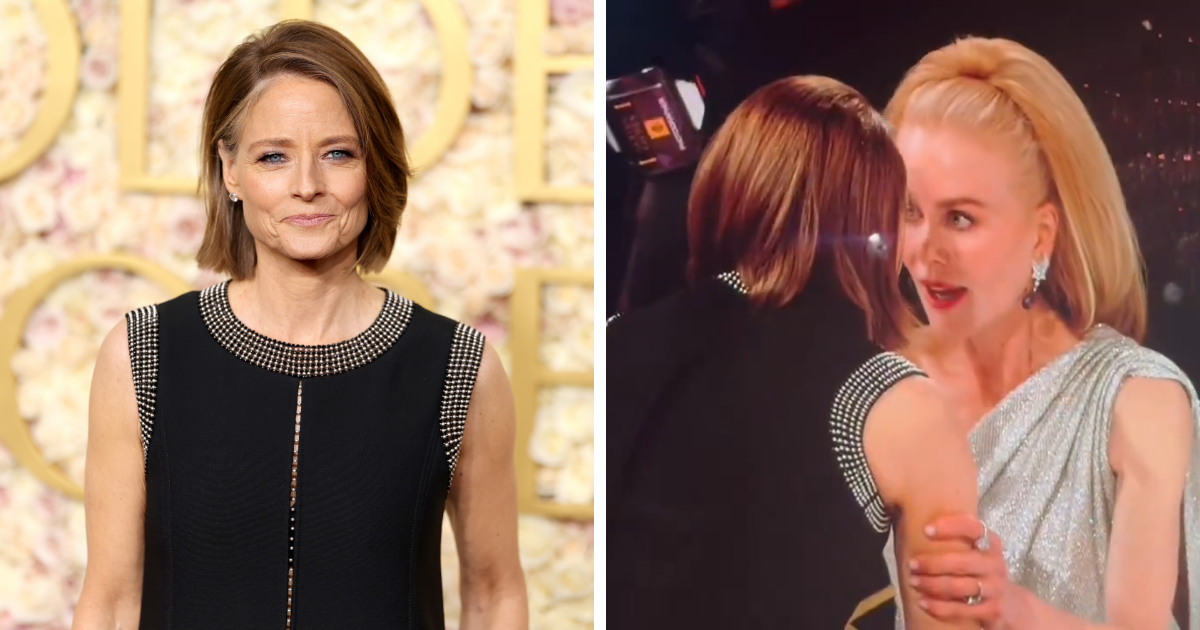
At the 2025 Golden Globes, a few seconds of conversation between Nicole Kidman and Jodie Foster somehow became the internet’s newest emotional detective case. Forget red carpet gowns, trophies, and acceptance speeches. For a brief moment, everyone became a lip reader, body language expert, friendship analyst, and part-time FBI agent with Wi-Fi.
The viral moment showed Kidman and Foster in what looked like an intense exchange during a commercial break. Kidman appeared focused, animated, and physically engaged, while Foster leaned in, listened closely, and later shared warmer body language with her fellow Oscar-winning peer. Naturally, social media did what social media does best: it zoomed in, slowed down, guessed wildly, and made popcorn.
Body language expert Judi James later suggested that the interaction appeared intense but not necessarily hostile. In her view, the close proximity, strong eye contact, and physical gestures could suggest dominance or conflict in another context, but here they also carried clear “signals of friendship.” That distinction matters. A serious face at an awards show is not automatically a feud. Sometimes, adults are simply talking like adults. Scandalous, I know.
What Happened Between Nicole Kidman and Jodie Foster?
The moment took place at the 82nd Golden Globe Awards, held at the Beverly Hilton in Beverly Hills. Jodie Foster had a major night, winning Best Performance by a Female Actor in a Limited Series, Anthology Series, or Motion Picture Made for Television for her role as Detective Liz Danvers in HBO’s True Detective: Night Country. Nicole Kidman, meanwhile, was nominated for Best Performance by a Female Actor in a Motion Picture – Drama for Babygirl, the A24 drama directed by Halina Reijn.
During a commercial break, cameras captured Kidman and Foster speaking closely. Kidman appeared to hold Foster’s arms at one point, nodding and maintaining firm eye contact. Foster seemed engaged as well, leaning in and later appearing to smile. The conversation was brief, but because the internet runs on mystery, caffeine, and celebrity micro-expressions, the clip quickly sparked speculation.
Some viewers wondered whether the two stars were arguing. Others thought Kidman might have been congratulating Foster on her win. Some fans guessed the conversation could have been emotional or personal. A few hopeful movie lovers decided they must be planning a project together, because when two icons talk intensely, the only acceptable explanation is “prestige drama incoming.”
Why the “Stop Talking” Moment Went Viral
The phrase “Stop Talking” became attached to the conversation because observers tried to interpret Kidman’s facial movements and gestures. But the key word here is interpret. Unless someone was sitting at the table with a microphone, a transcript, and excellent manners, nobody outside that circle knows exactly what was said.
That uncertainty is exactly why the clip traveled so quickly. Celebrity culture loves incomplete information. A silent video is practically a blank canvas. People project tone, intention, drama, friendship, concern, and sometimes an entire three-act screenplay onto a few seconds of footage.
Body Language Is Not a Lie Detector
Body language can be interesting, but it is not magic. A hand on someone’s arm might mean comfort, urgency, affection, emphasis, or “please listen before the orchestra starts playing us off.” Strong eye contact can suggest intensity, closeness, seriousness, or simply the habit of two trained actors who know how to hold a room without blinking like nervous squirrels.
Judi James’ analysis was careful because she did not declare the moment a fight. Instead, she noted that Foster’s proximity and eye contact could look dominant or confrontational in some settings, but the surrounding signs suggested friendship. That is a more balanced reading than the usual internet verdict of “they hate each other” delivered 11 seconds after a clip appears online.
Nicole Kidman’s “Insistent” Behavior: What It Could Mean
The word “insistent” became a major part of the discussion because Kidman appeared to prolong the exchange. According to James’ interpretation, Kidman seemed eager to finish her point or emphasize her answer to something Foster had asked. That does not mean she was rude. In real conversations, especially emotional ones, people often repeat, clarify, or physically gesture when they want to be understood.
Kidman is known for having an elegant, expressive public presence. She often appears poised, almost ethereal, on red carpets. Foster, by contrast, has a public image shaped by intelligence, directness, and decades of playing sharp, controlled characters. Put those two energies together in a noisy awards room and the visual contrast becomes irresistible.
Still, the footage seems more like a serious exchange between longtime colleagues than a chilly Hollywood showdown. The actresses were also photographed embracing, which supports the idea that the moment was warmer than some online interpretations suggested.
The Real History Between Nicole Kidman and Jodie Foster
One reason this interaction attracted attention is that Kidman and Foster share a meaningful Hollywood connection. In 2002, Jodie Foster starred in David Fincher’s thriller Panic Room, but Nicole Kidman was originally attached to the role. Kidman had to leave the production after aggravating an injury, and Foster stepped in.
Years later, during a Hollywood Reporter actress roundtable, the two women spoke warmly about that moment. Foster pushed back against the tired idea that actresses must be rivals, pointing out that women in the industry often support one another. Kidman thanked Foster for taking over the role at a time when she said she was in a very difficult emotional place.
That background makes the Golden Globes exchange look less like random tension and more like a moment between two people with shared professional history. They are not strangers making awkward small talk near the dessert table. They are major artists whose careers have crossed in a way that could easily create respect, gratitude, and perhaps a private shorthand.
Jodie Foster’s Big Night at the Golden Globes
Foster’s win for True Detective: Night Country was a significant moment. The series follows detectives Liz Danvers and Evangeline Navarro as they investigate a mysterious disappearance in the darkness of Alaska. Foster’s performance brought her another major award in a career already packed with serious hardware.
Her Golden Globes history includes wins for The Accused, The Silence of the Lambs, and The Mauritanian, along with the Cecil B. DeMille Award, an honorary recognition for outstanding contributions to entertainment. In other words, Foster has been collecting Golden Globes longer than some influencers have been collecting ring lights.
During her 2025 acceptance speech, Foster emphasized community and meaningful work. She also gave a playful nod to Sofía Vergara, who jokingly protested from the audience after losing in the same category. The moment added humor to the night and reminded viewers that awards ceremonies are often more relaxed inside the room than they look from the couch.
Nicole Kidman’s Awards Season Context
Nicole Kidman attended the Golden Globes as a nominee for Babygirl, in which she plays a powerful CEO whose personal and professional life becomes complicated by a relationship that challenges her control and identity. The role continued Kidman’s long tradition of choosing bold, psychologically layered material.
Although she did not win that night, the nomination reinforced her status as one of Hollywood’s most fearless performers. Kidman has built a career on refusing to stay in one lane. She can do prestige drama, surreal mystery, dark comedy, glossy melodrama, and the kind of emotionally intense role that makes viewers need a snack and a quiet walk afterward.
Her public conversation with Foster came during a night filled with wins, losses, reunions, and quick commercial-break interactions. The Associated Press reported that commercial breaks at the Globes are often frantic, with stars rushing to greet one another, take photos, and return to their seats before the show resumes. That atmosphere helps explain why conversations may look urgent or unusually animated.
Why Fans Read So Much Into Celebrity Conversations
Part of the fascination comes from access. Modern audiences see more behind-the-scenes material than ever before. A clip filmed from inside the room can make viewers feel like they are close enough to understand the emotional temperature. But visibility is not the same as context.
People also love celebrity friendships because they feel rare in a competitive industry. When two respected actresses appear deeply engaged, fans want the moment to mean something: support, advice, congratulations, comfort, or collaboration. That curiosity is not necessarily bad. It becomes a problem only when speculation hardens into “fact” without evidence.
The Internet Loves a Silent Movie
Silent clips are dangerous little things. Without audio, viewers fill in the blanks. A smile becomes suspicious. A nod becomes a warning. A hand gesture becomes a declaration of war. By breakfast the next morning, someone has usually announced, with total confidence, that a celebrity feud has begun because one person blinked three times near a floral centerpiece.
The Kidman-Foster moment is a useful reminder that famous people are still people. They have private conversations, emotional reactions, rushed exchanges, and expressive habits. Not every intense discussion is a conflict. Sometimes it is encouragement. Sometimes it is gratitude. Sometimes it is two actors speaking with the dramatic commitment of people who have spent their lives making words matter.
Was Nicole Kidman Being Too Insistent?
Based on the available footage and expert commentary, “too insistent” may be too strong. Kidman appeared engaged and emphatic, but that does not automatically mean pushy. Her gestures could show emotional investment, urgency, or a desire to reassure Foster. The fact that the two women were also seen embracing points toward warmth rather than hostility.
In normal life, people often become more physically expressive when they care about what they are saying. They touch a friend’s arm, lean closer in a loud room, repeat a phrase, or hold eye contact. Put that same behavior on a celebrity broadcast, and suddenly it becomes a national research project.
Body language experts can offer useful possibilities, but the safest conclusion is simple: Kidman and Foster appeared to have an intense, personal, and likely friendly exchange during a high-energy awards show. That may not satisfy the drama detectives, but it is probably closer to reality.
What This Moment Says About Women in Hollywood
The public reaction also reveals how quickly people frame interactions between women as rivalry or conflict. Foster herself has previously addressed the misconception that actresses are naturally set against one another. Her comments during the roundtable with Kidman pushed back on that outdated narrative.
The entertainment industry has long benefited from turning female stars into competitors, especially during awards season. But many actresses describe a very different reality: mentorship, professional respect, shared experience, and behind-the-scenes support. Kidman thanking Foster for stepping into Panic Room is a perfect example of that.
Rather than reading the Golden Globes clip as tension, it may be more useful to see it as a glimpse of connection. Two women with long, demanding careers shared a moment in a room full of pressure, cameras, and expectations. If it looked intense, maybe that is because the lives behind those careers are intense too.
Experience Section: What We Can Learn From the Nicole Kidman and Jodie Foster Moment
Anyone who has ever had a serious conversation in a crowded room can probably relate to this moment. You lean in because the room is loud. You touch someone’s arm because you want them to know you mean it. You repeat yourself because the music is swelling, someone is walking behind you, and your friend is about to be pulled away by a publicist with the speed of a Formula 1 pit crew.
The Kidman-Foster exchange feels familiar because many of us have been in conversations that looked more dramatic from the outside than they felt on the inside. Maybe you were comforting a friend at a party. Maybe you were congratulating someone after a big achievement. Maybe you were trying to explain a complicated situation before both of you had to return to your seats. From across the room, it might look tense. Up close, it might be love, concern, or support.
One lesson is that intensity is not always negative. In friendships and professional relationships, the most meaningful conversations are rarely casual. They involve eye contact, pauses, emphasis, and sometimes physical gestures. A person who insists on finishing a thought may not be controlling the conversation; they may simply care deeply about being understood.
Another lesson is that public moments rarely show the full story. We often judge people based on tiny fragments: a facial expression, a hand movement, a brief silence. But real communication depends on history. Kidman and Foster have shared professional history through Panic Room. They have also publicly spoken about support among actresses. That background changes how we should interpret the clip.
There is also something refreshing about seeing two highly accomplished women appear completely absorbed in each other’s words. Awards shows are often criticized as polished, rehearsed, and overly managed. But this moment felt human. It had the awkward beauty of real conversation: close faces, serious eyes, unclear meaning, and enough emotional charge to make strangers lean toward their screens.
For viewers, the healthier takeaway is not “Who was right?” or “Were they fighting?” It is this: communication can look messy even when it comes from care. Friends do not always speak softly. Colleagues do not always look relaxed. Support does not always arrive wrapped in a gentle smile. Sometimes it arrives with firm eye contact and a hand on the arm, as if to say, “Listen, I really mean this.”
That is why the Nicole Kidman and Jodie Foster moment stayed with people. It was not just celebrity gossip. It was a tiny public example of how complicated human connection can look when stripped of sound and context. The internet wanted a verdict. The smarter answer is more interesting: it was probably a layered, emotional, friendly exchange between two women who know exactly what it means to survive Hollywood with talent, discipline, and a very strong poker face.
Conclusion
The viral “Stop Talking” conversation between Nicole Kidman and Jodie Foster was less a confirmed scandal than a fascinating case study in how quickly viewers interpret celebrity behavior. Body language expert Judi James saw signs of intensity, but also friendship. The actresses’ shared history, Foster’s Golden Globes win, Kidman’s nomination, and the warmth seen elsewhere during the night all suggest a more generous reading than online drama allowed.
In the end, the moment says as much about us as it does about them. We are drawn to unscripted celebrity interactions because they feel real. But real does not always mean messy in the way the internet wants it to be. Sometimes, real is simply two brilliant actresses having a serious conversation in a loud room while the world tries, and fails, to read their lips.