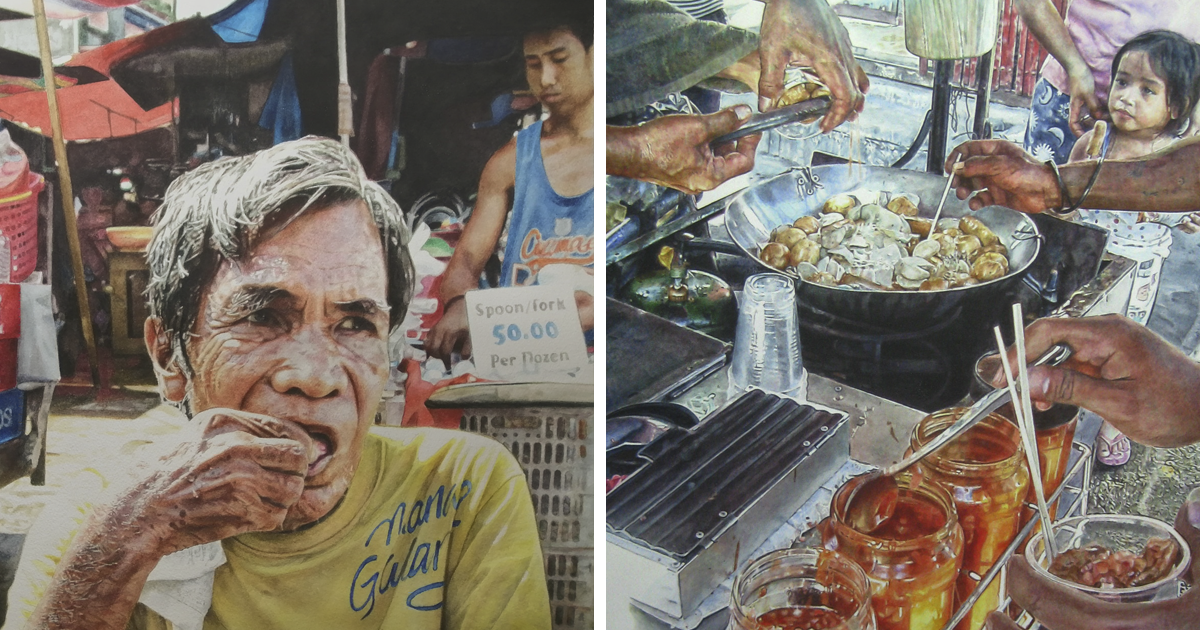
Manila rarely stands still long enough to pose for a portrait. Jeepneys squeeze through traffic, vendors arrange their goods beneath umbrellas, workers hurry along old commercial streets, and sunlight flashes across metal roofs, chrome, puddles, and shop signs. The Philippine capital is noisy, crowded, historic, imperfect, and wonderfully alive. For an artist interested in ordinary street life, it is less a city than an endless outdoor studio.
That energy is at the heart of a series of 19 hyperrealistic watercolor paintings by Filipino artist Ralvin Dizon. Rather than focusing only on postcard landmarks, the works turn attention toward people, vehicles, markets, street food, labor, and the countless small scenes that city residents can easily pass without a second look. Paintings such as Guerilla Tabora, Tindera & Palengkeras, Overdrive, Tusok Republic, Obrero De Calle Escolta, Dirty Ice Cream, and Plaza Miranda reveal a Manila built not merely from architecture, but from daily human activity.
The remarkable twist is the medium. These images can initially look like photographs, yet they were created by hand with watercolora material famous for flowing wherever it pleases at precisely the moment an artist would prefer it to behave. Apparently, nobody informed the paint that it was supposed to be difficult.
Finding Extraordinary Beauty in Ordinary Manila Street Scenes
The central idea behind the series is simple but powerful: ordinary moments can become extraordinary when they are truly observed. Manila offers no shortage of grand historical locations, from the Spanish-era streets of Intramuros to important religious and civic spaces. Yet the personality of the city also lives in less formal placesin public markets, roadside businesses, aging vehicles, delivery tricycles, food stalls, sidewalks, and the faces of people working through another busy day.
This approach connects the paintings to a long tradition of artists and photographers documenting urban life. A street scene becomes more than a record of buildings and traffic. It becomes evidence of how people occupy a place at a particular moment in history.
That is especially meaningful in Manila, a city shaped by centuries of trade, colonial history, wartime destruction, reconstruction, migration, commerce, and constant reinvention. Historic photographs preserved by institutions such as the Library of Congress show streets including Escolta and the old walled city in dramatically different eras. Modern Manila is another layer in that continuing story.
Hyperrealistic watercolor allows the artist to preserve this contemporary layer with unusual intimacy. A rusted panel, handwritten sign, weathered wall, plastic container, wrinkled shirt, or scratched vehicle can become visually important. Nothing is too ordinary to deserve attention.
Why Watercolor Makes These Hyperrealistic Paintings So Surprising
Watercolor is often associated with loose landscapes, soft washes, and spontaneous sketches. These paintings turn that expectation upside down. Instead of allowing forms to dissolve into suggestion, the artist uses the medium to construct highly detailed surfaces, convincing light, rich shadows, and textures that can fool the eye.
Watercolor generally consists of pigment carried in a water-soluble binder and applied most often to paper. Its transparency allows light to interact with the surface beneath the paint, helping produce the luminosity for which the medium is famous. Museums including the Metropolitan Museum of Art and the Getty describe the relationship among pigment, water, paper, transparency, and layered application as fundamental to watercolor’s distinctive visual character.
Hyperrealism Requires Control Without Killing the Medium
The challenge in highly realistic watercolor painting is maintaining precision while still respecting the physical behavior of water and pigment. Transparent washes can establish broad tonal relationships, while increasingly controlled layers can develop shadows, reflections, skin tones, fabric, signs, machinery, and tiny surface irregularities.
The brightest highlights may depend partly on the untouched paper itself. Dark areas often require patient layering rather than one heavy application. Edges must be carefully varied: some sharp enough to describe metal and lettering, others softer to create atmosphere and believable depth.
Museum collections demonstrate how watercolor artists have long combined transparent washes, opaque touches, dry-brush marks, scraping, and layered pigments to create remarkably varied effects. Hyperrealism simply pushes that vocabulary toward an extreme level of observation.
In other words, making watercolor look effortless may require an almost suspicious amount of effort.
A Month and a Half for a Single Painting
Dizon has described a working process that explains the extraordinary level of detail. A typical piece measures about 21 by 29 inches and may require roughly a month and a half of work, often involving five-hour painting sessions across five days each week.
That schedule changes the way these artworks should be viewed. A complicated Manila street scene is not simply copied in an afternoon. It is reconstructed slowly. Every person, wheel, reflection, bundle of merchandise, faded surface, and patch of light becomes a separate visual problem.
The physical work is only part of the challenge. Sustained precision is mentally exhausting. Hyperrealistic painting demands long periods of concentration, and one careless decision in watercolor can be difficult to hide. Oil and acrylic can often provide more opportunities for opaque correction; transparent watercolor is less interested in forgiving anybody’s bad afternoon.
The artist’s persistence also helps explain why viewers occasionally mistake the finished paintings for photographs. That misunderstanding can be frustrating in one sense, but it is also an accidental compliment. When hand-painted tires, skin, chrome, fabric, and street clutter look photographic, the technical illusion has clearly succeeded.
The Camera as a Modern Sketchbook
The source material begins in the streets. Dizon has explained that he walks through urban areas with a camera and photographs scenes that catch his attention. The camera functions as a personal sketchbook, freezing moments that would otherwise disappear before a large watercolor could even be planned.
This is important because the subjects are not generic inventions. They are rooted in directly observed environments. Photography captures the temporary arrangementthe exact light, posture, traffic, merchandise, and accidental geometry of a particular moment. The painter then spends weeks translating that fraction of a second into watercolor.
The method also creates an interesting conversation between photography and painting. A camera captures everything instantly, but a painting forces the artist to reconsider everything slowly. The original photograph may take one second. The painted version may take hundreds of hours. Time, apparently, has a sense of humor.
The 19 Paintings as a Portrait of Everyday Filipino Life
Markets and the People Who Keep Them Moving
Works such as Tindera & Palengkeras place vendors and market life at the center of the visual story. Manila’s markets are places of commerce, conversation, movement, food, color, and negotiation. They can contain vegetables, household items, religious objects, prepared foods, and countless products stacked into visually dense arrangements.
Quiapo in particular is known for its intense mixture of religious life, street trade, food, transportation, and crowds. National Geographic has described Quiapo Market as one of Manila’s major market environments, where food and everyday commerce coexist with the wider cultural identity of the district.
For a hyperrealist, such locations are almost unfairly rich in subject matter. A single stall can contain enough color, lettering, reflections, hands, bags, boxes, produce, and improvised organization to keep a paintbrush employed for several lifetimes.
Street Food Becomes Visual Culture
Tusok Republic and Dirty Ice Cream highlight another familiar dimension of Philippine urban life: food sold close to the street and eaten as part of the rhythm of the day.
Manila’s food culture reflects a complex history of Indigenous traditions and centuries of regional and international exchange. Markets and informal food environments remain important parts of the experience. Recent travel coverage continues to emphasize Metro Manila’s extraordinary diversity, from street snacks and traditional dishes to restaurants interpreting Filipino flavors in contemporary ways.
In painting, a street-food cart becomes more than a convenient place to grab something delicious. It becomes a collection of visual textures: stainless steel, glass, painted lettering, plastic, condensation, skewers, wheels, shadows, and human gestures. Food may disappear in a few bites. A watercolor can keep the cart around much longer.
Vehicles as Moving Pieces of Manila’s Identity
Transportation appears repeatedly throughout the series. Trike Delivery, Trisiklo At Aluminyo, Owner Trike Jeep, How’s My Driving?, Untitled Motor, and other works treat vehicles as serious visual subjects.
This makes perfect sense. In a dense urban environment, transportation is never just background scenery. Vehicles become workplaces, delivery systems, signs, sculptures, personal statements, and occasionally very loud arguments with the concept of available road space.
For the watercolor artist, they also offer irresistible technical challenges. Metal can be dull, polished, scratched, dented, painted, rusted, or reflectivesometimes all on the same vehicle. Tires have different surfaces from chrome. Windshields reflect the surrounding city while revealing glimpses of the interior. Lettering must follow perspective. Every mechanical detail has its own relationship with light.
Labor Is Part of the Landscape
Obrero De Calle Escolta and On The Job draw attention to workers rather than treating them as anonymous figures added merely to establish scale.
That distinction matters. Cities are often presented through skylines, monuments, and architecture, but cities function because people work inside them. Someone repairs the building, drives the vehicle, carries the load, sells the food, unloads the delivery, cleans the sidewalk, and opens the market before many residents have finished negotiating with their alarm clocks.
Escolta is a particularly meaningful setting. Historically associated with commerce and significant early urban architecture, the street has appeared in archival imagery and contemporary cultural documentation. Its changing identity mirrors Manila’s broader relationship with memory, decline, preservation, and renewal.
Painting a worker on such a street therefore creates two portraits at once: one of an individual and another of a city continually being maintained, changed, and lived in.
Manila Is Beautiful Because It Is Complicated
The strongest quality of these hyperrealistic Manila watercolor paintings is that they do not need the city to be polished into a tourism advertisement. Their beauty comes from observation.
Manila contains grand churches, historic districts, museums, contemporary business areas, crowded markets, dense neighborhoods, and streets where several centuries can appear to be arguing within the same block. Intramuros preserves an important part of the city’s Spanish colonial history, while modern districts across Metro Manila demonstrate the region’s constant transformation.
That contrast gives artists an enormous visual vocabulary. Old surfaces sit beside new advertisements. Historic buildings share the city with motorcycles and utility wires. Religious spaces open onto commercial streets. Bright tropical light can turn an ordinary sheet of metal into a mirror.
A photograph may record these contradictions. A detailed painting asks the viewer to remain with them.
Why Hyperrealistic Art Can Change the Way We Look at a City
Realism is sometimes misunderstood as mere copying. But choosing what deserves to be copied is already an artistic decision.
Why paint a vendor instead of a monument? Why spend weeks reproducing a delivery tricycle? Why give the same attention to a worn shoe, a dented vehicle, or a handwritten sign that another artist might reserve for a palace?
The answer lies in attention. Hyperrealistic street painting says that everyday life is worth studying closely. It elevates things people frequently ignore, not by changing them into something more glamorous, but by showing how visually complex they already are.
This idea is especially powerful in a city as active as Manila. Residents naturally learn to filter their surroundings. They have somewhere to go. The pedestrian becomes a blur. The vendor becomes part of the corner. The vehicle becomes traffic. The sign becomes visual noise.
Art reverses that process.
Suddenly, the overlooked scene is almost 30 inches wide and has taken more than a month to create. Now the viewer must look.
The Experience Behind Painting Manila: Learning to See Before Learning to Paint
Creating a long-term series about Manila street life begins well before the brush touches paper. The first challenge is learning how to walk through a familiar place without treating it as familiar.
That sounds simple. It is not.
When people travel to a new city, they notice everything. They photograph doors, street signs, meals, buses, cracks in old walls, and possibly a fire hydrant if the light is dramatic enough. In a familiar city, the brain becomes efficient. It decides that the same corner, vendor, vehicle, or intersection seen every day no longer requires close inspection.
An artist has to become inefficient again.
The experience of searching for subjects therefore becomes an exercise in attention. A walk through the city is no longer simply a journey from one destination to another. Light bouncing from a windshield may become the beginning of a painting. The posture of a worker resting beside equipment may suddenly reveal a complete composition. A cluster of market vendors can create a pattern of faces, merchandise, fabric, and shadows that exists for only a few seconds before someone moves.
The camera helps preserve those moments, but selecting the right scene still requires instinct. Not every technically complicated image becomes a good painting. The strongest subjects usually contain some combination of visual structure and human meaning.
Then comes the long transformation from reference image to watercolor.
During weeks of painting, the relationship with the original street scene changes. What first appeared to be “a tricycle” becomes dozens of separate shapes. A shirt becomes folds, highlights, reflected colors, and edges. A market becomes hundreds of decisions about what should be sharp, what should recede, and how one object overlaps another.
This process creates a strange kind of intimacy with ordinary things. After spending hours painting a rusted surface, an artist may never look at rust casually again. After carefully reproducing the reflections in a windshield, every vehicle on the street becomes a lesson in light.
The experience is also a test of patience. Five hours of detailed work can produce surprisingly little visible progress. A complicated section may occupy an entire session. Some days are satisfying. Others involve staring at a tiny area of paper and wondering why a wheel has apparently declared independence from perspective.
Yet slow work has an advantage. It creates time for understanding.
By the end of a large painting, the artist has spent far longer studying the scene than anyone who passed through it in real life. The finished image therefore becomes more than a copy of a photograph. It becomes a record of sustained attention.
That may be the most meaningful experience offered by a project like these 19 Manila watercolor paintings. The work changes not only what viewers notice, but also what the artist notices. The city becomes fuller.
A street vendor is no longer simply part of a crowd. A delivery vehicle is no longer merely something blocking the lane. An old commercial street is not merely a collection of aging buildings. Each becomes a combination of history, design, labor, personality, and visual detail.
Painting Manila in this way also reveals why urban beauty cannot always be separated from imperfection. A spotless, perfectly organized city might be easier to paint, but it could also be less interesting. Manila’s visual character often comes from layers: old and new, formal and improvised, historical and contemporary, beautiful and worn.
Hyperrealistic watercolor is particularly suited to exploring those layers because the medium can capture both precision and atmosphere. It can describe a sharp reflection on metal while allowing softer washes to create heat, distance, or humid light. Watercolor’s transparency gives the painting luminosity, while careful layering provides the density needed for realistic urban textures.
Most importantly, working on such scenes encourages a different definition of beauty.
Beauty does not have to arrive wearing perfect lighting and standing beside a famous landmark. Sometimes it is carrying a load down the street. Sometimes it is selling food. Sometimes it has chipped paint, muddy tires, an old umbrella, and several handwritten signs attached with whatever tape was available.
The experience of painting a city teaches the artist to stop waiting for spectacular subjects.
The spectacular subject may already be standing on the corner.
Conclusion: A Hand-Painted Love Letter to the Streets of Manila
These 19 hyperrealistic watercolor paintings celebrate Manila without pretending that the city is simple. They find visual richness in labor, transportation, street food, public markets, old commercial districts, and everyday encounters.
Ralvin Dizon’s painstaking processwalking the streets, photographing original subjects, and spending weeks developing large watercolor paintingsshows what can happen when ordinary scenes receive extraordinary attention.
The result is more than technical realism. It is a visual record of a living city.
Manila moves quickly. Businesses change. Vehicles disappear. Buildings age. Streets are rebuilt. People grow older, move away, and return. The moment captured in a reference photograph may never occur in exactly the same way again.
But on watercolor paper, a vendor can remain at the market. A worker can stay on Escolta. A tricycle can wait forever beneath the same light.
And perhaps that is the quiet power of the entire series: it reminds us that everyday life becomes history faster than we think. Sometimes all it takes to recognize its beauty is to stop, look closely, and give the ordinary the time it deserves.
Note: This article is an original, independently written synthesis based on the artist’s documented creative process and reputable cultural, historical, travel, archival, and museum references concerning Manila and watercolor art.