When LED light bulbs began marching into American homes, the sales pitch sounded almost magical: lower electric bills, less heat, instant brightness, and a lifespan of up to 100,000 hours. Install one today, marketers implied, and your grandchildren might eventually replace it while renovating their lunar vacation home.
Yet many homeowners have watched supposedly long-life LED bulbs flicker, dim, change color, or die after only a few years. Store shelves now commonly display ratings such as 10,000, 15,000, or 25,000 hours instead of the once-famous 100,000-hour promise.
So, what happened to the 100,000-hour LED bulbs? The technology did not suddenly forget how to make light. Instead, testing became more realistic, regulators demanded better evidence, manufacturers learned that an LED chip is only one part of a complete bulb, and intense price competition encouraged some decidedly mortal components to move into supposedly immortal products.
The 100,000-Hour Promise Was Not Entirely Fiction
A high-quality light-emitting diode can operate for an extremely long time under controlled conditions. It has no fragile filament to snap, no gas-filled tube to wear out, and no mechanical parts performing interpretive dance inside the bulb.
The problem was how that durability was translated into consumer advertising. Early lifespan claims often described the potential lumen-maintenance life of an LED package rather than the tested service life of an entire household bulb. The U.S. Department of Energy warned that an LED product must be evaluated as a complete system because its electronics, optics, connections, seals, housing, and thermal design can all cause failure.
At three hours of use per day, a 100,000-hour bulb would theoretically last more than 91 years. That number should have raised at least one eyebrow. Testing a consumer product continuously for eleven years before selling it would be inconvenient. Testing it for a century would be an unusually poor product-launch strategy.
Manufacturers therefore relied on shorter laboratory tests and mathematical projections. Those projections could be useful, but they were sometimes presented to shoppers as if someone had actually left the bulb burning since the invention of commercial radio.
An LED Chip Is Not an LED Bulb
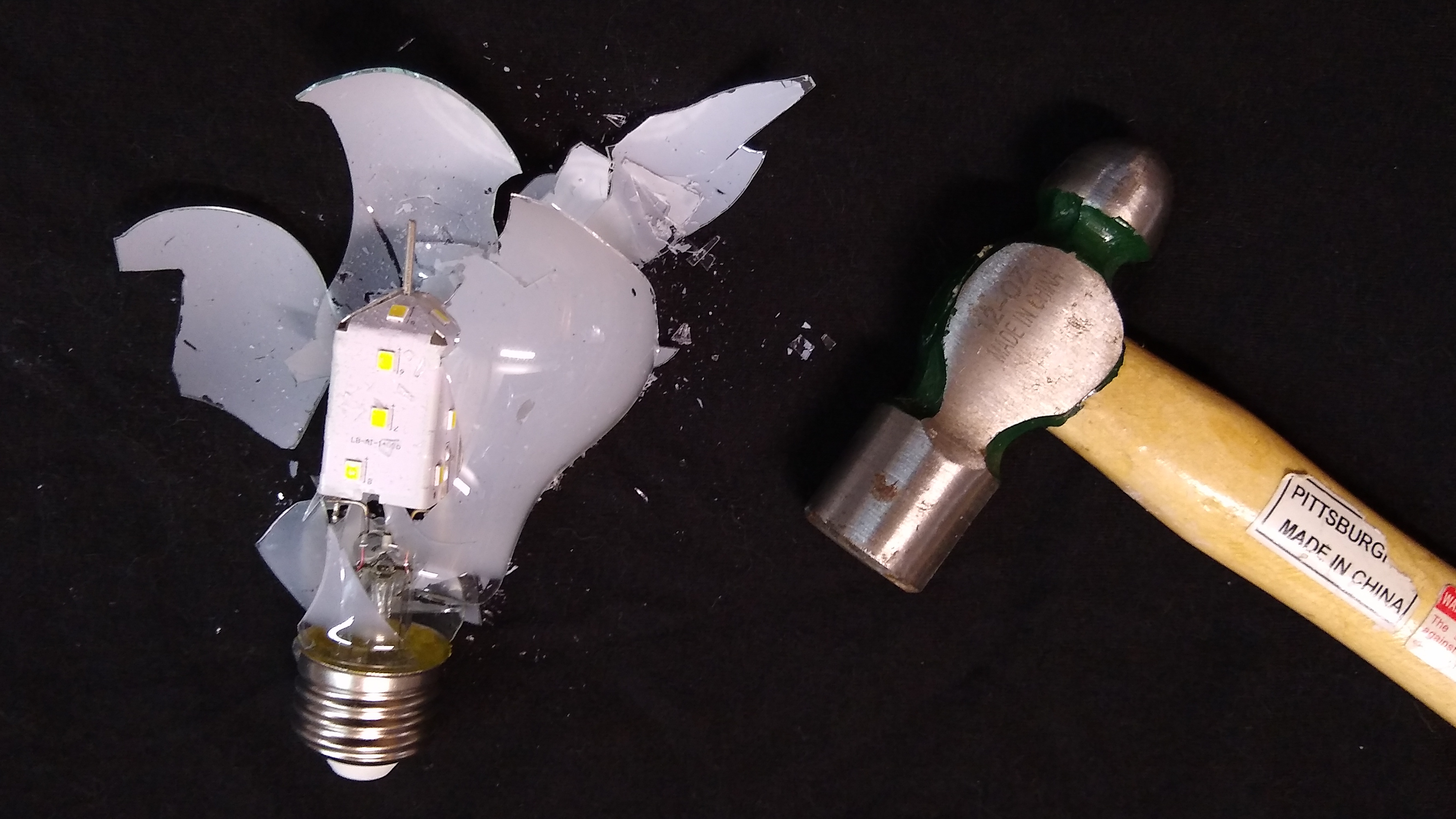
The glowing diode is merely the celebrity member of a much larger cast. A household LED bulb normally includes:
- One or more LED packages
- An electronic driver that converts household AC power
- Capacitors, resistors, diodes, and control components
- A circuit board and solder joints
- A heat sink or thermally conductive housing
- A diffuser, lens, reflector, or phosphor coating
- Adhesives, wires, connectors, and insulation
The bulb stops being useful when any essential part fails. A diode capable of glowing for 100,000 hours is not especially helpful when its power supply gives up after 6,000 hours and retires to the great recycling bin in the sky.
“100,000 Hours” Usually Did Not Mean 100,000 Hours Until Darkness
Traditional incandescent bulbs have a simple and dramatic ending. The filament breaks, the room goes dark, and someone discovers that the replacement bulbs are stored in the least accessible cabinet in the house.
LEDs often age differently. Instead of suddenly burning out, an LED package may gradually lose brightness. The lighting industry commonly describes useful LED life using an L70 rating. L70 represents the estimated time at which light output falls to 70% of its original level. In other words, the LED may still be glowing at the end of its “life”; it is simply producing 30% less light. ENERGY STAR explains that LED lifetime is commonly based on this predicted decline rather than complete failure.
This distinction was frequently lost in early marketing. Consumers heard “lasts 100,000 hours” and reasonably assumed the complete bulb would provide acceptable light for 100,000 hours. Engineers may have meant that the diode’s declining output curve could theoretically reach L70 around that point under particular temperatures and drive currents.
Projection Is Not the Same as Observation
Modern standards make the projection process more disciplined. IES LM-80 provides methods for measuring the maintenance of LED light sources, while TM-21 provides methods for projecting long-term output from that test data. The Illuminating Engineering Society emphasizes that temperature, drive current, materials, and package design all influence projected life. It also places limits on how far results should be extrapolated beyond the actual test period.
An ENERGY STAR lamp specification, for example, used 6,000-hour lumen-maintenance testing to support claims ranging from 15,000 to 50,000 hours. Longer claims required increasingly strong measured performance. The same specification established a minimum rated life of 15,000 hours for qualifying solid-state lamps rather than treating 100,000 hours as a casual default.
That did not prove that 100,000-hour lighting was impossible. It meant that extraordinary claims required extraordinary engineering, careful operating conditions, and much better evidence.
What Usually Fails Inside an LED Bulb?
1. The Driver Circuit
LEDs need controlled direct current, while American household outlets supply alternating current. The driver inside the bulb performs that conversion and regulates the power reaching the LEDs.
That driver contains components that may be far less durable than the LED packages. A technical discussion summarized by Hackaday cited field-failure data in which driver circuitry accounted for nearly 60% of catastrophic failures, while the LEDs themselves accounted for only about 10%. The precise percentages vary among products and applications, but the lesson is consistent: the power electronics are frequently the weakest link.
Electrolytic capacitors are often discussed because they offer substantial electrical capacity in a compact, affordable package. Unfortunately, they are sensitive to heat and aging. Better capacitors, conservative electrical designs, and larger heat-dissipating structures can improve reliability, but they also add cost and occupy valuable space inside a bulb that must fit an existing socket.
2. Heat Trapped in the Wrong Fixture
LED bulbs are efficient, but they do not operate without producing heat. More importantly, their sensitive electronics and semiconductor junctions prefer to remain relatively cool.
Heat must travel from the LED package through the circuit board and housing into the surrounding air. Place a bulb inside a tightly enclosed glass fixture, recessed can, or poorly ventilated ceiling fitting, and that escape route becomes a traffic jam.
The Department of Energy advises consumers that fully enclosed fixtures trap heat and can reduce the performance and life expectancy of some LED products. Bulbs used in those fixtures should be specifically rated for enclosed operation.
In DOE CALiPER testing, LED PAR38 lamps operated for nearly 14,000 hours at an elevated ambient temperature generally maintained light output better than conventional comparison lamps. However, performance varied considerably among models, some lamps failed catastrophically, and the researchers warned that elevated temperatures and enclosed applications could cause unacceptable degradation before rated life.
3. Cost Cutting Changed the Product
The earliest household LED bulbs were expensive, heavy, and sometimes shaped like tiny spacecraft. Their substantial metal heat sinks were not decorative enthusiasm; they helped move heat away from the electronics.
As LED prices fell, shoppers came to expect bulbs for a few dollars rather than $30 or $40. Manufacturers improved efficiency and reduced the amount of heat that needed to be managed, but the market also rewarded smaller heat sinks, fewer components, faster assembly, and cheaper driver designs.
A reasonable conclusion is that some manufacturers optimized for the warranty period and retail price rather than maximum theoretical life. A bulb engineered for 15,000 dependable hours can be smaller and cheaper than one engineered to survive 100,000 hours in stressful conditions. Most shoppers will notice a four-dollar price difference immediately; they cannot verify a lifespan difference for another decade.
4. Dimmers and Electrical Conditions Create Extra Stress
Not every LED bulb works correctly with every dimmer. Older dimmers were designed around incandescent loads and may cause buzzing, flickering, unstable startup, limited dimming range, or repeated electrical stress when paired with incompatible LEDs.
Voltage spikes, loose socket contacts, overheated fixtures, frequent thermal cycling, and poor-quality switches can also shorten life. The Department of Energy recommends checking both whether a bulb is dimmable and whether it is compatible with the installed dimming system.
Frequent switching is not automatically fatal to a well-designed LED. However, every heating and cooling cycle causes materials to expand and contract. Over thousands of cycles, solder joints, connections, and electronic components may experience mechanical and thermal fatigue.
5. A Bulb Can Fail Without Going Completely Dark
Failure does not always arrive as a dramatic blackout. An LED product may still illuminate while becoming unsuitable because it has lost brightness, developed objectionable flicker, shifted from warm white toward an odd green or pink tint, or produced visibly uneven light.
DOE research notes that LED packages rarely fail abruptly. More commonly, they experience changes in luminous output or color. This matters especially in retail stores, museums, hospitals, studios, and other places where color accuracy and consistency are important.
Therefore, a complete lifetime rating should consider more than whether a diode can produce any detectable light. A porch bulb that glows faintly and flickers like a low-budget haunted house is technically alive, but nobody is sending it a birthday card.
Why Manufacturers Stopped Promoting 100,000 Hours
Testing and Standards Became More Mature
Early solid-state lighting developed faster than standardized methods for evaluating it. The industry initially had better data for individual LED packages than for complete lamps and fixtures. As LM-80, TM-21, LM-84, TM-28, elevated-temperature testing, and system-level reliability research became established, marketers had less room to treat package projections as complete-product guarantees.
Regulators Expected Claims to Be Supported
The Federal Trade Commission pursued a notable case involving LED bulbs advertised with unsupported light-output and lifetime claims. According to the FTC, bulbs promoted with a 30,000-hour lifespan had test data showing that none of the tested products lasted beyond a few thousand hours. The resulting court order prohibited misleading claims about brightness, lifetime, energy use, and savings.
That case did not mean all LED claims were dishonest. It demonstrated that ambitious numbers printed on packaging needed defensible test data rather than optimism wearing a lab coat.
The Market Preferred Affordable Bulbs
For many household applications, 15,000 to 25,000 hours is already a long time. A bulb used three hours per day would take about 14 years to reach 15,000 hours and nearly 23 years to reach 25,000 hours.
A 100,000-hour bulb might theoretically serve the same socket for most of a human lifetime, but consumers may remodel, replace fixtures, move homes, adopt smart lighting, or simply decide that the old bulb’s color is no longer fashionable. Spending substantially more to protect against a replacement needed in 2078 is not an easy sales pitch.
Did Modern LED Bulbs Become Worse?
Not necessarily. Modern LEDs are generally more efficient, less expensive, lighter, and available with better color quality than early consumer models. Well-designed products can provide excellent service for many years.
The more accurate answer is that LED bulbs became a huge and uneven product category. A carefully engineered commercial lamp, a premium residential bulb, and an unbranded bargain bulb may all say “LED” on the package while having very different drivers, thermal designs, testing histories, and quality-control standards.
DOE testing has repeatedly found substantial variation among models. That means “LED bulbs last a long time” is broadly true, while “every LED bulb will reach its printed lifespan in every fixture” is definitely not.
How to Choose LED Bulbs That Are More Likely to Last
Check the Fixture Rating
Use an enclosed-fixture-rated bulb inside sealed ceiling globes, recessed housings, and outdoor fixtures with limited ventilation. Never assume that every LED is suitable simply because it physically fits.
Buy the Correct Brightness Instead of Excess Wattage
Choose bulbs by lumens, not by chasing the highest watt-equivalent number. An excessively powerful bulb in a compact fixture can create more heat than the installation was designed to handle.
Match Dimmable Bulbs With Compatible Dimmers
Look for compatibility information from the bulb or dimmer manufacturer. Persistent buzzing, flashing, or unstable low-level operation is not a charming personality trait.
Consider the Warranty
A meaningful warranty provides more practical information than an enormous projected-hour number. Keep the receipt or photograph it, especially for expensive smart bulbs, specialty lamps, and integrated fixtures.
Avoid Suspiciously Cheap, Untraceable Products
Low price alone does not prove poor quality, but unknown brands with vague specifications and no accessible support create additional risk. Look for recognizable safety certification marks, clear operating limitations, and complete packaging information.
Allow Heat to Escape
Do not cover bulbs with insulation unless the complete fixture is designed for that installation. Keep ventilation openings clear and use products intended for high-temperature or outdoor environments where required.
Evaluate the Whole Lighting System
A bulb that repeatedly fails in one socket may not be the real problem. Check for a loose connection, damaged socket, incompatible dimmer, excessive fixture temperature, or unstable wiring before sacrificing another bulb to the same electrical volcano.
Real-World LED Experiences: What Owners Commonly Discover
Consider a common household experience. A homeowner installs LED bulbs throughout the house on the same weekend. Five years later, some are still working perfectly, one has become noticeably dimmer, two occasionally flicker, and the bulb inside a sealed bathroom globe died before everything else. The products may have come from the same package, but their operating environments were not identical. The enclosed bathroom fixture accumulated heat, the kitchen bulbs experienced frequent switching, and the living-room lamps operated in open fixtures with plenty of airflow.
Another familiar scenario involves a bargain multipack. The price is irresistible, the packaging promises years of service, and the bulbs initially look fine. After several months, one begins flashing after it warms up. Turning it off for ten minutes temporarily cures the problem. That pattern often points toward a heat-sensitive driver component rather than a dead LED package. The diode is still capable of producing light; the electronics can no longer regulate it reliably at operating temperature.
Dimmers produce another category of mystery. A homeowner replaces four incandescent bulbs in a dining-room chandelier with dimmable LEDs. At full brightness, everything works. Below 30%, the bulbs shimmer, hum, and occasionally switch off. Replacing the bulbs again may not solve the problem because the older dimmer expects a much larger electrical load. Installing an LED-compatible dimmer often transforms the same bulbs from a paranormal event into ordinary lighting.
Outdoor fixtures create their own lessons. A bulb installed in a covered porch lantern may experience summer heat, winter cold, humidity, insects, vibration, and repeated dusk-to-dawn operation. A cheap indoor bulb can fail quickly there, while a properly rated outdoor or enclosed-fixture bulb survives for years. The word “LED” does not erase environmental requirements.
Long-lived bulbs can also create a subtler surprise: gradual change. Because light output declines slowly, occupants may not notice that a room has become dimmer until one bulb is replaced. The new bulb suddenly appears dramatically brighter, making its older neighbors look tired and slightly embarrassed. Color shift can be equally obvious when several bulbs illuminate the same wall. One aging lamp may appear greener or cooler than the rest even though it has not technically burned out.
The most useful experience is to track failures by location rather than assuming every short-lived bulb is defective. When multiple brands fail in the same fixture, investigate heat, wiring, voltage, and dimmer compatibility. When one product line fails across several normal fixtures, the bulbs themselves become the more likely suspect.
Finally, real-world ownership teaches that rated life is a population estimate, not a personal appointment. A 15,000-hour rating does not promise that every bulb will expire precisely at hour 15,001. Some fail early because of defects, some last much longer, and the rating depends on specified test conditions. Treat the number as a comparison tool, then consider the warranty, fixture environment, manufacturer, and operating restrictions before buying.
Conclusion: The 100,000-Hour LED Did Not DisappearIt Was Put in Context
The famous 100,000-hour LED bulb was partly a technological possibility, partly a projection, and partly a marketing simplification. High-quality LED packages can remain functional for extraordinary periods, but complete household bulbs are limited by drivers, capacitors, solder joints, optics, heat, installation conditions, and manufacturing quality.
As testing improved, the industry moved toward more defensible ratings such as 15,000, 25,000, or 50,000 hours. Regulators challenged unsupported claims, standards distinguished LED-package maintenance from complete-lamp reliability, and shoppers favored affordable bulbs over heavily engineered products designed to illuminate the next several generations.
The practical lesson is not that LED lighting was a scam. LEDs still offer major efficiency and lifespan advantages over incandescent lighting. The lesson is that the longest-lasting diode in the world cannot rescue a poorly cooled bulb with a bargain-bin power supply.
Note: This article synthesizes technical guidance, testing findings, standards information, and consumer-protection material from 12 reputable U.S. sources, including the Department of Energy, ENERGY STAR, the Illuminating Engineering Society, and the Federal Trade Commission.