Some relationship arguments begin with money. Others begin with jealousy, forgotten anniversaries, or somebody discovering that “working late” apparently involves three cocktails and a karaoke machine.
This one began with chili.
A woman shared an online story about making a huge slow-cooker batch of chili for her household, expecting it to provide dinner plus plenty of leftovers. There was only one complication: she was extremely sensitive to salty flavors, while her boyfriend loved adding extra salt to practically everything. Normally, that difference was easy to manage. She cooked lightly seasoned food, and he could customize his own plate afterward.
Simple. Diplomatic. A culinary peace treaty requiring nothing more complicated than keeping the salt shaker on his side of the table.
Instead, according to her account, he salted the entire pot.
Story basis:
A 10-Quart Pot Of Chili Becomes The Final Straw
The woman explained that she had prepared roughly 10 quarts of chili with leftovers in mind. After eating only a small amount earlier, she returned later for another serving and immediately realized something had changed.
Her boyfriend hadn’t merely seasoned his bowl. He had seasoned the shared batch so heavily that she no longer wanted to eat it.
That might sound like an annoying but minor kitchen mistake until one crucial detail enters the story: this allegedly wasn’t the first time.
She said they had discussed the problem repeatedly. He knew that heavily salted food was unpleasant for her. He had reportedly promised not to season shared dishes that way again, yet she described his behavior as unpredictable enough that she never knew whether future leftovers would remain edible to her.
For someone who bought groceries and frequently cooked large quantities specifically to save money and time, that mattered.
She wasn’t objecting to him liking salt. She wasn’t confiscating the shaker and sentencing him to a lifetime of flavorless potatoes. Her proposed compromise was almost comically straightforward: season your own serving however you want; leave the communal pot alone.
When that boundary was crossed again, frustration finally won.
“If I Can’t Eat, Neither Can He”
Rather than starting another argument, she dumped the chili.
All of it.
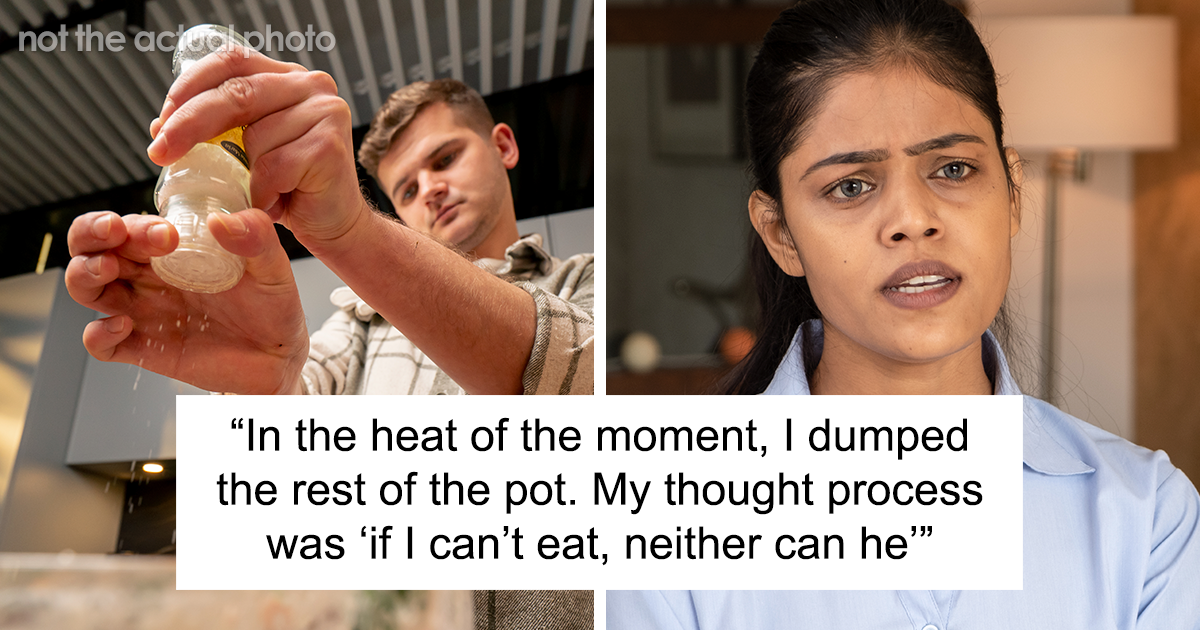
Her explanation was refreshingly unpolished: in the moment, she was angry, felt disregarded, and essentially thought, “If I can’t eat, neither can he.”
Was it petty? She knew it was. Was throwing away that much food wasteful? Also yes. Even many commenters who sympathized with her struggled with the image of an enormous pot of chili making the tragic journey from crockpot to garbage can.
But the evening wasn’t finished.
Her boyfriend apparently had a habit of eating leftovers late at night. When he discovered the chili was missing, she said he confronted her angrily. According to her account, he criticized the waste and argued that he thought she didn’t want any more.
That explanation landed badly. She had made enough food for multiple meals, eaten only a small portion, and paid for the groceries herself. From her perspective, the assumption that almost all the remaining chili had somehow become his was exactly the problem.
Original post details and community discussion:
The Fight Wasn’t Really About Salt
Anyone who has lived with another human being knows that tiny household disagreements are rarely just tiny household disagreements.
The toothpaste cap can actually mean, “I feel like I’m always cleaning up after you.” The wet towel on the bed can translate to, “Why am I responsible for noticing everything?” And a pot of salty chili can become shorthand for, “Why does what I ask for seem not to matter?”
The woman eventually acknowledged something similar herself. In an update, she said the chili represented a broader pattern of behavior that she had begun interpreting as selfishness.
She gave other examples: household resources being used without considering what she needed later and routine situations in which she felt her boyfriend prioritized himself automatically.
That’s what changed the discussion from Who committed the greater chili crime? to What happens when a partner repeatedly ignores a reasonable request?
Healthy Relationships Need Respect, Not Identical Preferences
Partners don’t need identical tastes to have a healthy relationship. One can love horror movies while the other considers anything scarier than a Pixar film an attack on the nervous system. One can enjoy ghost-pepper hot sauce while the other thinks black pepper is getting ambitious.
The relevant issue is whether both people make room for those differences.
The American Psychological Association has emphasized that communication patterns matter in healthy relationships. Other relationship-health guidance similarly highlights respect, trust, open communication, and boundaries as important foundations of functioning partnerships.
Relationship guidance synthesized from APA, Cleveland Clinic and Harvard Health:
In this case, the practical accommodation required almost no sacrifice. The boyfriend could add as much salt as he wanted after putting chili in his bowl.
He could create Lake Sodium in there if that brought him joy.
The problem arose when his preference changed food intended for everyone else.
Why Repeated Small Boundary Violations Feel So Big
One accidental oversalting would be frustrating. Repeatedly doing something after a partner has specifically asked you not to can create a different emotional reaction because the conflict stops being about the individual incident.
It becomes evidence.
People naturally begin asking questions: Did you forget? Did you listen? Do you disagree with my request? Or did you understand perfectly and simply decide that your preference mattered more?
Healthy boundary-setting starts with understanding what you need and communicating it clearly. Trust also depends partly on whether people take each other’s stated limits seriously rather than treating them as optional suggestions.
Boundary guidance:
The woman appeared to believe she had already completed those steps. She had explained her sensitivity. She had proposed a compromise. She said the same situation kept happening anyway.
That’s why her anger makes more sense when viewed cumulatively rather than as a reaction to one dinner.
Still, Dumping The Chili Wasn’t Exactly Conflict-Resolution Excellence
Understanding someone’s frustration doesn’t automatically make every reaction wise.
Throwing out a large quantity of edible food prevented the boyfriend from benefiting from what she saw as inconsiderate behavior, but it also escalated the situation and guaranteed another confrontation.
The internet predictably split over this point. Some readers argued that the boyfriend created the situation by repeatedly ruining shared food for her. Others believed throwing away so much chili was unnecessarily retaliatory and suggested giving it away, freezing it for someone else, or refusing to cook for him in the future.
Community reactions:
There is also a broader food-waste issue. The U.S. Environmental Protection Agency estimates that more than one-third of food in the United States goes uneaten and calculates substantial financial losses for American households from wasted food. USDA guidance encourages households to reuse or freeze leftovers when practical.
Food-waste guidance:
So yes, sacrificing an enormous batch of chili to the gods of relationship frustration was hardly an ideal ending.
But people don’t always choose optimal solutions while furious. If they did, comment sections would have far less material.
How Couples Can Handle These Conflicts Better
Relationship researchers often emphasize how conflicts begin and whether partners can repair them once emotions rise. The Gottman approach, for example, encourages gentler openings that describe feelings and needs instead of launching directly into character attacks. Repair attempts can also help stop negativity from escalating.
Conflict and repair research:
1. Address The Pattern, Not Just Tonight’s Dinner
Instead of “You ruined my chili again because you’re selfish,” the more productive message is closer to: “When shared food gets changed after I’ve asked that it remain lightly salted, I lose meals I planned to eat and feel like my needs aren’t being considered.”
The difference isn’t cosmetic. One statement attacks identity. The other identifies a behavior, its consequence, and what needs to change.
2. Create A Rule That Requires Almost No Negotiation
Some recurring conflicts should be eliminated with boring household rules.
Shared pot: moderate seasoning.
Individual bowl: do whatever your taste buds demand.
This same system works for chili oil, hot sauce, cheese, cilantro, sour cream, pepper, and practically every other ingredient capable of starting a dinner-table civil war.
3. Notice Whether Apologies Produce Changed Behavior
An apology matters most when it is followed by an adjustment.
If somebody repeatedly says, “Sorry, I won’t do that again,” and then reliably does that again, the eventual disagreement usually stops being about the original act. The unresolved question becomes whether agreements inside the relationship carry any weight.
4. Repair Before Resentment Becomes Contempt
Relationship experts warn particularly about contemptuous patterns in which partners respond with superiority, ridicule, dismissal, or disrespect. Repairing smaller conflicts early is much easier than waiting until every salt shaker represents five years of accumulated rage.
Gottman discussion of contempt and repair:
Listening also matters. Greater Good Science Center discussions of relationship conflict emphasize curiosity, validation, and trying to understand a partner’s position instead of immediately building the next counterargument.
Communication and empathy research:
There Was Also A Practical Reason Not To Salt Everything
Interestingly, leaving a communal dish less salty isn’t just a relationship compromise. It can make culinary sense when diners have different preferences.
Experienced cooking publications recommend seasoning gradually and tasting throughout cooking because oversalting is far harder to correct than undersalting. Serious Eats notes that salt levels should be built incrementally rather than corrected with one aggressive addition. Bon Appétit similarly advises restraint because salty dishes are difficult to rescue after the fact.
Culinary guidance:
If a soup or stew does become too salty, dilution with unsalted liquid or additional unseasoned ingredients can sometimes help, although that may substantially change the quantity and texture of the recipe.
Oversalting remedies:
And while the original poster said her sensitivity was primarily about taste rather than a medical restriction, sodium intake does have real health implications generally. The FDA and CDC recommend that most teens and adults stay below 2,300 milligrams of sodium per day, while the American Heart Association recommends no more than 2,300 milligrams and suggests a lower optimal target for many adults.
Current U.S. sodium guidance:
That doesn’t mean one salty chili dinner automatically constitutes a health crisis. It simply reinforces how reasonable it can be to let individual diners control additional salt themselves.
Her Update Made The Relationship Question Much Bigger
The most important part of the woman’s story arrived when she reflected on why the episode affected her so strongly.
She wasn’t really reconsidering a relationship because somebody incorrectly operated a salt shaker.
She was reconsidering it because she believed the chili incident fit an ongoing pattern.
In her update, she mentioned looking into childcare arrangements and suggested that practical family circumstances had contributed to staying in the relationship. She and her boyfriend had children, and he provided childcare while she worked.
Poster update:
Those realities make relationship decisions substantially more complicated than the classic internet recommendation of “dump him.” Shared parenting, finances, housing, childcare, work schedules, and emotional history don’t disappear because strangers have reached a unanimous verdict beneath a Reddit post.
Couples therapy can provide structured space for partners who want to examine recurring conflict and improve communication, although no therapy technique can substitute for a person’s willingness to participate and change behavior.
Couples-therapy context:
Experiences That Make This Chili Story Feel Familiar
The reason this story resonated with so many people isn’t that the average American household is one teaspoon away from collapse. It’s because many people have experienced the strange moment when an embarrassingly small disagreement suddenly reveals a much larger frustration.
The “I Already Asked You” Experience
Imagine that one partner repeatedly leaves an exterior door unlocked. The first time, the other person asks them to lock it. They apologize.
The second time, there’s another reminder.
By the tenth time, the argument isn’t really about rotating a deadbolt 90 degrees. The emotional question has become, “Why do I keep having to ask?”
The same applies to dishes left beside the dishwasher instead of inside it, wet laundry forgotten in the machine, borrowed items never returned, or shared food altered despite an agreement not to alter it.
Each incident is tiny. Repetition gives it weight.
The Household Labor Experience
Cooking also represents more than the finished food.
A large pot of chili may require planning meals, checking pantry supplies, buying groceries, unloading them, chopping vegetables, browning meat, seasoning ingredients, cleaning utensils, storing leftovers, and figuring out what everyone eats tomorrow.
When someone casually makes the final product unusable for the person who performed much of that work, frustration can feel disproportionate only if the invisible labor behind dinner is ignored.
Research and relationship discussions have repeatedly identified household labor and perceived fairness as common sources of dissatisfaction between couples.
Household labor and relationship satisfaction:
The Different-Tastes Experience
Successful shared meals often rely on a simple principle: customize at the last possible stage.
One person wants blazing heat? Put hot sauce on the table.
Someone hates cilantro? Garnish individual bowls.
A child doesn’t want onions? Keep the toppings separate.
One partner loves enough salt to preserve a medieval ham until 2073? Hand that person a shaker.
Similar food-preference disputes have appeared online involving spice rather than salt, including cases where one partner reportedly continued adding hot ingredients despite repeated requests not to. The recurring theme isn’t that couples must eat identical food; it’s whether one person’s preference consistently overrides the other’s ability to enjoy the meal.
Comparable food-preference dispute:
The Revenge-Is-Satisfying-For-About-Thirty-Seconds Experience
Most people have experienced the temptation to make a dramatic point.
Throw the chili away.
Hide the remote.
Stop replacing the toilet paper and wait for civilization to collapse.
The trouble is that retaliation often replaces one dispute with two disputes. The original problem remains, and now everyone gets to argue about the revenge too.
The more useful question after anger fades is whether the couple can identify the recurring behavior, agree on a concrete change, and follow through consistently.
If they can, the ridiculous argument can eventually become a funny story.
If they can’t, the ridiculous argument may be revealing something worth taking seriously.
Conclusion: Sometimes Chili Is Just ChiliAnd Sometimes It Isn’t
From the outside, ending or reconsidering a relationship over salted chili sounds absurd. From inside the relationship described by the poster, however, the food was merely the latest example in a sequence of interactions that left her feeling ignored.
She also wasn’t flawless. Throwing away a large amount of edible food out of anger was wasteful, and she openly recognized that. The original online discussion reflected both realities: her boyfriend’s repeated behavior was widely criticized, while some readers also objected to her retaliatory decision.
That’s what makes the story more interesting than a simple hero-versus-villain relationship tale.
Couples will irritate each other. They will misunderstand requests, season dinner badly, forget chores, say stupid things, and occasionally behave with all the emotional sophistication of raccoons fighting over a trash bag.
The important part is what happens next.
Can someone hear, “This bothers me,” without automatically translating it into an attack? Can partners make reasonable accommodations for each other? Can an apology become changed behavior? Can a conflict end with understanding instead of accumulating as ammunition for the next one?
If the answer is consistently no, then eventually something small may become the breaking point.
Sometimes it’s money.
Sometimes it’s laundry.
And sometimes it’s 10 quarts of chili that never stood a chance.
Note: This article analyzes a publicly shared relationship anecdote and broader relationship, nutrition, cooking, and food-waste guidance. Interpretations of the individuals’ motivations are contextual and should not be treated as psychological diagnoses.