Job interviews are usually stressful enough without the possibility of running into the manager who recently fired you. For one unemployed programmer, however, that possibility was not merely theoretical. It was printed directly on his interview confirmation.
After a recruiter accidentally arranged an interview with the same company that had dismissed him only weeks earlier, the applicant decided not to cancel. Instead, he treated the mistake as an invitation to conduct one of the funniest unofficial workplace experiments ever documented online. His essential equipment included an old uniform, several fake mustaches, a carefully incomplete résumé, and enough confidence to enter a building where multiple people might recognize him.
He then live-tweeted the entire adventure, transforming an ordinary recruiting error into a suspense story involving free snacks, confused managers, suspicious engineers, an increasingly ineffective disguise, and one gloriously dramatic exit.
A Recruiter Made an Awkwardly Spectacular Mistake
The interview invitation nobody expected
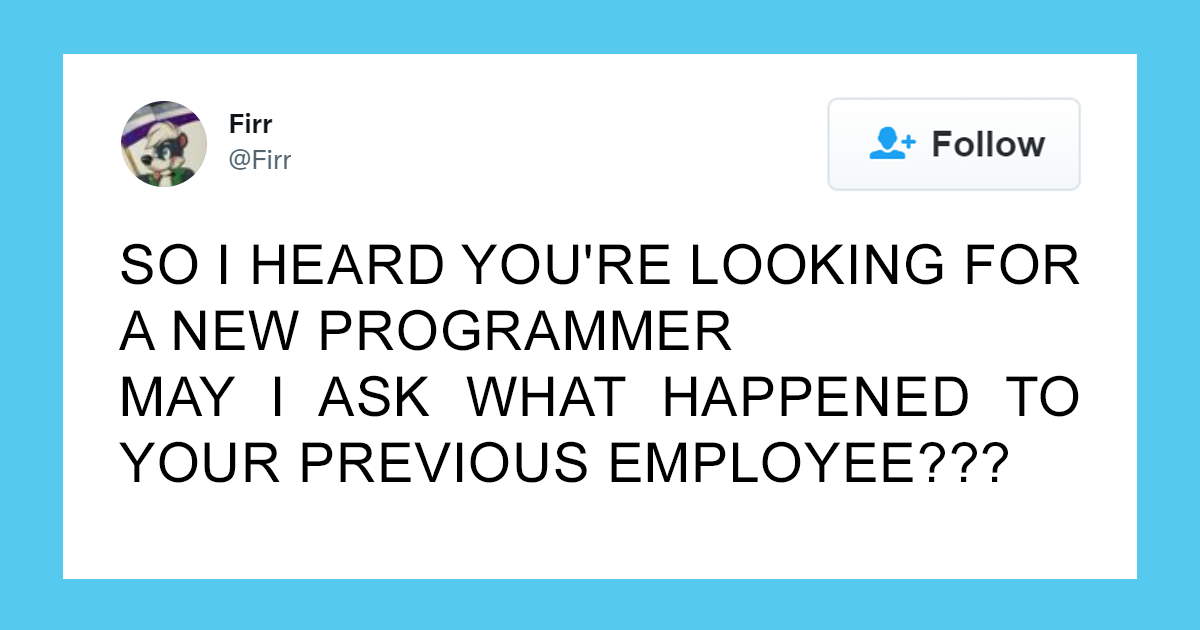
In November 2021, a social media user known as Firr announced that he was unemployed and that a recruiter had arranged a new job interview for him. So far, this was standard job-search territory. Recruiters connect applicants with employers every day, and most of those introductions do not require theatrical facial hair.
Then came the important detail: the employer was the company that had just fired him.
The open position was for a programmer working in systems integration, which was closely related to the job he had previously performed. The interview confirmation apparently moved through the recruiting process without anyone connecting the candidate to the former employee. Firr was understandably astonished, but he was also in a relatively comfortable position. He was doing freelance work, had other interviews scheduled, and could afford to spend part of an afternoon exploring the limits of corporate recordkeeping.
Rather than alerting the recruiter or canceling the appointment, he began planning. Would he arrive in formal clothing with a top hat? Would he wear his old company uniform to demonstrate suspiciously specific enthusiasm? The final decision combined the old uniform with a package of fake mustaches.
The narrative setup and employment details were verified against the original public thread and contemporary coverage.
The Fake-Mustache Job Interview Begins
Returning to the scene of the firing
On interview day, Firr drove to his former workplace wearing a purple shirt, a company-style cap, and a white adhesive mustache with the subtlety of a small household mop. He posted a photo from the parking lot and confidently suggested that nobody would recognize him.
The disguise was not his only preparation. When employees asked him to wear a face mask, he produced one that already had another mustache attached to it. This was not deception at an elite international-spy level. It was closer to a cartoon burglar placing a lampshade on his head and declaring himself furniture.
The front-desk employee showed no visible concern. Firr checked in, waited for the hiring manager, and discovered that his phone still connected automatically to the company’s Wi-Fi. Apparently, the organization had removed him from payroll more efficiently than it had removed him from the wireless network.
The hiring manager did not recognize him
The first hiring manager was someone Firr had not previously met. That fortunate detail allowed the interview to proceed with surprising normality.
The manager asked familiar questions about qualifications and experience. Firr’s résumé did not identify the former employer by name, but his description of the old position closely resembled the language in the new job listing. Consequently, he appeared remarkably well matched for the role. One might say he had inside knowledge, although in this case “inside” included knowledge of the break room, Wi-Fi password, and likely location of the emergency exits.
The manager reportedly regarded him as a strong candidate but did not have enough technical knowledge to conduct the deeper part of the interview. He therefore left to find an engineer.
Arrival, disguise, mask, Wi-Fi connection and first-interview details are documented in the live-tweeted images.
The interview unexpectedly became a snack review
While Firr waited, he mentioned that nerves had caused him to skip lunch. The manager responded kindly by bringing him water and snacks. When the technical interviewer was delayed, additional snacks appeared.
The growing collection included pretzels, gummy bears, bottled water, and beef jerky. Firr began changing mustaches while posing with his expanding buffet. The hiring manager, who was probably becoming increasingly unsure about the situation, seemed to default to the universal office solution for confusion: offering more food.
At this stage, the interview had already produced something valuable. Even without a job offer, Firr had acquired enough vending-machine inventory to survive a modest road trip.
The Disguise Faces Its First Serious Test
A familiar engineer enters the room
The hiring manager eventually found an employee who could evaluate Firr’s programming knowledge. This engineer had seen him around the workplace but apparently had not interacted with him often.
The engineer thought the applicant looked familiar and asked whether he had freelanced for the company before. Firr replied that he had freelanced at many places. Technically, this did not reveal the entire situation, but it also avoided a direct lie. It was the verbal equivalent of wearing a fake mustache: not especially convincing, yet apparently sufficient for another few minutes.
The technical conversation reportedly went well. Firr knew the work, understood the company’s needs, and was, in practical terms, an unusually qualified candidate. He had already performed nearly the same role in the same organization. His only significant disadvantage was that the company had recently made a formal decision not to employ him.
The former boss arrives
The comedy reached its turning point when someone from Firr’s former engineering group became involved. Word had apparently traveled through the building, and the old boss eventually approached the interview room.
Unlike the hiring manager, the former boss recognized him. He sat down and asked whether Firr was genuinely attempting to interview again for the position. Firr responded as though the word “again” were the confusing part and expressed an innocent desire to learn more about the role.
The atmosphere reportedly shifted from quirky interview to low-budget police interrogation. The old boss left, returned with the hiring manager, and explained the missing background information.
The hiring manager was furious that the candidate had not disclosed his recent termination. Firr joked that he could not recall it because so much could change in two weeks. He then offered the manager a gummy bear. The offer was politely declined, proving that there are limits even to professional courtesy.
The snack sequence, partial recognition and confrontation were recorded throughout the public thread.
The Interview Ends With a Perfect Final Scene
After more than an hour inside the company, Firr was escorted out. He intentionally made several wrong turns while asking whether this meant he would not be receiving the job. The answer was fairly clear, even without a formal rejection email.
He calculated that the interview had still been worthwhile. The company had spent an hour evaluating someone who genuinely possessed the required technical skills, while he had collected roughly eight dollars’ worth of complimentary snacks. In his personal accounting system, this qualified as a victory.
There was still one final performance waiting in the parking lot. When the former boss addressed him again, Firr dramatically removed his fake mustache and asked how the man had possibly discovered his identity. The boss’s response, according to the thread, was essentially an order to leave.
It was the correct ending: part workplace satire, part community theater, and part reminder that a thin strip of synthetic hair cannot defeat an employee database forever.
The walkout, snack estimate and final mustache reveal are documented in the concluding posts.
Why the Funny Live-Tweeting Story Went Viral
It reversed the usual power dynamic
Getting fired can affect income, routine, professional identity, and personal confidence. Research summarized by the American Psychological Association has linked unemployment with increased psychological distress and reduced life satisfaction. Job candidates also normally enter interviews knowing that employers control the opportunity, the timeline, and much of the conversation.
Firr’s live-tweeting reversed that dynamic. He did not need this particular position, so he could treat the interview as a comic experiment rather than a high-stakes evaluation. The company believed it was studying him, while thousands of online spectators were actually studying the company’s recruiting process.
Humor also gave him a way to reshape an unpleasant professional experience. Instead of allowing the firing to remain the final chapter, he added an epilogue containing fake facial hair and gummy bears. The result was not conventional career advice, but it was an effective demonstration of narrative control.
Research on job-loss stress and positive coping informs this analysis.
The mistake exposed gaps in the hiring process
The incident was funny because several safeguards failed simultaneously. The recruiter did not identify the connection between the candidate and employer. The employer apparently did not recognize a recent worker’s résumé. The hiring manager did not know the applicant, and an engineer only vaguely recognized him after speaking with him.
None of these mistakes alone is impossible, especially when recruiters represent multiple clients and large organizations divide hiring responsibilities among separate departments. Together, however, they created a remarkable situation in which a recently terminated programmer could return as an external applicant and advance through much of an interview.
The episode also illustrates why employers should verify basic candidate history before scheduling multiple staff members. A quick review could have revealed whether Firr was officially eligible for rehire, deliberately excluded from consideration, or potentially appropriate for a different team.
Could a Fired Employee Ever Be Hired Back?
Despite the chaos of this particular story, returning to a former employer is not automatically absurd. Rehired workers are often called boomerang employees, and many organizations actively consider them.
Former employees may require less onboarding because they understand the company’s products, systems, and culture. They may also return with new skills or a clearer understanding of what they want from their careers. Research and guidance published by Harvard Business Review, SHRM, and major employment platforms note that rehiring can reduce uncertainty and shorten the time required for a worker to become productive.
However, the reason for the original departure matters enormously. A worker who resigned respectfully for a better opportunity is different from someone dismissed for serious misconduct. Layoffs, reorganizations, management conflicts, role mismatches, and performance problems all require separate evaluation.
A legitimate boomerang interview should therefore address what happened, what has changed, and why both sides believe a second attempt would succeed. It should not depend on the applicant rotating through a ten-piece mustache collection while pretending not to know where the break room is.
Guidance on boomerang employees and rehiring former workers comes from HR and management research.
Practical Lessons for Candidates and Employers
What job candidates should do after being fired
Most candidates should not copy Firr’s strategy. A viral thread is not a substitute for rent money, and a former employer may control references or have professional connections throughout an industry.
When another interviewer asks about a termination, career specialists generally recommend a concise and honest answer. A candidate can explain the relevant circumstances, accept responsibility where appropriate, describe what was learned, and redirect the discussion toward current qualifications.
For example, someone dismissed after missing performance targets might explain that the role required a sales approach that did not match their strengths, then describe new training or measurable improvements made afterward. Someone affected by a reorganization should accurately call it a layoff rather than a firing. The goal is not to create an elaborate defense. It is to demonstrate judgment, growth, and reliability.
What recruiters should verify
Recruiters should confirm the employer’s identity, the candidate’s recent work history, and any obvious overlap before scheduling an interview. Applicant tracking systems can help, but software does not replace a careful review.
Recruiters should also provide candidates with enough information to identify potential conflicts. Concealing the employer’s name for too long may prevent an applicant from recognizing that they have already worked for the organization, interviewed with the same department, or signed an agreement affecting the opportunity.
What employers should learn about employee exits
A professional exit process protects more than the departing employee. Gallup’s workplace research emphasizes that thoughtful transitions can strengthen trust, preserve an employer’s reputation, and create a useful alumni network. Former workers may become customers, referral sources, contractors, or future rehires.
Employers should document whether departing employees are eligible for rehire and make that information accessible to recruiters. They should also remove former workers from security systems, internal accounts, and Wi-Fi networks in a consistent manner. Otherwise, the next applicant may arrive already connected to the internet and knowing exactly which hallway contains the premium gummy bears.
Interview guidance, exit practices and basic U.S. termination information were checked against career, HR and government resources.
Related Experiences: Turning an Awkward Career Setback Into a Better Next Step
Most people who unexpectedly encounter a former employer during a job search will not have an audience following every development online. Nevertheless, the emotional ingredients may feel familiar: embarrassment, curiosity, anger, uncertainty, and the quiet desire to prove that the company made a mistake.
Consider a marketing specialist who is laid off during a budget reduction. Three months later, an outside recruiter contacts her about a “fast-growing opportunity” without revealing the client’s name. During the first call, she realizes the position is with her old employer and appears to include many of her former responsibilities. Her best response is not necessarily to reject the interview. She can ask whether the company is intentionally considering former employees, whether the department has changed, and how the new role differs from the one eliminated.
That conversation could reveal a legitimate opportunity. Perhaps the company restored funding, replaced an ineffective manager, or redesigned the position with greater authority. Alternatively, it might expose poor planning. Either result gives the candidate useful information without requiring a disguise purchased near a party-supply aisle.
Another common experience involves a worker fired for a role mismatch rather than misconduct. Imagine a talented software developer promoted into project management because leaders assumed technical ability would automatically translate into enthusiasm for budgets, meetings, and status reports. It did not. After struggling for several months, the employee was dismissed.
If the former company later offered an interview for a purely technical position, returning might make sense. The candidate would need to discuss the earlier failure directly: the management role was a poor fit, performance suffered, and both sides should have recognized the mismatch sooner. That explanation shows more maturity than pretending the previous employment never occurred.
There is also a difference between using humor privately and turning a workplace conflict into public content. Joking with trusted friends can reduce tension and help a person process rejection. Publishing names, confidential information, internal messages, or accusations creates additional risks. Social media posts can reach future employers, clients, and colleagues long after the original frustration has passed.
Before sharing an employment story publicly, a worker should remove identifying details, avoid unsupported claims, review any confidentiality obligations, and consider whether the post will still appear reasonable several years later. Firr’s thread worked as comedy partly because it focused on absurdity rather than revealing proprietary technical information or attacking individual employees with serious allegations.
A person recently fired should also handle the practical matters before planning the perfect comeback. That means requesting written termination information, confirming the final paycheck, reviewing benefits, preserving relevant employment documents, and checking eligibility for unemployment compensation under state rules. Federal law does not generally require severance pay, although employment contracts, company policies, or state laws may create additional rights.
Once those essentials are addressed, the next step is rebuilding momentum. Update the résumé, contact supportive former colleagues, collect work samples that can be shared legally, and practice a calm explanation of the termination. The explanation should usually last less than a minute. A useful structure is: what happened, what you learned, what changed, and why the current opportunity is a better match.
The larger lesson is that being fired does not permanently define someone’s ability. It is a professional event, not a complete personality assessment delivered from the heavens on official company letterhead. Some terminations follow serious mistakes; others result from restructuring, weak management, changing expectations, or a mismatch between a person and a role.
Humor can help restore perspective, but good judgment determines what happens next. Firr’s adventure became memorable because the circumstances were extraordinary and he had other income options. For most workers, the wiser victory is less cinematic: leaving with useful records, explaining the experience honestly, finding a healthier position, and eventually laughing about the moment without needing to be escorted from the building.
General employment guidance is supported by U.S. Department of Labor, EEOC, Gallup and career resources. Employment rights vary by state and individual circumstances.
Conclusion
The programmer’s funny live-tweeting succeeded because it combined a genuine recruiting failure with impeccable comic timing. A recruiter sent him back to the company that had recently fired him, the first interviewer failed to recognize him, employees supplied an escalating quantity of snacks, and a fake mustache survived much longer than anyone could reasonably expect.
Beneath the comedy is a useful workplace lesson. Companies need organized recruiting records, respectful exit procedures, and clear rehire policies. Candidates need honesty, perspective, and enough self-awareness to distinguish a real second chance from an opportunity to create internet history.
Firr did not leave with a job offer. He did, however, leave with snacks, a viral story, and the satisfaction of dramatically removing a mustache in front of his former boss. In the unpredictable economy of online storytelling, that may be one of the strangest severance packages ever assembled.
Note: This article retells a publicly shared 2021 social media story using original wording and adds general career analysis. Employment laws, unemployment eligibility, and termination rights vary by state and individual circumstances.