An outdoor kitchen countertop has a tougher job than its indoor cousin. It must survive blazing sunlight, wind-driven rain, freezing nights, greasy burgers, spilled lemonade, hot cookware, and that one guest who insists on chopping directly on the counter despite the cutting board sitting three inches away.
That is why choosing the best countertop material for an outdoor kitchen is not simply a decorating decision. The right surface must match your climate, cooking habits, maintenance tolerance, installation method, and budget. A material that performs beautifully beneath a covered patio in Southern California may struggle through repeated freeze-thaw cycles in Minnesota.
For most homeowners, granite, quartzite, porcelain, ultra-compact surfaces, concrete, and stainless steel are the strongest choices. Soapstone, bluestone, and outdoor-rated tile can also work well in the right setting. Standard indoor quartz, laminate, and butcher block are generally riskier unless the manufacturer specifically approves the product for exterior use.
What Makes a Countertop Suitable for Outdoor Use?
Outdoor kitchen countertops face conditions that ordinary indoor counters rarely encounter. Before becoming emotionally attached to a dramatic marble-look slab, evaluate how it handles the following challenges:
- Ultraviolet exposure: Direct sunlight can fade pigments and damage resin-based materials.
- Temperature changes: Rapid heating, cooling, freezing, and thawing can stress slabs, seams, grout, and adhesives.
- Water: Rain and melting snow can enter pores, joints, cutouts, and poorly sealed edges.
- Heat: Grill zones need surfaces and installation materials capable of tolerating high temperatures.
- Stains: Oil, wine, barbecue sauce, citrus juice, and rusting utensils can leave permanent reminders of last weekend.
- Impact: Heavy cookware, ice buckets, serving trays, and outdoor equipment can chip vulnerable edges.
A good outdoor surface should therefore be weather-resistant, UV-stable, reasonably easy to clean, and compatible with exterior-grade adhesives, sealants, substrates, and cabinetry. Installation quality matters almost as much as the material itself. Even a nearly indestructible slab can fail when water collects beneath it or grill clearances are ignored.
1. Granite: The Best All-Around Natural Stone
Granite remains one of the most dependable outdoor kitchen countertop materials. It is naturally resistant to heat, available in a huge range of patterns, and capable of handling years of food preparation and entertaining. Because its color comes from minerals rather than surface printing or resin-heavy binders, properly selected granite generally performs well in sunlight.
Why Granite Works Outdoors
A dense granite slab can tolerate hot weather, cold weather, direct sun, and heavy use. Darker, tighter-grained varieties often hide cooking stains and outdoor dust better than pale, highly patterned slabs. A leathered or honed finish may also disguise fingerprints and minor wear more effectively than a mirror-like polish.
The catch is porosity. Granite should be sealed when needed, especially around sinks, grill cutouts, seams, and beverage stations. Not every slab absorbs moisture at the same rate, so ask the fabricator about the specific stone rather than following a universal resealing calendar.
Best for: Homeowners wanting a durable, classic surface with natural variation.
Watch out for: Neglected sealer, unsupported overhangs, poorly finished cutouts, and very dark slabs that become hot in full sun.
2. Quartzite: The Premium Natural-Stone Performer
Quartzite is often confused with quartz, but the two materials are not interchangeable. Quartzite is a natural stone formed under intense heat and pressure. Engineered quartz is a manufactured surface that typically combines mineral particles with resin.
For exposed outdoor kitchens, true quartzite can be an excellent choice. It offers impressive hardness, good resistance to sunlight, and the flowing veins many homeowners love in marble. In other words, it can deliver a luxurious appearance without behaving quite as delicately as marble at the first sight of lemon juice.
Questions to Ask Before Buying Quartzite
Stone names are not always used consistently in retail showrooms. Some slabs marketed as “soft quartzite” may behave more like marble or dolomitic stone. Ask for absorption information, recommended sealing practices, and a sample you can test with oil and acidic ingredients.
Best for: High-end outdoor kitchens where natural beauty and UV stability are priorities.
Watch out for: Mislabeling, premium fabrication costs, and porous varieties that require careful sealing.
3. Porcelain Slabs: The Best Low-Maintenance Choice
Large-format porcelain is one of the strongest modern options for an outdoor kitchen. It is nonporous, highly resistant to stains, and generally unaffected by UV exposure. Quality exterior-rated porcelain can also tolerate heat, moisture, and freezing conditions.
Porcelain slabs are available in designs that resemble marble, concrete, metal, and natural stone. That makes them especially appealing when you want a pale luxury look without signing up for the maintenance requirements of real marble.
Porcelain’s Biggest Weakness
Although the surface is hard, edges can chip if they are struck or fabricated poorly. Porcelain also requires specialized cutting tools and an installer familiar with large, relatively thin slabs. A bargain installation by someone learning on your project can become an expensive outdoor mosaic.
Best for: Sunny, uncovered kitchens and homeowners who want minimal sealing or staining concerns.
Watch out for: Vulnerable edges, complicated fabrication, and insufficient structural support around appliance openings.
4. Ultra-Compact and Sintered Surfaces: Best for Extreme Exposure
Ultra-compact surfaces, including products such as Dekton, are manufactured from minerals compressed and processed to create dense, low-absorption slabs. Many products in this category are designed for both indoor and outdoor applications.
These surfaces can offer strong resistance to UV exposure, scratches, stains, water, and heat. They are particularly useful for sleek contemporary kitchens with wide counters, waterfall ends, or coordinated wall cladding.
However, product specifications vary. “Ultra-compact,” “sintered,” and “porcelain” are sometimes used loosely in sales conversations. Review the technical sheet and exterior warranty for the exact color, thickness, and finish you are purchasing.
Best for: Fully exposed kitchens, modern designs, and owners who prioritize low maintenance.
Watch out for: Higher fabrication costs, potential edge chipping, and installers without product-specific training.
5. Concrete: The Best Customizable Countertop
Concrete is the shape-shifter of outdoor countertop materials. It can be poured in place or precast, colored, textured, polished, or formed around curves and unusual appliance layouts. Drainboards, trivets, bottle openers, and decorative aggregates can even be incorporated into the design.
Properly designed concrete is durable and well suited to outdoor environments. It also looks at home beside brick, stucco, stone veneer, wood-look cabinetry, or a modern steel grill.
Concrete Is Not Maintenance-Free
Concrete is porous and normally needs an exterior-appropriate sealer. It may develop hairline cracks as it cures or moves with temperature changes. Some homeowners consider those marks part of the industrial character; others stare at each crack as though it has personally betrayed them.
Successful concrete counters depend on reinforcement, controlled curing, suitable joint placement, proper support, and a sealer compatible with food-preparation areas. Epoxy and other coatings should never be assumed to be outdoor-safe; verify UV stability and temperature limitations before use.
Best for: Custom shapes, rustic or industrial designs, and skilled DIY projects.
Watch out for: Cracking, staining, heavy weight, poor drainage, and sealers that discolor in sunlight.
6. Stainless Steel: The Best Professional-Style Surface
Stainless steel creates a clean, commercial appearance and pairs naturally with grills, refrigerators, sinks, and storage drawers. It is nonporous, hygienic, heat-resistant, and easy to wipe down after food preparation.
It is especially practical around wet zones because there is no stone sealer to maintain. Custom fabricators can integrate backsplashes, marine edges, drainboards, and welded sinks for a nearly seamless work surface.
Choose the Right Stainless Grade
Type 304 stainless steel is widely used in kitchens. In coastal environments or locations exposed to salt and chlorides, a fabricator may recommend Type 316 for improved corrosion resistance. Regardless of grade, stainless steel is not magically immune to every stain or rust mark. Metal particles left on the surface can corrode, and harsh cleaners can damage the finish.
Scratches and fingerprints are unavoidable. A brushed or patterned finish generally ages more gracefully than a highly reflective surface.
Best for: Contemporary kitchens, serious cooks, wet preparation zones, and compact modular islands.
Watch out for: Glare, fingerprints, scratches, denting, surface heat in direct sun, and coastal corrosion concerns.
7. Soapstone: Best for a Soft, Naturally Aged Look
Soapstone is a dense natural material known for excellent heat resistance and low liquid absorption. Unlike many stones, it does not normally depend on sealing to prevent stains. Mineral oil may be applied to deepen and even out its color, but that treatment is primarily cosmetic.
The trade-off is softness. Soapstone can scratch, dent, and develop worn areas. Minor scratches may be sanded or blended with oil, which makes the material attractive to homeowners who prefer a relaxed, lived-in appearance.
Best for: Shaded or partially covered kitchens with traditional, farmhouse, or rustic styling.
Watch out for: Scratches, edge damage, limited slab sizes, and dark surfaces becoming hot under direct sun.
8. Outdoor-Rated Tile: The Best Budget-Friendly Design Option
Porcelain or exterior-rated ceramic tile can provide a durable countertop at a lower material cost than many full slabs. Tile also opens the door to colorful patterns, decorative borders, mosaics, and DIY installation.
The tile itself is rarely the weakest part. Grout lines, substrate movement, water penetration, and freeze-thaw cycles cause most outdoor tile problems. Large-format porcelain tile reduces the number of grout joints and creates a cleaner work surface.
Use exterior-rated setting materials, waterproof cement board or another approved substrate, and grout suitable for the local climate. Traditional plywood beneath exposed tile is an invitation for water to start a renovation project without your permission.
Best for: Covered kitchens, warm climates, colorful designs, and carefully planned DIY builds.
Watch out for: Dirty grout, cracked tiles, uneven work surfaces, moisture intrusion, and freezing climates.
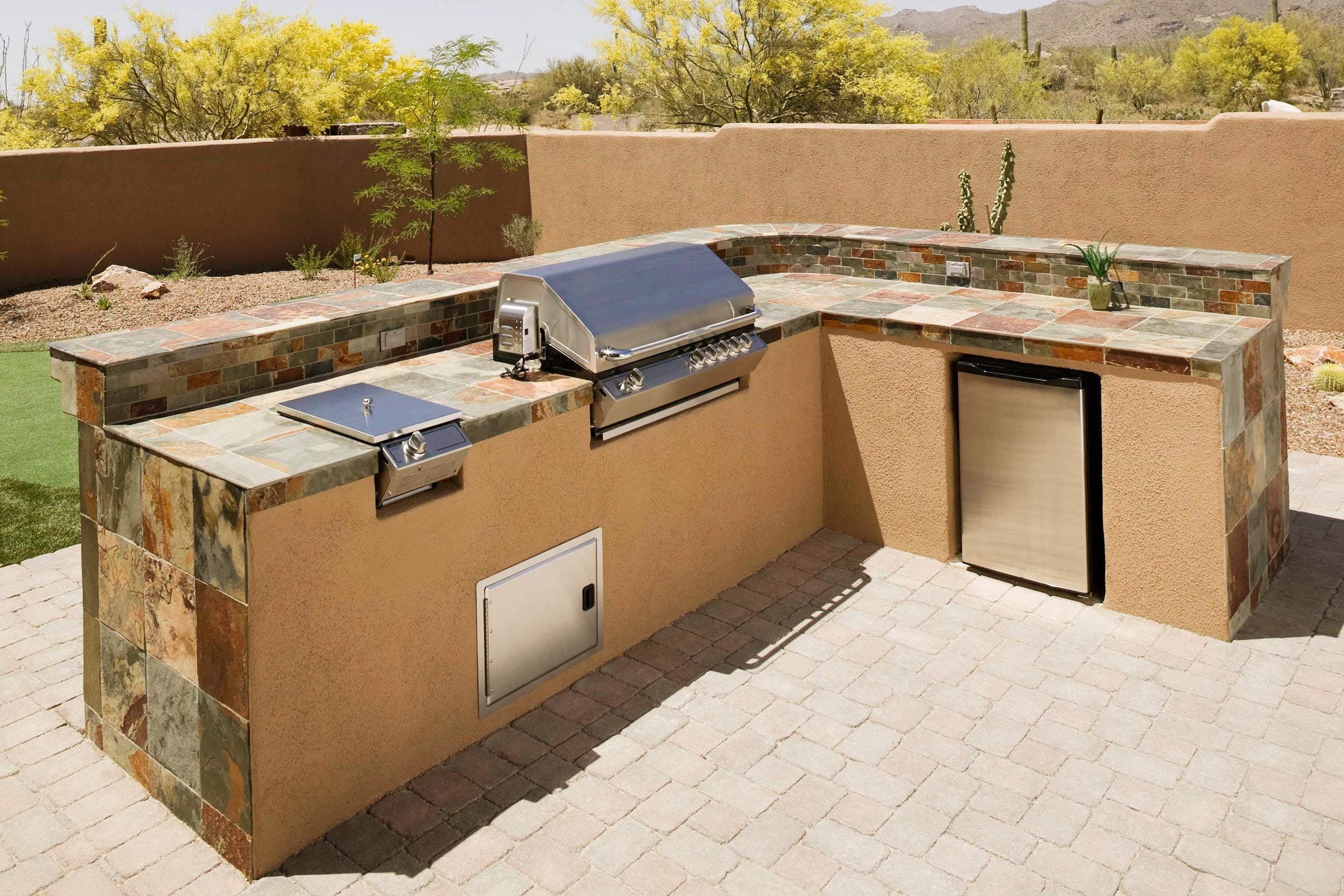
9. Bluestone and Dense Regional Stone
Bluestone, slate, and other dense regional stones can be excellent choices when locally available. They create a natural connection between the kitchen and surrounding patios, walls, or landscaping.
Performance varies significantly among stone types and quarries. Some stones tolerate freeze-thaw conditions well, while others absorb moisture, flake, or stain easily. Ask a local stone supplier whether the specific material has a proven history in exterior countertopsnot merely exterior paving.
Best for: Rustic kitchens and projects coordinating counters with local hardscaping.
Watch out for: Surface clefting, absorption, staining, inconsistent thickness, and limited fabrication options.
Outdoor Countertop Materials to Approach Carefully
Standard Engineered Quartz
Indoor quartz is durable and convenient inside the house, but many traditional products contain resins that can discolor or deteriorate after prolonged UV exposure. Do not assume an indoor quartz warranty covers exterior installation.
There are exceptions. Some manufacturers now offer quartz collections engineered and warranted specifically for outdoor conditions. Buy only after confirming that the exact product, color, installation, and location are covered in writing. The word “quartz” alone is not enough.
Marble and Limestone
Marble and many limestones are beautiful but vulnerable to acidic foods, staining, scratching, and weathering. They may be acceptable in a protected decorative bar where patina is welcome, but they are rarely the easiest choice for a hard-working grill station.
Laminate
Most laminate countertops rely on wood-based cores. Once moisture reaches seams, edges, or cutouts, the substrate can swell and delaminate. Laminate belongs indoors unless a complete exterior system is specifically designed and warranted for outdoor use.
Wood and Butcher Block
Wood adds warmth, but exposed countertops require frequent cleaning, drying, oiling, sealing, and inspection. Even rot-resistant species will move, fade, check, or weather. A removable wood cutting board is usually more practical than an entire exposed butcher-block counter.
How to Choose the Best Material for Your Climate
Hot, Sunny Regions
Prioritize UV-stable materials such as porcelain, granite, quartzite, or exterior-rated ultra-compact surfaces. Pale colors are more comfortable to touch than black surfaces after several hours of direct sun.
Freeze-Thaw Climates
Choose low-absorption surfaces and minimize joints where water can collect. Porcelain and properly selected dense stone are strong candidates. Concrete and tile can work, but installation, reinforcement, drainage, and exterior-rated setting materials become especially important.
Coastal Locations
Salt air affects metal components, fasteners, grills, and cabinetry as well as countertops. Porcelain and dense stone require relatively little concern, while stainless-steel specifications should be discussed with an experienced coastal fabricator.
Covered Outdoor Kitchens
A roof reduces UV exposure and direct rain, allowing more flexibility. However, a covered kitchen is still outdoors. Wind-blown moisture, humidity, pests, temperature changes, and condensation remain part of the job description.
Installation Details That Determine Long-Term Performance
The best countertop material can still disappoint when the installation ignores outdoor conditions. Include the following details in the project plan:
- Use an exterior-rated, dimensionally stable substrate.
- Provide adequate structural support for heavy stone or concrete.
- Follow the grill manufacturer’s combustible-clearance requirements.
- Use flexible exterior sealants around sinks, backsplashes, and appliance cutouts.
- Slope surfaces slightly where needed so water cannot pool.
- Avoid unsupported overhangs unless engineered brackets are installed.
- Protect vulnerable slab edges from chairs, coolers, and serving carts.
- Confirm that adhesives, grout, sealers, and coatings are approved for exterior exposure.
- Plan expansion joints where different materials meet.
Ask for a written care guide before approving the installation. The guide should identify acceptable cleaners, sealing requirements, heat limitations, warranty exclusions, and winterization steps.
Real-World Experiences When Selecting Outdoor Kitchen Countertops
Product descriptions tell you how a material performs in a laboratory. Daily use reveals whether you will still enjoy it after three summers, two winter storms, and approximately 400 sticky fingerprints.
Experience 1: The Dark Granite Grill Station
A dark granite countertop often looks spectacular beside stainless-steel appliances. It hides soot, pepper flakes, and minor cooking stains, making cleanup feel almost suspiciously easy. The surprise comes on sunny afternoons: black stone can become extremely warm. Guests may place a hand on it once, perform a small interpretive dance, and never repeat the experiment.
The practical lesson is not to avoid dark granite altogether. Use it strategically. Install it beneath a pergola, umbrella, or roof, or reserve shaded counter space for seating. A lighter bar top can also be paired with a darker grill surround.
Experience 2: The Beautiful White Quartzite Slab
White quartzite can give an outdoor kitchen the elegance of an indoor designer space. It reflects heat better than dark stone and looks excellent with wood-look cabinets or black appliances. Yet pale stone makes rust marks, grill grease, leaf tannins, and red wine easier to see.
A homeowner who wipes spills promptly and maintains the stone will probably love it. Someone who leaves barbecue sauce outside until Monday morning should choose a busier pattern or a less revealing color. Lifestyle compatibility matters more than showroom lighting.
Experience 3: The Low-Maintenance Porcelain Island
Porcelain earns praise because most spills remain on the surface instead of soaking in. It is particularly convenient near beverage centers, where citrus, wine, and colorful mixers regularly test the counter’s patience.
The important experience happens during installation. Homeowners sometimes select porcelain based only on the pattern and lowest bid. Then a poorly fabricated sink opening or sharp mitered edge chips. Hiring an experienced porcelain fabricator is usually more valuable than saving a small percentage on labor.
Experience 4: The DIY Concrete Counter
Concrete offers satisfying creative control. You can choose the thickness, color, edge shape, and exact dimensions. A successful pour feels like creating a piece of furniture that could survive a minor meteor event.
But concrete rewards preparation and punishes improvisation. Forms must be square, reinforcement must be planned, and curing cannot be rushed because guests are arriving Saturday. Test the mix and sealer on a sample first. That small practice slab can reveal unwanted color, pinholes, or a glossy finish that looks more like a bowling alley than natural concrete.
Experience 5: Stainless Steel Near the Pool
Stainless steel is wonderful for quick cleanup. Tomato juice, raw meat drips, and melted popsicles can be removed without worrying about stone pores. Around pools and coastal properties, however, chemical and salt exposure require greater attention to grade, finish, and maintenance.
The visual experience also changes over time. A brand-new steel surface looks immaculate. After regular use, it develops fine scratches and a softer patina. Owners who expect permanent showroom perfection may become frustrated. Owners who embrace the professional-kitchen look generally appreciate it more each year.
Experience 6: The Tile Counter With Too Much Grout
Small tile can create a charming Mediterranean or Southwestern counter. Unfortunately, dozens of grout lines also create dozens of places for sauce, dust, pollen, and moisture to gather.
Large-format tile is usually easier to live with. When small decorative tile is essential to the design, consider limiting it to a backsplash or vertical accent while using a smoother slab for food preparation.
The Most Useful Experience of All: Bring Samples Outside
Before ordering full slabs, place samples in the intended location for several days. Examine them in morning light, harsh afternoon sun, and evening shade. Splash them with water. Set a cold glass on them. Add a drop of cooking oil, mustard, lemon juice, and red wine according to the supplier’s testing instructions.
This simple experiment reveals more than a showroom visit. It shows whether glare is annoying, whether the color becomes painfully hot, whether fingerprints dominate the finish, and whether minor stains blend into the pattern. A countertop is a working surface, not a museum exhibit. Choose the one that handles your version of outdoor living.
Final Verdict: What Is the Best Outdoor Kitchen Countertop?
There is no single winner for every home, but several materials consistently rise to the top.
Granite is the best all-around natural-stone option. Quartzite is ideal when you want premium veining and impressive outdoor durability. Porcelain offers one of the strongest combinations of UV resistance, stain resistance, and low maintenance. Ultra-compact surfaces excel in highly exposed modern installations. Concrete provides unmatched customization, while stainless steel delivers professional performance and easy sanitation.
Choose according to your climate and cooking style rather than selecting a surface based on appearance alone. Confirm exterior approval, review the warranty, hire a qualified fabricator, and pay close attention to drainage, seams, cutouts, support, and grill clearances. Do that, and your countertop can spend years handling sunshine, storms, smoke, and enough barbecue sauce to concern a cardiologist.