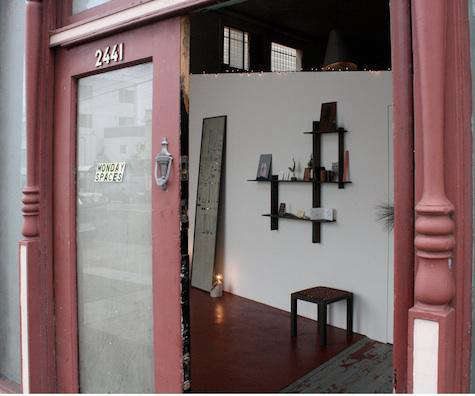
Historical note: This shopper’s diary revisits a San Francisco showroom documented in 2011. The address, opening schedule, prices, and product availability mentioned below are archival details and should not be treated as current retail information.
Some stores announce themselves with polished windows, glowing signs, and enough carefully aimed lighting to make a wooden spoon feel famous. Monday Spaces took a quieter approach. Located in San Francisco’s fog-friendly Outer Richmond, the small showroom presented furniture and lighting by Anzfer Farms alongside jewelry by designer Raissa Bump. It was less a conventional furniture store than a place where handmade objects could breathe, stretch out, and quietly convince visitors that an old piece of timber might have a more interesting résumé than they did.
Archival coverage places Monday Spaces at 2441 Balboa Street, where it opened on Mondays or by appointment. The unusual schedule suited a workshop-driven operation: this was not a warehouse full of identical dining tables waiting for weekend bargain hunters. It was a window into the practice of Anzfer Farms, the San Francisco design collaboration founded by Jonathan Anzalone and Joseph Ferriso. Their specialty was transforming reclaimed, salvaged, found, and naturally weathered wood into contemporary furniture, lamps, sculptural objects, and functional curiosities.
The result was a shopping experience built around discovery. Grain patterns were not defects to be hidden. Knots, cracks, fading, rough edges, and evidence of a previous life became part of the design vocabulary. At Monday Spaces, wood did not arrive looking factory-fresh and emotionally unavailable. It showed up with history.
A Small San Francisco Showroom with a Big Point of View
Monday Spaces belonged naturally in the Richmond District, a part of San Francisco known for independent businesses, neighborhood commercial streets, coastal weather, and a slightly slower rhythm than the city’s downtown core. The surrounding avenues stretch toward Ocean Beach, while the broader district sits between Golden Gate Park and the Presidio. On many days, the neighborhood’s cool air and muted light create an ideal backdrop for tactile materials such as linen, ceramic, oxidized metal, and unfinished wood.
Rather than competing with that atmosphere, the showroom appeared to absorb it. Anzfer Farms’ lamps, seating, tables, and sculptural pieces looked at home in a space where fog-softened daylight could reveal every uneven surface. The designs felt rustic without becoming themed, modern without looking clinically perfect, and artistic without forgetting that a chair should still support a person who has eaten too much sourdough.
This balance was one of the collaboration’s strengths. Contemporary reclaimed wood furniture can easily fall into familiar visual clichés: oversized barn doors, heavily distressed finishes, or tables so aggressively “rustic” that one expects a cowboy to appear with the receipt. Anzfer Farms followed a more restrained path. The makers used humble materials but simplified the forms, allowing proportion, color, texture, and construction to do the talking.
Who Were the Makers Behind Anzfer Farms?
Jonathan Anzalone and Joseph Ferriso brought complementary experience to the studio. Before making woodworking their principal vocation, Anzalone apprenticed with woodworker Peter Murkett, while Ferriso worked in a frame shop producing specialized display boxes. Together, they searched for driftwood near their San Francisco studio and recovered scrap lumber from demolition projects, then transformed those materials into furniture and lighting.
The name “Anzfer” combined portions of their surnames, while “Farms” gave the collaboration an intentionally curious identity. It suggested cultivation rather than mass production. Instead of growing tomatoes or suspiciously enormous zucchini, the pair cultivated materials, ideas, and forms. Wood that might otherwise have been discarded became the raw material for one-off household objects.
Their work also occupied the interesting territory between furniture design and fine art. A lamp could function perfectly well while retaining the visual authority of a small sculpture. A bench might invite someone to sit, but its stacked slabs and unexpected geometry could also change the character of an entire room. Their 2012 exhibition “Holz” was described as bringing collaborative furniture together with painting and relief work while exploring color, form, strength, and elegance.
That interdisciplinary attitude explains why Monday Spaces felt more like a workshop gallery than a traditional shop. The pieces were useful, but usefulness was only the beginning.
What Shoppers Found Inside Monday Spaces
Driftwood Lighting with Natural Personality
Among the most memorable objects were Anzfer Farms’ driftwood sconces and footed lamps. Instead of forcing salvaged branches and chunks of timber into perfect symmetry, the makers worked with their existing shapes. A piece of wood might twist, taper, lean, or carry a surface polished by water and time. The electrical components gave it a practical purpose, while the wood supplied a character that no molded imitation could reproduce.
Archival images showed a collection of lamps with exposed bulbs, compact wooden bases, and irregular silhouettes. One documented cedar footed lamp was listed at approximately $350 at the time. That historical price reflected more than the physical materials. Buyers were paying for sourcing, cleaning, drying, design decisions, electrical work, joinery, finishing, and the uncertainty involved in making a singular object from an unpredictable piece of wood.
In a mass-produced lamp, consistency is the goal. In a salvaged wood lamp, consistency would almost defeat the purpose. The charm lies in knowing that the next piece will not bend, crack, or stand in precisely the same way.
A Deck Chair Reduced to Its Essentials
Another documented piece was a remarkably simple deck chair formed from two substantial lengths of wood. Its appeal came from reduction: fewer parts, an immediately readable structure, and a silhouette that appeared both primitive and modern.
Minimal furniture can be surprisingly difficult to design. Decorative elements often disguise awkward proportions or complicated connections. Remove those distractions, and every angle becomes important. A chair made from only a few visible components has nowhere to hide. It either looks balanced and inviting, or it resembles lumber that lost an argument with a hardware store.
Anzfer Farms’ approach allowed the material’s weight and grain to become visual features. The chair did not need carved ornaments or glossy upholstery. Its construction was the ornament.
Woven Furniture and Contrasting Textures
The showroom also included woven furniture pieces that paired wooden frames with flexible surfaces. This combination softened the visual heaviness of reclaimed lumber. Solid wood provided structure, while woven sections introduced rhythm, lightness, and a sense of handwork.
Texture was central to the appeal. Smooth and rough areas could coexist within the same object. Tight weaving sat beside worn timber. The contrast encouraged closer inspection, which is precisely what a small showroom does best. Online product photography can communicate shape and color, but it cannot fully reproduce the pleasure of running a hand near an old grain line or seeing how a woven seat responds to weight.
Why Reclaimed Wood Made Sense in San Francisco
Anzfer Farms’ use of reclaimed material was aesthetically distinctive, but it also reflected a broader culture of reuse in San Francisco. The city adopted construction and demolition debris recovery requirements years before the original Monday Spaces feature appeared. Local policies encouraged the separation, recovery, recycling, and reuse of materials that might otherwise enter the waste stream.
At the national level, the U.S. Environmental Protection Agency identifies wood as a construction and demolition material that can be recovered for furniture, engineered wood products, mulch, compost, and other uses. The agency also recommends salvaging existing materials and purchasing reused or recycled products as practical ways to reduce waste.
Reclaimed wood furniture does not automatically become environmentally perfect merely because a board is old. Makers still need energy, transportation, finishes, adhesives, hardware, and workshop equipment. The material must also be inspected for damage, contamination, hidden fasteners, pests, and structural weakness. “Found on the beach” is an evocative origin story, but it is not a complete manufacturing plan.
Even so, careful reuse can extend the useful life of existing material, reduce demand for newly harvested timber, and preserve wood with colors or grain patterns that may be difficult to obtain from contemporary lumber. Certification systems such as those maintained by the Forest Stewardship Council also distinguish recycled material and responsibly sourced wood, helping buyers understand that terms such as “reclaimed,” “recycled,” and “certified” are related but not interchangeable.
From Showroom Furniture to Public Space
Anzfer Farms’ work eventually reached beyond private interiors. The studio designed and installed a parklet near Clement Street and Third Avenue, associated with Cumaica Coffee. San Francisco Planning records identify Anzfer Farms as the designer and installer of the parklet, which opened in 2013. Local coverage described custom furniture made from salvaged and reclaimed materials, counters for standing, and abundant planting.
The project demonstrated how the studio’s design language could operate at an urban scale. A weathered slab that looked sculptural in a showroom could become public seating outdoors. Irregular wood, layered planting, and handmade construction softened a strip of pavement and created a small neighborhood gathering place.
More than a decade later, reporting on the same Clement Street parklet credited Anzalone and Ferriso with its original conception and highlighted how continued community stewardship helped the space mature into a planted local landmark. That long afterlife is significant. It suggests that the best reclaimed wood design is not simply about rescuing old material; it is about creating something durable enough to gather new memories.
How to Shop for Handmade Reclaimed Wood Furniture
A showroom such as Monday Spaces rewarded curiosity, but distinctive materials require practical questions. Beauty is important, yet a dining table must survive more than admiring glances and one carefully staged bowl of lemons.
Ask Where the Material Came From
“Reclaimed wood” can refer to lumber recovered from demolished buildings, discarded industrial material, urban trees, old furniture, driftwood, manufacturing scraps, or other sources. Each category behaves differently. Wood from an interior structure may be dry and stable, while driftwood may need extensive cleaning and conditioning. A responsible maker should be able to explain the general origin and preparation process, even when the exact biography of every board is unavailable.
Examine Stability and Joinery
Old wood can be exceptionally strong, but age alone is not a structural guarantee. Look for properly designed joints, stable legs, secure wiring in lamps, and appropriate support beneath long surfaces. Natural cracks may be harmless or intentionally preserved, but cracks near joints deserve closer attention.
Understand the Finish
Ask whether the surface uses oil, wax, lacquer, polyurethane, paint, or no finish at all. The answer affects maintenance, stain resistance, texture, and repairability. An unfinished side table may develop a lovely patina. An unfinished dining table may develop a detailed historical record of every glass of red wine ever placed upon it.
Measure Twice and Include the Doorway
One-of-a-kind furniture cannot always be exchanged for a smaller model. Record the dimensions of the intended space, hallways, elevators, stair turns, and door frames. Sculptural pieces often have irregular projections that make ordinary width measurements incomplete.
Expect Variation
Color, grain, old nail holes, edge shapes, and surface wear are part of reclaimed furniture’s appeal. Shoppers seeking a perfectly uniform finish may be happier with conventional manufactured furniture. Buying handmade salvaged wood means accepting a degree of visual unpredictabilityand occasionally discovering that the “imperfection” becomes the detail everyone compliments.
Why the Monday Spaces Concept Still Feels Relevant
The retail world has changed dramatically since the original 2011 showroom feature. Independent makers can now reach buyers through social media, online marketplaces, studio websites, design platforms, and temporary pop-ups. Yet the central idea behind Monday Spaces remains powerful: a limited, intimate showroom can make craftsmanship easier to understand.
When visitors encounter furniture near the place where it was conceived or made, they see more than a final product. They can compare materials, notice tool marks, discuss construction, and understand why handmade work costs more than a flat-packed substitute. The purchase becomes a conversation rather than a simple transaction.
Small showroom hours can also encourage intentional shopping. A store open only on selected days does not support the familiar routine of wandering in, buying something vaguely beige, and wondering two weeks later why it is in the living room. It asks shoppers to plan, look closely, and consider whether a piece genuinely belongs in their home.
A Longer Shopper’s Diary Experience: Visiting with Curious Eyes
Imagine approaching Balboa Street on a cool San Francisco morning during the showroom’s documented era. The sky is bright but indecisive, the kind of weather that makes locals carry a jacket even while insisting they do not need one. The storefront does not shout for attention. Instead, the wood visible inside supplies the invitation.
The first impression is not of a coordinated furniture collection in the conventional sense. There are no matching bedroom packages or signs promising a free ottoman if you purchase before midnight. The pieces relate through material and attitude rather than identical finishes. A compact lamp may sit near a woven chair; a slab of timber may become a bench, a base, or an object that seems to be deciding what it wants to be.
You begin by looking at silhouettes. From a few feet away, the furniture appears direct and almost elemental. Then you move closer, and the surfaces complicate the picture. One board contains several shades of brown, gray, gold, and near-black. Another carries small holes or softened edges inherited from its former use. Rather than erasing those marks, the design gives them space.
The lamps are especially easy to imagine living with. An exposed bulb above a weathered wooden base creates a pleasant tension: the light source is modern and immediate, while the support looks as though it traveled through rain, salt air, demolition dust, or all three. Switch it on, and the shadows emphasize every ridge. A standardized lamp illuminates a room; a lamp like this also illuminates itself.
A shopper interested in a chair would naturally test more than its appearance. Is the seat angle comfortable? Does the frame remain steady? Does the woven material flex pleasantly or feel too loose? Handmade furniture invites this kind of physical evaluation. You do not merely look at it from a respectful museum distance. You negotiate with it. The chair makes a case for your living room, and your back delivers the final verdict.
Conversation would have been an important part of the experience. Reclaimed material produces questions that a product label cannot answer elegantly. Where did this board come from? Was the shape found or cut? How dry was the driftwood before fabrication? Could a similar lamp be made at a different height? Which marks were preserved, and which had to be repaired?
These questions reveal the number of decisions hidden inside an apparently simple object. A maker must determine where to cut without losing the wood’s identity, how to flatten one surface while preserving another, and when an irregularity creates character rather than instability. Good restraint can require more judgment than elaborate decoration.
The visit also changes how you see discarded material outside the showroom. A weathered plank in an alley stops looking like anonymous debris and begins to resemble a possible shelf, stool, frame, or lamp base. This does not mean everyone should start collecting random lumber from sidewalks. Old boards can contain nails, chemicals, rot, mold, or creatures with strong opinions about eviction. It does mean thoughtful design can train the eye to recognize latent value.
Before leaving, you might return to the simplest piece in the room. It may not be the largest or most dramatic object. Perhaps it is a small footed lamp or an uncomplicated chair whose form becomes more persuasive with time. That is often how distinctive handmade furniture works. It does not perform every trick during the first ten seconds. It reveals itself gradually, which is useful because ideally you will be looking at it for years.
The lasting pleasure of the Monday Spaces experience was not only the possibility of purchasing furniture. It was the chance to see a material’s second life beginning. The old wood arrived with evidence of weather, labor, architecture, or accident. Anzfer Farms added design, craft, and function. The buyer would add the next layer: meals, books, conversations, moves, scratches, repairs, and daily use.
That is the real appeal of reclaimed wood furniture. It is not nostalgia sealed under varnish. It is continuity. One life of the material ends, another begins, and somewhere in San Francisco a lamp made from an unlikely piece of timber quietly proves that useful objects do not have to start from scratch.
Conclusion
Anzfer Farms at Monday Spaces represented a particularly San Francisco combination of resourcefulness, independent design, neighborhood retail, and artistic experimentation. Jonathan Anzalone and Joseph Ferriso treated reclaimed wood not as a shortcut to rustic style, but as a material capable of supporting elegant forms, functional furniture, atmospheric lighting, and even public gathering spaces.
The archived showroom reminds modern shoppers to slow down and examine how objects are made. A salvaged wood chair may be less predictable than a factory-made alternative, but its variations create personality. A driftwood lamp may require special care, yet it can bring warmth and sculptural interest to an otherwise ordinary corner. Most importantly, these pieces demonstrate that sustainability can be tactile, useful, and genuinely attractive rather than merely printed as a green leaf on the packaging.
Editorial note: Monday Spaces and the details associated with its 2011 feature are presented as design history. Readers should independently verify the current status of Anzfer Farms, retail locations, products, appointments, and pricing before making travel or purchasing plans.