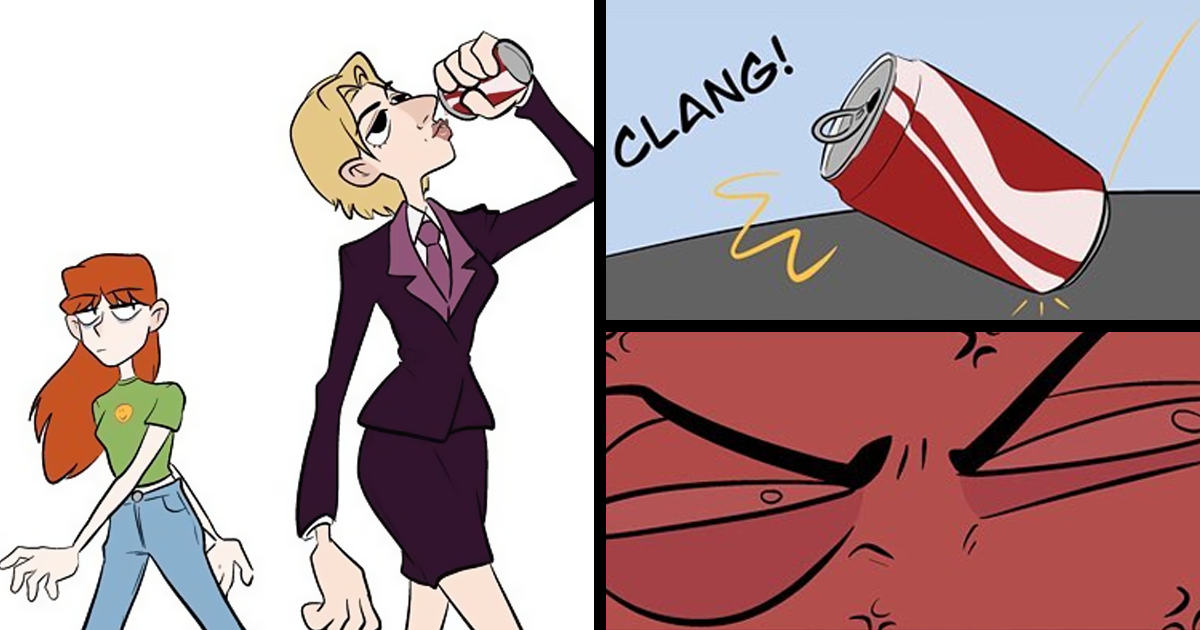
Everyday life is full of dramatic moments. Unfortunately, most of them involve missing socks, empty snack packages, awkward conversations, stubborn pets, and the sudden realization that tomorrow is Monday. French comic artist Ariane, better known online as ari_stocrate, understands this miniature chaos perfectly. Instead of searching for epic adventures, she turns ordinary problems into hilarious comics that feel suspiciously familiar.
Her illustrated world includes relationship misunderstandings, questionable personal decisions, vegan life, procrastination, social awkwardness, and a cat who appears to operate under his own legal system. The drawings are simple, the punchlines arrive quickly, and the situations often make readers think, “Wait, has this artist been watching me?”
Meet the Artist Behind the Relatable Comics
Ariane is a French webcomic artist based in Paris. In an earlier profile, she explained that she had drawn since childhood, experimented with comics during high school, and became more serious about the format after discovering digital illustration. Her online identity, ari_stocrate, became associated with minimalist comics inspired by real-life inconveniences, relationships, pets, food, and the strange logic of adulthood. Her current WEBTOON profile also describes her as a Paris-based artist living with a sphynx cat and two lizards.
When asked about her creative inspiration, Ariane offered a wonderfully unserious explanation before admitting that many ideas come from real life. She has also named Garfield as an important influence. That connection makes sense: both comic worlds understand that food, laziness, irritation, and judgmental cats are more than subjects. They are an entire artistic philosophy.
Her cat Jasper became one of the recurring personalities in the comics. Rather than portraying him as an ordinary household pet, Ariane humorously described him as an exiled, dangerously powerful creature from another planet. It is exactly the kind of explanation a cat would approvegrand, mysterious, and completely free of accountability.
Why These 30 Hilarious Comics Feel So Familiar
The appeal of Ariane’s everyday life comics does not depend on complicated plots. It comes from recognition. Readers see a character making an ambitious plan, losing motivation almost immediately, and then negotiating with herself as though laziness were a highly qualified attorney.
The situations are exaggerated, but the emotions underneath them are real. We have all experienced the confidence of making a healthy grocery list and the betrayal of remembering that cookies exist. We have all planned a productive evening, opened our phones “for one minute,” and somehow emerged two hours later with extensive knowledge about an animal we had never previously considered.
Small Problems Become Major Events
In real life, many daily problems are too minor to justify a dramatic reaction. That does not stop us from having one. A dropped piece of food can feel like a national emergency. A slow internet connection becomes a personal attack. Hearing the alarm clock can inspire all five stages of grief before breakfast.
Ariane’s comics work because they give these tiny struggles the level of emotional importance they appear to have in the moment. The character’s facial expressions and body language transform an ordinary inconvenience into a heroic battle against the universe.
Relationships Provide Endless Comic Material
Romantic relationships are built on love, trust, communication, and asking the other person where they want to eat until both people lose the will to continue. The relationship humor in ari_stocrate comics highlights the affectionate absurdity of sharing daily life with another human.
There are differences in habits, conflicting expectations, playful arguments, and moments when one partner clearly wants attention while pretending not to want attention. These scenes do not present relationships as perfect. They present them as warm, strange, occasionally irritating, and deeply human.
That imperfection makes the humor inviting rather than cynical. The joke is rarely that affection has failed. The joke is that affection must survive blankets being stolen, snacks being eaten, and someone saying, “I’m fine,” in a tone that has never once meant fine.
Cat Logic Makes Human Logic Look Optional
Living with a cat means accepting that the household contains a tiny roommate who pays no rent, ignores instructions, and regularly sits on the exact object you need. Jasper’s presence gives Ariane a source of comedy that can interrupt any situation without warning.
Cats are especially effective comic characters because their behavior already feels like a punchline. They demand access to a room and immediately want to leave it. They reject an expensive bed and sleep inside the delivery box. They ask for food while standing beside food. Then they stare at their humans as though the disappointing service will be mentioned in a formal review.
Pet-inspired comics often connect strongly with readers because specific animal behavior can feel surprisingly universal. Other cartoonists have similarly described hearing from readers who recognize their own cats in illustrated mischief, suggesting that pets create a shared comic language among people who have accepted that their homes no longer fully belong to them.
The Art of Making Simple Comics Funny
Ariane’s visual style is intentionally minimal. Characters, expressions, speech bubbles, and essential props carry the joke without forcing the reader to study a heavily detailed scene. The simplicity is not evidence that less thought went into the comic. It is evidence that the artist understands timing.
In comedy, every unnecessary element can become a speed bump. A short comic needs to establish the situation, create an expectation, and deliver a surprise before the reader’s attention wanders away to check a notification. Clean layouts help the eye move through those steps naturally.
Ariane has argued that comic-strip creators do not need highly realistic artwork because the joke is the central ingredient. She has also warned that excessive changes in angles, poses, and visual details can damage comic timing. Her approach treats simplicity as a storytelling decision rather than a limitation.
Facial Expressions Carry the Punchline
Many relatable comics depend on the difference between what a character says and what the character’s face reveals. A calm sentence paired with exhausted eyes can communicate an entire week of frustration. A confident smile followed by immediate panic creates a joke before the dialogue is even finished.
Minimalist cartooning allows these expressions to dominate the panel. Raised eyebrows, blank stares, dramatic tears, and tiny signs of disappointment become visual shortcuts. Readers understand them instantly because the emotions are familiar even when the character design is highly stylized.
The Final Panel Changes Everything
A strong webcomic often leads readers toward one conclusion and then turns sharply in the last panel. The setup may appear sweet, logical, or motivational. The ending reveals selfishness, laziness, feline sabotage, or another wonderfully imperfect reality.
This structure rewards fast reading while encouraging sharing. The reader does not need extensive background information. Within seconds, the comic creates a complete experience: recognition, anticipation, surprise, and laughter.
30 Everyday Experiences That Make the Comics Relatable
Rather than relying on one narrow subject, the collection reflects a broad range of ordinary experiences. Across Ariane’s comic world, readers can recognize variations of the following familiar struggles:
- Planning to be productive and immediately becoming tired from the planning.
- Opening the refrigerator repeatedly as though new food might appear through persistence.
- Trying to eat responsibly while snacks conduct an aggressive advertising campaign.
- Sharing food with a partner after clearly stating that no sharing would occur.
- Getting comfortable in bed moments before remembering an unfinished task.
- Negotiating with an alarm clock that refuses to respect emotional boundaries.
- Attempting to exercise and treating the warm-up as a significant achievement.
- Going outside confidently before questioning every clothing choice.
- Replaying an awkward conversation long after everyone else has forgotten it.
- Receiving a short message and analyzing it like evidence in a criminal investigation.
- Trying to appear calm while the imagination creates twelve unlikely disasters.
- Making weekend plans and later resenting the person who made them.
- Wanting attention but refusing to request it in a recognizable way.
- Starting an argument confidently and discovering the other person has facts.
- Stealing blankets while insisting that blanket ownership is a complicated issue.
- Watching one episode and accidentally completing an entire season.
- Checking social media briefly and losing a measurable portion of the day.
- Taking a flattering photograph after producing many images that appear medically concerning.
- Expecting a peaceful meal while a cat begins a supervised inspection.
- Buying a pet toy only to watch the pet choose the packaging.
- Trying to work from home with an animal sitting on the keyboard.
- Calling a cat’s name and receiving a look of administrative disapproval.
- Cleaning a room by moving the mess into a different room.
- Buying something unnecessary because it was technically discounted.
- Preparing for adulthood and discovering that adulthood has no preparation manual.
- Attempting self-care and turning it into another task to complete perfectly.
- Feeling socially energetic until another person attempts to start a conversation.
- Cooking an ambitious meal and creating an ambitious pile of dishes.
- Promising to sleep early before developing urgent midnight curiosity.
- Laughing at personal problems because crying requires more organization.
These experiences are not necessarily identical to individual panels in the collection. They capture the broader territory in which relatable everyday comics operate: the gap between our plans and our behavior, between our public confidence and private confusion, and between what pets are supposed to do and whatever they have decided to do instead.
Why Relatable Webcomics Thrive Online
Webcomics are designed for the way people now consume visual stories. A few panels can be read on a phone during a commute, a lunch break, or a five-minute rest that mysteriously becomes a forty-minute rest. The format is quick enough for casual readers but expressive enough to build recognizable characters and a consistent creative identity.
The Library of Congress has treated born-digital comics as meaningful records of online culture, noting that webcomics can preserve viewpoints and creators historically underrepresented in mainstream publishing. Its webcomics archive also recognizes that digital strips document contemporary experiences, including work, relationships, technology, and changing social habits.
Relatability is particularly powerful on social platforms. Readers can tag friends, share a comic with a partner, or send it to someone without additional explanation. The comic itself says, “This is us.” Nathan Pyle’s success with Strange Planet, for example, demonstrated how reframing ordinary human behavior through simple characters could attract a large online audience. The details differ, but the underlying mechanism is similar: familiar life becomes funnier when an artist presents it from a slightly altered perspective.
Humor Turns Frustration Into Connection
One reason funny everyday comics are comforting is that they transform private embarrassment into a shared experience. Procrastination may feel like a personal failure until a comic shows thousands of readers recognizing the same habit. The problem has not disappeared, but it suddenly feels less lonely.
Cartoonist Adrian Tomine has described being drawn to the contradiction of finding humor in painful or uncomfortable moments. That principle helps explain why comics about awkwardness, anxiety, failed plans, and domestic chaos can feel reassuring rather than negative. The artist does not deny the problem. She changes the angle from which it is viewed.
Research has also associated spontaneous laughter and adaptive humor with reduced stress responses and more positive emotional states. A funny comic is not a replacement for professional support or practical action, but a moment of laughter may offer breathing room when the day feels unnecessarily dramatic.
What Emerging Comic Artists Can Learn From Ariane
Start With What You Know
A creator does not need an extraordinary lifestyle to produce entertaining work. Ordinary routines contain hundreds of possible stories: preparing food, commuting, dating, caring for animals, working, exercising, shopping, and trying to sleep while remembering something embarrassing from 2014.
The secret is observation. A useful comic idea often begins when the artist notices a mismatch between intention and reality. “I will wake up early” becomes funny when placed beside what actually happens. “My cat loves me” becomes funnier when the evidence suggests the cat mainly loves access to warm furniture.
Remove Anything That Slows the Joke
Details should support the story rather than compete with it. New artists sometimes believe that every panel must demonstrate their full technical ability. However, a joke may work better with one clear expression, one necessary prop, and one carefully placed line of dialogue.
This does not mean all comics must look simple. It means the chosen style should serve the emotional rhythm. Ariane’s minimalist digital artwork succeeds because it lets readers move directly toward the reaction or twist.
Build Characters From Consistent Behavior
Readers return when they understand how characters tend to react. The central character may overthink, procrastinate, crave food, or become dramatically overwhelmed. The boyfriend may respond with affection or confusion. Jasper may behave like a furry authority figure whose jurisdiction includes every surface in the apartment.
Consistency creates familiarity, while variation prevents repetition. The same personality can face a new problem in every strip. Over time, readers feel that they know the cast, even when each comic lasts only a few panels.
Reader and Creator Experiences With Everyday-Life Comics
Reading a relatable comic often begins with a tiny moment of surprise. The first panel appears ordinary: someone is making dinner, resting on a couch, talking to a partner, or attempting to complete a basic task. Then the situation develops in exactly the unreasonable way real life tends to develop. By the final panel, the reader is laughing not only at the character but also at the uncomfortable accuracy of the observation.
That sense of recognition changes the reading experience. A comic about forgetting why you entered a room is amusing on its own. It becomes more satisfying when you remember doing the same thing ten minutes earlier. The laughter contains relief: apparently, this strange behavior is not unique, and other people are also wandering through their homes with no idea what they intended to retrieve.
Sharing the comic creates another layer of experience. A reader may send a relationship strip to a partner with no message except an accusing emoji. A cat comic may be forwarded to everyone who has witnessed a pet knock an object from a table while maintaining direct eye contact. In those moments, the comic becomes social shorthand. It communicates an entire memory or personality trait without requiring a long explanation.
Creating everyday-life comics requires a different kind of attention. The artist must notice experiences that most people dismiss immediately. A ruined meal, strange text exchange, failed workout, or pet interruption becomes raw material. The creator mentally steps outside the irritation and asks, “What is the funniest version of this?”
That process can change how ordinary problems feel. Missing a train is still inconvenient, but it may also contain a perfect facial expression, an absurd internal monologue, or an unexpected final panel. The artist begins collecting tiny failures instead of treating all of them as wasted moments. Life remains messy, but the mess now has creative value.
The challenge is deciding how much reality to keep. A real conversation may involve ten minutes of hesitation and unnecessary context. A successful comic might reduce it to three lines. The emotional truth remains, while everything that delays the punchline disappears. This editing process explains why an apparently simple strip can require careful work.
Creators must also accept that personal humor will not connect with every reader. One person may laugh loudly; another may stare at the panel as though it contains advanced mathematics. Ariane’s perspective on minimalist comics offers a helpful reminder: the creator’s job is not to prove technical sophistication in every frame. The job is to communicate the joke clearly to the audience most likely to appreciate it.
For readers, the result is a compact break from an overcomplicated day. For artists, it is a way of organizing chaos into setup and punchline. For cats, it is further evidence that humans will document almost anything instead of filling the food bowl.
Conclusion: Ordinary Life Is Funnier Than It Looks
Ariane’s ari_stocrate comics demonstrate that artists do not need superheroes, distant planets, or enormous adventures to tell engaging stories. A Paris apartment, a relationship, a digital drawing tablet, a few inconvenient habits, and one highly opinionated cat can provide more than enough material.
The humor succeeds because it is specific but recognizable. Readers may not share every detail of Ariane’s life, yet they understand procrastination, awkwardness, cravings, misunderstandings, failed plans, and animal-related chaos. Her minimalist visual approach keeps the focus on timing, emotion, and the sudden twist that turns a normal situation into a memorable joke.
These 30 hilarious comics remind us that everyday problems do not always need a profound solution. Occasionally, they need a speech bubble, an exaggerated expression, and a final panel that confirms everyone else is improvising adulthood too.