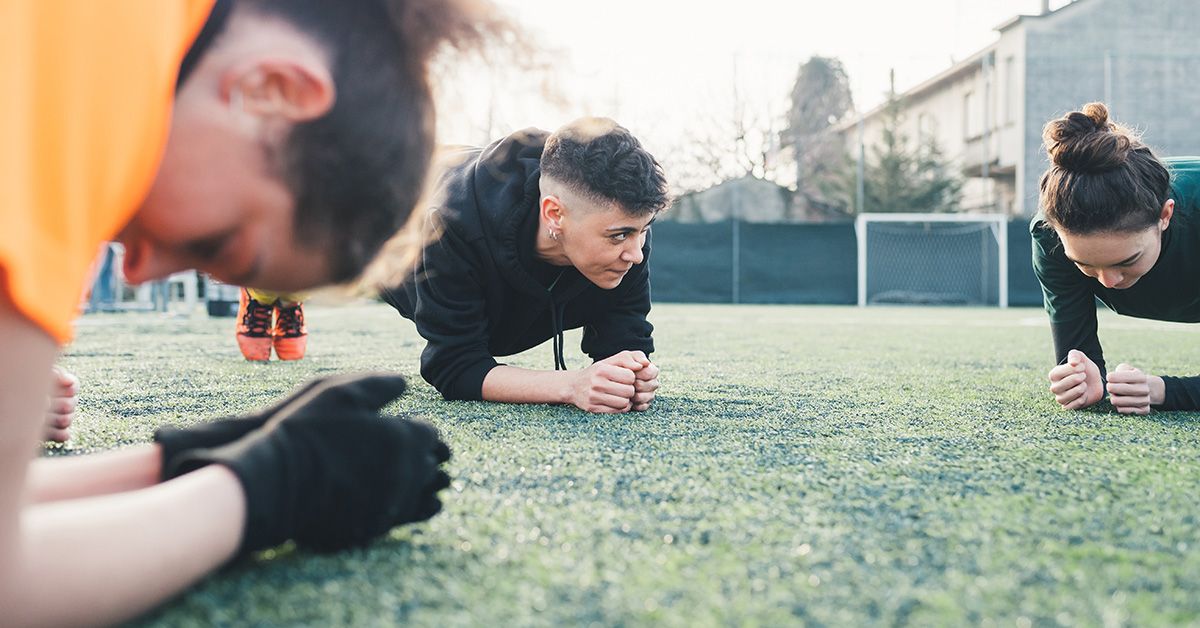
A strong core is useful for far more than convincing your bathroom mirror that you have been doing crunches. Your core helps stabilize your spine, transfer force between your upper and lower body, maintain balance, support posture, and make ordinary movements such as carrying groceries, climbing stairs, bending, reaching, running, and lifting feel more controlled.
And despite what decades of late-night fitness commercials may have suggested, the core is not simply the six-pack area. It includes muscles around your abdomen, lower back, pelvis, hips, sides, and buttocks. These muscles work together to stabilize your trunk while your arms and legs move. Major medical and fitness organizations therefore treat core training as an important part of a balanced strength program rather than a cosmetic side quest.
The good news is that effective core exercises exist for practically every fitness level. You can begin with a wall plank and basic bridge, progress to bird dogs and dead bugs, and eventually tackle loaded carries, advanced planks, rollouts, and other demanding movements. No circus tricks required.
What Does Your Core Actually Include?
When people hear the word core, they often immediately think of the rectus abdoministhe muscles that can create the familiar six-pack appearance. Those muscles matter, but they are only part of the story.
Your core also involves the transverse abdominis, internal and external obliques, spinal stabilizers, lower-back muscles, pelvic muscles, diaphragm, hip musculature, and glutes. Collectively, these tissues create a central support system connecting the upper and lower body.
Think of your core as the sturdy center of a suspension bridge. If the middle section is wobbling around like gelatin, generating efficient movement at either end becomes considerably harder.
Why Core Strength Matters
Better Stability and Balance
Core muscles help keep the trunk stable as your body changes position. That matters when you walk over uneven ground, carry something heavy, play sports, or simply recover after accidentally stepping on a child’s toy at 6:30 in the morning.
Core strengthening may contribute to better balance and steadier movement, and balance work becomes increasingly important with age. Federal physical activity guidance also recommends regular muscle-strengthening activity for adults, while older adults benefit from exercises that specifically challenge balance.
More Efficient Everyday Movement
A stable trunk provides a foundation for movement in your arms and legs. Tasks such as lifting a suitcase, standing from a chair, gardening, swinging a racket, or carrying a toddler all involve the core even though nobody announces, “Attention, transverse abdominis activation commencing now.”
Strengthening your middle can improve your ability to control these movements and may make physical activities feel easier and more coordinated.
Support for the Spine
Muscles around the abdomen and back help stabilize the spine. Core strengthening is commonly included in exercise and rehabilitation programs designed to improve back function, although the correct exercise depends on the individual and the cause of any existing symptoms.
If you have significant back pain, recent surgery, osteoporosis, a neurological condition, or another medical concern, talk with a healthcare professional or physical therapist before starting unfamiliar exercises. Exercise should challenge you, not generate mysterious electrical sensations down your leg.
How to Engage Your Core Correctly
Core engagement does not mean sucking your stomach inward until breathing becomes a luxury. Instead, imagine gently tightening your midsection as though someone were about to poke you in the stomach.
You should still be able to breathe. Mayo Clinic specifically recommends breathing freely during core-strengthening exercises while maintaining abdominal control.
During most exercises:
- Keep your spine in a comfortable, controlled position.
- Brace the abdominal muscles without holding your breath.
- Move slowly enough to maintain control.
- Stop the set when your technique deteriorates.
- Progress gradually rather than jumping immediately to the hardest variation.
Beginner Core Exercises
Beginners should prioritize control, breathing, and basic stability. The goal is not to leave the first workout crawling toward the refrigerator.
1. Wall or Counter Plank
Stand facing a wall or sturdy counter. Place your hands or forearms on the surface and step your feet backward. Keep your body in a straight line from head to heels while gently bracing your abdomen.
Try: 15 to 30 seconds for 2 to 3 rounds.
This elevated variation reduces the difficulty of a traditional plank and can be useful for people who are not ready for floor-based core exercises. Harvard Health similarly recommends elevated plank variations as accessible starting points.
2. Glute Bridge
Lie on your back with your knees bent and feet flat. Brace your core, squeeze your glutes, and raise your hips until your torso and thighs form a comfortable line. Avoid aggressively arching your lower back.
Try: 8 to 12 repetitions for 2 sets.
Bridges train the glutes and muscles around the pelvis while requiring trunk stability. They are frequently included in core and rehabilitation programs.
3. Heel Slides
Lie on your back with your knees bent. Brace your abdomen and slowly slide one heel away from your body without allowing your lower back or pelvis to shift excessively. Return and switch sides.
Try: 6 to 10 repetitions per side.
4. Chair Stand
Sit near the front of a sturdy chair. Keep your feet planted, brace your trunk, stand up under control, and slowly sit back down.
Try: 8 to 12 repetitions.
Although usually considered a lower-body exercise, standing from a chair requires trunk stabilization and is especially practical for people who prefer not to exercise on the floor. Functional strengthening exercises such as chair stands are also encouraged in guidance for older adults.
Intermediate Core Exercises
Once basic exercises feel controlled, increase the challenge by moving your limbs while asking your trunk to remain stable.
5. Bird Dog
Start on your hands and knees. Brace your core, extend one arm forward and the opposite leg backward, pause briefly, and return. Switch sides.
Avoid rotating your hips or dramatically arching your back. Imagine balancing a glass of water on your lower backpreferably an imaginary glass, unless you enjoy mopping.
Try: 6 to 10 repetitions per side.
Bird dogs appear in core-training recommendations from major fitness and orthopedic resources because they challenge coordinated trunk stability while the arms and legs move.
6. Dead Bug
Lie on your back with your arms pointing toward the ceiling and your hips and knees bent roughly 90 degrees. Brace your abdomen. Slowly lower one arm and the opposite leg while keeping your trunk controlled, then return to the starting position and alternate.
Try: 6 to 10 repetitions per side.
The dead bug is particularly useful because the challenge comes from preventing unwanted movement rather than performing dozens of fast spinal bends. Both Cleveland Clinic and HSS include dead-bug variations among useful core exercises.
7. Forearm Plank
Place your forearms on the floor with your elbows below your shoulders. Extend your legs and brace your abdomen and glutes so your body remains reasonably straight.
Try: 15 to 30 seconds for 2 to 3 rounds.
If your hips begin sinking or your lower back feels increasingly compressed, end the set. A clean 20-second plank beats a heroic 90-second plank that slowly transforms into modern sculpture.
8. Side Plank
Lie on one side and support your upper body on your forearm. Lift your hips while keeping your torso aligned. Beginners can keep the lower knee on the ground before progressing to straight legs.
Try: 10 to 30 seconds per side.
Side planks emphasize lateral trunk stability and are useful complements to front planks.
Advanced Core Exercises
Advanced does not mean “perform something terrifying because a stranger on social media did it.” It means adding resistance, leverage, instability, or movement while preserving excellent control.
9. Suitcase Carry
Hold a moderately heavy dumbbell or kettlebell in one hand. Stand tall and walk without leaning toward or away from the weight.
Try: 30 to 60 seconds per side for 2 to 3 rounds.
The uneven load forces your trunk to resist side bending, making suitcase carries an excellent example of functional core training. Loaded carries are also recommended by Harvard Health as a way to challenge core stability during movement.
10. Plank Shoulder Tap
Begin in a high plank. Without allowing your hips to swing dramatically, lift one hand and touch the opposite shoulder. Alternate sides.
Try: 6 to 12 controlled repetitions per side.
11. Pallof Press
Stand sideways to an anchored resistance band or cable. Hold the handle near your chest, brace your trunk, and press your hands straight forward while resisting the band’s attempt to rotate your body.
Try: 8 to 12 repetitions per side.
This style of anti-rotation training teaches the core to resist unwanted movement, which is often more relevant to real-world stability than simply producing repeated twisting motions.
12. Ab Wheel or Stability-Ball Rollout
From a kneeling position, brace your abdomen and slowly extend your arms forward using an ab wheel, suspension trainer, stability ball, or similar setup. Move only as far as you can while maintaining trunk control, then return.
Try: 5 to 10 controlled repetitions.
Rollout-style exercises substantially increase the leverage placed on the trunk and should be earned through easier progressions first. HSS includes rollout variations among more challenging anterior-chain exercises.
A Simple Core Workout for Each Fitness Level
Beginner Routine
- Wall plank: 2 x 20 seconds
- Glute bridge: 2 x 10
- Heel slide: 2 x 8 per side
- Chair stand: 2 x 8
Intermediate Routine
- Dead bug: 3 x 8 per side
- Bird dog: 3 x 8 per side
- Forearm plank: 3 x 20 to 40 seconds
- Side plank: 2 x 20 seconds per side
Advanced Routine
- Plank shoulder tap: 3 x 10 per side
- Pallof press: 3 x 10 per side
- Suitcase carry: 3 x 40 seconds per side
- Rollout: 3 x 6 to 10
Two or three dedicated core sessions per week can fit comfortably into a broader resistance-training plan. You can also add a couple of core movements to the end of regular strength workouts. Current U.S. physical activity recommendations call for muscle-strengthening activity involving all major muscle groups at least two days per week.
How to Progress Without Making Your Core Hate You
Progressive overload applies to core training just as it does to squats, presses, and rows. But adding difficulty does not always require heavier weights.
You can progress by:
- Adding a few repetitions.
- Holding an isometric exercise slightly longer.
- Increasing resistance.
- Using a longer lever position.
- Moving more slowly.
- Reducing external support.
- Progressing from two-sided to one-sided loading.
- Performing controlled movement while keeping the trunk stable.
Increase one variable at a time whenever possible. If you simultaneously double the resistance, triple the repetitions, remove a support point, and decide to train on a wobble board, you have not created progressive overload. You have created an audition for an orthopedic appointment.
Common Core-Training Mistakes
Doing Only Crunches
Crunches can train abdominal muscles, but a complete core program should also challenge stability, side-to-side control, hip and pelvic function, and the muscles supporting the spine.
Holding Your Breath
Unless a specific lifting technique calls for specialized breath control, most general core exercises should allow normal breathing. If your face gradually resembles a tomato during a basic plank, reconsider your strategy.
Chasing Long Plank Times
Once technique deteriorates, continuing the stopwatch contest provides diminishing value. Increase the challenge of the exercise instead of simply extending a sloppy hold indefinitely.
Moving Too Fast
Momentum can disguise weak control. Slow dead bugs, bird dogs, carries, and plank variations often reveal far more about core stability than racing through repetitions.
Ignoring Pain
Normal muscular effort, fatigue, or mild post-workout soreness is different from sharp pain, numbness, tingling, weakness, or pain radiating into an arm or leg. Persistent or severe symptoms warrant professional evaluation.
Real-World Experiences With Core Training: What People Commonly Learn
One of the most interesting things about core training is how different the experience can be from what beginners expect. Many people begin with a simple objective: flatten the stomach, build visible abs, or survive a plank longer than their workout partner. After several weeks, however, the benefits they notice first are often surprisingly practical.
A common beginner experience is realizing how difficult slow exercises can be. Someone who can perform 30 quick crunches may struggle with six carefully controlled dead bugs per side. That initially feels confusing. The exercise looks easier, yet the abdominal muscles suddenly have very strong opinions about the situation.
The reason is control. During a dead bug or bird dog, the goal is not merely to move an arm or leg. The challenge is keeping the trunk and pelvis stable while that movement occurs. Once beginners stop rushing and concentrate on maintaining position, they often discover that fewer repetitions create a much more meaningful challenge.
Another frequent lesson is that longer is not automatically better. Consider someone who begins by holding a plank for 20 seconds. Within several weeks, that person reaches 60 seconds. Instead of pushing toward two, three, or five minutes, it can be more productive to introduce a harder variationa longer-lever plank, shoulder tap, loaded carry, or appropriately programmed rollout. Progress becomes about improving strength and control rather than collecting stopwatch trophies.
People who spend much of their day sitting often notice another practical change: they become more aware of posture and trunk position during everyday movements. They may naturally brace before picking up a heavy grocery bag or realize they have been twisting awkwardly when moving boxes. Core exercises do not magically guarantee perfect posture or prevent every injury, but practicing controlled movement can improve body awareness.
Older exercisers may have an entirely different experience. Getting onto the floor can sometimes be more challenging than the exercise itself. That does not mean effective core training is unavailable. Counter planks, chair stands, standing marches, carries, and other upright exercises can challenge trunk stability without repeatedly transitioning between the floor and standing. Guidance from Harvard Health and the National Institute on Aging supports adapting exercise to ability rather than assuming everybody must perform the same movements.
Intermediate gym-goers often experience another revelation: their core is already working during exercises they never considered “ab exercises.” Squats, deadlifts, loaded carries, rows, overhead presses, push-ups, and unilateral exercises all require the trunk to stabilize against external forces. Dedicated core training can complement these movements rather than replace them.
A practical training week might therefore look surprisingly uncomplicated. On Monday, someone performs dead bugs and side planks after a full-body workout. On Wednesday, suitcase carries finish a session. On Saturday, bird dogs and Pallof presses provide another small dose of stability training. Total dedicated core time might be only 20 to 30 minutes across the entire week.
Consistency is usually more valuable than turning one Saturday morning into the Olympic Games of Abdominal Suffering. A handful of well-chosen exercises performed regularly, with progressively better control, can produce far more useful results than constantly switching to whatever exercise happens to be trending online.
The most sustainable experience is also the least glamorous: start at the level you can control, practice patiently, and progress when the current version becomes genuinely easy. Your core does not know whether an exercise looked impressive on social media. It only knows how much force it had to manage.
Final Thoughts
The best core exercises for all fitness levels share one feature: they can be scaled to match the person performing them. Beginners can develop control with elevated planks, bridges, heel slides, and chair stands. Intermediate exercisers can progress to bird dogs, dead bugs, side planks, and full planks. Advanced trainees can introduce unilateral loading, anti-rotation work, dynamic plank variations, and rollouts.
There is no single magical core exercise, and you do not need a 45-minute abdominal demolition session every day. Train the core from multiple directions, prioritize clean technique, breathe normally, and make gradual progress. A stronger midsection should help you move through life betternot merely make getting out of bed the morning after “ab day” an adventure.
Note: This article provides general fitness information and is not a substitute for individualized medical or physical therapy advice. People with significant pain, recent injuries or surgery, osteoporosis, pregnancy-related concerns, chronic medical conditions, or movement limitations should consult an appropriate healthcare professional before beginning a new exercise program.