Unrequited sitcom romances are television’s emotional equivalent of slipping on a banana peel while holding flowers. They are awkward, ridiculous, sometimes painfully sincere, and often funnier than the “real” love stories happening around them. While many sitcom couples get candlelit confessions, dramatic airport chases, and season-finale kisses, the one-sided crush usually gets a weird pause, a rejected invitation, and a laugh track that sounds suspiciously like public humiliation.
Still, the best unrequited sitcom romances are not just throwaway jokes. They reveal character. They create tension without turning the show into a soap opera. They give writers a reliable comedy engine: one person wants romance, the other person wants literally anything else. A sandwich. A new desk. A safe exit. Anything.
From office crushes to school hallway heartbreak, these five hilariously unrequited sitcom romances became unforgettable because they mixed embarrassment, hope, denial, and comic timing into something viewers could recognize. Most of us have not declared love in a police precinct or sprinted away after touching a coworker’s knee, but emotionally? We have been there. Maybe not the knee-touching part. Hopefully not.
Why Unrequited Sitcom Romances Are So Funny
Comedy loves imbalance. In a mutual romance, both characters move toward each other. In an unrequited romance, one character is building a castle in the clouds while the other is looking for the emergency exit. That gap creates the joke. The larger the gap between fantasy and reality, the bigger the laugh.
These storylines also work because sitcoms thrive on repetition. A recurring crush gives viewers a pattern to enjoy: the hopeful look, the overconfident plan, the rejection, the recovery, and thenbecause sitcom characters have the emotional memory of a goldfish with a dreamthe next attempt. But the best shows know when to add warmth. They let the rejected character be silly without making them completely cruel, and they let the uninterested character say no without turning into a villain.
That balance is why the following five examples remain so memorable. They are funny because they are uncomfortable, but they last because they say something true about wanting someone who does not want you back.
1. Steve Urkel and Laura Winslow Family Matters
The patron saint of “Did I do that?” romance
No list of hilariously unrequited sitcom romances can ignore Steve Urkel and Laura Winslow. Steve was not just crushing on Laura; he treated the crush like a full-time job with benefits, overtime, and probably a company newsletter. From the moment Jaleel White’s high-waisted, suspender-powered nerd became the breakout star of Family Matters, his adoration for Laura became one of the show’s central comic engines.
Laura, played by Kellie Shanygne Williams, spent much of the series reacting to Steve’s affection with a mixture of annoyance, exhaustion, and the facial expression of someone who has just heard a smoke alarm start singing opera. Steve brought grand gestures, scientific experiments, and endless devotion. Laura brought boundaries, side-eye, and a strong desire for Steve to stand several feet farther away.
What made the Steve-and-Laura dynamic funny was not simply that Steve was rejected. It was that Steve approached rejection with Olympic-level resilience. A normal person might hear “no” and take a walk. Steve heard “no” and apparently thought, “Excellent, we are still communicating.” His confidence was strange because it lived right next door to total social disaster. He could build inventions, solve problems, and outsmart adults, yet still fail to notice when Laura’s patience was packing a suitcase.
Of course, this romance has a twist: Laura eventually developed feelings for Steve in the final season. That ending means their relationship is not permanently unrequited. However, for most of the show’s run, Steve’s devotion was one-sided enough to qualify for its own zip code. The long delay is exactly why the early years remain so iconic. Viewers remember the chase, the squeaky voice, the clumsy entrances, and the sense that Steve’s heart was somehow louder than his accordion.
From an SEO-friendly sitcom history perspective, Steve and Laura represent the classic “persistent nerd loves popular girl” trope. Modern audiences may view that trope more critically, especially when persistence crosses into pressure. But the best reading of Steve is that his comedy came from emotional exaggeration. He was not just a boy with a crush; he was a walking cartoon of adolescent longing, complete with catchphrases, suspenders, and the confidence of a tiny romantic tank.
2. Screech Powers and Lisa Turtle Saved by the Bell
Bayside High’s most fashionable rejection machine
If Steve Urkel brought scientific intensity to one-sided love, Screech Powers brought chaotic hallway energy. On Saved by the Bell, Screech’s long-running crush on Lisa Turtle became one of the show’s most familiar teen-sitcom gags. He adored her. She did not return the feeling. In fact, Lisa often responded as if romance with Screech were a pop quiz she had not studied for and absolutely refused to take.
Lisa, played by Lark Voorhies, was stylish, confident, and socially sharp. Screech, played by Dustin Diamond, was goofy, enthusiastic, and usually operating on a frequency only dolphins and sitcom sidekicks could hear. Their mismatch was the joke. Lisa wanted fashion, popularity, and sophistication. Screech wanted Lisa, and possibly a little applause for wanting Lisa so consistently.
The humor came from contrast. Screech did not flirt like a smooth operator; he flirted like a science fair project that had gained feelings. Lisa’s rejections were often quick, cutting, and delivered with the precision of someone who had been dealing with this nonsense since homeroom. In a softer show, his crush might have been sweet. In Saved by the Bell, it became a running gag powered by adolescent awkwardness and neon-colored confidence.
What makes this unrequited sitcom romance especially interesting today is how it reflects the style of late-1980s and early-1990s teen comedy. The “geek chases glamorous girl” setup was treated as harmless fun, even when the repeated pursuit could be uncomfortable by modern standards. Looking back, the storyline is funniest when viewed as heightened sitcom absurdity rather than a dating manual. Please do not use Bayside High as a relationship coaching institute. Mr. Belding had enough to deal with.
Still, Screech and Lisa remain memorable because the dynamic was instantly clear. No complicated backstory was needed. One look at Screech’s hopeful expression and Lisa’s “absolutely not” energy told the audience everything. It was young love, except only one person had signed the paperwork.
3. Toby Flenderson and Pam Beesly The Office
The quietest crush in Scranton became the loudest awkward moment
Some unrequited sitcom romances are loud. Toby Flenderson’s crush on Pam Beesly was not. It was quiet, sad, and folded into the beige carpet of Dunder Mifflin like an HR memo nobody wanted to read. That is exactly what made it so funny.
On The Office, Toby was already the human embodiment of a sigh. As the HR representative, he was disliked by Michael Scott, ignored by many coworkers, and generally treated like a damp cardigan with paperwork. His affection for Pam added another layer of melancholy to his character. Pam was kind to him, which in Toby’s emotional economy may have counted as fireworks, a string quartet, and a destination wedding.
The most infamous Toby-and-Pam moment happens in the Season 4 episode “Night Out.” During an awkward conversation with Jim and Pam, Toby places his hand on Pam’s knee. The room freezes. Toby realizes what he has done. Instead of calmly apologizing like a functioning adult, he announces that he is moving to Costa Rica and then flees. It is one of the great cringe-comedy exits: not a walk of shame, but a sprint of total spiritual collapse.
What makes Toby’s unrequited crush so effective is how little the show overplays it. He is not chasing Pam through the office with flowers. He is not writing ballads by the copier. He mostly suffers silently, which fits the documentary style of The Office. The camera catches what characters try to hide: glances, hesitations, and tiny emotional disasters. Toby’s feelings are funny because they seem to surprise even Toby. He looks like a man being haunted by his own crush.
The storyline also works because Pam and Jim’s romance is the emotional center of the series. Toby’s longing is never a serious threat; it is a comic shadow beside a much larger love story. Jim is charming, playful, and deeply connected to Pam. Toby is Toby. The comparison is brutal, and the show knows it. Yet there is a strange sympathy in the humor. Toby’s crush is embarrassing, but it is also recognizably human. Sometimes affection grows in silence. Sometimes it escapes through your hand and causes you to relocate internationally.
4. Charles Boyle and Rosa Diaz Brooklyn Nine-Nine
A crush, a rejection, and an unexpectedly healthy friendship
Charles Boyle’s early crush on Rosa Diaz in Brooklyn Nine-Nine could have been a disaster in the wrong sitcom. He is emotional, intense, and prone to saying things that sound like they were marinated overnight in sincerity. Rosa is guarded, intimidating, and allergic to sentimental nonsense. Put them together, and you get one of the funniest mismatches in modern workplace comedy.
In the first season, Charles is clearly smitten with Rosa. He admires her toughness, mystery, and terrifying ability to make silence feel like a weapon. Rosa, played by Stephanie Beatriz, is not interested in him romantically. Not a little. Not secretly. Not “maybe after sweeps week.” She makes her lack of romantic interest clear, and the show earns credit for letting that boundary matter.
Charles, played by Joe Lo Truglio, is funny because his emotions arrive overdressed. He can turn a small compliment into a full banquet of feeling. Around Rosa, that intensity becomes especially absurd. He looks at her like she is a rare art object; she looks back like she is considering whether the precinct has a trapdoor.
But this is also one of the most satisfying entries on the list because Brooklyn Nine-Nine allows Charles to move on. The joke does not depend on him ignoring Rosa forever. Over time, their dynamic becomes a genuine friendship. That evolution matters. It turns a potentially stale one-sided romance into character growth. Charles learns that admiration does not have to become entitlement. Rosa learns that Charles, while deeply weird about food and feelings, can be loyal and trustworthy.
The result is a workplace sitcom romance that becomes funnier in hindsight because it does not trap the characters in the same joke forever. Boyle and Rosa are hilarious as an unrequited crush, but they are even better as friends. The show keeps the comedy while letting both characters keep their dignity. That is rarer than a normal Boyle family recipe.
5. Milhouse Van Houten and Lisa Simpson The Simpsons
Everything’s coming up Milhouseexcept romance
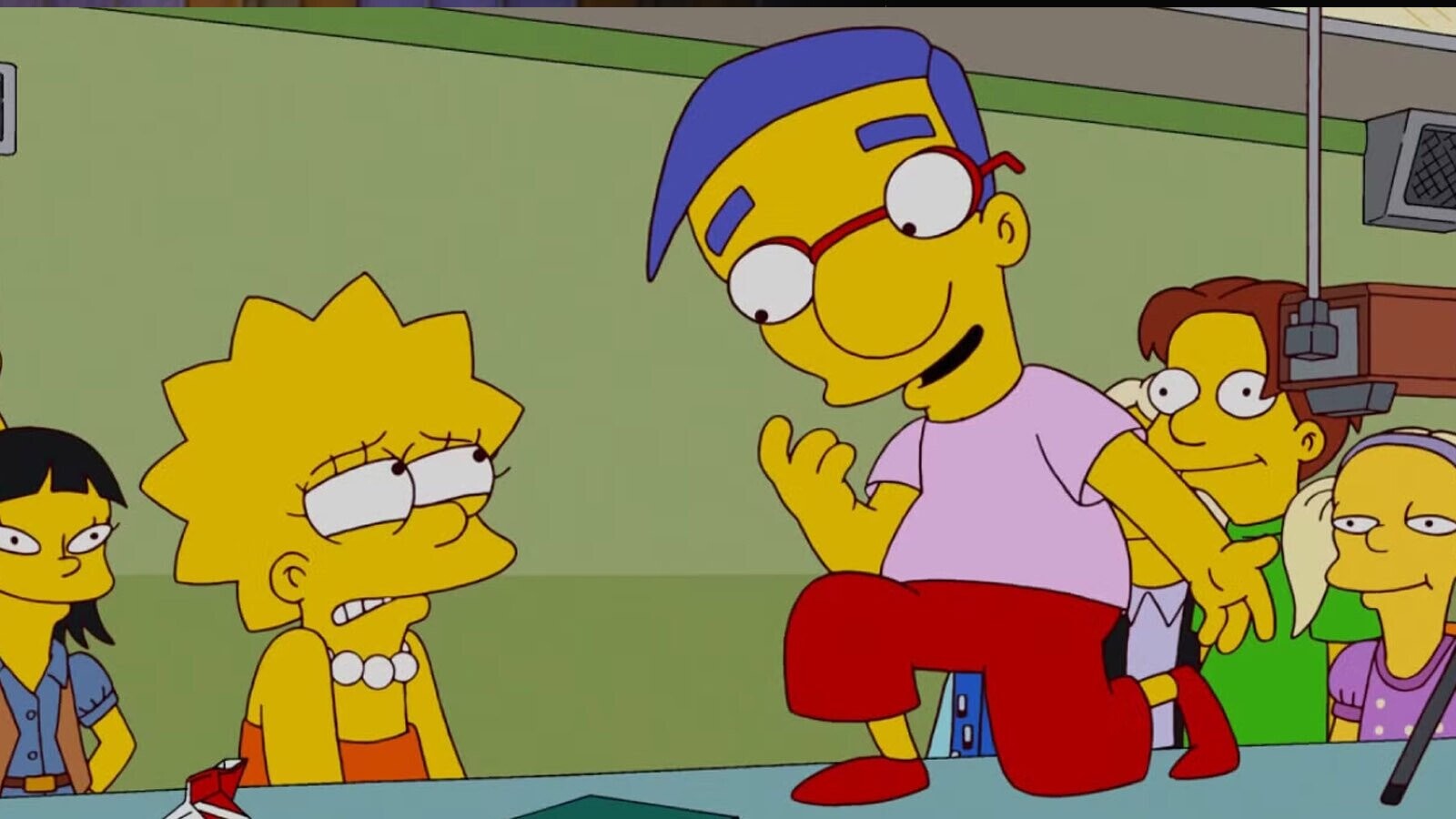
Milhouse Van Houten’s crush on Lisa Simpson is one of the longest-running examples of animated unrequited love. Milhouse has been pining for Lisa across decades of The Simpsons, which is impressive considering he is still somehow a child. Time does not move normally in Springfield, but rejection certainly does.
Milhouse is Bart’s best friend, a nervous blue-haired boy with enormous glasses and the confidence level of a damp napkin. Lisa is intelligent, principled, artistic, and often emotionally older than nearly everyone around her. Milhouse’s affection for her is sincere, but Lisa rarely sees him as a romantic option. She may care about him, but caring is not the same as wanting to split a milkshake under fluorescent cartoon lighting.
The comedy comes from Milhouse’s endless optimism. He is rejected, ignored, and overshadowed, yet he keeps returning with hope. His crush is not suave or strategic. It is pure Milhouse: anxious, dramatic, and somehow both sad and hilarious. When he gets even the smallest hint that Lisa might consider him, his inner fireworks go off like Springfield’s safety regulations have been canceled.
Over the years, The Simpsons has played with possible futures and alternate romantic outcomes for Lisa and Milhouse. Some flash-forward episodes imagine them together, often with a comic bleakness that suggests destiny has a wicked sense of humor. But in the main childhood timeline, their relationship remains mostly one-sided. Milhouse wants romance; Lisa wants self-actualization, social justice, jazz, and probably a quieter lunch period.
What makes Milhouse and Lisa endure is the bittersweet edge beneath the joke. Milhouse is funny because he is hopeless, but he is also relatable because hope is stubborn. He reminds viewers of the part of childhood that believed wanting something badly enough might make it happen. Lisa, meanwhile, reminds viewers that kindness does not require romantic agreement. She can be compassionate without owing him a love story. That is a surprisingly mature lesson from a boy whose greatest victory may still be shouting, “Everything’s coming up Milhouse!”
What These One-Sided Sitcom Crushes Have in Common
These five sitcom romances come from different eras and formats, but they share a few key ingredients. First, each pairing is built on contrast. Steve is chaos; Laura wants normalcy. Screech is goofy devotion; Lisa is polished confidence. Toby is silent yearning; Pam is emotionally elsewhere. Charles is enthusiastic vulnerability; Rosa is armored independence. Milhouse is pure nervous hope; Lisa is thoughtful ambition.
Second, each romance is funnier because the audience knows the truth before the lovestruck character fully accepts it. We can see the rejection coming. We can feel the awkward pause approaching like a slow-moving parade float. That anticipation is half the comedy.
Third, the best examples give both characters a point of view. The rejected person is not just a clown, and the uninterested person is not just cruel. Laura has the right to be annoyed. Lisa Turtle has the right to say no. Pam has the right to be uncomfortable. Rosa has the right to set boundaries. Lisa Simpson has the right to choose her own crushes, even if Milhouse has already mentally planned the wedding, honeymoon, and matching saxophone cases.
Why Viewers Love Hilariously Unrequited Sitcom Romances
Unrequited sitcom romances are popular because they exaggerate an experience nearly everyone understands. Most people have liked someone who did not like them back. Many have misread a smile, overanalyzed a conversation, or turned a tiny moment of kindness into a three-act romantic fantasy. Sitcoms take that private embarrassment and make it public, ridiculous, and safe to laugh at.
There is comfort in watching fictional characters survive romantic rejection. Steve keeps inventing. Screech keeps being Screech. Toby moves to Costa Rica, which is extreme but memorable. Charles becomes a better friend. Milhouse continues Milhousing. Their hearts get dented, but the show goes on. That is the sitcom promise: embarrassment may last for a scene, but next week brings a new episode.
These storylines also let viewers laugh at emotional overconfidence. A crush can make a person believe they are starring in a romance when they are actually a supporting character in someone else’s lunch break. Sitcoms understand that gap. They turn it into timing, reaction shots, and dialogue sharp enough to cut through a school locker.
Experiences and Lessons Related to Five Hilariously Unrequited Sitcom Romances
Watching these five hilariously unrequited sitcom romances can feel like opening a yearbook and discovering that your most embarrassing emotional moments have been professionally lit for television. The details may be exaggerated, but the feelings are familiar. The crush that made you rehearse a casual “hi” for twenty minutes. The text message you rewrote until it looked like a legal document. The time someone was merely polite and your brain responded by designing a future home with excellent natural light.
That is why these sitcom examples work so well as viewing experiences. They remind us that attraction can make smart people behave like malfunctioning appliances. Steve Urkel was a genius, yet Laura could reduce him to a squeaky romantic tornado. Toby worked in human resources, a department theoretically connected to appropriate workplace behavior, yet one awkward knee-touch sent him fleeing toward a new continent. Charles Boyle could solve crimes, but Rosa’s presence turned his emotional volume knob to “wedding toast at a very small restaurant.”
The experience of watching these characters is funny partly because it lets us feel superior. We sit on the couch thinking, “I would never be that obvious.” This is a dangerous thought. Somewhere in our past, there is probably evidence to the contrary. Maybe we did not wear suspenders or confess feelings in a precinct, but we may have laughed too hard at someone’s joke, attended an event for suspiciously strategic reasons, or claimed to be “just in the neighborhood” while standing 42 minutes from home.
These sitcom romances also teach a useful lesson about boundaries. The healthiest examples are the ones where the rejected character eventually accepts reality. Charles and Rosa are the best model here. He has feelings, she does not return them, and the show eventually lets them build a friendship that is not treated as a consolation prize. That matters because real affection should not require someone else to surrender. A “no” is not a plot obstacle; it is information.
At the same time, unrequited crushes are not always foolish. Sometimes they reveal a person’s capacity for hope. Milhouse may be ridiculous, but his optimism is oddly heroic. Toby may be tragic, but his quiet longing gives him depth. Screech may be over-the-top, but his feelings are part of the messy comedy of being young. The key difference is whether the character grows or stays trapped in the same loop.
For viewers, the best takeaway is simple: it is okay to have embarrassing feelings. It is not okay to make those feelings someone else’s problem forever. Laugh at the awkwardness, learn from the rejection, and keep your dignity if possible. And if you ever touch your crush’s knee by accident in front of their partner, maybe do apologize before announcing an international move.
Conclusion: The Comedy of Wanting What You Cannot Have
The best unrequited sitcom romances are not just jokes about rejection. They are tiny comic studies of hope, denial, ego, vulnerability, and timing. Steve and Laura gave viewers the loud, nerdy epic. Screech and Lisa delivered teen-crush chaos. Toby and Pam perfected workplace cringe. Charles and Rosa showed how a one-sided crush can mature into real friendship. Milhouse and Lisa turned childhood longing into an animated institution.
These romances remain memorable because they capture a universal truth: love is not always mutual, graceful, or well-lit. Sometimes it is clumsy. Sometimes it wears suspenders. Sometimes it runs away to Costa Rica. But in sitcoms, even heartbreak can get a punchlineand occasionally, that punchline is the most honest part of the whole story.