Celebrity scandals are cultural junk food. We know the outrage cycle is not especially nutritious, yet the moment a famous person wears the wrong outfit, kisses the wrong person, declines to post a public tribute, or holds a coffee cup during a salute, millions of people suddenly become constitutional scholars, etiquette instructors, and emergency wardrobe technicians.
Some controversies involve serious misconduct and deserve careful scrutiny. Others begin with a minor mistake, a misunderstood photograph, an adult making an ordinary personal choice, or a public figure refusing to perform the version of perfection demanded by strangers. The original event may be real, but the punishment grows wildly out of proportion.
An online discussion asked people to identify celebrity scandals they believed received excessive backlash. The responses covered entertainment, sports, politics, sexuality, mental health, body image, and the strange belief that famous people must publicly document every emotion. The examples below are based on documented events, although whether any reaction was “overblown” remains a matter of opinion.
Discussion basis: the original online thread and published collection.
When a Human Struggle Became Public Entertainment
Several of the most frequently mentioned celebrity controversies were not really scandals at all. They were vulnerable moments treated as spectator sports, often with women receiving the harshest coverage.
-
1. Britney Spears’ Public Breakdown
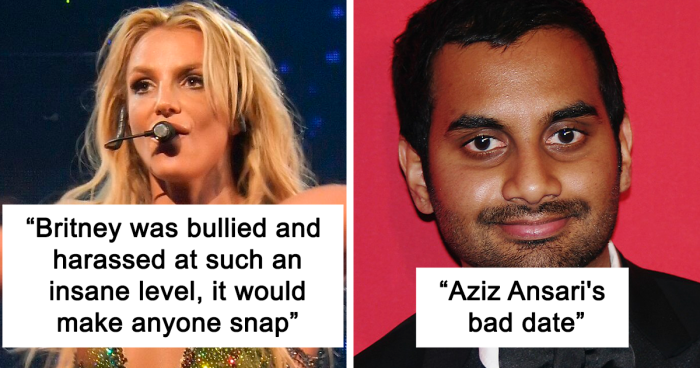
During the mid-2000s, Britney Spears was followed constantly by paparazzi while navigating divorce, custody disputes, mental health struggles, and overwhelming fame. Her shaved head and other distressed behavior became punchlines. Years later, many observers reconsidered whether the real scandal was the public’s enthusiasm for watching someone unravel.
-
2. Monica Lewinsky Becoming America’s Favorite Target
Monica Lewinsky was a young White House intern involved with one of the most powerful men in the world. Yet she absorbed a remarkable share of the humiliation. Her name became a decades-long joke while the power imbalance, political maneuvering, and media cruelty received considerably less attention.
-
3. Brandi Chastain Celebrating in a Sports Bra
After scoring the winning penalty in the 1999 Women’s World Cup final, Brandi Chastain removed her jersey and celebrated in a sports bra. Some coverage treated the moment as scandalous rather than athletic joy. Male players had celebrated shirtless for years without inspiring an emergency meeting of the morality police.
-
4. Female Celebrities Being Punished for Existing in Public
Online commenters grouped together incidents such as invasive photographs of Anne Hathaway, relentless coverage of Miley Cyrus’ private behavior, and the policing of young women’s clothes and bodies. In many cases, the person whose privacy was violated somehow became the person expected to apologize. Celebrity logic is impressive that way.
-
5. Billie Eilish Mouthing an Offensive Lyric as a Young Teen
An old video showed a teenage Billie Eilish mouthing an anti-Asian slur included in a song. She later apologized and said she had not understood the word’s meaning. Criticism was understandable, but some people questioned why a child singing along received fiercer condemnation than the adult artist who wrote and recorded the lyric.
-
6. Janet Jackson’s Super Bowl “Wardrobe Malfunction”
Janet Jackson’s breast was briefly exposed when Justin Timberlake pulled away part of her costume during the 2004 Super Bowl halftime show. Jackson faced canceled appearances, career damage, and years of blame, while Timberlake’s career continued with fewer consequences. The exposure lasted a moment; the double standard had remarkable stamina.
Supporting reporting on Spears, Lewinsky, Chastain, and Jackson.
Identity, Sexuality, and the Public’s Unsolicited Opinions
Some supposed scandals reveal more about society’s discomfort than about the celebrity involved. The public act may have been ordinary, but it collided with expectations involving sexuality, race, gender, or childhood fame.
-
7. George Michael Being Publicly Outed After His Arrest
George Michael was arrested during a 1998 undercover operation in a Beverly Hills public restroom. The event effectively forced him to discuss his sexuality publicly. Although he later responded with humor and defiance, the sensational coverage reflected an era when being exposed as gay could still threaten an entertainer’s career.
-
8. Simone Biles Withdrawing During the Tokyo Olympics
Simone Biles withdrew from several Olympic events after experiencing the “twisties,” a dangerous loss of spatial awareness. Critics accused her of quitting or letting down her country. Gymnasts pointed out that competing without reliable air awareness could cause catastrophic injury. Apparently, avoiding paralysis was insufficiently patriotic for some commentators.
-
9. Barack Obama’s Coffee-Cup Salute
President Barack Obama was criticized after saluting Marines while holding a coffee cup. Another episode involved his initially failing to return a salute before going back to greet the Marine. Neither incident altered national security, but both supplied hours of commentary to people who had temporarily appointed themselves directors of presidential hand placement.
-
10. The Chicks Criticizing President George W. Bush
In 2003, Natalie Maines criticized President George W. Bush and the approaching Iraq War during a London concert. The Chicks faced radio bans, boycotts, destroyed albums, and threats. Whether listeners agreed with the statement or not, the retaliation demonstrated how quickly “freedom of speech” can become “freedom from speech I dislike.”
-
11. Colin Kaepernick Kneeling During the National Anthem
Colin Kaepernick knelt during the national anthem to protest police brutality and racial inequality. The gesture became a national argument about patriotism, the military, sports, and race. His intended subject was often displaced by debates about the method of protestwhich is a remarkably efficient way to avoid discussing the protest itself.
-
12. Martha Stewart’s Case Being Reduced to “Insider Trading”
Martha Stewart’s legal case is frequently summarized inaccurately. She faced civil insider-trading allegations but was criminally convicted of conspiracy, obstruction, and making false statements during the investigation. People may debate whether her sentence was proportionate, but the case was more complicated than the familiar “she sold one stock” version.
Supporting records on Biles, Kaepernick, and Stewart.
Outfits, Flutes, Bodies, and Other National Emergencies
Nothing demonstrates misplaced celebrity outrage quite like the transformation of clothing, musical instruments, and ordinary adult behavior into civilization-threatening incidents.
-
13. Barack Obama Wearing a Tan Suit
Obama wore a tan suit during a 2014 press briefing, prompting criticism that the color looked insufficiently serious. The outfit became shorthand for trivial political outrage. The nation survived, the suit harmed no one, and beige eventually returned to its traditional role of making office walls look vaguely acceptable.
-
14. Lizzo Playing James Madison’s Crystal Flute
Lizzo, a classically trained flutist, was invited by the Library of Congress to play a crystal flute made for President James Madison. Specialists supervised the instrument’s handling. Nevertheless, critics claimed she had disrespected history. The Library itself celebrated the performance, suggesting history was considerably less offended than social media was.
-
15. Jessica Simpson’s “Mom Jeans”
Jessica Simpson performed in high-waisted jeans in 2009 and was met with cruel headlines about her weight. She later explained that the coverage deeply affected her relationship with performing. The scandal was not that her body had changed. It was that ordinary clothing became permission for industrial-scale body shaming.
-
16. Tabloid Fixation on Meghan Markle’s Biracial Identity
Meghan Markle’s racial background became the focus of commentary that often relied on stereotypes, coded language, and debates about whether she belonged in the British royal family. Being biracial was never a scandal. The real controversy was how comfortable parts of the press and public became while treating it like one.
-
17. Michael Phelps Being Photographed With a Bong
A 2009 photograph appeared to show Olympic swimmer Michael Phelps using a marijuana pipe. He apologized, lost a sponsorship, and received a suspension. Many people considered the reaction excessive, noting that the private conduct did not erase his athletic achievements or suggest marijuana had somehow helped him swim like a torpedo.
-
18. Charlie Chaplin Being Branded a Communist
Charlie Chaplin’s political views and refusal to seek American citizenship attracted government scrutiny during the Red Scare. When he traveled abroad in 1952, his reentry became conditional on an investigation, and he chose to remain in Europe. The episode is now often cited as an example of suspicion overwhelming evidence and artistic freedom.
Supporting records on Lizzo and Jessica Simpson.
When Context Disappeared From the Conversation
Online outrage rewards speed, certainty, and dramatic wording. Context arrives later, usually carrying paperwork and asking whether anyone saved it a seat.
-
19. The Debate Over Aziz Ansari’s Uncomfortable Date
A 2018 article described an anonymous woman’s distressing sexual encounter with Aziz Ansari. Ansari said he believed the activity was consensual and apologized after learning she felt otherwise. The story ignited a broader debate about consent, pressure, communication, journalistic standards, and whether every troubling encounter belongs in the same category.
-
20. Miley Cyrus Growing Beyond Hannah Montana
When Miley Cyrus adopted a more adult image, some viewers reacted as though the former child star had violated a lifelong contract to remain Hannah Montana. Her performances were deliberately provocative, but much of the outrage came from an unrealistic demand that a grown woman continue playing a wholesome television teenager forever.
-
21. Al Franken’s Resignation
A staged photograph involving Al Franken became the most recognizable image connected to accusations against him, although multiple women later alleged unwanted touching or kissing. Franken disputed important parts of several claims and resigned from the Senate. Critics of the response argue the process moved too quickly; others believe resignation was appropriate.
-
22. Old Offensive Remarks Resurfacing Without Context
People online frequently mentioned celebrities being “canceled” over a single remark from many years earlier. Old statements can reveal genuine prejudice and deserve criticism. However, proportionality matters: Was it a pattern? Did the person apologize? Did behavior change? Accountability without room for growth becomes punishment as entertainment.
-
23. Jenna Ortega Smoking and Drinking as an Adult
Photographs of adult actor Jenna Ortega smoking and drinking wine inspired criticism from people who appeared to confuse her with Wednesday Addamsor possibly with a child they personally raised. Fans can dislike smoking while still recognizing that an adult celebrity does not need public permission to make legal personal choices.
-
24. Elizabeth Olsen Not Posting a Public Tribute
Elizabeth Olsen faced criticism for not immediately posting on social media after Chadwick Boseman’s death. The reaction assumed grief must be public, prompt, and correctly formatted. People mourn differently, and silence does not prove indifference. Instagram is a communications platform, not a legally mandated electronic condolence book.
Sports, Fandoms, and Scandals With Questionable Villains
The final examples show how quickly audiences assign blame, sometimes before learning who acted, what rules applied, or whether the celebrity had done anything at all.
-
25. Ross Rebagliati’s Olympic Cannabis Test
Canadian snowboarder Ross Rebagliati briefly lost his 1998 Olympic gold medal after testing positive for cannabis. An appeals panel restored it because marijuana was not properly listed as a banned substance under the applicable rules. The episode produced a memorable scandal despite no finding that cannabis enhanced his performance.
-
26. Victor Wembanyama Being Blamed for a Security Incident
Britney Spears approached NBA player Victor Wembanyama in Las Vegas in 2023, and a member of his security team pushed her hand away. Wembanyama was flooded with criticism even though he was not the person who made contact. Police reviewed the incident and did not file charges.
-
27. Taylor Swift and the Leaked Kanye West Phone Call
Taylor Swift was branded dishonest after edited recordings appeared to challenge her account of a conversation about Kanye West’s song “Famous.” A longer recording leaked years later and appeared to support her claim that she had not been told the exact insulting lyric. By then, the internet had already held the trial, appeal, and symbolic execution.
-
28. Ordinary K-Pop Idol Behavior Becoming a “Scandal”
K-pop stars have faced intense reactions for dating, smoking, gaining weight, crying at funerals, or appearing insufficiently cheerful. Strict image management and highly invested fandoms can turn basic human behavior into controversy. An idol may sing about love for years, yet personally dating someone can still trigger a five-alarm emergency.
-
29. Roky Erickson’s Marijuana Arrest and Institutionalization
After a 1969 marijuana arrest, psychedelic-rock pioneer Roky Erickson entered the state hospital system and endured harsh psychiatric treatment. He already had serious mental health difficulties, making simple cause-and-effect claims inappropriate. Still, many view his experience as a tragic collision of punitive drug laws, illness, and inadequate care.
-
30. David Bowie Publicly Discussing His Sexuality
David Bowie’s statements about being gay or bisexual challenged expectations in the 1970s and generated both fascination and backlash. The precise effect on his American career remains debated, but his openness was treated as scandalous in ways that reveal how aggressively the entertainment industry once policed sexuality and gender expression.
What It Feels Like to Watch a Celebrity Uproar Unfold
For many readers, the experience of following a celebrity scandal begins innocently. A dramatic headline appears between a weather update and a photograph of someone’s lunch. You click because the wording suggests a civilization-ending event. Three minutes later, you discover that an actor drank wine, a singer wore pants, or a politician selected the wrong shade of fabric.
The first emotional response is often certainty. Social media presents a short clip, a screenshot, or a quotation stripped of the sentences around it. Because everyone else appears confident, uncertainty starts to feel like cowardice. Users choose sides, repeat the most memorable interpretation, and begin judging people who had not heard about the controversy ten minutes earlier.
Then the missing context arrives. A longer video changes the sequence of events. The supposed aggressor was standing twenty feet away. The “disrespectful” musician had been invited by the institution she was accused of insulting. The athlete was facing a genuine physical danger. The celebrity who had “ignored” a death was grieving privately. By that point, however, the emotional investment is substantial. Admitting that the original reaction was excessive means surrendering likes, jokes, and the satisfying feeling of having joined the morally correct team.
Another familiar experience is noticing how unevenly outrage is distributed. Women are criticized for aging, gaining weight, losing weight, covering up, showing skin, having children, not having children, speaking confidently, or appearing insufficiently cheerful. Queer celebrities have historically been treated as deceptive for remaining private and scandalous for being open. Athletes of color may discover that a peaceful protest is considered more offensive than the injustice being protested.
This does not mean celebrity criticism is always unfair. Wealth and fame do not excuse abuse, discrimination, exploitation, or criminal conduct. Public figures can cause real harm, and journalism has exposed misconduct that powerful institutions attempted to hide. The challenge is distinguishing accountability from spectacle.
A useful test is to ask four questions before joining the pile-on: What has actually been verified? Is the reaction proportional to the conduct? Am I criticizing harm or merely disapproving of a personal choice? Would the response be the same if the celebrity had a different gender, race, sexuality, political identity, or fan base?
Waiting for context may feel boring, especially when the internet is already distributing torches and matching pitchforks. Yet restraint usually ages better than instant certainty. The celebrity news cycle moves quickly, but screenshots of confidently wrong opinions have excellent long-term storage.
Conclusion: Not Every Controversy Deserves a Cultural Emergency
The 30 celebrity scandals above are not identical. Some involved mistakes, some involved legitimate ethical questions, and several were never scandals in any meaningful sense. What connects them is the argument that public reaction became larger, crueler, or less informed than the underlying event justified.
Celebrity culture encourages audiences to treat famous people as symbols rather than humans. Once that happens, a private struggle becomes entertainment, an outfit becomes a political statement, and silence becomes evidence of guilt. A healthier approach leaves room for context, proportionality, privacy, correction, and the radical possibility that not every trending topic requires a verdict.
Editorial note: Describing an uproar as excessive does not mean every underlying concern was imaginary or harmless. It means the scale, target, certainty, or duration of the public reaction may deserve scrutiny of its own. This article synthesizes public discussions with reporting and records from major news, cultural, sports, and government sources.