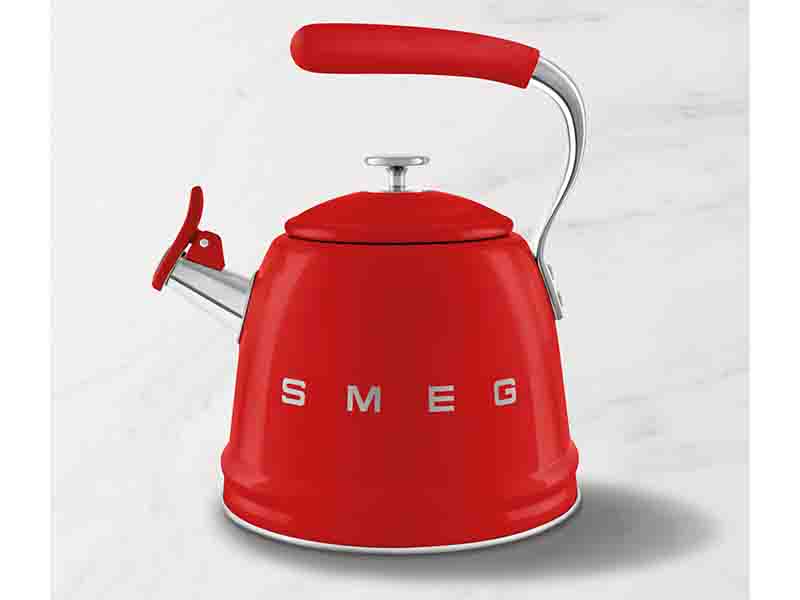
The Smeg Stainless Steel Whistling Tea Kettle is what happens when an ordinary water boiler receives an Italian makeover and decides it is far too attractive for the cupboard. With its polished stainless steel body, rounded 1950s-inspired silhouette, and unmistakable Smeg styling, this stovetop kettle is designed to remain on display long after the tea has been poured.
Beauty, however, is only part of the buying decision. A premium kettle must also fill easily, work with your cooktop, pour without dribbling, and produce a whistle loud enough to rescue you from an abandoned pot of water. The Smeg WKF01 promises all those fundamentals in a roughly 2.3-liter package, along with a cool-touch silicone handle and compatibility with gas, electric, ceramic, and induction cooktops.
Is it a practical everyday kettle, an expensive kitchen ornament, or a little of both? This in-depth review examines its construction, capacity, performance, usability, maintenance requirements, and overall value.
Smeg Whistling Kettle at a Glance
| Product type | Traditional stovetop whistling kettle |
|---|---|
| Model family | Smeg WKF01 |
| Maximum capacity | Approximately 2.3 liters, 2.4 quarts, or 10 small cups |
| Body and lid | Stainless steel |
| Base | Stainless steel and aluminum construction |
| Handle | Ergonomic handle with a non-slip silicone covering |
| Cooktop compatibility | Gas, induction, electric, and ceramic |
| Boil notification | Fixed single-tone whistle |
| Care | Hand wash only |
Some U.S. retailers describe the kettle as holding 2.4 or 2.5 quarts, while Smeg lists the maximum capacity as 2.3 liters. These figures reflect rounding rather than different kettle sizes. Also, the advertised 10-cup capacity refers to relatively small servings, not 10 full eight-ounce American measuring cups.
Retro Design Without the Pastel Paint
Smeg is famous for turning countertop appliances into decorative objects. The stainless steel WKF01 follows the brand’s familiar 1950s aesthetic but replaces playful pastel coloring with a more restrained metallic finish. That makes it easier to pair with stainless steel ranges, refrigerators, sinks, and cookware.
The body has soft curves rather than the sharp, industrial lines found on many stainless steel tea kettles. A rounded lid, prominent handle, polished accents, and laser-applied Smeg logo create a look that is both nostalgic and contemporary. It can suit a mid-century kitchen, but it will not seem lost beside modern cabinetry and minimalist appliances.
The polished surface naturally commands attention. It also collects fingerprints and water spots with the determination of a toddler touching a freshly cleaned window. A quick wipe with a soft microfiber cloth generally restores the shine, but buyers who dislike visible smudges may prefer one of the colored finishes.
Stainless Steel Construction and Everyday Durability
The kettle body, lid, and spout are made from stainless steel, while the base combines stainless steel with aluminum. Aluminum conducts heat effectively, and the surrounding stainless steel provides durability and compatibility with induction cooking surfaces. This layered approach helps spread heat across the bottom rather than concentrating it in one small area.
Stainless steel is a sensible kettle material because it does not chip like enamel and is generally resistant to staining and corrosion when maintained correctly. It is not maintenance-free, however. Hard-water minerals can accumulate inside, and moisture left around the rim or spout may eventually cause discoloration. Emptying unused water and allowing the kettle to dry can significantly reduce those problems.
At approximately 2.9 pounds when empty, the Smeg kettle has a reassuringly substantial feel. Fill it to maximum capacity and it becomes considerably heavier, so people with limited hand strength may prefer to heat only the amount of water they need.
Capacity: Generous Without Becoming Restaurant Equipment
The 2.3-liter maximum capacity is one of the kettle’s strongest practical features. It can prepare several mugs of tea, enough water for a French press, or a useful quantity for instant foods and cooking. It is particularly convenient when serving guests because one boil can cover a small group instead of sending the host back to the stove every six minutes.
An interior water-level guide helps prevent overfilling. This matters because a whistling kettle needs empty space for steam to form and escape safely through the spout mechanism. Filling beyond the maximum line may weaken the whistle and increase the risk of hot water sputtering from the spout.
For one morning mug, there is no reason to fill the entire kettle. Heating only the required quantity saves time and energy while making the kettle easier to lift. The maximum capacity is there when needed; it is not a daily challenge issued by the manufacturer.
How the Smeg Whistling Tea Kettle Performs
Boiling Speed
Because the Smeg WKF01 is a stovetop kettle, boiling speed depends heavily on the burner, water volume, starting temperature, and whether the lid and spout cover are properly closed. Induction usually delivers especially responsive heating, while traditional electric coils may take longer.
The wide base provides a useful contact area for heat transfer. For efficient boiling, match the burner to the bottom of the kettle and keep gas flames beneath the base. Flames curling up the sides waste energy, heat the handle area, and may discolor the polished exterior.
This is not an electric rapid-boil appliance, so it does not promise a universal boil time. It trades automated speed for cooktop flexibility, a classic ritual, and one fewer power cord occupying the counter.
The Single-Tone Whistle
When the water reaches a rolling boil, steam passes through the covered spout and produces a fixed single-tone whistle. The alert is simple but useful: it allows you to prepare cups, find the tea bags, or wonder why you own seventeen nearly identical mugs without staring at the stove.
The whistle is not adjustable, and its effectiveness depends on the kettle being assembled and filled correctly. The lid should sit securely, the spout cap must be closed, and the water should remain between the recommended level markings. Mineral deposits around the whistle opening can also reduce its volume, so that area needs occasional cleaning.
Pouring and Handling
A conical spout directs water in a tidy stream suitable for tea, French press coffee, oatmeal, instant soup, and similar tasks. The flip-open spout cover makes pouring more convenient while helping contain steam during boiling.
The handle has a non-slip silicone covering designed to stay more comfortable than bare metal. Its high arch provides room for a secure grip and keeps the hand away from the body. “Cool-touch” should not be interpreted as permission to abandon common sense: steam, high flames, and extended boiling can still make nearby components hot. Let the whistle settle, keep fingers away from the spout, and use a dry potholder whenever the handle feels warmer than expected.
What the Kettle Does Not Include
The Smeg stainless steel stovetop kettle is deliberately analog. It does not have temperature presets, an illuminated water window, automatic shutoff, keep-warm mode, or a removable limescale filter. Those features are common on premium electric kettles, including several models in Smeg’s own countertop range.
The absence of automatic shutoff is the most important difference. The whistle is an alert, not a safety system that turns off the burner. Someone must remain within hearing distance and remove the kettle from the heat promptly. Allowing any stovetop kettle to boil dry can damage the product and create a serious hazard.
There is also no gooseneck spout. The conical design pours cleanly for general kitchen use, but serious pour-over coffee enthusiasts may prefer the slower, more precise flow of a dedicated gooseneck kettle. The Smeg is better described as an elegant all-purpose hot-water kettle than specialized coffee equipment.
Cleaning and Descaling the Stainless Steel Kettle
Smeg and major U.S. retailers recommend hand washing the WKF01. Wait until it has cooled, then clean the exterior with warm water, mild dish soap, and a soft sponge or cloth. Avoid steel wool, abrasive powders, harsh chemicals, and rough scouring pads, which can scratch the polished finish.
After rinsing, dry the kettle thoroughly with a soft cloth. Air-drying polished stainless steel often leaves mineral spots, especially in hard-water areas. Regular drying also prevents moisture from lingering around seams, the lid opening, and the spout.
How to Remove Mineral Buildup
White or chalky deposits inside the kettle are usually limescale, not a failure of the stainless steel. The exact cleaning method should follow the product manual, but a common approach for stainless steel kettles is to heat a diluted solution of water and white vinegar, allow it to sit briefly, and rinse repeatedly. A citric-acid descaler intended for kettles can also work when used according to its label.
Never mix cleaning agents. After descaling, boil and discard fresh water before making a drink. In areas with very hard water, filtered water and frequent light cleaning are easier on the kettle than waiting for a miniature limestone cave to develop inside it.
Advantages and Potential Drawbacks
Reasons to Consider It
- Distinctive Smeg design that can remain attractively displayed on the stovetop.
- Durable stainless steel body with a heat-conductive aluminum component in the base.
- Works with induction, gas, ceramic, and electric cooking surfaces.
- Generous capacity for families, entertaining, coffee, and cooking.
- Single-tone whistle provides an audible boiling alert.
- Non-slip silicone handle improves comfort and grip.
- Conical spout is designed for controlled, tidy pouring.
Reasons to Think Twice
- The premium price is much higher than that of basic stainless steel kettles.
- There is no automatic shutoff or temperature control.
- A full kettle may feel heavy for some users.
- The polished finish readily reveals fingerprints and water spots.
- It requires hand washing and periodic descaling.
- The standard spout cannot match a gooseneck kettle’s pour-over precision.
How It Compares With Other Tea Kettles
Affordable stovetop kettles can boil water and whistle for a fraction of the Smeg’s price. If function per dollar is the only criterion, a simple stainless steel model from a mainstream cookware brand will usually be the more economical purchase.
Enameled steel kettles from brands such as Le Creuset and KitchenAid offer a similarly decorative approach, often with bold colors and strong heat retention. Enamel can resist water staining well, although it may chip if knocked against a hard surface. The stainless steel Smeg avoids enamel chipping but needs regular drying to preserve its reflective finish.
Electric kettles are generally better for buyers who value automatic shutoff, rapid heating, and temperature settings for green, white, oolong, or black tea. They require electrical counter space, however, and their bases and cords are not always welcome in a carefully edited kitchen.
The Smeg occupies a specific middle ground: it offers the simplicity and broad cooktop compatibility of a traditional kettle, wrapped in a design intended to function as permanent kitchen décor. You are paying for both the water-boiling tool and the visual pleasure of owning it.
Who Should Buy the Smeg Stainless Steel Whistling Tea Kettle?
This kettle is a strong match for someone who drinks tea or French press coffee regularly, wants a large stovetop capacity, and values design enough to pay more for it. It also makes sense in a kitchen with existing stainless steel appliances or other Smeg products.
It may be less suitable for a budget-focused shopper, a person who frequently forgets cookware on the stove, or anyone who needs exact water temperatures. People with reduced grip strength should also consider the weight of a 2.3-liter kettle when full.
As a gift, it has considerably more presence than a generic kettle. It feels substantial, looks luxurious, and is useful enough to avoid becoming one of those beautiful wedding presents that spends twelve years hiding behind a fondue set.
Extended Everyday Experience: Living With the Smeg Kettle
The most noticeable part of the everyday Smeg kettle experience happens before the burner is even switched on. Unlike a basic appliance that disappears into a cabinet, the polished WKF01 influences the appearance of the kitchen. It reflects nearby surfaces, coordinates naturally with stainless steel appliances, and gives an otherwise ordinary stove a deliberate finishing touch.
Filling is straightforward because the lid is removable and the opening is comfortably accessible. The interior level markings are useful, although they require looking inside rather than glancing through an external window. For a single drink, adding only a few cups of water makes the kettle noticeably easier to handle and shortens the wait. When company arrives, its larger capacity becomes genuinely helpful.
The stovetop routine feels slower and more intentional than pressing a button on an electric kettle. There is no digital display counting upward and no blue light making the kitchen resemble an airport runway. You place the kettle over an appropriately sized burner, close the spout cover, and wait for the whistle. For some owners, that analog ritual is part of the appeal; for others, it will feel less convenient than automatic shutoff.
Once the whistle sounds, the high handle provides a confident grip and the conical spout delivers a direct stream. The kettle is well suited to filling mugs or a French press, and it is handy when a recipe needs boiling water. A full kettle demands two-handed awareness, even if only one hand holds it. The combination of metal, 2.3 liters of water, and gravity is not interested in your morning multitasking ambitions.
The silicone handle is more pleasant than an uncovered metal arch, but careful handling remains essential. On a gas stove, keeping the flame beneath the base protects both the user and the finish. After boiling, briefly allowing steam to clear before opening the spout reduces the chance of an unpleasant surprise for the fingers.
Maintenance becomes part of the ownership experience, especially with the stainless steel version. A soft cloth removes fingerprints quickly, while drying the exterior after washing helps prevent obvious spots. Inside, owners who use hard tap water will eventually encounter mineral deposits. Regular descaling is far easier than attacking a thick crust after several months.
Over time, the key question is whether its appearance continues to bring enjoyment. In purely technical terms, the kettle heats water, whistles, and pourstasks that cheaper models also perform. Its additional value comes from the tactile handle, substantial construction, familiar retro curves, and the small pleasure of using an object that does not need to be hidden after breakfast.
For the right buyer, the Smeg Stainless Steel Whistling Tea Kettle makes an everyday routine feel a little more polished. For the wrong buyer, it is simply an expensive way to persuade water to become hot. That distinction is less about boiling performance than personal priorities.
Final Verdict
The Smeg Stainless Steel Whistling Tea Kettle successfully combines classic stovetop operation with recognizable Italian-inspired design. Its stainless steel construction, generous capacity, cool-touch silicone handle, audible whistle, and compatibility with every major cooktop type make it more than a decorative showpiece.
Its premium price, hand-wash requirement, visible fingerprints, and lack of automatic controls prevent it from being the universal choice. Nevertheless, buyers who appreciate analog simplicity and want a kettle attractive enough to live permanently on the stove are likely to find it satisfying. It boils water without unnecessary technological theaterand looks exceptionally good while doing it.
Note: Capacity descriptions and prices may vary slightly among U.S. retailers. Always follow the instructions supplied with the specific WKF01 model, never heat an empty kettle, and do not leave it unattended on an active burner.