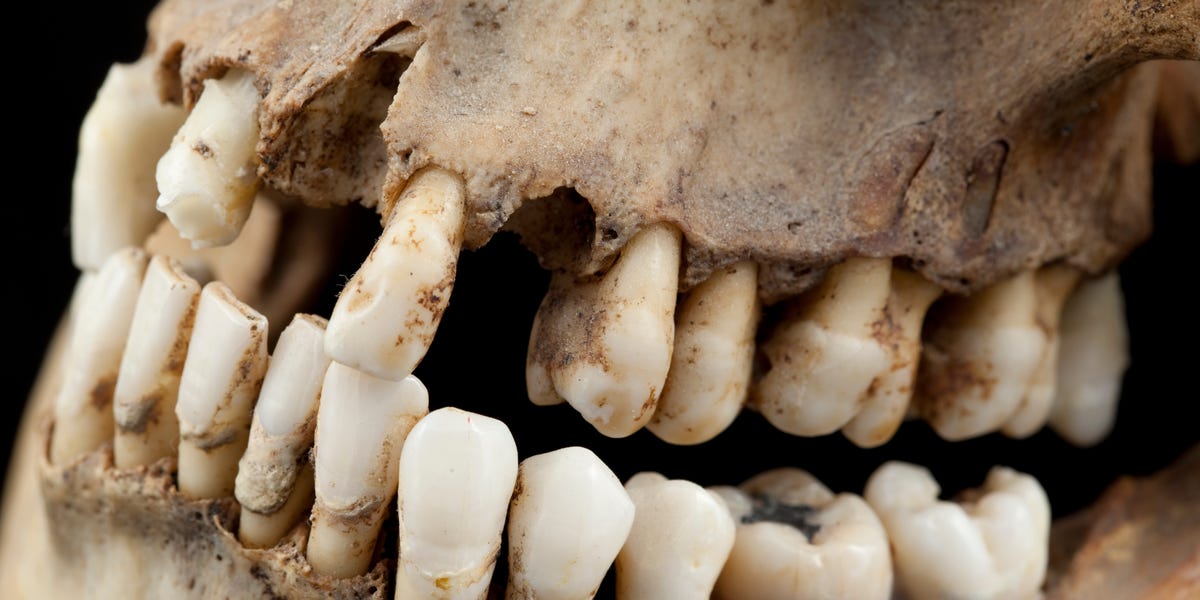
Sometimes history does not arrive with a trumpet blast, a gold crown, or a dusty scroll covered in dramatic curse words. Sometimes it arrives as one surviving tooth.
Near Jerusalem, archaeologists uncovered the fragmentary remains of a Byzantine-era ascetic buried with heavy metal chains. At first glance, the burial seemed to fit a familiar historical pattern: an extreme male religious devotee who used physical suffering and self-denial as part of a spiritual life. Then researchers studied the enamel of a single tooth.
The result was not a discovery that overturns Christianity, disproves scripture, or sends every church historian sprinting toward the nearest panic room. It does, however, challenge a long-standing assumption about early Christian asceticism: that the most extreme forms of bodily self-denial were practiced almost entirely by men.
The tooth likely belonged to a woman.
That small finding has big implications for how historians understand women, devotion, authority, and religious life in the Byzantine world. It also offers a useful reminder that archaeology rarely rewrites history with one dramatic swipe. More often, it loosens one old assumption, brushes away some dust, and asks everyone to look again.
The Headline Needs a Little Archaeological Cleanup
“A tooth challenges Christianity’s history” sounds like the kind of headline that should be read while holding onto a chair. But the real story is both more careful and more interesting.
This discovery does not challenge the central beliefs of Christianity. It does not prove or disprove the existence of Jesus, alter the New Testament, or reveal that monks secretly invented brunch. What it challenges is a narrower historical narrative about who participated in severe ascetic practices in late antique Christianity.
For many years, the most dramatic examples of Christian asceticism were associated with men. Histories often focus on male hermits, monks, stylites who lived on pillars, and holy men who fasted, wore rough clothing, slept little, or withdrew from society. These figures were highly visible in religious texts, sermons, artwork, and later popular culture.
Women were certainly part of early Christian religious life. Female monastic communities, wealthy women who supported churches, widows devoted to religious service, and women ascetics all appear in historical records. However, archaeological evidence for women practicing the most physically punishing forms of asceticism has been much harder to find.
That is what makes the burial at Khirbat el-Masani so significant. It does not say women were absent from religious history and have suddenly appeared. Instead, it suggests that women may have participated more directly in harsh bodily disciplines than scholars once assumed.
A Burial Nearly Lost to Time, Roots, and Bad Luck
The discovery came from Khirbat el-Masani, a Byzantine monastery site near Jerusalem. The monastery dates broadly to the period between the fourth and seventh centuries, when Christianity had become deeply woven into the political, social, and spiritual life of the eastern Roman world.
Archaeologists found several burial crypts at the site. Most human remains can provide clues through the pelvis, skull, long bones, teeth, burial location, grave goods, and surrounding architecture. In this case, though, the individual’s remains had been badly damaged over the centuries. Tree roots, soil conditions, and decay had reduced the skeleton to only a few pieces.
What survived included three neck vertebrae and one upper premolar tooth. That is not much to work with. It is the archaeological equivalent of trying to solve a family mystery using one shoelace, half a receipt, and a suspiciously old spoon.
Yet the burial contained something highly unusual: heavy metal chains associated with the body. Researchers interpreted the chains as evidence of an extreme ascetic practice. In some Christian traditions, ascetics deliberately embraced hardship to reject worldly comfort, discipline the body, and seek spiritual focus.
Other items near the burial, including small metal pieces and a tiny cross, strengthened the interpretation that the person had been part of a Christian religious environment rather than simply restrained as a prisoner. Context matters enormously in archaeology. A chain alone can mean many things. Chains in a monastery burial, near Christian symbols, tell a more specific story.
How One Tooth Became a Historical Witness
Why the Bones Could Not Answer the Question
Traditionally, archaeologists estimate biological sex from skeletal features, especially the pelvis and skull. Those methods can be highly useful when the bones are well preserved. Unfortunately, this burial had lost the very parts of the skeleton that would normally provide the clearest answers.
Ancient DNA was also not an easy solution. DNA is fragile. Heat, moisture, microorganisms, soil chemistry, and simple bad luck can damage genetic material beyond recovery. After roughly 1,500 years underground, a skeleton does not always arrive in the laboratory ready for a science-fiction montage.
That left researchers with the tooth.
Dental Enamel Proteomics Steps In
Tooth enamel is one of the hardest and most durable materials in the human body. It can preserve traces of proteins long after softer tissue, bone collagen, and DNA have degraded. Scientists can examine these ancient proteins through a field known as dental enamel proteomics.
The researchers focused on amelogenin, a protein involved in tooth enamel formation. Humans have versions associated with the X and Y chromosomes. In simplified terms, the presence of a Y-linked amelogenin signal can indicate a male biological sex pattern, while the absence of the Y-linked signal alongside X-linked amelogenin can support a female biological sex estimate.
In the Khirbat el-Masani tooth, researchers found X-linked amelogenin peptides but did not identify the Y-linked version. Their conclusion was cautious: the remains were very probably female.
That wording matters. Good archaeology does not confuse “strongly supported” with “absolutely certain.” Proteins can degrade unevenly, and absence of a detectable Y-linked peptide is not the same thing as a magical historical paternity test. Still, the evidence was strong enough for the study’s authors to identify the ascetic as likely female.
For a burial with only a tooth and a few vertebrae remaining, that is an extraordinary amount of information. The little premolar did not speak, of course. Teeth rarely give interviews. But through molecular analysis, it offered a clue that centuries of assumptions had missed.
Asceticism: When Spiritual Discipline Became a Full-Time Job
Asceticism is often described as the voluntary rejection of comfort, pleasure, possessions, or bodily ease for spiritual purposes. In early Christianity, this could include fasting, celibacy, prayer, poverty, isolation, rough clothing, long vigils, and withdrawal from ordinary social life.
Not every monk or nun lived dramatically. Most religious communities were built around prayer, study, work, hospitality, and shared routines. But some ascetics pursued much harsher disciplines. Famous male examples included hermits who lived in deserts, monks who survived on limited food, and stylites who spent years living on raised platforms or pillars.
These stories were memorable, sometimes shocking, and often repeated. The result is that male ascetics became the main characters in popular accounts of early Christian self-denial. Their biographies were copied, celebrated, argued over, and eventually turned into spiritual legends.
Women practiced asceticism too, although their stories were often recorded differently. Women such as Macrina the Younger and Melania the Younger became known for religious discipline, charitable work, celibacy, prayer, and monastic leadership. Female ascetic life could take place in a convent, within a household, in a retreat, or through a religious community connected to a city or pilgrimage route.
What has remained less visible is material evidence showing women using the same severe physical methods associated with famous male ascetics. The chained burial may help fill part of that gap.
Why This Discovery Matters for Women in Early Christianity
The significance of the burial is not that historians had never heard of religious women. They had. The significance is that archaeology has produced physical evidence that may complicate the traditional gender divide between male “extreme ascetics” and female “quietly devout believers.”
History often preserves the lives of people with institutional power, literary supporters, or famous admirers. In the Byzantine world, many religious texts were written by men, copied by male scribes, and preserved through male-led institutions. That does not mean women were absent from religious life. It means their experiences were less likely to receive the same spotlight.
The Khirbat el-Masani burial suggests that at least one likely woman may have adopted an unusually demanding form of religious self-discipline. Whether she was a nun, hermit, pilgrim, holy woman, or member of a specific monastic community cannot be determined with certainty. But the chains indicate that her religious identity may have involved visible, intense bodily devotion.
This matters because archaeological evidence can force historians to revisit comfortable categories. Men did this. Women did that. Monks suffered publicly. Nuns prayed quietly. Real human beings, as usual, were probably more complicated than the labels assigned to them centuries later.
What the Tooth Does Not Tell Us
Even a remarkable discovery has limits. The tooth cannot tell us the woman’s name, her family, her exact age, her social status, or whether she chose every aspect of her religious life freely. It cannot tell us how long she wore chains, whether she had followers, or whether her practices were approved by church leaders.
It also cannot prove that extreme asceticism was common among women. One burial is evidence of one person, not a population survey. Archaeologists need additional finds, better-preserved burials, inscriptions, texts, and comparative studies before making broad claims about an entire religious movement.
Still, one burial can matter enormously. History is built from evidence, and evidence does not need to be common to be important. A rare artifact can reveal that an old assumption was too narrow. Once that happens, researchers know what questions to ask next.
Did more women practice severe asceticism than written records suggest? Were women’s forms of self-denial described differently from men’s? Did religious communities conceal, normalize, or discourage such practices? Were chains symbols of holiness, penance, humility, social status, or all of the above?
The tooth does not answer every question. It gives historians better questions, which is often how serious research begins.
Experiencing the Story Beyond the Headline
The most meaningful way to experience a discovery like this is not to imagine it as a spooky relic from a sensational headline. It is to picture the human world around it.
Start with the setting. The burial came from a monastery near Jerusalem, a place connected to pilgrimage, religious travel, prayer, and community. Imagine stone walls, lamps burning in dim rooms, travelers arriving tired from dusty roads, monks and nuns following daily routines, and the constant presence of sacred sites nearby. The world of Byzantine Christianity was not quiet or simple. It was crowded with debates, rituals, politics, trade, pilgrimage, and competing ideas about holiness.
Then consider the body in the burial. Ancient religious discipline can feel distant or strange to modern readers, especially when it involved fasting, isolation, or chains. It is tempting to turn the person into a symbol: “the chained woman,” “the ascetic,” or “the archaeological mystery.” But she was also a human being who lived through ordinary days, physical discomfort, relationships, illness, aging, and death.
That perspective changes the experience of the find. Instead of seeing the tooth as a tiny science puzzle, readers can see it as part of a life that was once complicated and deeply personal. The tooth belonged to someone who likely made choices, followed beliefs, endured hardship, and was remembered by a religious community strongly enough to be buried in a meaningful setting.
A museum visit can make this kind of history feel more immediate. When looking at Byzantine crosses, lamps, pilgrim tokens, monastery fragments, manuscripts, or religious clothing, it helps to ask simple questions: Who used this? Who made it? Who was allowed to participate in religious life? Whose stories were written down, and whose stories disappeared into the ground?
Readers can also experience the topic through historical writing. Accounts of early monks and nuns often sound dramatic because they were meant to inspire, warn, or promote ideals of holiness. Reading them alongside archaeology is useful because the two sources do different jobs. Texts show what people wanted others to remember. Burials show what people actually left behind.
The tension between those two forms of evidence is where the story becomes especially powerful. A written account may praise a famous male saint who lived on a pillar. A burial, meanwhile, may reveal a likely woman who practiced a similarly demanding religious life without leaving behind a famous biography.
There is also a modern lesson here. People are often tempted to believe history is complete because libraries are full and documentaries have dramatic music. But history is always incomplete. It depends on survival, preservation, funding, excavation, translation, and interpretation. A tree root can erase a skeleton. A single tooth can preserve a clue. The past is not a neatly labeled filing cabinet; it is more like a garage after three generations of family members have moved in and out.
That is why discoveries like this matter. They do not merely add a new fact to a timeline. They invite us to notice who may have been missing from the story all along.
Conclusion: A Small Tooth, a Bigger Christian History
The Khirbat el-Masani tooth does not rewrite Christianity from the ground up. It does something more believable and more valuable: it challenges a narrow assumption about early Christian devotion.
By identifying a chained Byzantine ascetic as very probably female, researchers have added material evidence to the long, complicated history of women in Christian religious life. The find suggests that women may have taken part in severe ascetic practices that historians often associated with men alone.
That does not make the past suddenly simple. It makes it richer. And it proves that archaeology can still find major historical questions hiding in surprisingly small placesincluding one stubborn, ancient tooth.
Editor’s note: This article discusses a peer-reviewed archaeological study of a likely female Byzantine ascetic. The finding challenges assumptions about gender roles in ascetic practice, not the core theological claims of Christianity. Biological sex estimation from enamel proteins is scientific evidence with stated limitations and should be described cautiously.